Massive star-forming clumps at low and high redshift How can we - - PowerPoint PPT Presentation
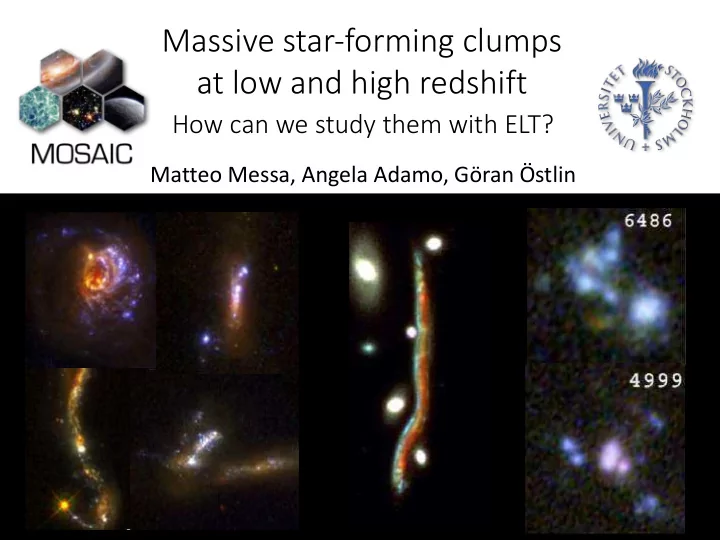
Massive star-forming clumps at low and high redshift How can we study them with ELT? Matteo Messa, Angela Adamo, Gran stlin Overview Star formation is a hierarchical process - Star clusters and star-forming clumps - Ubiquitous (in
Overview
Star formation is a hierarchical process
- Star clusters and star-forming clumps
- Ubiquitous (in star-forming galaxies)
- Tracers of the star-formation process
4 kpc Spiral arm of M51 ~1 kpc SF region in LMC 10 pc YMC in the MW
Star formation at high redshift
- Galaxies dominated by bright clumps
- Mass: 108-109 M☉
- Size: 1 kpc
e.g. Elmegreen+2007, Elmegreen+2009, Guo+2012, Tacconi+2013
- Clumps are larger and more massive
than in local universe
- Different Galaxy-scale properties
- Gas-rich
- Highly turbulent
- Rotational supported
e.g. Förster Schreiber+2009, Wisnioski+2015, Girard+2018
Elmegreen+2005
Chain Clump cluster Double clump Tadpole Spiral Elliptical
High-redshift clumps
Star formation at high redshift
- Galaxies dominated by bright clumps
- Mass: 108-109 M☉
- Size: 1 kpc
e.g. Elmegreen+2007, Elmegreen+2009, Guo+2012, Tacconi+2013
- Clumps are larger and more massive
than in local universe
- Different Galaxy-scale properties
- Gas-rich
- Highly turbulent
- Rotational supported
e.g. Förster Schreiber+2009, Wisnioski+2015, Girard+2018
- Survival and migration of clumps
shape galaxies:
- Formation of bulge
Bournaud+2007
High-redshift clumps
Cava+2018
High-redshift clumps
Star formation at high redshift
- Lensed systems: resolving below kpc sizes
- “Cosmic Snake” galaxy (Cava+2018), z=1
- Same clumps at different resolutions: 10 times difference in mass
- High-definition allows study at sub-galactic scales: testing evolution of clumps
Star formation at high redshift
- Lensed systems: resolving below kpc sizes
- “Cosmic Snake” galaxy (Cava+2018), z=1
- Same clumps at different resolutions: 10 times difference in mass
- High-definition allows study at sub-galactic scales: testing evolution of clumps
- Sensitivity
- To study less massive clumps
- Until now: imaging (clumps are too faint for spectroscopy)
High-redshift clumps
Elmegreen+2009
Star formation at low redshift: LARS galaxies
- Analogs of high-z Lyman-break galaxies, study their Ly-α emission
- Redshift = 0.028 – 0.18
- Multi-band observations with HST
Low-redshift clumps
Sizes down to ~10 pc scale Mass down to ~105 M☉
Star formation at low redshift: LARS galaxies
- Testing the effect of different resolutions
- Nearby galaxy ESO 338-IG04: resolved down to cluster scales
Low-redshift clumps
< 10 pc 10-100 pc 100-400 pc Larger sizes Brighter luminosities Lower SFR densities Resolved single clusters Resolved clumps Kpc-size clumps dominating the galaxy
Messa+submitted
Low-redshift clumps
Star formation at low redshift: LARS galaxies
- SFR – size relation
- Comparison to sample at various redshifts
- Denser than clumps at z=0 (SINGS)
- ΣSFR,cl similar to clumps in z=1-3 galaxies (Livermore+2012,2015)
- Less dense than z=3-6 compact star-forming regions (Bouwens+2017,Vanzella+2017)
Messa+submitted
Low-redshift clumps
Star formation at low redshift: LARS galaxies
- Clumpiness:
- Fraction of UV light in clumps
- Higher at lower resolution
Messa+submitted LARS01
Low-redshift clumps
Star formation at low redshift: LARS galaxies
- Clumpiness:
- Fraction of UV light in clumps
- Higher at lower resolution
- In function of galactic-scale properties
- Vshear/σ0: rotational over dispersion velocities
- ΣSFR
Dispersion dominated Rotation dominated
Messa+submitted
Consistent with instability theories
Studying clumps with ELT
What do we need to study clumps across redshifts?
- High spatial resolution
- High sensitivity
- Large field of view (multiplex capability)
ELT-MOSAIC can address this! High–redshift galaxies:
- NIR spectroscopy à rest frame optical (Hα, Hβ, optical lines)
- Gas kinematics
- Ionization state
- Metallicity
- TALK by Lorenza Della Bruna tomorrow
Studying clumps with ELT
High redshift galaxies:
- Current facilities:
- KMOS z~1 galaxies: mK<24, M*>109 M☉
- ELT-MOSAIC:
- lower luminosities (M* ~ 108 M☉)
- More irregular and clumpy galaxies
- Sub-kpc scale
2’’
0’’.075 kpc scale
HDM
Stott+2016 HUDF
Studying clumps with ELT
High redshift galaxies
- Lensed systems: sub-kpc scale
30-pc-scale clumps Cava+2018
FIBERS, HMM: 0’’.6: Interesting high-z compact sources e.g. Bouwens z~6 low-lum galaxies
Studying clumps with ELT
High redshift galaxies
- Lensed systems: sub-kpc scale
Studying clumps with ELT
Low redshift galaxies
- Sub-kpc scale
- Combination HDM+HMM
- Gas dynamics at the same scales as small clumps
- NIR lines
- See POSTER by Katie Hollyhead
Conclusions
- Clumpy star formation at high-z
- Reflecting the galaxy properties
- Important for galaxy evolution across redshifts
- Studying clumps in local galaxies
- To test the galactic-scale properties
- ELT-MOSAIC
- Spectroscopy of clumpy high-redshift galaxies at sub-kpc scale
- Spectroscopy of lensed galaxies at ~10 pc scale