
SLIDE 1
Source Sheet for Zvi Zohar’s presentation at Valley Beit Midrash
Sephardic Halakha: Inclusiveness as a Religious Value
Women
Background:
Chapter 31 of the Biblical book of Proverbs is a song of praise to the “Woman of Valor” (Eshet Hayyil). Inter alia, the Biblical author writes of the Eshet Hayyil: She is clothed in strength and glory, and smiles when contemplating the last day. She opens her mouth in wisdom, and instruction of grace is on her tongue… Her children rise up, and call her blessed; her husband praises her: 'Many daughters have done valiantly, but you are most excellent of them all.' Grace is deceitful, and beauty is vain; but a woman that feareth the LORD, she shall be praised. Give her of the fruits of her hands; and let her works praise her in the gates. Rabbi Israel Ya’akov AlGhazi (d. 1756) was born in Izmir and moved to Jerusalem, where he was subsequently chosen to be chief rabbi. His exposition of Eshet Hayyil is presented at length by his son, rabbi Yomtov AlGhazi, 1727-1802 (who was in his turn also chief rabbi of Jerusalem), in the homiletic work Yom Tov DeRabbanan, Jerusalem 1843. The following is a significant excerpt from that text:
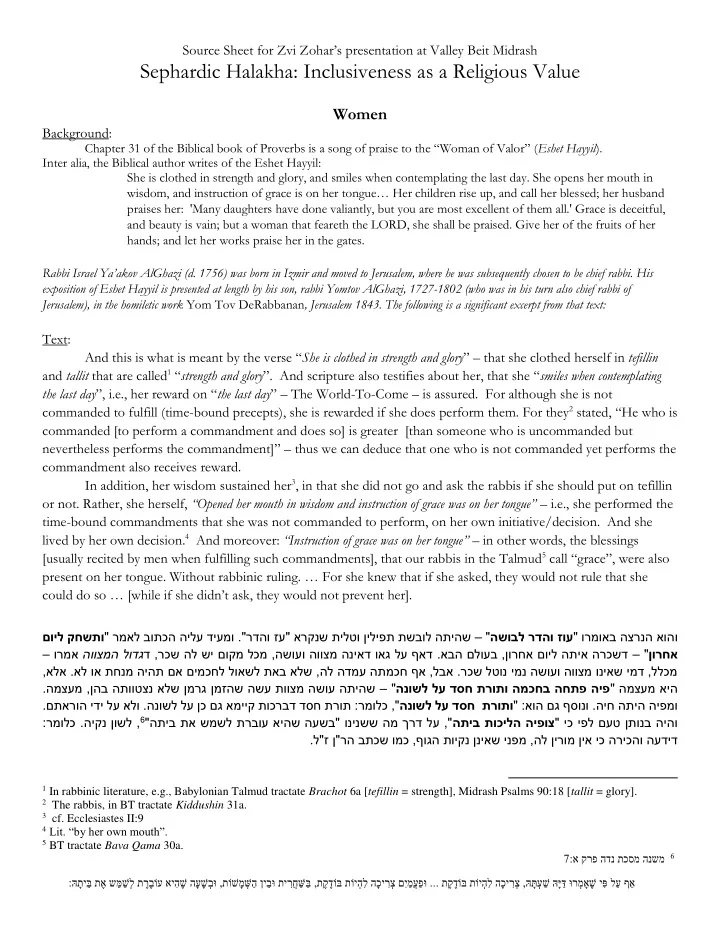
Text: And this is what is meant by the verse “She is clothed in strength and glory” – that she clothed herself in tefillin and tallit that are called1 “strength and glory”. And scripture also testifies about her, that she “smiles when contemplating the last day”, i.e., her reward on “the last day” – The World-To-Come – is assured. For although she is not commanded to fulfill (time-bound precepts), she is rewarded if she does perform them. For they2 stated, “He who is commanded [to perform a commandment and does so] is greater [than someone who is uncommanded but nevertheless performs the commandment]” – thus we can deduce that one who is not commanded yet performs the commandment also receives reward. In addition, her wisdom sustained her3, in that she did not go and ask the rabbis if she should put on tefillin
- r not. Rather, she herself, “Opened her mouth in wisdom and instruction of grace was on her tongue” – i.e., she performed the
time-bound commandments that she was not commanded to perform, on her own initiative/decision. And she lived by her own decision.4 And moreover: “Instruction of grace was on her tongue” – in other words, the blessings [usually recited by men when fulfilling such commandments], that our rabbis in the Talmud5 call “grace”, were also present on her tongue. Without rabbinic ruling. … For she knew that if she asked, they would not rule that she could do so … [while if she didn’t ask, they would not prevent her].
ו ורמואב הצרנה אוה"השובל רדהו זוע "– "רדהו זע" ארקנש תילטו ןיליפת תשבול התיהש רמאל בותכה הילע דיעמו ." םויל קחשתו ןורחא "– ד ,רכש הל שי םוקמ לכמ ,השועו הווצמ הניאד ואג לע ףאד .אבה םלועב ,ןורחא םויל התיא הרכשדהווצמה לודג ורמא– א .אל וא תחנמ היהת םא םימכחל לואשל תאב אלש ,הל הדמע התמכח ףא ,לבא .רכש לטונ ימנ השועו הווצמ וניאש ימד ,ללכמ ,אל " המצעמ איההנושל לע דסח תרותו המכחב החתפ היפ "– .המצעמ ,ןהב התווטצנ אלש ןמרג ןמזהש השע תווצמ השוע התיהש " :אוה םג ףסונו .היח התיה היפמותרותו הנושל לע דסח .םתארוה ידי לע אלו .הנושל לע ןכ םג אמייק תוכרבד דסח תרות :רמולכ ," " יכ יפל םעט ןתונב היהולה היפוצהתיב תוכי"התיב תא שמשל תרבוע איהש העשב" ונינשש המ ךרד לע ,"6 :רמולכ .היקנ ןושל , .ל"ז ן"רה בתכש ומכ ,ףוגה תויקנ ןניאש ינפמ ,הל ןירומ ןיא יכ הריכהו העדיד
1 In rabbinic literature, e.g., Babylonian Talmud tractate Brachot 6a [tefillin = strength], Midrash Psalms 90:18 [tallit = glory]. 2 The rabbis, in BT tractate Kiddushin 31a. 3 cf. Ecclesiastes II:9 4 Lit. “by her own mouth”. 5 BT tractate Bava Qama 30a. 6