
SLIDE 1
Accident Sequence Quantification in Multi-unit Seismic PSA using MCSs
Yongjin Kim, Seunghyun Jang, Moosung Jae* Department of Nuclear Engineering, Hanyang University, Seoul, 04763, Korea *Corresponding Author: jae@hanyang.ac.kr
- 1. Introduction
The accident sequence probability in nuclear power plant PSA (Probabilistic Safety Assessment) is required to make link between the levels of PSA. The REA (Rare Event Approximation) and MCUB (Minimal Cutsets Upper Bound) quantification for the sequences have been commonly applied to internal event PSA model with fault trees when cutsets are derived. But, in case of dealing with earthquake, the assumption made to apply REA may not able to be implemented because high probability of SSCs (System, Structure and Component) failure should be considered. Additionally, as simultaneous core damage of more than 1 unit is likely to happen in extreme condition, the different approach is required for quantification. In Korea, the tools are invented to solve such a problem, FTeMC (Fault Tree top event probability Evaluation using Monte Carlo simulation) with SiTER (Splitter and Integrator for Total Estimation of Site Risk) program and BeEAST (Boolean Equation Evaluation Analysis and Sensitivity Tool) [1,2]. FTeMC is able to give accident sequence probability using Monte Carlo simulation. To utilize designated cutset information which FTeMC does not produce, the truncation limit need to be considered. Also, to quantify the probability of accident sequences in case of external event with BeEAST, the cutsets and the result that BeEAST prints out need to be treated additionally to consider the success probabilities. In this study, cutset modification and multi-unit consideration (CMMC) method for accident sequence quantification is proposed to utilize the cutsets and BeEAST program for quantification. The quantification results derived by FTeMC and the CMMC methods with BeEAST are compared using pilot multi-unit seismic PSA model built as an example. Also, the quantification result of multi-unit options equipped in BeEAST program also compared.
- 2. Method
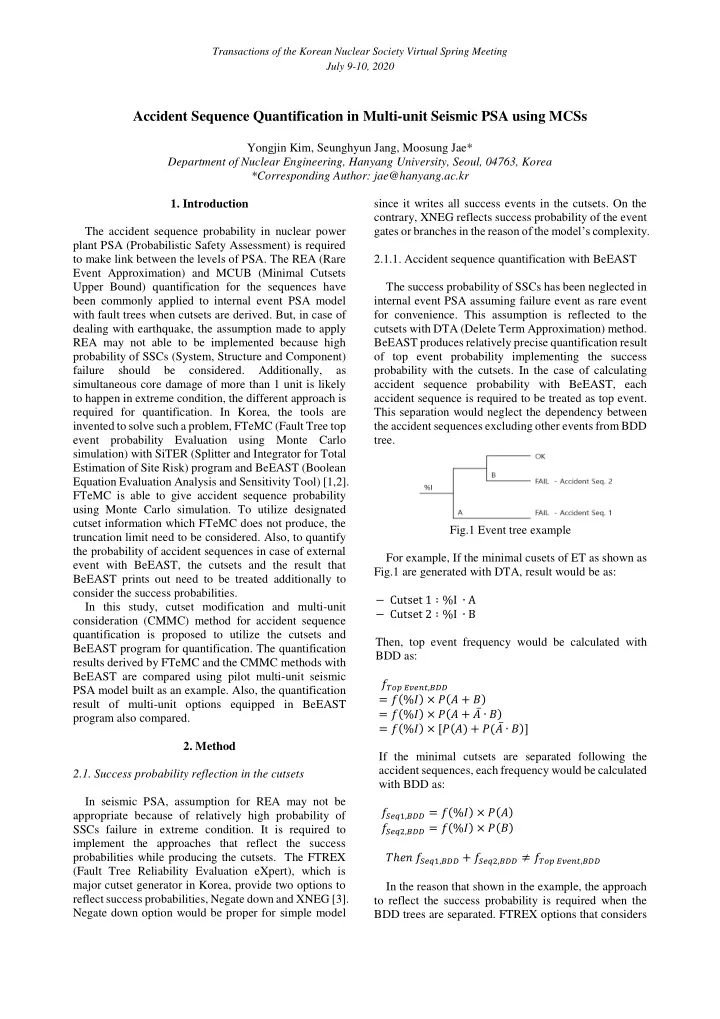
2.1. Success probability reflection in the cutsets In seismic PSA, assumption for REA may not be appropriate because of relatively high probability of SSCs failure in extreme condition. It is required to implement the approaches that reflect the success probabilities while producing the cutsets. The FTREX (Fault Tree Reliability Evaluation eXpert), which is major cutset generator in Korea, provide two options to reflect success probabilities, Negate down and XNEG [3]. Negate down option would be proper for simple model since it writes all success events in the cutsets. On the contrary, XNEG reflects success probability of the event gates or branches in the reason of the model’s complexity. 2.1.1. Accident sequence quantification with BeEAST The success probability of SSCs has been neglected in internal event PSA assuming failure event as rare event for convenience. This assumption is reflected to the cutsets with DTA (Delete Term Approximation) method. BeEAST produces relatively precise quantification result
- f top event probability implementing the success