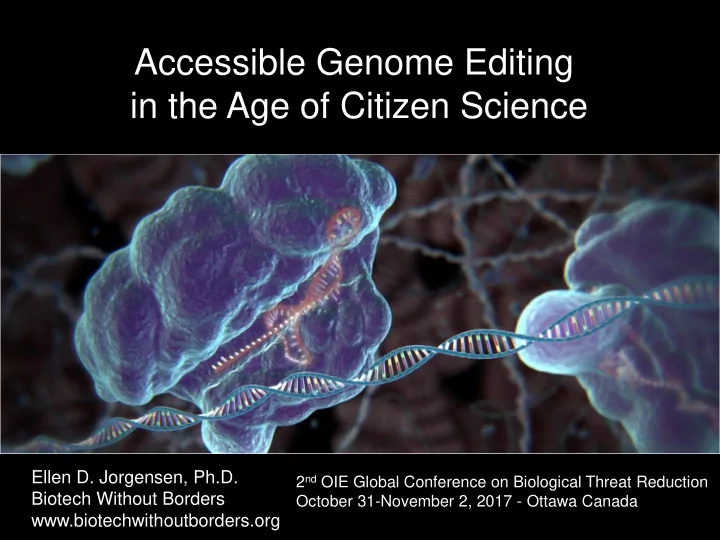
Accessible Genome Editing in the Age of Citizen Science Ellen D. - - PowerPoint PPT Presentation

accessible genome editing
SMART_READER_LITE
LIVE PREVIEW

Accessible Genome Editing in the Age of Citizen Science Ellen D. - - PowerPoint PPT Presentation

Accessible Genome Editing in the Age of Citizen Science Ellen D. Jorgensen, Ph.D. 2 nd OIE Global Conference on Biological Threat Reduction Biotech Without Borders October 31-November 2, 2017 - Ottawa Canada www.biotechwithoutborders.org


slide-1
SLIDE 1

Accessible Genome Editing in the Age of Citizen Science

Ellen D. Jorgensen, Ph.D. Biotech Without Borders www.biotechwithoutborders.org

2nd OIE Global Conference on Biological Threat Reduction October 31-November 2, 2017 - Ottawa Canada

slide-2
SLIDE 2

“Central to our mission is the belief that biotechnology and greater public understanding about it has the potential to benefit everyone”

slide-3
SLIDE 3

Self-identified DIYbio practitioners

slide-4
SLIDE 4
slide-5
SLIDE 5
  • Incorporated as Nonprofits
  • BSL1 Lab Space open to public
  • Mission to foster science literacy –

classes, talks , workshops

  • Provide community lab space to facilitate

innovation and exploration

  • Outreach programs for students and

adults

What are Community Labs?

slide-6
SLIDE 6
slide-7
SLIDE 7
slide-8
SLIDE 8
slide-9
SLIDE 9
  • Secure space (keypad entry to building, lockable labs)
  • Fire extinguishers, eyewash stations, personal protective

equipment

  • Organisms/activities appropriate for BSL 1 (no human

pathogens)

  • Consistent with NIH recombinant DNA guidelines
  • Minimize hazardous chemical use
  • Commercial biological and hazardous waste disposal
  • Safety & equipment training for all members
  • Scientific Advisory Board available for input

Safety/Security Measures

slide-10
SLIDE 10
slide-11
SLIDE 11
slide-12
SLIDE 12

Typical Projects

  • Food and Environment exploration through DNA

Barcoding

  • Microbial Sampling & Microbiome analysis
  • Personal genomic exploration
  • Metabolic engineering of E. coli K12
  • Expression of proteins in yeast
  • Engineering Arabidopsis & tobacco using

Agrobacterium tumefaciens

  • No human or animal pathogens
slide-13
SLIDE 13
slide-14
SLIDE 14
slide-15
SLIDE 15

Biosecurity

  • Initial meeting with NYC WMD team (FBI-FDNY-

NYPD)

  • Genspace-FBI joint presentations to public
  • Synbio/FBI Building Bridges
  • FBI/DIYbio conferences
  • WMD Basic Training
  • AAAS multi-agency meetings
  • Code of Ethics conference
  • UN WMD Branch, Office for Disarmament Affairs
  • DTRA meetings
slide-16
SLIDE 16

Multi-stakeholder Forum on Science, Technology and Innovation for the SDGs New York, 15-16 May 2017

Top Ten Technologies Impacting the UN Sustainable Development Goals

  • 1. Synthetic Biology (high throughput engineering)
  • 2. Improvements in DNA sequencing technologies
  • 3. High capacity DNA synthesis
  • 4. Chromosome building
  • 5. Precise editing of DNA (e.g. CRISPR)
  • 6. Cell-free systems
  • 7. Metagenome and microbiome engineering
  • 8. Tissue engineering (lab grown organs and

meat)

  • 9. Improved imaging systems for living organisms

10.Modeling (the virtual cell)

slide-17
SLIDE 17

Why is CRISPR Transformative?

  • “Word processor for genomes”
  • Relatively cheap and easy to use
  • Universally useful tech for any process

that relies on genetic engineering

  • Can be precisely targeted in genome with

ease, unlike traditional genetic engineering

  • Increases the accessibility of biotech
slide-18
SLIDE 18

Some Uses of CRISPR

  • Repair genetic disorders (cystic fibrosis,

Huntingtons, beta thalassemia)

  • Reprogram immune system cells to fight cancer

(CAR-T therapy)

  • Greatly increase the speed of development in

agricultural genetic engineering (plants and animals)

  • Decrease antifungal resistance
  • Embryo editing
  • Gene drives (engineer a species)
slide-19
SLIDE 19
slide-20
SLIDE 20
slide-21
SLIDE 21

Why use CRISPR in Community Labs?

  • Common tool to jumpstart innovation
  • Educate the public about it
  • Discuss the social, moral and ethical

implications of germline editing

  • Engage around environmental engineering

through gene drives (altering or eliminating a species)

  • Editing embryos is far above the capability
  • f a community lab
slide-22
SLIDE 22