ACCESS 2014 results dropped off at schools 2010-2011 Survey (used - - PDF document

access 2014 results dropped off at schools 2010 2011
SMART_READER_LITE
LIVE PREVIEW

ACCESS 2014 results dropped off at schools 2010-2011 Survey (used - - PDF document

4/4/2014 Title II A 2013-14 Friendly Reminders Private & Parochial 2014-15 Parameters Overview Administrators Meeting What makes professional development effective? (article discussion) April 2, 2014 Location: St. Maria


slide-1
SLIDE 1

4/4/2014 1

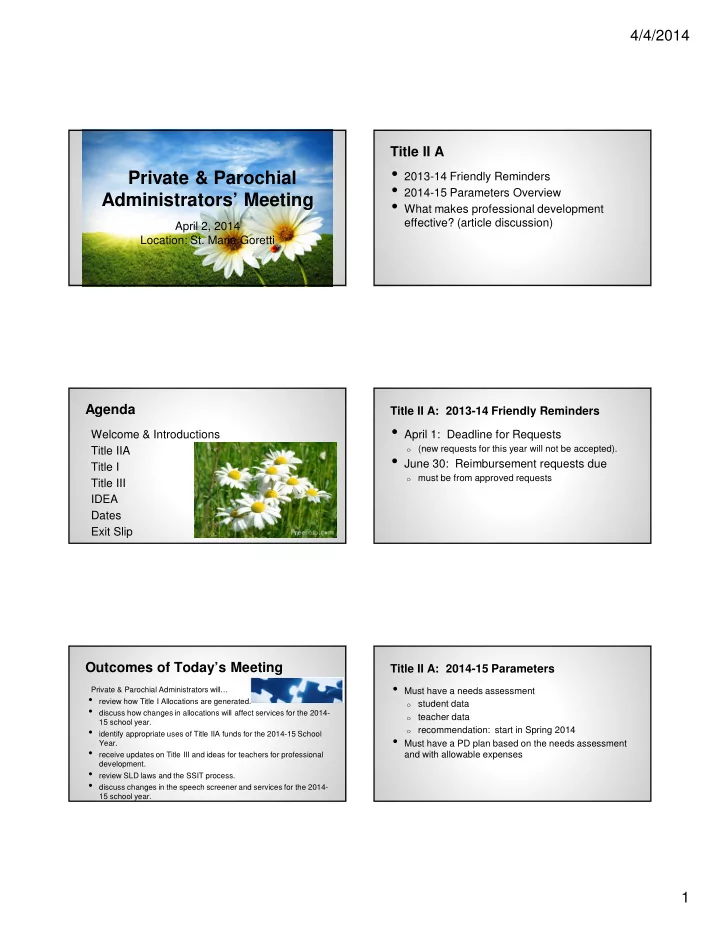
Private & Parochial Administrators’ Meeting

April 2, 2014 Location: St. Maria Goretti

Agenda

Welcome & Introductions Title IIA Title I Title III IDEA Dates Exit Slip

Outcomes of Today’s Meeting

Private & Parochial Administrators will…

  • review how Title I Allocations are generated.
  • discuss how changes in allocations will affect services for the 2014-

15 school year.

  • identify appropriate uses of Title IIA funds for the 2014-15 School

Year.

  • receive updates on Title III and ideas for teachers for professional

development.

  • review SLD laws and the SSIT process.
  • discuss changes in the speech screener and services for the 2014-

15 school year.

Title II A

  • 2013-14 Friendly Reminders
  • 2014-15 Parameters Overview
  • What makes professional development

effective? (article discussion) Title II A: 2013-14 Friendly Reminders

  • April 1: Deadline for Requests
  • (new requests for this year will not be accepted).
  • June 30: Reimbursement requests due
  • must be from approved requests

Title II A: 2014-15 Parameters

  • Must have a needs assessment
  • student data
  • teacher data
  • recommendation: start in Spring 2014
  • Must have a PD plan based on the needs assessment

and with allowable expenses

slide-2
SLIDE 2

4/4/2014 2

Title II A: 2014-15 Parameters

  • Title IIA Requests - based on PD Plan
  • Title IIA Reimbursement - only for approved

requests

  • More details in September, 2014

2014-15 Allowable Title IIA Requests Title IIA requests must be related to your Needs Assessment Per new guidelines, Title IIA can reimburse professional development including graduate courses and license advancement to all staff in core academic areas ONLY

Examples of Allowable Expenses

  • Professional development books (not

student) related to core academic areas

  • Attend conferences related to core academic

areas

  • Tuition reimbursement for graduate or

undergraduate coursework

Core Academic Areas

  • Arts, music, dance,

drama/theater

  • Civics and government, history,

geography, and economics

  • Foreign languages
  • Reading and English Language

Arts

  • Mathematics
  • Science: life science, physical

science, earth and space science, astronomy, chemistry and physics

Non-Core Academic Areas:

  • Agriculture
  • Bookkeeping, accounting,

business, cooperative education and library science

  • Health education, health
  • ccupations, and physical

education

  • Family and consumer sciences,

technology education, marketing education, trades and industry, computer science, driver education and journalism

  • Psychology, sociology, and

speech

MMSD Professional Development

  • •Many MMSD courses open to

private/parochial staff

  • MMSD courses not reimbursable

MMSD PD Catalog: mmsd.org/pdcatalog

What Makes Professional Development Effective?

  • 1. Skim the article, Effective Teacher Development: What

Does the Research Show?

  • 2. In a small group, discuss
  • How do effective professional development designs

compare to your PD?

  • In what ways might you change your approach to

gathering information for a PD needs assessment, planning PD, and or budgeting based on this research?

  • What is your next step?
slide-3
SLIDE 3

4/4/2014 3

What Questions do you have for Title IIA?

Title I

Allocations

  • Pooling Resources
  • Poverty/Non-Poverty Survey

Affirmations

  • Updating 2013-14 Affirmations for Title I

Parent Involvement

  • Entry & Dismissal Letters and Quarterly Progress

Reports

  • Attending Back to School Nights

ESEA and Title I, Part A

Elementary and Secondary Education Act (ESEA) of 1965. Title I, Part A funds are targeted to high-poverty school districts and provide supplementary education to students who are educationally disadvantaged or at risk of failing to meet the state standards.

Distribution of Funds

U.S. Department of Education WI Department of Public Instruction Madison Metropolitan School District Title I School

Title I School Eligibility

  • Based on the number of children ages 5 -17 in

poverty in a school’s attendance area, including those who attend a private school

  • Schools are eligible if poverty percentage is

above that of the district. (46.84%)

Middle Schools 2014-15

Eligible middle schools will receive Title I funds. This means that participating private schools can choose to serve their students in grades 6-8 who would have attended a Title I receiving public school.

slide-4
SLIDE 4

4/4/2014 4

  • Importance
  • The number of total Poverty/Non-Poverty Surveys

should be close to the total school enrollment for Title II collected in January

  • Impact of this year’s survey data
  • Future data collection ideas?

Poverty & Non-Poverty Surveys Poverty & Non Poverty Survey

Numbers of Schools Participated? Non-Poverty Students tallied Poverty Students tallied 2010-2011 Survey (used for both the 11-12 & 12- 13 School Year 16 Elementary: 514 Middle/High: 288 Elementary: 182 Middle/High: 58 2012-2013 Survey (for use for the 2013-14 school year) 17 Elementary: 736 Middle/High: 369 Elementary: 140 Middle/High: 57

(108 in Title I Elem. Schools)

2013-2014 Survey (for use for the 2014-15 school year) 14 Elementary: 608 Middle/High: 275 Elementary: 115 Middle/High: 31

(77 in Title I Elem. Schools)

Title I for the 2014-15 School Year

Since the:

  • Title I service allocation is reduced; and
  • Eligible middle school students are now

included, The priority ranking of students is even more critical.

Title I - End of Year Survey

Will be sent to all schools and ask for feedback on topics including:

  • services during the 2013-14 school year (only for

schools receiving services this year)

  • content / professional development topics to be covered

during future Administrators’ Meetings

  • preferences for meeting times
  • MMSD TI staff attendance at back to school night

events for parent involvement purposes

Title III End of Year Timeline

May 2014

  • ACCESS 2014 results dropped off at schools
  • Can-Do Descriptors are included in the results

package.

  • PP schools mail ACCESS 2014 results home to

parents

  • K-models may be given to incoming 5K students for the

fall

Title III 2014-15 Timeline

August 15, 2014 - ELL Rosters will be sent to PP schools September 5, 2014 - PP schools must have their ELL Rosters updated so that all new students can be given the K-Model/W-APT by the 3rd Friday count deadline. September 19, 2014 - Updated ELL Rosters due to Molly Adams with new students and W-APT scores. September - W-APT/ACCESS training date (Specific Dates TBD)

  • Begin collecting MMSD Title III permission slip due

December - January - ACCESS 2015 testing window (Specific Dates TBD)

slide-5
SLIDE 5

4/4/2014 5

Identifying English Language Learners

  • Why is it important to identify early?
  • Current 4k students can be screened this
  • spring. Please contact Erica Friedle at

ezfriedle@madison.k12.wi.us if you would like to start the identification process this spring

New Cover Letter

  • Send to parents of potential ELLs with Home

Language Survey

  • Increase parent communication
  • Title IIIA will no longer use enrollment

paperwork beginning in 2014-15.

Title III A Participation

School 11-12 12-13 13-14 Abundant Life 2 2 6 Edgewood Campus 2 5 11 High Point 1 Lighthouse 14 15 20 Madinah Academy 8 11 18

  • St. Dennis

13

  • St. James

11 12 10

  • St. Maria Goretti

4 6 11 Waldorf 1 1 Total 55 52 77

Title III Allocations

2012-13 School Year 5,059 Public School Students + 52 Private School Students 5,111 Total Students Participating in ACCESS 2013 Total award = $638,768 / 5111 ELLs = $124.98 per student. $124.98 x 52 students = $6,498.96 allocated towards Erica's salary 2013-14 School Year 5,140 Public School Students + 77 Private School Students 5,217 Total Students Participating in ACCESS 2014 Award given in June/July for the 2014-15 School Year

Professional Development Around English Language Learners

  • ESL 101
  • a. Differentiation for Language Learners
  • b. Can Do Strands from WIDA
  • c. Best practices for ELL
  • GLAD Strategies (Guided Language

Acquisition Design)

  • Bi-Literacy Summer Course Opportunities

What Questions do you have for Title III?

slide-6
SLIDE 6

4/4/2014 6

IDEA

Specific Learning Disability Student Support & Intervention Team (SSIT) Speech Screening Process 3-Year Reevaluations Array of Services for 2014-15

What is a Specific Learning Disability?

Students with specific learning disabilities (SLD) have severe trouble learning or demonstrating skills in one or more of these academic areas:

  • ral expression listening comprehension

written expression basic reading skill reading fluency reading comprehension mathematics calculation mathematics problem solving

How is SLD Determined under IDEA?

1) Insufficient Progress The student cannot meet standards within a reasonable amount of time even after multiple, intensive interventions.

No comparable private-parochial school requirement.

How is SLD Determined under IDEA?

2) Inadequate Classroom Achievement 1.25 Standard Deviations below expected age or grade level after intensive interventions.

Significantly below grade/age level and significantly below expected level, given intellectual ability, after intensive intervention.

How is SLD Determined under IDEA?

Learning difficulties not caused primarily by exclusionary factors: Insufficient instruction Instruction in non-dominant language Environment, Cultural, Economic Factors

Same for Private - Parochial School Students

Student Support Intervention Process

slide-7
SLIDE 7

4/4/2014 7

Speech Screening Process Speech Screening Process 3-Year Re-evaluations

Parents will receive letters this summer.

Array of Services for 2014-15

Discussion & Questions

Dates

April 16 - Names due for Summer Learning Academy June 30 - All reimbursements for the 2013-14 School year are due. Next Year Dates: September 17, 2014 January 21, 2015 April 15, 2015