Living and Dying Well Any diagnosis Any location y Living Li i - - PDF document

living and dying well
SMART_READER_LITE
LIVE PREVIEW

Living and Dying Well Any diagnosis Any location y Living Li i - - PDF document

Meeting of the Cross Party Group in the Scottish Parliament on Palliative Care Wednesday 12 December 2012 Promoting confidence in Promoting confidence in palliative care in Care Homes palliative care in Care Homes palliative care


slide-1
SLIDE 1

1

‘Promoting confidence in palliative care in Care Homes’ ‘Promoting confidence in palliative care in Care Homes’ palliative care in Care Homes palliative care in Care Homes

Dr Sally Lawton S i L t i P lli ti C Senior Lecturer in Palliative Care (Nursing) NHS Grampian

1

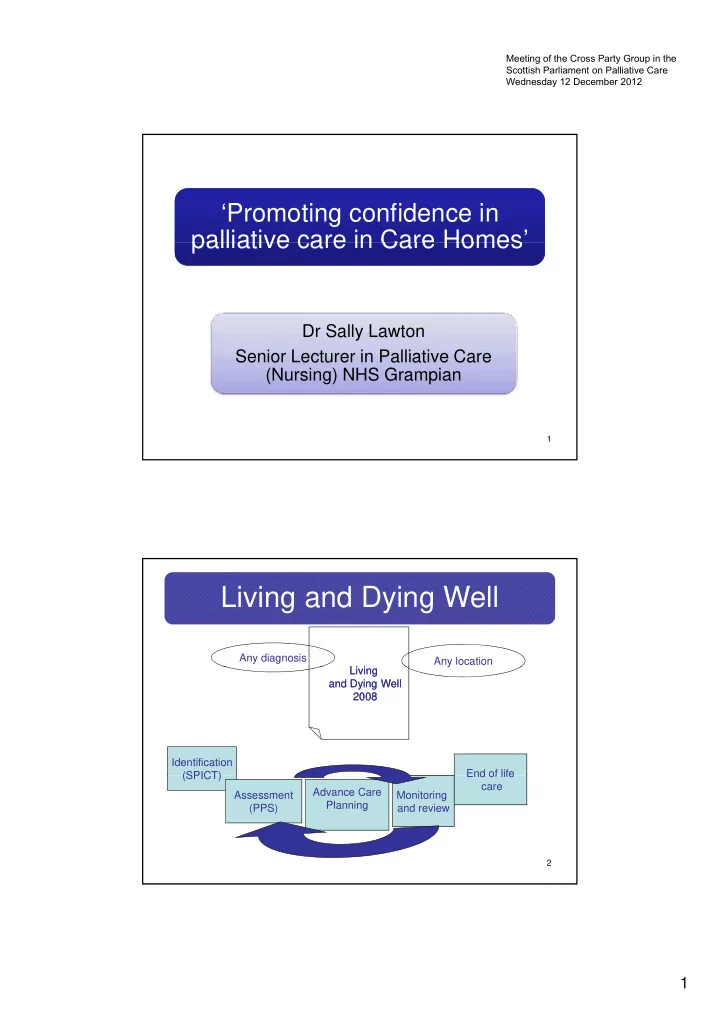
Living and Dying Well

Li i Li i Any diagnosis Any location Living Living and Dying Well and Dying Well 2008 2008 y Identification (SPICT) End of life (SPICT) Assessment (PPS) Monitoring and review Advance Care Planning End of life care

2

Meeting of the Cross Party Group in the Scottish Parliament on Palliative Care Wednesday 12 December 2012
slide-2
SLIDE 2

2

How did we build confidence?

Recognising the palliative environment Giving staff tools to assess and recognise change Helping staff to liaise more effectively with local Primary Care Teams Giving staff tools to develop advance care plans Discussing end of life care using after death reviews

3

The structure of the Project

4

Meeting of the Cross Party Group in the Scottish Parliament on Palliative Care Wednesday 12 December 2012

slide-3
SLIDE 3

3

5

Palliative environment

Palliative Care categories (n=4204)

800 300 400 500 600 700 number Shire Nursing Shire Residential city nursing city residential city VSH 100 200 dementia

  • rgan failure

frailty mental health issues malignancy Learning Difficulties palliative category

6

Meeting of the Cross Party Group in the Scottish Parliament on Palliative Care Wednesday 12 December 2012

slide-4
SLIDE 4

4

The PPS

PPS Level Ambulation Activity & evidence

  • f disease

Self-care Intake Conscious level 100% Full Normal activity & work No evidence of disease Full Normal Full 90% Full Normal activity & work Full Normal Full Some evidence

  • f

disease 80% Full Normal activity with effort Some evidence

  • f

disease Full Normal or reduced Full 70% Reduced Unable Normal job/work Significant disease Full Normal or reduced Full 60% Reduced Unable hobby/house work Significant disease Occasional assistance necessary Normal or reduced Full or confusion 50% Mainly sit/lie Unable to do any work Extensive disease Considerable assistance required Normal or reduced Full or confusion 40% Mainly in bed Unable to do most ti it Mainly assistance Normal or reduced Full or drowsy / f i activity Extensive disease +/- confusion 30% Totally bed bound Unable to do any activity Extensive disease Total care Normal or reduced Full or drowsy +/- confusion 20% Totally bed bound Unable to do any activity Extensive disease Total care Minimal to sips Full or drowsy +/- confusion 10% Totally bed bound Unable to do any activity Extensive disease Total care Mouth care only Drowsy or coma +/- confusion 0% Death

  • 7

Assessment tool – the PPS

900

PPS Data (n=2742)

400 500 600 700 800 900 Nursing Home Residential Home 100 200 300 PPS 70 or more PPS 60 PPS 50 PPS 40 PPS 30 PPS 20 PPS 10 Very Sheltered Housing

8

Meeting of the Cross Party Group in the Scottish Parliament on Palliative Care Wednesday 12 December 2012

slide-5
SLIDE 5

5

  • skin care that minimizes skin breakdown
  • food fluid and nutritional intake as appropriate
  • Consider physical, psychological, spiritual and social needs at each level
  • Create a rapport that enables the patient/family/carer to express their understanding of their situation and explore concerns
  • Consider environmental factors that will enhance care
  • Liaise with relevant health/social care agencies as required

Nursing care Activities related to the PPS Scores ( by Sally Lawton September 2010 Roxburghe House) PPS Score >/= 70 (promotion of self care) Supervise care activities that promote wellbeing using existing local care plans

  • food, fluid and nutritional intake as appropriate
  • continence care that protects the skin
  • wound/stoma care that controls exudate and lessens odour
  • concordance with prescribed medication
  • assessing and monitoring symptoms

PPS Score 40 -60 (assessment, monitoring and review) Assess, review and assist as required with care activities that maximise wellbeing using existing local care plans

  • moving and handling using appropriate equipment
  • skin care that minimizes skin breakdown
  • oral care to promote a healthy mouth
  • food, fluid and nutritional intake as appropriate
  • continence care that protects the skin
  • wound/stoma care that controls exudate and lessens odour
  • concordance with prescribed medication
  • assessing and monitoring symptoms

PPS Score 10 - 30 (High nursing dependency) Undertake care activities to promote comfort using existing local care plans

  • assisting with moving and handling using appropriate equipment
  • providing skin care that minimizes skin breakdown
  • providing oral care that prevents complications associated with dry mouths
  • assisting with food, fluid and nutritional intake as appropriate
  • providing continence care that protects the skin
  • providing wound/stoma care that controls exudate and lessens odour
  • administering prescribed medication
  • assessing and monitoring symptoms

9

PPS re-assessments

Total changes in PPS (n=2061) 1000 400 500 600 700 800 900 num bers Nursing Home Aberdeenshire(n=508) Residential Home Aberdeenshire (n=183) Nursing Home Aberdeen city (n=1020) Residential Homes Aberdeen City (n=237) VSH Aberdeen City (n=113) 100 200 300 PPS static PPS decreasing PPS increasing PPS status

10

Meeting of the Cross Party Group in the Scottish Parliament on Palliative Care Wednesday 12 December 2012

slide-6
SLIDE 6

6

End of life care - Deaths

Deaths (n=293)

300 100 150 200 250 numbers 50 deaths in the home deaths in hospital unknown death in community hospital

11

Comments/reflections about the deaths – What went well

Enabling the resident to fulfil their Enabling the resident to fulfil their preferred place of care

Teamwork between the home and Primary Care Working with the family and providing all care Primary Care

Effective symptom control and equipment

12

Meeting of the Cross Party Group in the Scottish Parliament on Palliative Care Wednesday 12 December 2012

slide-7
SLIDE 7

7

Comments/reflections about the deaths – problems

Patient died in hospital

Very sudden decline and death – no indication (8)

Care was reactive – no DNA CPR

Problems with hospital discharge – Naso-gastric Ambulance was sent and patient admitted to hospital instead of OOH visit Problems with hospital discharge – Naso-gastric tube, inappropriate transportation No review of medication when resident was unable to swallow No medication for agitation

13

Comments/reflections about the deaths – suggestions

Improved communication

More knowledge about

Improved communication between Care Home, family and Primary Care

More knowledge about palliative care needed by staff in the Home and Primary Care staff

Earlier review and Should have used the PPS Earlier review and ACP needed Should have used the PPS and improve documentation

14

Meeting of the Cross Party Group in the Scottish Parliament on Palliative Care Wednesday 12 December 2012

slide-8
SLIDE 8

8

Areas for development

On-going need for closer links with Primary Care for some homes Competing priorities! Aim to reduce ‘reactive’ care DNA CPR Staffing issues

15

Conclusion

Successful Project – welcome by the 81 Care Homes Staff want to provide care until the end of life Project approach helped to increase confidence Evidence that Homes are adapting practice p g p

  • Using the PPS
  • Working with GPs to develop ACPs

Project approach being used in Community Hospitals and Department

  • f Medicine for the elderly

16

Meeting of the Cross Party Group in the Scottish Parliament on Palliative Care Wednesday 12 December 2012