SLIDE 1 G.A. Verkhogliadov1, D.S. Gets1, M.A. Masharin1, S.M. Makarov1, A.A. Zakhidov1,2 Light-emitting solar cell optical properties improving by solvent annealing Lab symbolics
Lab symbolics
1 Department of Physics, ITMO University, St. Petersburg 197101, Russian Federation 2 Alan G. MacDiarmid NanoTech Institute, University of Texas at Dallas, Richardson, TX 75083, USA
Introduction Theory Fabrication Setup Results Conclusion References [1] Nature Photonics volume 12, pages 355–361 (2018) [2] Nano Lett. 2018, 18, 3, 2172–2178 [3] Adv. Energy Mater. 2016, 6, 1600330
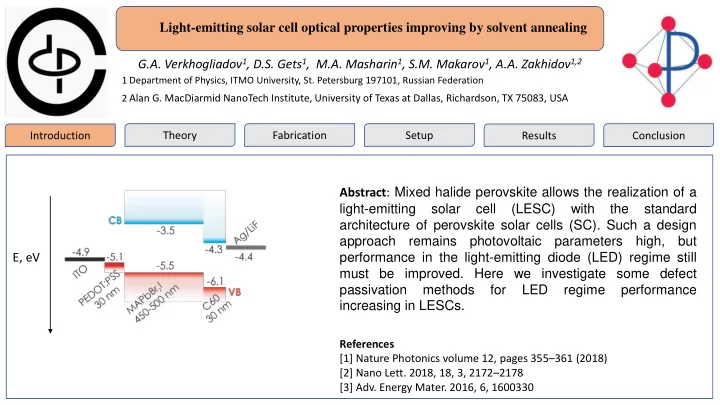
Abstract: Mixed halide perovskite allows the realization of a light-emitting solar cell (LESC) with the standard architecture of perovskite solar cells (SC). Such a design approach remains photovoltaic parameters high, but performance in the light-emitting diode (LED) regime still must be improved. Here we investigate some defect passivation methods for LED regime performance increasing in LESCs. E, eV
SLIDE 2
Light-emitting solar cell optical properties improving by solvent annealing Lab symbolics Lab symbolics
Introduction Theory Fabrication Setup Results Conclusion References [5] arXiv:1910.12285
Electrically driven dipole layer formation
References [4] Energy Environ. Sci., 2017,10, 1950-1957
Dualfunctional devices G.A. Verkhogliadov, D.S. Gets, M.A. Masharin, S.M. Makarov, A.A. Zakhidov
High potential barrier for charge injection Under applied voltage organic cations with nonzero dipole momentum migrates to interface with C60 and form a dipole layer, which reduce the potential barrier.
SLIDE 3
G.A. Verkhogliadov, D.S. Gets, M.A. Masharin, S.M. Makarov, A.A. Zakhidov Light-emitting solar cell optical properties improving by solvent annealing Lab symbolics Lab symbolics
Introduction Theory Fabrication Setup Results Conclusion References [6] Nano Energy, Volume 28, October 2016, Pages 417-425
Solvent annealing Spin coating
DMF and DMSO were used for a solvent annealing T = 100C t=20 min
SLIDE 4
G.A. Verkhogliadov, D.S. Gets, M.A. Masharin, S.M. Makarov, A.A. Zakhidov Light-emitting solar cell optical properties improving by solvent annealing Lab symbolics Lab symbolics
Introduction Theory Fabrication Setup Results Conclusion
PLQY and PL lifetime measurements PL Lifetime measurements scheme PLQY measurements scheme I(t)=∑Ai*exp(-t/ti)
SLIDE 5
G.A. Verkhogliadov, D.S. Gets, M.A. Masharin, S.M. Makarov, A.A. Zakhidov Light-emitting solar cell optical properties improving by solvent annealing Lab symbolics Lab symbolics
Introduction Theory Fabrication Setup Results Conclusion
Segregation suppression Solvent annealing
Intensity, mW/cm2 PLQY, % (no solvernt) PLQY, % (DMF)
PLQY, % (DMSO)
17.5 5.64 5.2 8.85 65.6 3.22 6.72 10.47 106 3.42 6.43 13.83
SLIDE 6 G.A. Verkhogliadov1, D.S. Gets1, M.A. Masharin1, S.M. Makarov1, A.A. Zakhidov1,2 Light-emitting solar cell optical properties improving by solvent annealing Lab symbolics
Lab symbolics
1 Department of Physics, ITMO University, St. Petersburg 197101, Russian Federation 2 Alan G. MacDiarmid NanoTech Institute, University of Texas at Dallas, Richardson, TX 75083, USA
Introduction Theory Fabrication Setup Results Conclusion
- 1. Light-emitting solar cell optical parameters can be improved by grain surface modification and
photoactive layer composition changing. 2. Solvent annealing leads to grain size increasing and reduce nonradiative recombination via defects.
- 3. Potassium halide and lead acetate addition provide blue shift of electroluminescence to visible
range. g.verkhogliadov@metalab.ifmo.ru