Absolutism vs. Constitutionalism absolutism: a form of government - - PDF document

absolutism vs constitutionalism
SMART_READER_LITE
LIVE PREVIEW

Absolutism vs. Constitutionalism absolutism: a form of government - - PDF document

Absolutism vs. Constitutionalism absolutism: a form of government in which a monarch has unlimited power constitutionalism: governmental authority is limited by laws laws can be written or unwritten The English Parliament House of Lords


slide-1
SLIDE 1

Absolutism vs. Constitutionalism

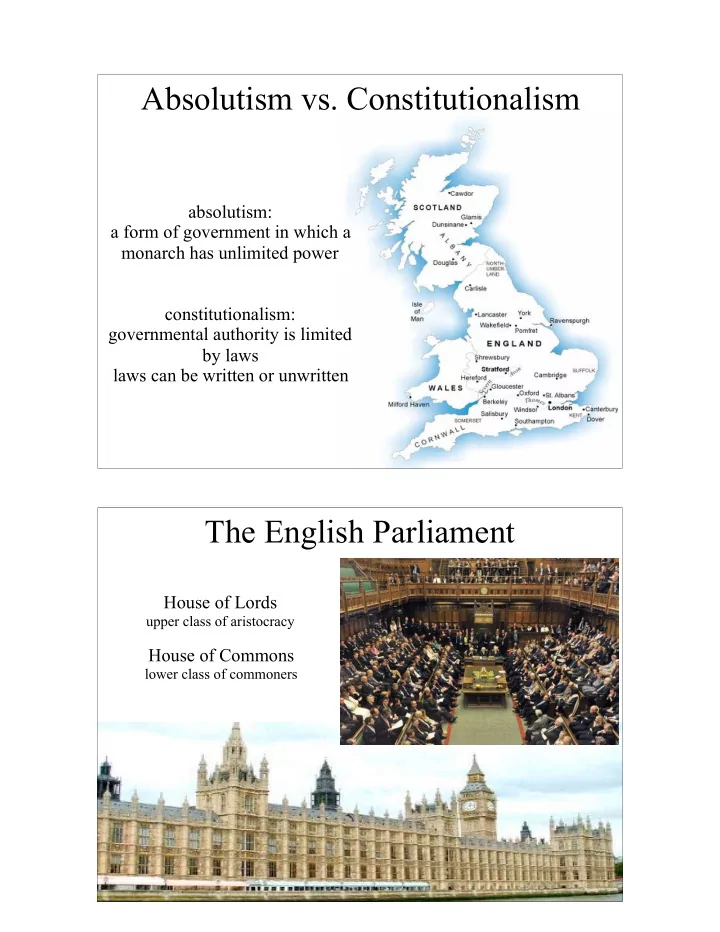
absolutism: a form of government in which a monarch has unlimited power constitutionalism: governmental authority is limited by laws laws can be written or unwritten

The English Parliament

House of Lords

upper class of aristocracy

House of Commons

lower class of commoners

slide-2
SLIDE 2

Agriculture Affects Government

new agricultural techniques improved agricultural yield enclosure movement:

  • ld common lands enclosed and turned into

sheep runs “commoners” becoming wealthy: rented out lands invested in commercial ventures made good marriages It is said that members of the House of Commons were so wealthy they could “buy the House of Lords three times over!” willing to pay higher taxes, but… wanted to be sure they had a voice in the government 1603: childless Queen Elizabeth dies James Stuart becomes King James I of England Stuart Dynasty begins

(a Stuart ruled England from 1603-1625)

The Stuart Dynasty Begins

Scottish James I did not understand many English laws or customs when urged to wave at crowds he threatened to drop his pants “so they can cheer at my arse”

the Great Chain of Being and Divine Right

  • f Kings:

kings receive their power directly from God

King James Bible = during the reign of James I

James’ essay on his ideas of divine right: “The Trew Law of Free Monarchy”

Kings are justly called gods, for that they exercise a manner or resemblance of divine power upon earth: for if you will consider the attributes to God, you shall see how they agree in the person of a king. God hath power to create or destrov make or unmake at his pleasure, to give life or send death, to judge all and to be judged nor accountable to none; to raise low things and to make high things low at his pleasure, and to God are both souls and body due. And the like power have kings: they make and unmake their subjects, they have power of raising and casting down, of life and of death, judges over all their subjects and in all causes and yet accountable to none but God only. . . .

slide-3
SLIDE 3

The Gunpowder Plot of 1605 plan was to blow up the House of Lords James's Catholic daughter would be new leader an anonymous letter revealed the plot to the authorities they searched the House of Lords at midnight Guy Fawkes found guarding gunpowder barrels eight men, including Fawkes, were arrested all were convicted: hanged, drawn and quartered

Conflict

James liked to squander money on a lavish court accumulated a lot of debt Parliament, used to ruling with the king, showed their anger by using the “power of the purse” James died in 1625 and was succeeded by his son, Charles I in 1628 Parliament passed the Petition of Right:

no taxes without Parliament’s consent, no arbitrary imprisonment, no quartering of soldiers in private homes, no declaring martial law in times of peace

Charles I

Ship Money Tax seacoast towns had always paid a tax to pay for coastal defense Charles made inland towns begin to pay the tax as well middle class merchants and gentry opposed this: accused the king of taxing without Parliament’s consent

wife = Henrietta Maria Catholic sister of French King Louis XIII

close friends with Archbishop

  • f Canterbury, William Laud

known to have very Catholic leanings

tried to force Scotland to use the Anglican Book of Prayer Charles = no money = no troops forced to call a Parliament to appropriate defense funds Charles I officially accepted the Petition of Right, but then decided that since he and Parliament couldn’t seem to work together, he just wouldn’t summon it to meet Controversy: Was Charles Protestant or Catholic?

slide-4
SLIDE 4

devout Puritan Oliver Cromwell created the New Model Army: extreme Puritans who believed they were doing battle for the Lord ended with Cromwell’s victory and capture of the king

The English Civil War

V. Charles tried to widen a division in Parliament by arresting some radicals

  • ther radicals are outraged and civil war begins

Charles = Royalists (“Cavaliers”)

nobility, cavalry staff, merchants seeking law and order

Parliament = Parliamentarians (“Roundheads”)

London city militiamen, country squires with business connections

Cromwell kicked out all members of Parliament

  • pposed to putting Charles I on trial for treason

this “Rump Parliament” put Charles I on trial convicted him of treason executed him on January 30, 1649

Cromwell Rules

1653 Cromwell became Commander-In-Chief of the army, head of the Rump Parliament, and named “Lord Protector” created a 15-member Council of State abolished the monarchy and the House of Lords some members of Parliament questioned his authority 1655 Cromwell dissolved Parliament divided the country into 11 military districts, each ruled by a major general

“He, the said Charles Stuart, as a tyrant, traitor, murder, and public enemy to the good people of his nation, shall be put to death by the severing of his head from his body.”
slide-5
SLIDE 5

Cromwell’s Rules

banned Christmas celebrations forbade the use of makeup, colorful dress, and the playing of sports punishments included whippings, being put in the stocks, fines, and/or jail terms gave all religions BUT Catholics the right to practice their religion censored the press and closed theaters changed feast days to fast days

Cromwell Dies

1658: Cromwell dies: malaria? kidney infection? poisoning? his coffin was escorted by 30,000 soldiers

“It was the joyfullest funeral I ever saw; for there were none that cried but dogs” John Evelyn

Cromwell’s son Richard succeeded him after only 18 months Charles II came out of exile and was restored to the throne monarchy reestablished: called “The Restoration” Royalists desecrated Cromwell’s body exhumed, hanged, and drawn and quartered his head was placed on a pole at Westminster Abbey (traditional punishment for treason at the time) remained there for for 24 years

slide-6
SLIDE 6

Is Humpty Dumpty about the English Civil War?

“According to an insert taken from the East Anglia Tourist Board in England, Humpty Dumpty was a powerful cannon used in the Siege of Colchester during the English Civil War. It was mounted on top of the church in Colchester, a Royalist stronghold against a Roundheads siege in the summer of 1648. The church tower was hit by enemy cannon fire and the top of the tower was blown off, sending ‘Humpty’ tumbling to the

  • ground. Naturally all the King's horses and all the King's men

(royalist cavalry and infantry respectively) tried to mend ‘him’ but in vain.”

Professor David Daube in The Oxford Magazine of February 16, 1956

“Humpty Dumpty sat on a wall. Humpty Dumpty had a great fall. All the king’s horses and all the king’s men Couldn’t put Humpty together again.”