Early French Absolutism French Rule in Turmoil 1559: King Henry II - - PDF document

early french absolutism french rule in turmoil
SMART_READER_LITE
LIVE PREVIEW

Early French Absolutism French Rule in Turmoil 1559: King Henry II - - PDF document

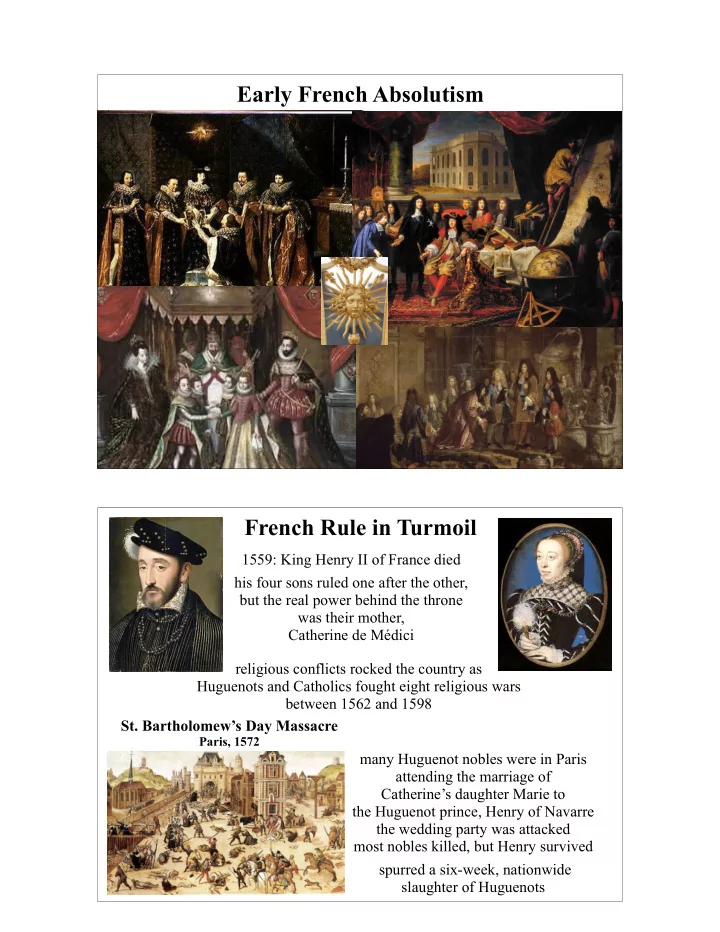
Early French Absolutism French Rule in Turmoil 1559: King Henry II of France died his four sons ruled one after the other, but the real power behind the throne was their mother, Catherine de Mdici religious conflicts rocked the country


slide-1
SLIDE 1

Early French Absolutism

1559: King Henry II of France died

  • his four sons ruled one after the other,

but the real power behind the throne was their mother, Catherine de Médici

French Rule in Turmoil

many Huguenot nobles were in Paris attending the marriage of Catherine’s daughter Marie to the Huguenot prince, Henry of Navarre the wedding party was attacked most nobles killed, but Henry survived

  • spurred a six-week, nationwide

slaughter of Huguenots religious conflicts rocked the country as Huguenots and Catholics fought eight religious wars between 1562 and 1598

  • St. Bartholomew’s Day Massacre

Paris, 1572

slide-2
SLIDE 2

Descended from the popular medieval king Louis IX, Henry was robust, athletic, and handsome.

  • Prince Henry inherited the throne of

France in 1589, becoming Henry IV, the first king of the Bourbon dynasty in France.

  • Many Catholics, especially

Parisians, opposed a Protestant king.

  • Henry chose to convert from

Protestantism and become a Catholic, saying “Paris is well worth a mass.”

Henry of Navarre

In 1598, Henry declared that the Huguenots could live in peace in France and set up their own houses of worship in some cities.

  • This declaration of religious toleration was called the Edict of Nantes.

Edict of Nantes

After a generation of war, most French people welcomed peace, but some hated Henry for his religious compromises.

  • In 1610, a fanatic leaped

into the royal carriage and stabbed Henry to death. Henry devoted his reign to rebuilding France and its prosperity.

  • He restored the French monarchy to a strong

position.

slide-3
SLIDE 3

After Henry’s assassination, his son Louis XIII became king at the age of eight-and-a-half.

  • His mother Marie de’ Medici acted as Regent until

1617.

  • Louis’ initial reign was weak, but then he appointed

Cardinal Richelieu as his chief minister in 1624.

Cardinal Richelieu

Louis XIII

Richelieu’s goal was to increase the power of the Bourbon monarchy, which he did at the expense of the Huguenots.

  • He believed that Protestantism was a breeding ground

for political conspiracies against the Catholic king.

  • As such, he forbade Protestant cities to have walls so

they could not defy the king and then withdraw behind strong defenses.

Cardinal Richelieu

Richelieu also sought to weaken the nobles’ power against the king. He ordered nobles to take down their fortified castles.

  • He appointed more government agents from

the middle class than from the noble class.

  • To make France the strongest state in

Europe, Richelieu sought to limit Hapsburg power by involving involved France in the Thirty Years’ War.

  • The Hapsburgs ruled Spain, Austria, the

Netherlands, and parts of the Holy Roman Empire (the lands surrounding France).

  • Richelieu would die in 1642,

six years before the end of the Thirty Years’ War.

Richelieu Consolidates Power

slide-4
SLIDE 4

One year after Richelieu’s death, Louis XIII, sensing his own demise, put his affairs in order.

  • Custom would have made his wife, Queen Anne, the

sole Regent of France.

Louis XIV Comes to Power

Doubting her political abilities, he decreed that a regency council would rule on four-year-old Louis XIV’s behalf (with her as head of the council). Richelieu’s successor, Cardinal Mazarin, was credited with ending the Thirty Years’ War.

  • Many people in France, particularly the nobles, hated

Mazarin because he increased taxes and strengthened the central government.

Cardinal Mazarin

From 1648 to 1653, violent anti-Mazarin riots tore France apart and included threats on the young king’s life by nobles.

  • In the end, the nobles’ rebellion failed:

> Its leaders distrusted each another even more than they distrusted Mazarin. > The government used violent repression. > Peasants and townspeople grew weary of disorder and fighting.

  • For many years afterward, the French would accept the oppressive laws of an

absolute king, convinced that the alternative - rebellion - was even worse.

  • Even after the violence was over, Louis never forgot his fear and anger.
  • He determined to become so strong

that the nobility could never threaten him again.