Abandoned Vessels and Marine Debris Recent Removal Actions In the - - PowerPoint PPT Presentation

abandoned vessels and marine debris recent removal
SMART_READER_LITE
LIVE PREVIEW

Abandoned Vessels and Marine Debris Recent Removal Actions In the - - PowerPoint PPT Presentation

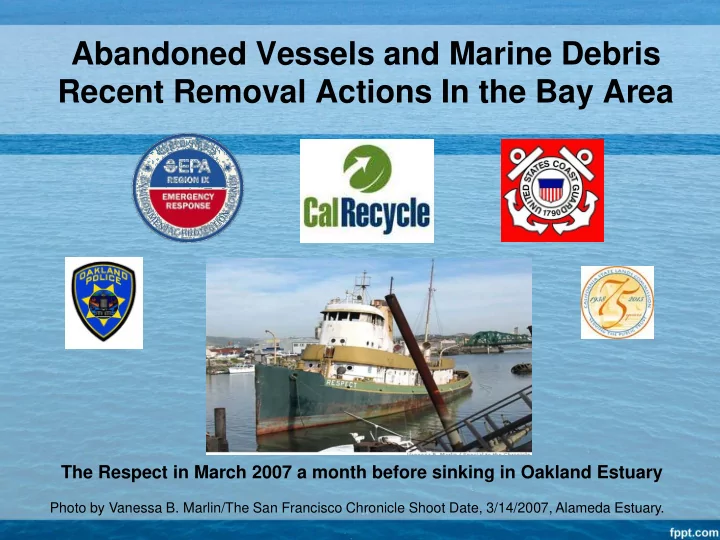
Abandoned Vessels and Marine Debris Recent Removal Actions In the Bay Area The Respect in March 2007 a month before sinking in Oakland Estuary Photo by Vanessa B. Marlin/The San Francisco Chronicle Shoot Date, 3/14/2007, Alameda Estuary. Before


slide-1
SLIDE 1

Abandoned Vessels and Marine Debris Recent Removal Actions In the Bay Area

Photo by Vanessa B. Marlin/The San Francisco Chronicle Shoot Date, 3/14/2007, Alameda Estuary.

The Respect in March 2007 a month before sinking in Oakland Estuary

slide-2
SLIDE 2

Before Oakland Estuary – There was The Petaluma Precedent

  • The State identified abandoned former vessels and marine debris

in the Petaluma River.

  • Requested Federal Assistance to “Raise and/or Assess”.
  • Past State removals have found significant hazardous materials

and/or oils.

slide-3
SLIDE 3

Inland vs. Coastal Zone

Where is Petaluma River? Why EPA?

  • USCG is the lead for OPA

and CERCLA response actions in the Coastal Zone

  • On Petaluma River

everything North of the Hwy 37 Bridge is considered Inland Zone

  • EPA agrees to assist state
  • http://epamap35.epa.gov/jba/default.html
slide-4
SLIDE 4

What R9 Learned . . . Abandoned Vessels Release Haz Substances

  • EPA Petaluma Precedent Removal Action Documented
  • Hull, Decking, and Engine Compartment of the Vessels contained

– Heavy Metal Paints – Asbestos – PCBs – Lead Acid Batteries – Mercury Switches and Ballasts – Radium Dial – Waste Oil

  • Orphan Containers Onboard

– Corrosives – Ignitables – Flammables – Compressed Gases

slide-5
SLIDE 5

Petaluma Precedent:

A Submerged Three Car Garage

(Joint Resources in Removal)

slide-6
SLIDE 6

EPA and CalRecycle Partner to Cleanup Petaluma River in 2011

  • EPA - Hazardous Substances - $651,586
  • CalRecycle - Solid Waste - $495,000
  • Sonoma County Sheriff’s Marine Unit:

Adjudicated Vessels Abandoned

  • Removed 11 vessels, 6 river debris sites,

3 vehicles inside barge, 3 piers, and 3 barges which contained:

  • 445 cu yds. Non-Friable Asbestos
  • 18 cu yds. Hazardous Waste Solid
  • 1090 pounds of Miscellaneous

Hazardous Waste

  • 72 lead Acid Batteries
slide-7
SLIDE 7

Oakland Estuary: How did this effort Start?

  • OPD requested a site visit base on the previous Petaluma Cleanup
  • CalRecycle received $650,000 grant from Cosco Busan Oil Spill Settlement

Recreational Use Program to enhance Oakland Estuary via removal of marine debris, abandoned vessels, old piers & docks, and navigational hazards. CalRecycle matched grant with its own $650,000 for total of $1.3m enhancement project

  • August 24, 2012, CalRecycle sends Request for Federal Action to USCG, Sector SF,

EPA and ACOE “specifically requesting all three federal agencies participate in a joint venture in raising, evaluating, assessing, and removing abandoned vessels and debris in the Oakland Estuary.”

  • May 14, 2013, USCG authorized USEPA to serve as lead in coastal zone (USCG

jurisdiction) under CERCLA; USCG retain lead for oil response under CWA/OPA.

slide-8
SLIDE 8

EPA Conducts a Removal Assessment

  • On April 18, 2013, the EPA and their technical contractor

conducted a removal assessment. April 18 was a minus tide day allowing for access to parts of the submerged

  • vessels. USCG and California Fish and Wildlife were

present as well

  • EPA collected samples from the tugs “Captain Al” and

“Respect”, the commercial fishing vessel and the “flotilla”(a wooden tug boat and dock) in San Leandro

  • Bay. The Removal Assessment summary report stated:

“The results of this removal assessment document that concentrations of metals, PCBs, TPH, and asbestos are present above screening levels in samples collected from four submerged or partially submerged vessels within the Oakland Estuary”.

Site 6 Site 3

slide-9
SLIDE 9

Overview of the Project Area and Plan

  • CalRecycle will tow or

remove, using a crane barge, all vessels to a staging area where they can be removed and demolished

  • CalRecycle will process

and dispose all solid wastes. Hazardous waste will be given to EPA to dispose

slide-10
SLIDE 10

Additional Sites

  • Proposed 8 Sites
  • 19 Sites NOAA List
  • General Debris Removal
  • New Sites
  • Total 35 Sites
slide-11
SLIDE 11

Site 1: State Lands Commission Adjudication

Source Google Earth

slide-12
SLIDE 12

Site 1 and Other Locations: Abandoned and Adjudicated Vessels

slide-13
SLIDE 13

EPA and State Working Together

slide-14
SLIDE 14

Site 2 and 3

Source Google Earth

slide-15
SLIDE 15

Site 2 and 3

Note: Site 2 and 3 have historic preservation issues. Site 2 was eventually dropped due to these issues.

slide-16
SLIDE 16

Site 3: Removal Activities

Note: Site 3 included demolishing a wharf. This action was identified as having an adverse effect on the historical significance to the property and area. Although it was still ultimately demolished, several recording steps were completed prior to the commencement of removal activities.

slide-17
SLIDE 17

Site 4 - Pier and Site 5 - SLC Adjudication

Source Google Earth

slide-18
SLIDE 18

Site 4 and 5

Note: Site 4 was an abandoned vessel inside a circular pier (left) and Site 5 had abandoned vessels and illegally moored unregistered vessels.

slide-19
SLIDE 19

Site 4 Removal

slide-20
SLIDE 20

Site 6 w/EPA

Source Google Earth

slide-21
SLIDE 21

Site 6: The Tugs “Captain Al” and “Respect”

slide-22
SLIDE 22

Site 6: What About The Sediments?

Note: Initially the plan was to pump sediments into a 200 foot hopper barge.

slide-23
SLIDE 23

Site 6: What About The Sediments?

Note: Switched out to a land based system

slide-24
SLIDE 24

Site 6: What About The Sediments?

  • Approximately 1700 Cubic

Yards of sediment were removed from inside the tugs “Captain Al and “Respect”

  • Over 1 Million Gallons of water

was discharged back into estuary after sediments were allowed to settle out

Sediment settles out with the help of a flocculent Sediment slurry before settling

slide-25
SLIDE 25

Site 6: Raising The Tug “Captain Al”

slide-26
SLIDE 26

Site 6: Demolishing the Tug “Captain Al”

slide-27
SLIDE 27

The Respect Sinks on April 10, 2007 One Day After Being Vandalized

  • April 12, 2007: SF Chronicle Watch UPDATE: DAY 23 Sunken Respect:

A 150-foot vintage towboat named Respect sank Wednesday morning in the Alameda Estuary. A tipster alerted Chronicle Watch in March that the '50s-era vessel was listing on a deteriorating barge and in danger of breaking free from its tethers and drifting into the Park Street Bridge. Since that report, Mike Dillabough of the Army Corps of Engineers helped locate the boat's owner, a longtime ship captain from Vancouver, British Columbia, who had planned to tow the Respect to a Seattle shipyard for restoration. Now, crews with the U.S. Coast Guard and the Army Corps of Engineers are surveying the ship to see if it is blocking traffic in the channel. The spot will be marked with a buoy, and the owner has pledged to hire contractors to raise the boat. . . . There are no chemicals onboard that would pose a threat, Dillabough said.

slide-28
SLIDE 28

The Respect and its Owners

  • 1945: The tugboat was built in 1945 for the Atchinson, Topeka, and

Santa Fe Railway Company, and was originally known as the Engel. It provided Cross-Bay Float Service from 1945 to 1969

  • 1969: With barge traffic declining, Santa Fe sold Engel to John K.
  • Seaborn. The name changed to the Respect in 1975
  • 2006: Seaborn sold the vessel to Gary Sause of Sause Marine

Services, Inc., who apparently intended to dieselize the vessel

  • Approx 2007: Sause sold the vessel to Jeff Varnell for $1, who

soon thereafter sold it to for $1 to Ronald Cook of British Columbia, the owner at the time of its sinking in 2007

slide-29
SLIDE 29

Who is Ronald Cook, the Owner when the Respect Sank?

  • AUGUST 27, 2003: U.S. ANNOUNCES SENTENCING OF “CAPTAIN” COOK FOR

ILLEGALLY DUMPING ASBESTOS INTO THE SEA

  • A federal district court sentenced Cook to 24 months incarceration and 3 years

supervised release. Cook, a Canadian citizen from Victoria, British Columbia, was convicted under the Ocean Dumping Act and the Act to Prevent Pollution from Ships as the individual responsible for illegally dumping trash bags full of asbestos and renovation debris into the Gulf of Mexico.

  • Cook lead a crew performing demolition on an old ferry boat, that was being

transformed into river boat gambling casino. To save costs, crew bagged demolition debris, including plastic garbage bags full of asbestos, and threw it overboard into Pacific Ocean, Gulf of Mexico, and Caribbean Sea at Cook’s direction. Witnesses reported hundreds of bags were dumped; assumed a significant amount discharged, as asbestos removal estimated at $600,000 to $1.7 million.
slide-30
SLIDE 30

Site 6 Raising The Tug “Respect”

slide-31
SLIDE 31

Site 6 Raising The Tug “Respect”

slide-32
SLIDE 32

EPA Contractors Removing Asbestos from the Respect December 2013

slide-33
SLIDE 33

Site 6 Demolishing The Tugs “Respect”

slide-34
SLIDE 34

Site 8: San Leandro Bay

Source Google Earth

slide-35
SLIDE 35

Site 8: San Leandro Bay

Note: After the EPA removed asbestos, the state demolished the vessel and dock.

slide-36
SLIDE 36

Since You’re Here Would You Mind...?

Not only did we remove additional abandoned vessels and marine debris, we also took on a shoreline clean-up

slide-37
SLIDE 37

Since You’re Here…Would You Mind..?

slide-38
SLIDE 38

EPA’s Time-Critical Removal Action July 23, 2013

  • EPA approved Action Memo for Oakland Estuary Marine Debris Removal; total

project ceiling of $3.6m and total estimated recoverable costs of $5.4m to address: – 4 large sunken wrecks (Respect, Captain & 2 commercial fishing vessels); – Any haz substances from approx 35 illegally moored vessels, dilapidated docks, piers, pilings and other like marine debris

  • CalRecycle lead addressing and disposing solid waste
  • Coast Guard, as lead FOSC for oil response, after much discussion, opened the Oil

Spill Liability Trust Fund (OSLTF) to fund raising of Respect, removal/disposal of fuel at cost of approximately $2.6 million

  • Cost to EPA to comply with National Historic Preservation Act Approximately

$50,000.

slide-39
SLIDE 39

What EPA Found at Oakland Estuary

  • Hazardous Substances

– Asbestos Containing Material 17,700 Lbs – Waste Paint Related Material 3,270 Lbs – Flammable Liquid 1,000 Gal – Acid Liquid 40 Lbs – Toxic Liquid 120 Lbs – Waste Oil 50 Gal – Explosives (flares) 32 Units – Marine Batteries 29 Units – Non-RCRA Debris 33 Yds – Miscellaneous ( antifreeze, aerosols) 145 Lbs

  • Sediments (California Hazardous)

1700 Cubic Yds

  • Propane containers, E-Waste, etc.

Various

slide-40
SLIDE 40

CalRecycle Stats

  • 73 Sites Processed

– 58 Vessels – 9 Debris Sites – 4 Docks – 2 Shore Lines

  • 5 Vessels left
  • 7 Sites Remain
slide-41
SLIDE 41

Solid Waste Stats

  • Recycling

– Metal ~ $68,000

  • Creosote ~ 125.5 t
  • Debris~ 354.5 t
  • Concrete – 35 loads
slide-42
SLIDE 42

Other Stats

  • 911 Response to Sunk or Sinking Vessels

– 6x – Ave 2 a month in the estuary

  • Worst response – 55 gal blue drum –HW
  • Channel Closures -2x
  • Yelled at or threatened by indigents – 8x
  • Finding a paint marks for 5 blocks from a

former keel - Priceless

slide-43
SLIDE 43

Got Keel?

slide-44
SLIDE 44

3 Keys to Success

  • Enforcement with Local Law and State Lands
  • Local Project with Federal and State Partnerships

– Federal: USEPA, USCG, USACE, NOAA – State: SLC, DFG, BCDC, RWQCB – Local: OPD, APD, ACSO, City of Oakland, City of Alameda, East Bay Parks, and others – Community: Harbor Masters, Bay Keeper, Local Residents and Political Support – Contracting Resources

  • EQM, PCE, Global, Jerico, Dutra, SEAL, Divers, BYS
  • Joint Resources working together for a common goal

with specific abilities and authorities.

slide-45
SLIDE 45

Most Common Question/Statement Raised by Illegal Mooring

  • 1. My boat is not a threat, why do I have to move it?
slide-46
SLIDE 46

Questions Raised by Abandoned Wrecks . . .

  • 1. Do Abandoned Vessels pose significant threats to marine

environment? Macro Marine Debris (Yes!)

  • 2. If so, under what authorities could/should they be addressed and by

whom and when in the process? (floating vs. sunk)? 3. How do we prevent boats from being abandoned and getting stuck with costs? (mooring regulation, additional enforcement funding, environmental ins. Or financial assurance req’ts?) 4. How do we get Congress’ Attention and Funding Support? (One Way: The Marine Debris Research, Prevention and Reduction Act of 2006. . . . ( “Marine Debris Act”))