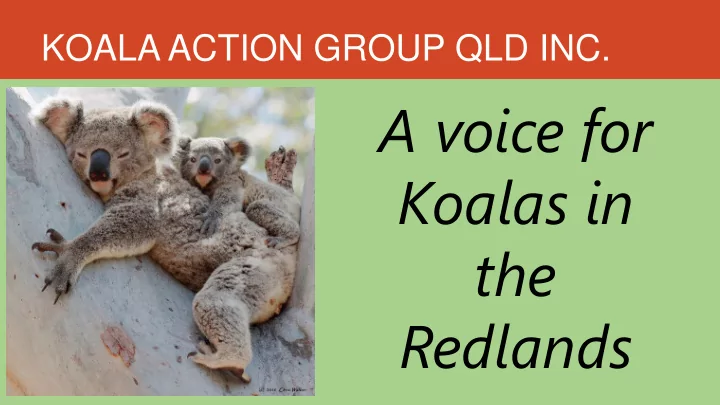
A voice for Koalas in the Redlands OUR MISSION STATEMENT To - - PowerPoint PPT Presentation

a voice for koalas in
SMART_READER_LITE
LIVE PREVIEW

A voice for Koalas in the Redlands OUR MISSION STATEMENT To - - PowerPoint PPT Presentation

KOALA ACTION GROUP QLD INC. A voice for Koalas in the Redlands OUR MISSION STATEMENT To Secure the future for Koalas in the Redlands Revegetation Education Legislation Revegetation Planted more than 100,000 trees


slide-1
SLIDE 1

KOALA ACTION GROUP QLD INC.

A voice for Koalas in the Redlands

slide-2
SLIDE 2

OUR MISSION STATEMENT

“To Secure the future for Koalas in the Redlands”

  • Revegetation
  • Education
  • Legislation
slide-3
SLIDE 3

Revegetation

  • Planted more than 100,000 trees
  • Work under the Redland City Council Bushcare Program
  • Focus on areas along watercourses and creek lines
  • Plant five native species to one eucalyptus tree
slide-4
SLIDE 4

Education

  • Community
  • Schools
  • Decision makers
slide-5
SLIDE 5

Legislation

Working with all levels of government to improve planning legislation and environmental polices

slide-6
SLIDE 6

Key Threats

  • Habitat Loss
  • Disease
  • Dogs
  • Vehicle Strikes
slide-7
SLIDE 7

Annual Koala Count-a-thon

  • Annual event for past 30

years

  • Raises awareness

through media

  • Involves community
  • Provides data and

information on koala location

slide-8
SLIDE 8

T

  • ondah GPS Tracking Project

TOONDAH HARBOUR PRECINCT, CLEVELAND

  • 10,000 people proposed for residential development in Moreton

Bay Marine Park

  • A colony of healthy breeding koalas under threat
  • Robust scientific data required to gain information
  • Koalas are being fitted with GPS tracking koalas
  • Automatic downloads twice per day showing movement and

usage of habitat trees

slide-9
SLIDE 9

Project Participants

Tyler Mia Kasey Airlie Saxon Hollie & Violet Scout Ethan

slide-10
SLIDE 10

Project Aims

  • Monitoring koala movements (how far they

travel and which roads they cross)

  • Identify key habitat trees
  • Ongoing monitoring through a breeding

season and non-breeding season (12 months)

  • Document breeding success and longer-

term health status

  • Achieve better outcomes for habitat

protection on future development sites

  • Create awareness in the community and

visitors to the area

  • Provide data to Council staff and other

interested parties

slide-11
SLIDE 11

LX Collars and anklets

  • Specifically designed for koalas to

be low profile and safe

  • Rapid detection of death / serious

illness or injury

  • 12 hourly uploads on LX website

displaying koalas location and movement patterns

  • Centralised database enabling

EVE and KAG to update and access data including vet checks

slide-12
SLIDE 12

KAG’s role

  • Locating koalas when needed for capture
  • Transportation of koalas
  • Weekly manual tracking to monitor health

and collect data in the field

  • Sharing information and involving

community

slide-13
SLIDE 13

Data collected

slide-14
SLIDE 14

What have we found so far?

  • Key trees in the area play an

important role for the colony of koalas, in particular a large Blue gum (Eucalyptus Tereticornis) in the garden

  • f

a townhouse complex in Shore Street East.

  • The tree appears to play a role

socially and as a nursery with up to 4 koalas seen at times.

  • Usually a mixture of juveniles and

adult females sighted in the tree.

slide-15
SLIDE 15
  • Tyler, the alpha male travels the greatest distance from the

Redland Water/Redland Trade College grounds in Middle Street across to Linear Park near Raby Bay

  • He also has an ability to detect when we have released a

koala back after a collar fitting and/or health check even though he is some distance away

  • The koala have quite different personalities, some more

adventurous than others

  • Juvenile ‘Ethan’ has surprised us by staying for weeks at a

time in the family tree

  • Koalas are surprisingly clever at hiding and sometimes

tracking them to an exact location is quite a challenge and at times we’ve had to give up

  • Juvenile ‘Saxon’ regularly goes back to exactly the same

spot tucked away in thick vegetation

slide-16
SLIDE 16

Tree species being used

  • Qld Blue Gum
  • Tallowwood
  • Spotted Gum
  • Flooded Gum
  • Moreton Bay

Ash

  • Grey Ironbark
  • Paperbark
  • Moreton Bay Fig
  • She-oak
  • Tuckaroo
  • Brown Plum Pine
  • Golden Shower

Tree

  • Camphor Laurel
  • Mango
  • Cadaghi
  • African Tulip
  • Umbrella Tree
  • Broad Leaf Pepper

Tree

slide-17
SLIDE 17

Movement & Home Range Mapping

Tyler (4 year old)

slide-18
SLIDE 18

Mia (5.5 years old) and Kasey (3)

slide-19
SLIDE 19

Scout (3.5 years) and Saxon (18 month juvenile) Airlie (6.5 years old)

Ethan (2 years old)

slide-20
SLIDE 20

Hollie (2.5 years) Violet (1)

  • Home range is the out of the Toondah precinct in

the north end of Nandeebie Park

  • Her young Violet separated a few months ago is

usually found in nearby tree

slide-21
SLIDE 21
slide-22
SLIDE 22

Current status of the Koala

  • Koala Coast region has declined by approximately 80%
  • It was once considered the most significant koala

populations in Australia living in close proximity to a major city

  • In the past 20 years koala numbers have declined from

more than 6000 to around 1000

  • In 2012, the Commonwealth Government listed the

koala as ‘vulnerable’ in Queensland under the Environment Protection and Biodiversity Conservation Act 1999 (Commonwealth)

  • The AKF estimates there are between 45,000 and

85,000 koalas left in Australia

  • The government claim there are about 400,000
slide-23
SLIDE 23

A future?

  • A Koala Protection Act needs to be

implemented urgently

  • Would have same principles as the

Bald Eagle Act in the USA

  • Do not touch the animal, do not

touch their habitat

  • Political will is needed for this to
  • ccur
slide-24
SLIDE 24

Thank you to all supporters who have made the tracking project possible by donating money and volunteering time. We appreciate funding received from Redland City Council Community Grants, Councillors Wendy Boglary and Murray Elliott through the Councillors’ Small Grant and the State Government through the Qld Gambling Community Benefit Fund.