A TE TECHN CHNOLOGY ROA ROADMA MAP TO TOWARDS MI MINE NERAL EXPL - - PowerPoint PPT Presentation

a te techn chnology roa roadma map to towards mi mine
SMART_READER_LITE
LIVE PREVIEW

A TE TECHN CHNOLOGY ROA ROADMA MAP TO TOWARDS MI MINE NERAL EXPL - - PowerPoint PPT Presentation

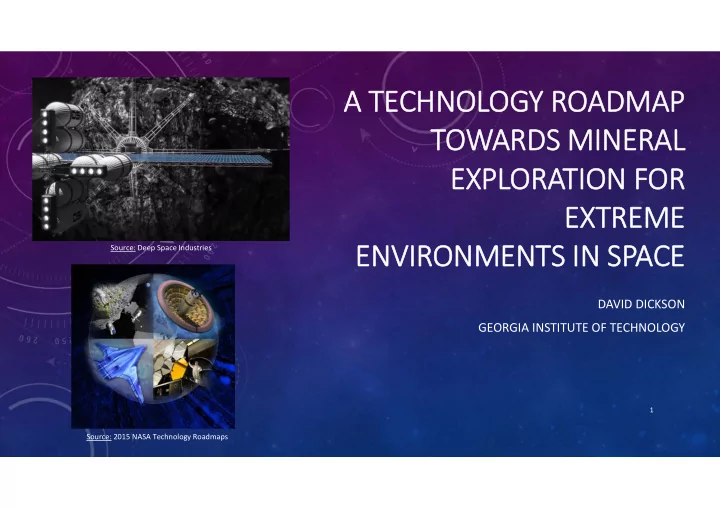
A TE TECHN CHNOLOGY ROA ROADMA MAP TO TOWARDS MI MINE NERAL EXPL EXPLORA ORATION ION FO FOR EXTREM EXTREME ENVIR ENVIRONM NMENT ENTS IN IN SP SPACE Source: Deep Space Industries DAVID DICKSON GEORGIA INSTITUTE OF TECHNOLOGY 1 Source:


slide-1
SLIDE 1

A TE TECHN CHNOLOGY ROA ROADMA MAP TO TOWARDS MI MINE NERAL EXPL EXPLORA ORATION ION FO FOR EXTREM EXTREME ENVIR ENVIRONM NMENT ENTS IN IN SP SPACE

DAVID DICKSON GEORGIA INSTITUTE OF TECHNOLOGY

Source: Deep Space Industries Source: 2015 NASA Technology Roadmaps

1

slide-2
SLIDE 2

WHAT DO WE MEAN BY A SPACE MINING TECHNOLOGY ROADMAP?

  • What is a “technology roadmap” (TR)?
  • The 2015 NASA Technology Roadmap is a good archetype.
  • According to the 2015 NASA Technology Roadmaps, the TR links a needed mission capability to a

Strategic Technology Investment Plan (STIP)

  • A needed mission capability is derived from the mission goal—in this case, mineral exploration.
  • The STIP prioritizes technology candidates and provides guiding principles for technology investment.
  • The TR accomplishes this linking by laying out a schedule and deliverables for
  • New technological capabilities
  • Building on already‐proven technological capabilities.
  • These capabilities are laid out in specified categories in the 2015 TR.
  • Specific areas
  • Cross‐cutting technologies
  • In 15 separate areas

Source: 2015 NASA Technolgy Roadmaps

2

slide-3
SLIDE 3

WHERE DOES THE NASA TECHNOLOGY ROADMAP ADDRESS ASTEROID MINING TECHNOLOGY NEEDS?

  • Short answer — It doesn’t. (Not explicitly, at least.)
  • Why not?
  • The FY 2014 NASA Strategic Plan gives some insight.
  • There are 3 strategic objectives.
  • Expand the frontiers of knowledge, capability, and opportunity in space.
  • Advance understanding of Earth and develop technologies to improve

the quality of life on our home planet.

  • Serve the American public and accomplish our Mission by effectively

managing our people, technical capabilities, and infrastructure.

  • Objective #2 is the only one where asteroid mining (and mining writ large) is

mentioned.

  • It is referred to in the context of commercial ventures—in other words, it is

regarded as a strategic objective that will be set and pursued in the private sector.

Source: 2014 NASA Strategic Plan

3

slide-4
SLIDE 4

TO ADDRESS ASTEROID MINING TECHNOLOGY NEEDS, THE CURRENT ROADMAP COMPRISES MUCH OF THE ENABLING TECHNOLOGY

  • Much of the technology needs of space mining and those from the NASA Technology Roadmaps coincide.
  • The same enabling technologies further both NASA’s strategic objectives and those of potential asteroid mining

concerns.

  • Particularly in the areas of:

TA 2: In‐Space Propulsion TA 3: Space Power and Energy Storage TA 4: Robotics and Autonomous Systems TA 7.1: In‐Situ Resource Utilization TA 11: Modeling, Simulation, Information Technology, and Processing TA 12: Materials, Structures, Mechanical Systems, and Manufacturing TA 14: Thermal Management Systems

4

slide-5
SLIDE 5

WHERE WOULD THE DIRECT TECHNOLOGY NEEDS FOR ASTEROID MINING BE ADDRESSED?

  • The area of the Technology Roadmap that comes closest (though not quite there) to directly addressing

the needs of asteroid mining is that of Reconnaissance, Prospecting, and Mapping (TA 7.1.1), Resource Acquisition (TA 7.1.2) and Processing and Production (TA 7.1.3).

  • For brevity, the rest of this presentation will largely focus on the technology needs for TA 7.1.1.
  • Currently, the following are subareas of 7.1.1 that are cited as technology advancement candidates for

prospecting:

  • Penetrometers, Shear Gauges, Compaction, Density Instruments
  • Flow Instruments
  • Drill Embedded Chemical Instrument – Laser Induced Breakdown Spectroscopy
  • Drill Embedded Chemical Instrument – Neutron Spectrometer
  • Drill Embedded Physical Instruments (Resistivity, Thermal, Shear, etc.)
  • Sensor to Measure Blowing Rate of Material During Landing
  • Instruments to Measure Chemical Compositions

5

slide-6
SLIDE 6

WHAT ARE WE MISSING HERE?

  • New exploration methods!
  • Both
  • Methods applicable to space mining in and of themselves, and
  • Methods being developed for advanced terrestrial mining that may be

adaptable for space/microgravity/extreme environment adaptations

6

slide-7
SLIDE 7

SOME VALUABLE PRIVATE‐SECTOR SOURCES

Source: Space Studies Program, ASTRA: Asteroid Mining, Technologies Roadmap, and Applications, Strasbourg, France: International Space University, 2010 Source: CSIRO Futures, METS: A Roadmap for Unlocking Future Growth Opportunities for Australia, Canberra, Australia, May 2017

7

Three major new terrestrial mining technology areas:

  • Exploration Under

Cover

  • Data‐driven mining

decisions

  • Robotics and

automation

slide-8
SLIDE 8

FRAMING THE PROBLEM IN MISSION FORM

  • The ASTRA Report completed a SWOT (Strengths,

Weaknesses, Opportunities, and Threats) trade study which made recommendations for the first attempted asteroid mining mission.

  • Their specific recommendation was for a short‐term,

fully autonomous, large‐asteroid mining mission described as follows:

“Architecture L3: This unmanned architecture requires robotic assembly of multiple vehicles launched to LEO. The assembled spacecraft travels to the asteroid. The setup of mining equipment, the mining itself, and the processing of the mined materials is all performed robotically. The delivery of extracted materials to Earth follows.”

8

Source: Space Studies Program, ASTRA: Asteroid Mining, Technologies Roadmap, and Applications, Strasbourg, France: International Space University, 2010, pg. 30

slide-9
SLIDE 9

EXPLORATION UNDER COVER

  • Terrestrial roadmap needs (METS Report, pg. 53):
  • Directional drilling
  • First principles mineral system/orebody formation
  • 3D seismic exploration
  • Deposit modeling that build on existing characterization datasets
  • 4D geodynamic maps

9

  • Adaptation for space mining:
  • Adapt for low gravity (anchoring, etc.)1
  • Adapt for icy rock/regolith/low temperatures2
  • Surface gravimetric surveying3
  • Shock heating and freezing4
  • Data analytics (see next slide)
  • Additions/modifications to NASA 2015 Technology Roadmap:
  • Mostly additions to TR 7.1.1
  • Exploration methods largely constitute a set of “more novel” technology candidates when asteroid mining is the goal.
slide-10
SLIDE 10

DATA‐DRIVEN MINING DECISIONS

10

  • Terrestrial roadmap needs (METS

Report, pg. 29):

  • Integrated sensors
  • Sensor durability to high/low

temperatures

  • Self‐powering sensors
  • Wireless connectivity of in‐situ

remote sensors

  • Embedded sensors
  • Advanced user interfaces
  • Advanced visualization
  • Improved mathematical models
  • Cyber security
  • Adaptation for space mining:
  • Radiation and low‐temperature hardening of sensors for space applications
  • Exploration studies needed to feed datasets, similar to parallel work done for Mars data‐driven

prospecting5

  • Additions/modifications to NASA 2015 Technology Roadmap:
  • More elaboration of TR 8.3.3 with regard to hardening of in‐situ sensors
  • More elaboration of TR 11.2.4 (Geological Modeling), 11.4.2 (Intelligent Data Understanding), and 11.4.8

(Cyber Security)

slide-11
SLIDE 11

ROBOTICS AND AUTOMATION

11

  • Terrestrial roadmap needs (METS

Report, pg. 60):

  • Machine vision
  • Advancer materials and additive

manufacturing

  • Miniaturization of batteries
  • Dexterous end effectors
  • Improved computational ability

(integration of sensors, big data, self‐ calibration)

  • Swarm robotics
  • Distributed control
  • Virtual and augmented reality
  • Haptic commands
  • Adaptation for space mining:
  • This is largely identical to the needs expressed in NASA TR 4, with the exception of radiation and low‐

temperature hardening.

  • One possible addition: Self‐replicating robotic system for bootstrapping.6
  • Additions/modifications to NASA 2015 Technology Roadmap:
  • For the latter adaptation, I recommend an entirely new sub‐roadmap (TR 4.8—Self‐replication

architecture)

slide-12
SLIDE 12

CUSTOMERS FOR AN ASTEROID MINING SPACE TECHNOLOGY ROADMAP

  • Government space agencies
  • Companies
  • Professional organizations
  • Privately‐funded ventures
  • Anyone with an acute interest in accelerating reduction of the long‐term cost of investment in off‐Earth

mining, particularly asteroids

  • Although the NASA TR remains the gold standard of space technology

roadmaps, additional guidance for exploration and prospecting technology for asteroids may be found in terrestrial mining roadmaps.

  • Coming cutting‐edge terrestrial mining exploration and prospecting

techniques, modified for space, may be the key input needed for industry partners to plan technology investments for the coming space “gold rush.”

12

slide-13
SLIDE 13

EPILOGUE: ISRU AND INVESTMENT RETURN

  • One last point, again from the ASTRA report:
  • “As this venture would likely require significant levels of investment for startup and research and

development costs, the project is not currently financially viable.” (ASTRA report, pg. 52)

  • “The most influential value driver is the mass return ratio. Doubling the ratio from one to two increases

the value of the enterprise more than tenfold. Table 10‐2 below illustrates this changing of variable.” (Ibid)

  • “In order to come closer to making asteroid mining a financially viable venture, we strongly recommend

that engineering efforts be focused on maximizing the mass return ratio.”

13

Source: Space Studies Program, ASTRA: Asteroid Mining, Technologies Roadmap, and Applications, Strasbourg, France: International Space University, 2010, pg. 52

(italics and boldface mine)

slide-14
SLIDE 14

REFERENCES

1 Gertsch, L., et al., “Adaptation of Mining Methods for Low‐ and Micro‐gravity Environments: Part 1”,

Space Resources Roundtable Proceedings, 2013.

2 James G. Mantovani, Laurent Sibille, et. al., “Excavation and Volatile Analysis in Icy Asteroid Simulant”,

Space Resources Roundtable Proceedings, 2016.

3 K. Carroll, et. al., “Asteroid Mineral Prospecting via Surface Gravimetric Surveying”, Space Resources

Roundtable Proceedings, 2016.

4 Saydam S;Nguyen P, 2015, 'Applicability of shock heating and freezing on regolith found on asteroids for

exploration drilling', MEA Journal of Research Projects Review 2015, vol. 4, pp. 21 ‐ 26, http://www.mea.edu.au/

5 Sibille, L., et al. “Modeling Tool for Off‐Earth Mining Optimization and Resource Processing Based on

Geological Contexts”, Space Resources Roundtable Proceedings, 2017.

6 Mueller, R., et. al., “Affordable, Rapid Bootstrapping of Space Industry and Solar System Civilization”,

Space Resources Roundtable Proceedings, 2012.

14