A question-answer distance measure to investigate QA system progress - - PowerPoint PPT Presentation

a question answer distance measure to investigate qa
SMART_READER_LITE
LIVE PREVIEW

A question-answer distance measure to investigate QA system progress - - PowerPoint PPT Presentation

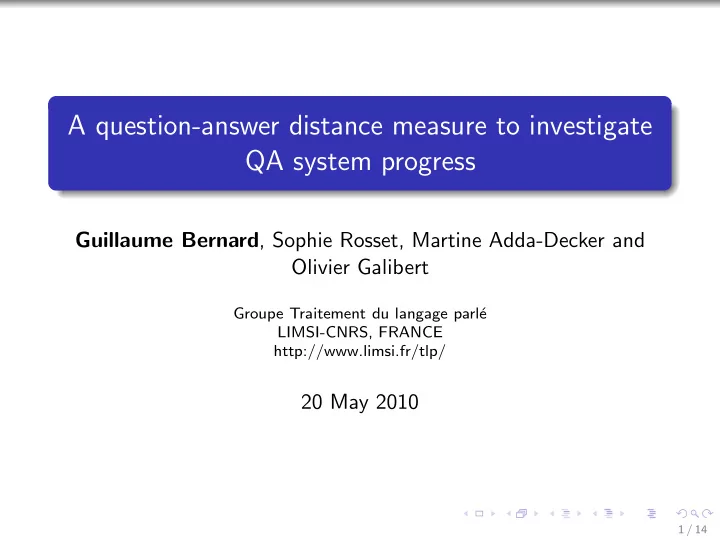
A question-answer distance measure to investigate QA system progress Guillaume Bernard , Sophie Rosset, Martine Adda-Decker and Olivier Galibert Groupe Traitement du langage parl e LIMSI-CNRS, FRANCE http://www.limsi.fr/tlp/ 20 May 2010 1


slide-1
SLIDE 1

A question-answer distance measure to investigate QA system progress

Guillaume Bernard, Sophie Rosset, Martine Adda-Decker and Olivier Galibert

Groupe Traitement du langage parl´ e LIMSI-CNRS, FRANCE http://www.limsi.fr/tlp/

20 May 2010

1 / 14

slide-2
SLIDE 2

Introduction

Questions-answering (QA) systems Provide precise answers to the user questions Search the answer through a corpus of documents Example Question: Besides France and Germany, where have we seen case of mad-cows disease ? Answer: In Belgium Importance of evaluating the evolution of such systems Evaluation campaigns: TREC, QA@CLEF, QAst ...

2 / 14

slide-3
SLIDE 3

Introduction

Evaluation campaigns on questions-answering systems Documents come from various origins: newspaper, meetings transcriptions ... Question corpus

Questions built by evaluators using the document corpus

Measure the progress in QA domain Issue addressed Can we compare a QA system on successives evaluation campaigns? → Assessing the evolution of the evaluation criteria Context of the work QAst: Questions-Answering on Speech Transcriptions

3 / 14

slide-4
SLIDE 4

Introduction

The QAst evaluation campaign Evaluate systems on speech transcriptions Three different languages: French, English and Spanish QAst 2009: a new building procedure for the questions

4 / 14

slide-5
SLIDE 5

Introduction

A new question corpus building procedure 2008: questions created from the documents 2009: more “spontaneous” questions provided by naive users:

Use of excerpts of document

Ask questions on information related to these excerpts

Example Text fragment:Jacques Chirac is the previous President of France. 2008 question:Who is the previous President of France ? 2009 question:What is the age of Jacques Chirac ? Question Does this questions building methodology changes the evaluating features of the QAst campaign ?

Observation of the impact on the results of the QA systems: comparison between 2008 and 2009 results

5 / 14

slide-6
SLIDE 6

Observations on QAst 2008 and 2009 results

Results on LIMSI system French English Spanish Acc(%) ∆ Acc(%) ∆ Acc(%) ∆ QAst 2008 50

  • 22

52

  • 25

56

  • 20

QAst 2009 28 27 36 Results for the other participants

System English Acc(%) ∆ INAOE 2008 33%

  • 5

INAOE 2009 28% UPC 2008 34%

  • 13

UPC 2009 21%

6 / 14

slide-7
SLIDE 7

Observations on QAst 2008 and 2009 results

Observations Strong decrease between 2008 and 2009 Hypothesis for the loss Influence of the way the questions were built

Greater distance between the text fragment used to create the question and the answer

Example Text fragment:Jacques Chirac is the previous President of France. 2008 question:Who is the previous President of France ? 2009 question:What is the age of Jacques Chirac ? Idea Quantifying the influence of the new building procedure

7 / 14

slide-8
SLIDE 8

A measure for the question corpus

Aim of the measure Evaluation of the distance between the elements of each question of a corpus and the corresponding answers

Question elements considered: named entities and multi-words expressions

Gives two values: the average distance and the standard deviation Computing of a global distance for each question Distance evaluated in words Average of distances between the elements of the question found in the document and the answer

8 / 14

slide-9
SLIDE 9

A measure for the question corpus

Example

9 / 14

slide-10
SLIDE 10

A measure for the question corpus

Example

9 / 14

slide-11
SLIDE 11

A measure for the question corpus

Example

9 / 14

slide-12
SLIDE 12

A measure for the question corpus

Example

9 / 14

slide-13
SLIDE 13

A measure for the question corpus

Example Global distance of the question: Average(10+2+1) = 4

9 / 14

slide-14
SLIDE 14

Results: average distance and standard deviation

Evolution of the Average Distance and Standard Deviation French English Spanish AD SD ∆ AD SD ∆ AD SD ∆ 2008 45 100 +98 97 284 +39 381 851

  • 359

2009 143 431 136 310 22 73 Strong increase on French and English, but also a very strong decrease on Spanish

New building procedure does not always imply an increase of the distance The corpora have not the same features for 2008 and 2009

High Standard Deviation: strong distance variations in corpus

10 / 14

slide-15
SLIDE 15

Focus on question distances

Average distance values - 2008 and 2009 test corpus X axis: distance classes (DC); Y axis: #questions in DC Evolution of the question corpus between 2008 and 2009 Strong dispersion for the three languages

11 / 14

slide-16
SLIDE 16

Discussion

Correlation with evaluation campaign results Segmentation of the documents by the QA systems

Use a window size fixed by tuning on the 2008 corpus

In 2009, the snippets are either too small (French, English) or too big (Spanish)

→ Potential explanation for the strong loss Usability for futures evaluations Measure based on our representation of the elements of a question

Can be generalized on other systems using different representations (e.g. keywords)

Measure can be used as a control parameter criterion for building question corpus

Allow to evaluate the features of a campaign

12 / 14

slide-17
SLIDE 17

Conclusions and perspectives

Conclusions Huge performance loss between QAst 2008 and 2009 evaluations

New building procedure for the question corpus of 2009

Application of a measure based on a distance between the elements of the question and the answer

Strong variations between the two instances of the QAst campaign

The strong variations can potentially explain the bad results

  • f the QA systems

The measure can control for variations between two instances

  • f a campaign

Perspectives Complementary measures

Referential expressions Language-specific features

13 / 14

slide-18
SLIDE 18

Questions

Thank you for listening ! Any questions ?

14 / 14