A Quantum Mechanical Description of the Laws of Relativity - - PowerPoint PPT Presentation

a quantum mechanical description of the laws of relativity
SMART_READER_LITE
LIVE PREVIEW

A Quantum Mechanical Description of the Laws of Relativity - - PowerPoint PPT Presentation

QSCP XIII 2008 East Lansing A Quantum Mechanical Description of the Laws of Relativity General formulation of Q.M. f Resonances Emergence of Jordan blocks Complex Systems r ODLRO b Coherent Dissipative


slide-1
SLIDE 1

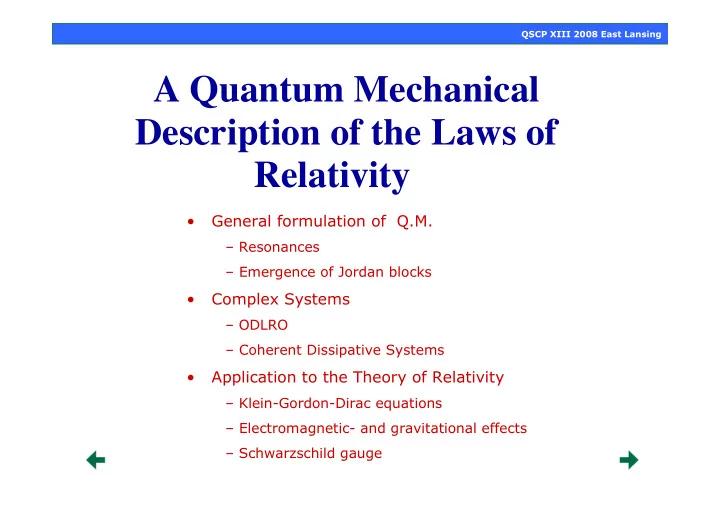
A Quantum Mechanical Description of the Laws of Relativity

  • General formulation of Q.M.

– Resonances – Emergence of Jordan blocks

  • Complex Systems

– ODLRO – Coherent Dissipative Systems

  • Application to the Theory of Relativity

– Klein-Gordon-Dirac equations – Electromagnetic- and gravitational effects – Schwarzschild gauge

f ö r b i l d

QSCP XIII 2008 East Lansing

slide-2
SLIDE 2

Dilatation Analytic Scaling

Balslev-Combes, Commun. Math. Phys 22 (1971) 280-294

f ö r b i l d

QSCP XIII 2008 East Lansing

D (H) = F Œ H , HF Œ H

{ }

U(J )= exp(iAJ ) A= 1

2

r p

k

r x

k + r

x

k

r p

k

[ ]

k=1 k=N

Â

slide-3
SLIDE 3

U is a unitary one-parameter dilation group realizing the scaling below. Continuing q to complex values defines under certain conditions a dilatation analytic family of operators subject to the B-C theorem

f ö r b i l d

QSCP XIII 2008 East Lansing

H ÆUHU-1 = H(J ) U(J )F(x1,...,xN )= exp(iAJ )F(x1,...,xN ) = exp( 3N

2 J )F(eJ x1,...,eJ xN )

slide-4
SLIDE 4

Assuming that the interaction is a sum of two-body ∆-compact operators and T the kinetic energy operator then H below has a compact analytic extension to the complex plane Ω. The B-C theorem concerns the spectrum of H

f ö r b i l d

QSCP XIII 2008 East Lansing

eJ Æ h = heiJ; U(J ) ÆU(iJ ) ÆU(h) H = T +V Æ H(h)+V(h) = h-2T +V(h) H(h)F(h) = eF(h); h Œ W

slide-5
SLIDE 5

QSCP XIII 2008 East Lansing

slide-6
SLIDE 6

QSCP XIII 2008 East Lansing

slide-7
SLIDE 7

QSCP XIII 2008 East Lansing

slide-8
SLIDE 8
  • Här är plats för den första

punkten

  • Här finns plats för den

andra

  • Och den tredje osv.

Plats för bild

QSCP XIII 2008 East Lansing

slide-9
SLIDE 9

Complex symmetric interaction

  • Analytic continuation of quantum mechanics
  • Complex scaling of unitary dilation group
  • Extended Hamiltonian spectrum
  • Dynamics - time evolution

bild

QSCP XIII 2008 East Lansing

j * r

( )

Ú

W r

( )f r ( )dr =

j * r'*

( )

Ú

W r'

( )f r' ( )dr'

r = r

1,r2,...rN; r'= h3Nr; h = eiq; J £ p /2

slide-10
SLIDE 10

possible? always mation transfor similarity this Is ) ( E ) ( E ) ( H ) ( H ) ( H ) ( H ) ( *) ( in analytic elements matrix ) ( H *) (

2 1 22 21 12 11

˜ ˜ ¯ ˆ Á Á Ë Ê Æ ˜ ˜ ¯ ˆ Á Á Ë Ê = Y Y Y Y a a a a a a a a a a a

ij j i j i

d

QSCP XIII 2008 East Lansing

slide-11
SLIDE 11

Example : H12 = H21 = iu; u Œ ¬; H11

  • iu
  • iu

H22 Ê Ê Ë Ë Á Á ˆ ˆ ¯ ¯ ˜ ˜ Æ E 2u E Ê Ê Ë Ë Á Á ˆ ˆ ¯ ¯ ˜ ˜ With degenerate eigenvalues l± = 1

2 (H11 + H22)±

(H11 - H22)2 - 4u2 = l+ = l- = 1

2 (H11 + H22) = H11 ±u = E

if H22 = H11 ± 2u

  • 1. Crossing rule. 2. Eigenvalue real. 3. Appearance of unphysical solutions

CMMSE 200 CMMSE 2008 Murcia 8 Murcia QSCP XIII 2008 East Lansing

slide-12
SLIDE 12

Coulomb Reconstruction

QSCP XIII 2008 East Lansing

slide-13
SLIDE 13

Q = B-1JB; Qkl = (dkl - 1

m)e i p m (k+l-2)

; k,l = 1,2...m J = 1 . 1 . . . . . . 0. . . . . 1. . . Ê Ê Ë Ë Á Á Á Á Á Á Á Á Á Á Á Á ˆ ˆ ¯ ¯ ˜ ˜ ˜ ˜ ˜ ˜ ˜ ˜ ˜ ˜ ˜ ˜ ; h Q h = h B-1QB h = f J f = fk fk+1

k=1 m-1

Â

Unitary transformation between the real and the complex symmetric form

QSCP XIII 2008 East Lansing

slide-14
SLIDE 14

B = 1 m 1 w w 2 . w m-1 1 w 3 w6 . w 3(m-1) . . . . . . . . . . 1 w 2m-1 w 2(2m-1) . w(m-1)(2m-1) Ê Ê Ë Ë Á Á Á Á Á Á Á Á Á Á Á Á ˆ ˆ ¯ ¯ ˜ ˜ ˜ ˜ ˜ ˜ ˜ ˜ ˜ ˜ ˜ ˜ ; w = e

ip m

h = h1,h2 ,...hm h B = g = g1,g2,...gm h B-1 = f = f1, f2,...fm

QSCP XIII 2008 East Lansing

slide-15
SLIDE 15

Q

kl

r = (dkl - (Rr )kl )e i pr m (k+l-2)

; k,l = 1,2...m; r £ m (Rr)kl = 1 m sin( pr(l-k)

m

) sin( p (l-k)

m

) k ≠l r m k = l Ï Ï Ì Ì Ô Ô Ô Ô Ó Ó Ô Ô Ô Ô .

CMMSE 2008 Murcia QSCP XIII 2008 East Lansing

slide-16
SLIDE 16

QUANTUM TECHNOLOGY

Application Area Mechanism/Technique

Condensed Matter Broken Symmetry Superconductivity SC ODLRO Quantum Hall Effect Topology High Temperature SC Quantum Statistics Superfluidity Gauge Symmetry SQUID Josephson Effect

QSCP XIII 2008 East Lansing

slide-17
SLIDE 17

ih ∂r(t) ∂t = ˆ L r(t) ˆ P r = Ar + Br; exp( ˆ P ) = e Ar e B ˆ P = -i ˆ L t; A = -iHt = B†

Liouville von Neuman Equation: Bloch equation

  • ∂r

∂b = ˆ L

B

ˆ P = - b

2 ˆ

L

B; A = - b 2 H = B

QSCP XIII 2008 East Lansing

slide-18
SLIDE 18

G = Y (x1...xN Y (x1...xN ; Tr{G} =1; G 2 = G = G † G (p)(x1...xp x1

'...xp ' ) =

N p Ê Ê Ë Ë Á Á ˆ ˆ ¯ ¯ ˜ ˜ Y *

Ú

(x1..xp,xp+1..xN )Y (x1

'..xp ' ,xp+1..xN )dxp+1...dxN

Tr{G (p)} = N p Ê Ê Ë Ë Á Á ˆ ˆ ¯ ¯ ˜ ˜ ;

QSCP XIII 2008 East Lansing

slide-19
SLIDE 19

B = 1 m 1 w w 2 . w m-1 1 w 3 w6 . w 3(m-1) . . . . . . . . . . 1 w 2m-1 w 2(2m-1) . w(m-1)(2m-1) Ê Ê Ë Ë Á Á Á Á Á Á Á Á Á Á Á Á ˆ ˆ ¯ ¯ ˜ ˜ ˜ ˜ ˜ ˜ ˜ ˜ ˜ ˜ ˜ ˜ ; w = e

ip m

h = h1,h2 ,...hm h B = g = g1,g2,...gm h B-1 = f = f1, f2,...fm

QSCP XIII 2008 East Lansing

slide-20
SLIDE 20

Coleman’s Extreme State for the Antisymmetrised geminal power gN/2 for N particles, m=2s, where i=1,2..s correspond to a-spin and i+s to b-spin:

QSCP XIII 2008 East Lansing

g1 = 1 m hk

k=1 k=m

Â

; hk = 1 2 fi Ÿfi+s Y = [SN /2 ]-1gŸ gŸ...= g N /2 Theorem: The geminal g is an eigenfunction of G(2)(gN/2) with a nonvanishing eigenvalue if and only if g is of extreme type, e.i. The eigenvalues of G(1)(g) are all equal

slide-21
SLIDE 21

G (2) = lL g1 g1 + lS gk

k=2 m

Â

gk = GL

(2) + GS (2)

lL = N

2 - (m - 1)lS; m Æ •; lL Æ N 2 lS = N 2m (N -2) (2m-1) ; m Æ • lS Æ 0

m ≥ N

2 ; E = Tr H1 G (1)}

{

+ Tr H12 G (2)}

{

If m = N 2 ; lL = lS = 1. (independent particles)

The Extreme Case

and the emergence of ODLRO Off-Diagonal Long-Range Order

QSCP XIII 2008 East Lansing

slide-22
SLIDE 22

GS

(2) µ

hk (dkl - 1 m)

l=1 m

Â

hl

k=1 m

Â

= gk

k=2 m

Â

gk e-b LBGS

(2) µ

hk eib 1

2(ek +el )(dkl - 1

m)

l=1 m

Â

hl

k=1 m

Â

remember Qkl = (dkl - 1

m )e i p m (k+l-2)

; e-b LBGS

(2) µ

fk fk+1

k=1 m-1

Â

if bel = 2p l

m ; l = 1,2....m; ( where b = 1 kT and el = h 2t l )

Requesting the precise relations between the temperature, b, the life time and the dimension of the Jordan block the thermalized matrix becomes proportional to the complex symmetric matrix Q similar to J

QSCP XIII 2008 East Lansing

slide-23
SLIDE 23

Propagator : e

  • i ˆ

P t t ; ˆ

P = (w0t -i) ˆ I + ˆ J ˆ J = h Q h = h B-1QB h = f J f = fk fk+1

k=1 m-1

Â

ˆ T = ˆ J t generates a polynomial evolution e

J t t =

it t Ê Ê Ë Ë Á Á ˆ ˆ ¯ ¯ ˜ ˜

k=0 m-1

Â

k

1 k! ˆ J k

Consequences

QSCP XIII 2008 East Lansing

slide-24
SLIDE 24

Propagator ‹ Fourier transform fi fi Resolvent exp(-i ˆ P t t ) ´(wt ˆ I - ˆ P )-1 (wt ˆ I - ˆ P )-1 = (w -w0)t + i

( )

k=0 m

Â

  • k

ˆ J k-1 Power factor ‹ Fourier transform fi fi Higher order poles

QSCP XIII 2008 East Lansing

slide-25
SLIDE 25

dN = - 1 t N(t)dt; N(t) = e

  • t

t

Exponential decay rule

dN = t m-2(m- 1- 1 t )N(t)dt; N(t) = t m-1e

  • t

t .

General rule Note that dN(t)>0 if t<(m-1)t

QSCP XIII 2008 East Lansing

slide-26
SLIDE 26

QSCP XIII 2008 East Lansing

slide-27
SLIDE 27

QSCP XIII 2008 East Lansing

slide-28
SLIDE 28

QUANTUM TECHNOLOGY

Application Area Mechanism/Technique

Coherent Dissipative Quantum-Thermal Systems Correlations Aqueous Solutions Grotthus Type Proton Transfer Self-Dissociation Polar Molecules FIR Molten Salts Ionic Conductance Protons and Muons in Metals Coherent Tunneling Polymers, Organic Molecules Quantum Diffusion

QSCP XIII 2008 East Lansing

slide-29
SLIDE 29

QSCP XIII 2008 East Lansing

slide-30
SLIDE 30

Applications of the Coherent - Dissipative Ensemble

Proton Transfer High TC Superconductivity Microscopic Selforganization

  • E. J. Brändas, in Dynamics During Spectroscopic Transitions,

Eds E. Lippert, J. D. Macomber, Springer, Berlin Chapters 6 & 7, (1995).

  • E. J. Brändas, Adv. Chem.Phys. 99, 211 (1997).
  • E. J. Brändas and B. Hessmo, Lecture Notes in Physics, 504, 359 (1998).
  • L. J. Dunne and E. J. Brändas, Int. J. Quant. Chem. 99, 798-804 (2004).
  • E. J. Brändas, Adv. Quant. Chem. 47, 93-106 (2004); 54, 115-132 (2008).

CMMSE 2008 Murcia QSCP XIII 2008 East Lansing

slide-31
SLIDE 31

Quote in ”Einstein Defiant”, by Edmund Blair Bolles, 2004:

Einstein granted that the (Dirac) equation was ”the most logically perfect presentation” of quantum mechanics yet found, but not that it got us any closer to the ”secret of the Old One”. It neither described the real world phenomena that he wanted to understand nor proposed new concepts that would make the real world accessible to understanding.

P l a t s ö r b i l d

QSCP XIII 2008 East Lansing

slide-32
SLIDE 32

It is well-known that the Klein-Gordon (and the Dirac-Coulomb) equation can be written formally as a simple self-adjoint secular problem.

för bild

QSCP XIII 2008 East Lansing

H = m0 n n

  • m0

Ê Ê Ë Ë Á Á ˆ ˆ ¯ ¯ ˜ ˜ ;

l

2 = m0 2 +n 2

l = m; n = p/c

Hence m2c4=m02c4+p2c2

slide-33
SLIDE 33

Alternatively one may obtain a “similar” result via a resonance state ansatz

  • Simple Klein-Gordon-like model
  • Complex symmetric interaction
  • Non-positive metric

Secular equation: för

bild

QSCP XIII 2008 East Lansing

H = m

  • in
  • in
  • m

Ê Ê Ë Ë Á Á ˆ ˆ ¯ ¯ ˜ ˜

l2 = m2 -n 2

slide-34
SLIDE 34

Non-positive definite metric

  • Particle in ”positive part”
  • Anti-particle in ”negative part”
  • Anti-hermitean operator

för bild

QSCP XIII 2008 East Lansing

H = H'D-1 = m

  • in
  • in
  • m

Ê Ê Ë Ë Á Á ˆ ˆ ¯ ¯ ˜ ˜ ; D = 1

  • 1

Ê Ê Ë Ë Á Á ˆ ˆ ¯ ¯ ˜ ˜

slide-35
SLIDE 35

Secular Equation;

  • Lambda is the eigenvalue
  • m is the energy in mass units
  • nu is the kinematical interaction

för bild

QSCP XIII 2008 East Lansing

n = p/c; l = m0; l± = ±m0 = ± m2 - p2 /c2 m2c4 = m0

2c4 + p2c2; m = m0 / 1- b2

b = p/mc = u/c

l2 = m2 -n 2

slide-36
SLIDE 36

l+ = m0; m0 = c1 m + c2 m l- = -m0; m

0 = -c2 m + c1 m

c1 =

1+ X 2X ; c2 = -i 1-X 2X ; c1 2 + c2 2 = 1

X = 1- b 2; b = p/mc = u/c

Solving the secular equation one obtains:

m = c1 m0 - c2 m m = c2 m0 + c1 m

QSCP XIII 2008 East Lansing

slide-37
SLIDE 37

mc2 Æ mc2 - iG /2; t = h/G m0c2 Æ m0c2 - iG0 /2; t 0 = h/G0 G0 = G 1- b2; t 0 = t 1- b2 .

  • I. Consequence of the resonance picture:

t t0 = t0 t fi fi t = t0 1- b

2

By comparing time measurements in the two scales, i.e.

QSCP XIII 2008 East Lansing

slide-38
SLIDE 38

l = l0 1- b 2 t = t0 1- b 2 m = m0 1- b 2

Enforcing Lorentz invariance:

QSCP XIII 2008 East Lansing

slide-39
SLIDE 39

(Eop - eA0)2 = m0

2c4 + (p - e c

r A )2c2

Introducing an electromagnetic field, where (A0,A) are the scalar and vector potentials

  • II. Consequence of the resonance picture:

Appearance of Jordan blocks

QSCP XIII 2008 East Lansing

slide-40
SLIDE 40

(Eop - eA0)2 = m0

2c4 + (p - e c

r A )2c2 ?

What about introducing a gravitational field

  • f·m·M/r?
  • Problem. Potential depends on the velocity

and hence force-, momentum- and energy laws are different.

QSCP XIII 2008 East Lansing

slide-41
SLIDE 41

“General Theory of Relativity” via our resonance state ansatz

  • V= -f·m·M/r: f=gravitational constant
  • m=gravitational mass, M=”very large mass”
  • r=distance from ”m” to ”M”

för bild

QSCP XIII 2008 East Lansing

H = m +V /c2

  • in
  • in
  • m -V /c2

Ê Ê Ë Ë Á Á ˆ ˆ ¯ ¯ ˜ ˜

slide-42
SLIDE 42

In a privileged system with center in “M” and analogously for the anti-system, we propose the following simple bi-orthogonal secular problem.

för bild

QSCP XIII 2008 East Lansing

H = m(1-k /r)

  • ip/c
  • ip/c
  • m(1-k /r)

Ê Ê Ë Ë Á Á ˆ ˆ ¯ ¯ ˜ ˜ ; k = f ⋅ M c

2

l

2 = m 2(1-k /r) 2 - p 2 /c 2

l = m0(1-k /r); n = p/c

slide-43
SLIDE 43

Secular Equation

för bild

QSCP XIII 2008 East Lansing

l± /(1-k /r) = ±m0 = ± m2 - p2 /(1-k /r)c2 m = m0 / 1- b'2; r > k b'= p/mc(1-k /r) = u/c(1-k /r)

l2 = m2(1-k /r)- p2 /c2 m0

2 = m2 - p2 /(1-k /r)c2

slide-44
SLIDE 44

l+ = m0; m0 = c1 m + c2 m l- = -m0; m

0 = -c2 m + c1 m

c1 =

1+ X 2X ; c2 = -i 1-X 2X ; c1 2 + c2 2 = 1

X = 1- b'2; b'= p/mc(1-kr) = u/c(1-kr)

Solving the secular equation as before one gets:

  • r

m = c1 m0 - c2 m m = c2 m0 + c1 m

QSCP XIII 2008 East Lansing

slide-45
SLIDE 45

b'= u c(1-k/r) = k r -k £ 1 b¢ = 1fi fi r = RLS = 2k

Note that for r=R=к, where к equals the classical gravitational radius, the classical force law breaks

  • down. This singularity is one half of the famous

Laplace-Schwarzschild solution RLS=2к From the law that the angular momentum for a system subject to central force is constant follows u/c= к/r and a singularity in the secular equation at r=RLS =2к !

QSCP XIII 2008 East Lansing

slide-46
SLIDE 46

Hdeg = 1 2 m

  • im
  • im
  • m

Ê Ê Ë Ë Á Á ˆ ˆ ¯ ¯ ˜ ˜ Æ Hdeg = 0 m Ê Ê Ë Ë Á Á ˆ ˆ ¯ ¯ ˜ ˜ 0 =

1 2 m - i 1 2 m

0 =

1 2 m + i 1 2 m

We obtain the relativistic restriction r ≥2к For r =RLS= 2к one obtains (note that either is m finite, m0=0 or m0 ≠0 and m infinite) The gravitational interaction creates a Jordan block!

QSCP XIII 2008 East Lansing

slide-47
SLIDE 47

Hdeg = m

  • im
  • im
  • m

Ê Ê Ë Ë Á Á ˆ ˆ ¯ ¯ ˜ ˜ Æ Hdeg = 0 2m Ê Ê Ë Ë Á Á ˆ ˆ ¯ ¯ ˜ ˜ 0 =

1 2 m - i 1 2 m

0 =

1 2 m + i 1 2 m

Consider the relativistic restriction p/m≤c An electromagnetic fluctuation can also generate a Jordan block!

QSCP XIII 2008 East Lansing

slide-48
SLIDE 48

Hdeg = 1

2

m

  • im
  • im
  • m

Ê Ê Ë Ë Á Á ˆ ˆ ¯ ¯ ˜ ˜ Æ Hdeg = 0 m Ê Ê Ë Ë Á Á ˆ ˆ ¯ ¯ ˜ ˜ H

deg = 1 2

m im im

  • m

Ê Ê Ë Ë Á Á ˆ ˆ ¯ ¯ ˜ ˜ Æ H

deg = 0

m Ê Ê Ë Ë Á Á ˆ ˆ ¯ ¯ ˜ ˜

  • III. Consequence of the resonance picture:

When two Jordan blocks “meet” we have the possibility of e-doubling!

QSCP XIII 2008 East Lansing

slide-49
SLIDE 49

(Eop - eA0 )2 = m0

2c4 + (p- e c

r A )2c2

IV: Consequence of the resonance picture: Note that particles with zero restmass is commen- surate with the degenerate case and therefore must interact “twice as much” with a gravitational field in order to be consistent with the singularity at RLS,

  • cf. The Einstein’s law of light deflection.

V: Consequence of the resonance picture: The Pauli principle

QSCP XIII 2008 East Lansing

slide-50
SLIDE 50

0 Ÿ 0 = i m0 Ÿ (-m0)

  • E. g. for a sudden onset of the degeneracy

condition, i.e. m=m0,we may verify that Or that the antisymmetrised product of the “vacuum” vectors is equal to the antisym- metrised product of the particle- and its anti-particle vectors and vice versa. “Pauli’s exclusion principle”.

QSCP XIII 2008 East Lansing

slide-51
SLIDE 51

g = 0 Ÿ 0 = i m0 Ÿ (-m0) Y = [SN /2]-1gŸgŸ...= gN /2

The many-body wavefunction, based on anti- symmetric particle-anti-particle pairs reads

  • V. Consequences of the resonance theory.

This leads to the development of the theory

  • f anti-symmetrised geminal powers, exhibi-

ting special density matrix characteristics.

QSCP XIII 2008 East Lansing

slide-52
SLIDE 52

The Dirac Equation as a hermitean matrix problem

QSCP XIII 2008 East Lansing

hD =

mc2 cs ⋅ p cs ⋅ p

  • mc2

Ê Ê Ë Ë Á Á Á Á ˆ ˆ ¯ ¯ ˜ ˜ ˜ ˜

s x = 0 1 1 Ê Ê Ë Ë Á Á ˆ ˆ ¯ ¯ ˜ ˜ ; s y = 0

  • i
  • i

Ê Ê Ë Ë Á Á ˆ ˆ ¯ ¯ ˜ ˜ ; s z = 1

  • 1

Ê Ê Ë Ë Á Á ˆ ˆ ¯ ¯ ˜ ˜ .

slide-53
SLIDE 53

Or written out in more detail:

QSCP XIII 2008 East Lansing

hD =

mc2 cs ⋅ p cs ⋅ p -mc2 Ê Ê Ë Ë Á Á Á Á ˆ ˆ ¯ ¯ ˜ ˜ ˜ ˜ = mc2 cpz c(px - ipy) mc2 c(px + ipy)

  • cpz

cpz c(px - ipy)

  • mc2

c(px + ipy)

  • cpz
  • mc2

Ê Ê Ë Ë Á Á Á Á Á Á Á Á Á Á Á Á ˆ ˆ ¯ ¯ ˜ ˜ ˜ ˜ ˜ ˜ ˜ ˜ ˜ ˜ ˜ ˜

slide-54
SLIDE 54

The Dirac Equation in its complex symmetric formulation reads

QSCP XIII 2008 East Lansing

hSD =

mc2

  • ics ⋅ p
  • ics ⋅ p
  • mc2

Ê Ê Ë Ë Á Á Á Á ˆ ˆ ¯ ¯ ˜ ˜ ˜ ˜

s x = 0 1 1 Ê Ê Ë Ë Á Á ˆ ˆ ¯ ¯ ˜ ˜ ; s y = 0

  • i
  • i

Ê Ê Ë Ë Á Á ˆ ˆ ¯ ¯ ˜ ˜ ; s z = 1

  • 1

Ê Ê Ë Ë Á Á ˆ ˆ ¯ ¯ ˜ ˜ .

slide-55
SLIDE 55
  • r written out in more detail, with the y-axis pointing to-

wards the far away center of mass and the x-axis perpendi- cular to y in the plane of motion. Hence p=px, and py=pz=0

QSCP XIII 2008 East Lansing

hSD =

mc2

  • ics ⋅ p
  • ics ⋅ p
  • mc2

Ê Ê Ë Ë Á Á Á Á ˆ ˆ ¯ ¯ ˜ ˜ ˜ ˜ = mc2

  • ipxc

mc2

  • ipxc
  • ipxc -mc2
  • ipxc
  • mc2

Ê Ê Ë Ë Á Á Á Á Á Á Á Á Á Á ˆ ˆ ¯ ¯ ˜ ˜ ˜ ˜ ˜ ˜ ˜ ˜ ˜ ˜

slide-56
SLIDE 56
  • r permuting the basis vectors appropriately:

QSCP XIII 2008 East Lansing

˜ h

SD = H

H Ê Ê Ë Ë Á Á ˆ ˆ ¯ ¯ ˜ ˜ H = mc2

  • ipxc
  • ipxc
  • mc2

Ê Ê Ë Ë Á Á ˆ ˆ ¯ ¯ ˜ ˜

  • btaining two separate Klein-Gordon problems one

for the large- and one for the small component

slide-57
SLIDE 57

We note the discontinuity at r=RLS=2к. For 1/2 RLS<r<RLS the mass m becomes purely imaginary and from r<1/2 RLS the branches interchange. To reflect this behaviour we redefine the basis vectors corresponding to the second block by multiplying the mass by i obtaining

QSCP XIII 2008 East Lansing

HS =

H iH Ê Ê Ë Ë Á Á ˆ ˆ ¯ ¯ ˜ ˜

slide-58
SLIDE 58

For m0 ≠0 the secular equation including gravity yields

QSCP XIII 2008 East Lansing

m = m0(1-k(r)) 1- 2k(r) = l0 1- 2k(r)

where l0 is the eigenvalue of the matrix

m (1-k(r)) k(r) k(r)

  • (1-k(r))

Ê Ê Ë Ë Á Á ˆ ˆ ¯ ¯ ˜ ˜

slide-59
SLIDE 59

Identifying real and imaginary parts

QSCP XIII 2008 East Lansing

m = m0(1-k(r)) 1- 2k(r) = l0 1- 2k(r) m = mr - iG; l0 = lr - iG0 t = t0 1- 2k(r); G = h t ; G0 = h t0

slide-60
SLIDE 60

Combining factors from the limit rest-mass m0 approaching zero

QSCP XIII 2008 East Lansing

dt 2 = dt 0

2(1- 2k(r))

l2 = m2(1-k0(r))2 - p2 /c2 = 0 k0(r) = 2m/r = 2k(r) ds2 = (1-k0(r))c2dt 2 - (1-k0(r))-1dr 2 - r 2dW 2

we find compatibility with the Schwarzschild metric:

slide-61
SLIDE 61

Coordinate transformations: Example the Schwarzschild Metric:

QSCP XIII 2008 East Lansing

x* P = (2ph)-2ei/h(˜

x ⋅P)

x = x y z ict Ê Ê Ë Ë Á Á Á Á Á Á Á Á ˆ ˆ ¯ ¯ ˜ ˜ ˜ ˜ ˜ ˜ ˜ ˜ ; P = px py py iE /c Ê Ê Ë Ë Á Á Á Á Á Á Á Á ˆ ˆ ¯ ¯ ˜ ˜ ˜ ˜ ˜ ˜ ˜ ˜

slide-62
SLIDE 62

The complex symmetric form identifying the

  • perators in secular equation may be rewritten

QSCP XIII 2008 East Lansing

r p = -ih— E = ih ∂ ∂t r P P = -ih(—, i/c ∂ ∂t ) l2 = (E 2 - p2c2) = -c2 r P P ⋅ r P P =

  • c2 ˜

P P ⋅ P = -c2P 2 = m0

2c4

slide-63
SLIDE 63

The solution to the operator equation defining the restmass may be modified to incorporate gravitation

QSCP XIII 2008 East Lansing

x * -P 2 P = m0

2c2 x* P

r,-ict p, iE c = (2ph)-2ei/h(˜

r ⋅p-Et)

P 2 Æ P grav

2

= 1- 2Gm c2r Ê Ê Ë Ë Á Á ˆ ˆ ¯ ¯ ˜ ˜

  • 1

pr

2 - 1- 2Gm

c2r Ê Ê Ë Ë Á Á ˆ ˆ ¯ ¯ ˜ ˜ E 2 c2 a = 1- 2Gm c2r Ê Ê Ë Ë Á Á ˆ ˆ ¯ ¯ ˜ ˜

  • 1/2

1- 2Gm c2r Ê Ê Ë Ë Á Á ˆ ˆ ¯ ¯ ˜ ˜

1/2

Ê Ê Ë Ë Á Á Á Á Á Á Á Á ˆ ˆ ¯ ¯ ˜ ˜ ˜ ˜ ˜ ˜ ˜ ˜ ; x'= a-1x; P'= aP aP

slide-64
SLIDE 64

Using simple matrix algebra we obtain directly

QSCP XIII 2008 East Lansing

(r, ict)* P 2 pr, iE/c Æ (r', ict')* P'2 p'r , iE'/c = (r', ict')* P grav

2

p'r , iE'/c = (r, ict)* P grav

2

pr, iE/c Thus we have built in the gravitational interaction into the formulation such that the surrounding field here appears as an effect of the geometry character- izing the gravitational source.

slide-65
SLIDE 65

Recent References

Erkki J. Brändas: Are Jordan Blocks Necessary for the Interpretation of Dynamical Processes in Nature?

  • Adv. Quant. Chem. 47, 93-106 (2004).

Erkki J. Brändas: Some Theoretical Problems in Chemistry and Physics. Int. J. Quant. Chem. 106 2836-2839 (2006). Erkki J. Brändas: Quantum Mechanics and the Special- and General Theory of Relativity,

  • Adv. Quant. Chem. 54, 115-132 (2008).

Erkki J. Brändas: Are Einstein’s Laws of Relativity a Quantum Effect?, in Frontiers in Quantum Systems in Chemistry and Physics, eds by J. Maruani et al.,Kluwer Academic Publishers, Vol. 18, 235-251 2008.

QSCP XIII 2008 East Lansing

slide-66
SLIDE 66

Quantum Complex Non-Linear Dynamical Systems

Application Area Technique

Complex Systems Semigroups, Dilations Cellular Systems Self-organization Image processing Aliasing Signal processing Prolate Spheroidals Antenna Synthesis Finite Fourier Transform Resonances in Atoms and Molecules Complex Rotations Signal-to-Noise Stochastic Differential Eq.

QSCP XIII 2008 East Lansing

slide-67
SLIDE 67

B = 1 m 1 w w 2 . w m-1 1 w 3 w6 . w 3(m-1) . . . . . . . . . . 1 w 2m-1 w 2(2m-1) . w(m-1)(2m-1) Ê Ê Ë Ë Á Á Á Á Á Á Á Á Á Á Á Á ˆ ˆ ¯ ¯ ˜ ˜ ˜ ˜ ˜ ˜ ˜ ˜ ˜ ˜ ˜ ˜ ; w = e

ip m

h = h1,h2 ,...hm h B = g = g1,g2,...gm h B-1 = f = f1, f2,...fm

QSCP XIII 2008 East Lansing

slide-68
SLIDE 68

To see how the transformation above lends itself to an interesting structure we consider again the transformation formula based non the unitary transformation B which shows that a complex symmetric matrix is similar to a real matrix that represents the standard Jordan form. But it does exhibit many interesting properties as a simple example will demonstrate. We introduce the notation displaying the cyclic structure incorporated, denoting the simple column (w, w3, w5, ····,w2n-1)† , for an arbitrary n, with the symbol (n)† where n≤m. For m=12 we can obtain for √12 B the symbolic form

QSCP XIII 2008 East Lansing

slide-69
SLIDE 69

1

( )

1

( )

1

( )

1

( )

1

( )

1

( )

1

( )

1

( )

1

( )

1

( )

1

( )

1

( )

12 Ê Ê Ë Ë Á Á Á Á Á Á Á Á Á Á Á Á Á Á Á Á Á Á Á Á Á Á Á Á Á Á Á Á Á Á Á Á ˆ ˆ ¯ ¯ ˜ ˜ ˜ ˜ ˜ ˜ ˜ ˜ ˜ ˜ ˜ ˜ ˜ ˜ ˜ ˜ ˜ ˜ ˜ ˜ ˜ ˜ ˜ ˜ ˜ ˜ ˜ ˜ ˜ ˜ ˜ ˜ 6 Ê Ê Ë Ë Á Á Á Á Á Á Á Á Á Á Á Á Á Á ˆ ˆ ¯ ¯ ˜ ˜ ˜ ˜ ˜ ˜ ˜ ˜ ˜ ˜ ˜ ˜ ˜ ˜ 6 Ê Ê Ë Ë Á Á Á Á Á Á Á Á Á Á Á Á Á Á ˆ ˆ ¯ ¯ ˜ ˜ ˜ ˜ ˜ ˜ ˜ ˜ ˜ ˜ ˜ ˜ ˜ ˜ 4 Ê Ê Ë Ë Á Á Á Á Á Á Á Á ˆ ˆ ¯ ¯ ˜ ˜ ˜ ˜ ˜ ˜ ˜ ˜ 4 Ê Ê Ë Ë Á Á Á Á Á Á Á Á ˆ ˆ ¯ ¯ ˜ ˜ ˜ ˜ ˜ ˜ ˜ ˜ 4 Ê Ê Ë Ë Á Á Á Á Á Á Á Á ˆ ˆ ¯ ¯ ˜ ˜ ˜ ˜ ˜ ˜ ˜ ˜ 3 Ê Ê Ë Ë Á Á Á Á Á Á ˆ ˆ ¯ ¯ ˜ ˜ ˜ ˜ ˜ ˜ 3 Ê Ê Ë Ë Á Á Á Á Á Á ˆ ˆ ¯ ¯ ˜ ˜ ˜ ˜ ˜ ˜ 3 Ê Ê Ë Ë Á Á Á Á Á Á ˆ ˆ ¯ ¯ ˜ ˜ ˜ ˜ ˜ ˜ 3 Ê Ê Ë Ë Á Á Á Á Á Á ˆ ˆ ¯ ¯ ˜ ˜ ˜ ˜ ˜ ˜ 12 Ê Ê Ë Ë Á Á Á Á Á Á Á Á Á Á Á Á Á Á Á Á Á Á Á Á Á Á Á Á Á Á Á Á Á Á Á Á ˆ ˆ ¯ ¯ ˜ ˜ ˜ ˜ ˜ ˜ ˜ ˜ ˜ ˜ ˜ ˜ ˜ ˜ ˜ ˜ ˜ ˜ ˜ ˜ ˜ ˜ ˜ ˜ ˜ ˜ ˜ ˜ ˜ ˜ ˜ ˜ 2 Ê Ê Ë Ë Á Á ˆ ˆ ¯ ¯ ˜ ˜ 2 Ê Ê Ë Ë Á Á ˆ ˆ ¯ ¯ ˜ ˜ 2 Ê Ê Ë Ë Á Á ˆ ˆ ¯ ¯ ˜ ˜ 2 Ê Ê Ë Ë Á Á ˆ ˆ ¯ ¯ ˜ ˜ 2 Ê Ê Ë Ë Á Á ˆ ˆ ¯ ¯ ˜ ˜ 2 Ê Ê Ë Ë Á Á ˆ ˆ ¯ ¯ ˜ ˜ 12 Ê Ê Ë Ë Á Á Á Á Á Á Á Á Á Á Á Á Á Á Á Á Á Á Á Á Á Á Á Á Á Á Á Á Á Á Á Á ˆ ˆ ¯ ¯ ˜ ˜ ˜ ˜ ˜ ˜ ˜ ˜ ˜ ˜ ˜ ˜ ˜ ˜ ˜ ˜ ˜ ˜ ˜ ˜ ˜ ˜ ˜ ˜ ˜ ˜ ˜ ˜ ˜ ˜ ˜ ˜ 3 Ê Ê Ë Ë Á Á Á Á Á Á ˆ ˆ ¯ ¯ ˜ ˜ ˜ ˜ ˜ ˜ 3 Ê Ê Ë Ë Á Á Á Á Á Á ˆ ˆ ¯ ¯ ˜ ˜ ˜ ˜ ˜ ˜ 3 Ê Ê Ë Ë Á Á Á Á Á Á ˆ ˆ ¯ ¯ ˜ ˜ ˜ ˜ ˜ ˜ 3 Ê Ê Ë Ë Á Á Á Á Á Á ˆ ˆ ¯ ¯ ˜ ˜ ˜ ˜ ˜ ˜ 4 Ê Ê Ë Ë Á Á Á Á Á Á Á Á ˆ ˆ ¯ ¯ ˜ ˜ ˜ ˜ ˜ ˜ ˜ ˜ 4 Ê Ê Ë Ë Á Á Á Á Á Á Á Á ˆ ˆ ¯ ¯ ˜ ˜ ˜ ˜ ˜ ˜ ˜ ˜ 4 Ê Ê Ë Ë Á Á Á Á Á Á Á Á ˆ ˆ ¯ ¯ ˜ ˜ ˜ ˜ ˜ ˜ ˜ ˜ 6 Ê Ê Ë Ë Á Á Á Á Á Á Á Á Á Á Á Á Á Á ˆ ˆ ¯ ¯ ˜ ˜ ˜ ˜ ˜ ˜ ˜ ˜ ˜ ˜ ˜ ˜ ˜ ˜ 6 Ê Ê Ë Ë Á Á Á Á Á Á Á Á Á Á Á Á Á Á ˆ ˆ ¯ ¯ ˜ ˜ ˜ ˜ ˜ ˜ ˜ ˜ ˜ ˜ ˜ ˜ ˜ ˜ 12 Ê Ê Ë Ë Á Á Á Á Á Á Á Á Á Á Á Á Á Á Á Á Á Á Á Á Á Á Á Á Á Á Á Á Á Á Á Á ˆ ˆ ¯ ¯ ˜ ˜ ˜ ˜ ˜ ˜ ˜ ˜ ˜ ˜ ˜ ˜ ˜ ˜ ˜ ˜ ˜ ˜ ˜ ˜ ˜ ˜ ˜ ˜ ˜ ˜ ˜ ˜ ˜ ˜ ˜ ˜

The group structure of the transformation matrix B m=12

QSCP XIII 2008 East Lansing

slide-70
SLIDE 70

Note that the columns (2, 12), (3, 11), (4, 10), (5,9), and (6.8) are related by the operation of multiplying the complex conjugate with a minus sign. The relation above connects columns s, for 1<s≤n/2, and n+2-s. The 2-cycle is always (i,-i) if n is even. The rows have a similar symmetry, i.e. for m=12 the rows (1,12), (2,11), (3,9)…. (6,7) are complex conjugate of each other. In general this is true for rows s, 1<s≤n/2, and n+1-s. For m odd the middle cycle is (1,-1). One might speculate what would be the consequence for m=p, where p is a prime number, since the only “repetitive vector” would be in the middle containing sub-blocks of (1,-1).

QSCP XIII 2008 East Lansing

slide-71
SLIDE 71

The present structure suggests a tempting interpretation in the biological field, e.g. proton correlations in DNA, the origin of the screw like symmetry of the double helix and possible long term correlations

  • f

the smallest microscopic self-organizing units of co-oper- ating in vivo systems, subject to prolonged time scales and associated time evolutionary consequences.

QSCP XIII 2008 East Lansing

slide-72
SLIDE 72

QSCP XIII 2008 East Lansing

CMMSE 2004, UPPSALA UNIVERSITY