SLIDE 1
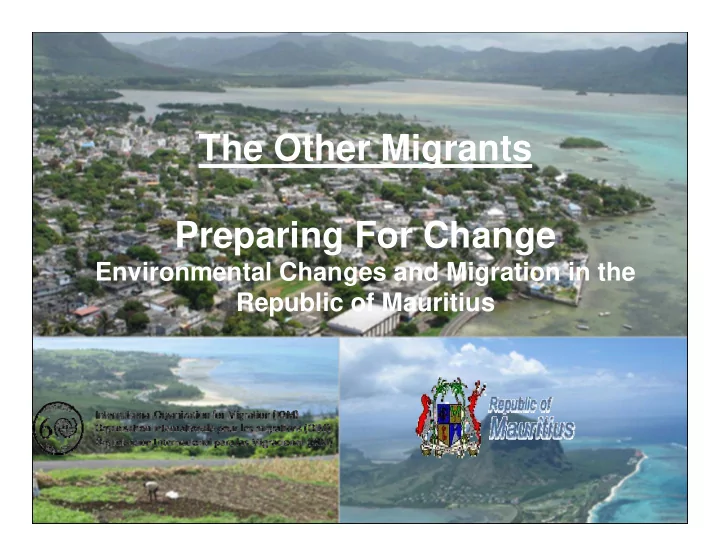
The Other Migrants Preparing For Change
Environmental Changes and Migration in the Republic of Mauritius
SLIDE 2 Introducing the Project
Like most island states, Mauritius is particularly vulnerable to the impacts of climate change. This is especially the case given that some key sectors of its economy are highly dependent
environmental conditions. The Other Migrants project funded by 1035 Facility is thus highly relevant to the Mauritian and regional context.
SLIDE 3
Overall Objective
To contribute towards strengthening the capacity of the Government of Mauritius and the resilience of communities to deal with the challenges of climate and environmental change. The project also builds on national efforts to implement climate change strategies and formalize a new vision for the Republic.
SLIDE 4
Area of Coverage
The Republic of Mauritius Mauritius Rodrigues Agalega
SLIDE 5
Purposes
Compile information through field assessments Strengthen and build capacity of national Institutions Promote alternative livelihoods for the most vulnerable communities with a focus on green jobs To encourage dialogue and information sharing between the different Ministries and Institutions involved and between the different islands in the Indian Ocean Region
SLIDE 6
Existing Initiatives in the Region and Mauritius
Barbados Programme of Action for the Small Islands Development States (SIDS) Millennium Development Goals (MDGs) – Goal 7 Indian Ocean Commission and WIOMSA Regional Strategy on Climate Change Adaptation Maurice Ile Durable Africa Adaptation Programme
SLIDE 7
Partnership Strategy/ Institutional Framework
Project Implementation Committee with relevant ministries Civil Society through NGOs – e.g., MRU2025 Academia – e.g., IDDRI Private Sector ‐ CSRs Inter‐governmental organizations – e.g., COI (Regional Photo Contest) and UNDP (Research on Rodrigues)
SLIDE 8
Methodology and Design
Research Action Assessments Actions to address the Findings
Awareness Raising Campaigns Advocacy Pilot Job Creation Project Training in the Setting up of Business Capacity building
SLIDE 9
Key Environmental vulnerabilities in Mauritius
As most SIDS, Mauritius is highly vulnerable to the impacts of environmental changes ‐ Cyclones – by far the most frequent disaster ‐ Sea‐Level rise – currently 3.5 mm/year ‐ Temperature rise ‐ +0.84 C to +3.77 C by 2069 ‐ Rainfall patterns Problems re: uncertainties and monitoring
SLIDE 10 Impacts add up to non climatic environmental degradations: (i) Pollution from pesticides, (ii)
- verfishing and (iii) landslides
Source: Nigel and Rughooputh 2009
SLIDE 11
An economy dependent on the environment
‐ Key economic sectors dependent upon environmental conditions and have an environmental impact: 1)Fishing – rough sea; fish migratory routes; coral bleaching; overfishing 2)Sugar cane production – no research done on how crops have been affected; fertilizers 3)Tourism – beach tourism; pressures on coastal ecosystems
SLIDE 12
Methodology
Expert interviews – around 35 with key governmental agencies and ministries, NGOs and inter‐gov agencies Field visits – Direct observation of environmental changes, habitats and social attitudes in reaction to these changes – 8 sites Focus Groups – Qualitative approach allowing the emergence of a collection opinion – 4 focus groups with about 10‐15 participants each.
SLIDE 13
Major Limitations
Lack of quantitative data– no register was accessible; no aggregated data on the socio‐economic profile of communities; Lack of evolution scenarios re: vulnerability changes – in process Impossibility to get to Agalega Pilot sites were selected – there exist other micro‐ communities affected by environmental changes
SLIDE 14
Environmental Migration in Mauritius
‐ Gradual process where people have moved mainly temporarily within the islands (e.g., Rodrigues) ‐ Multi causality of migration – socio‐economic determinants often linked with environmental migration – the search of alternative livelihoods; ‐ Migration will have a stronger impact on the most vulnerable groups in the islands; ‐ Not necessarily a failure to adapt
SLIDE 15
Perception of changes
‐ Migration decision – perception of change is as important as the change itself; ‐ Tsunami of 2004 – impact in the perception of change ‐ All coastal zones are particularly vulnerable – erosion and floods compounded with economic development. Some inland sites as well
SLIDE 16 Rethinking vulnerability to natural hazards for improving adaptation to climate change
Alexandre MAGNAN
Iddri ‐ alexandre.magnan@iddri.org
IOM workshop “Climate change, environmental degradation and migration” 29 – 30 March 2011, Geneva
Institute for Sustainable Development and International Relations
Sciences Po – 27 rue Saint‐Guillaume, 75337 Paris Cedex 07 (France) ‐ www.iddri.org
SLIDE 17
International Dialogue on Migration “Climate change, environmental degradation and migration” 29 – 30 March 2011, Geneva
The science of climate change says that: ‐ Climate change is ongoing ‐ Its effects during the coming century are partly irreversible environmental pressures will inevitably increase Proactive attitude : Assessing societies’ reaction before climate change impacts occur, in order to allow people, in the short and long term, to stay where they currently live. Vulnerability as an “upstream entry point” for launching an adaptation to climate change process migration?
SLIDE 18
- 2. Vulnerability : a wide range of influential factors
IOM workshop “Climate change, environmental degradation and migration” 29 – 30 March 2011, Geneva
However, the preconceived idea is that “the poorest are the most vulnerable to climate change because they lack adaptive capacity” 6 main influential factors of vulnerability:
- The spatial configuration
- The sensitivity of the ecosystems
- The societal cohesion
- The diversification of (economic and subsistence) activities
- The political and institutional organisation
- The general living conditions
SLIDE 19
- 3. Towards an operational definition of what a
“vulnerable local community” is
IOM workshop “Climate change, environmental degradation and migration” 29 – 30 March 2011, Geneva
‐ located in an exposed area: it is directly threatened by natural hazards, or its ecosystems and environmental features in general are degraded and/or sensitive to environmental stresses; ‐ and/or it is not characterized by a “community spirit”: strong links of solidarity and support among a majority of the members of a community reduce its vulnerability; ‐ and/or it is strongly dependent on environmental resources for its subsistence and/or for creating income; ‐ and/or it is marginalized in the territory (geographical isolation) and/or in the
- rganization of the country (institutional and socio‐economic isolation);
‐ and/or its living conditions are fragile because of a lack of revenues, a lack of education, a lack of transportation means, for instance. At a local scale, a “vulnerable” community is:
SLIDE 20
- 4. A framework for identifying “adaptation projects”
IOM workshop “Climate change, environmental degradation and migration” 29 – 30 March 2011, Geneva
(1) Sociocultural dimension
Pilot projects should be consistent with the social and cultural values of people and should correspond to the capabilities/competencies/knowledge of communities. (1.1) Pilot projects are consistent with social features and cultural values (what people expect from the present and for the future). (1.2) They are located near the family/community’s living place, and do not induce displacements of the community (or a part of it) for long periods of time. (1.3) They are based on existing knowledge and competencies (in order to avoid sociocultural maladaptation). (1.4) They do not require too complicated new skills to be developed.
(2) Environmental dimension
Pilot projects should be consistent with the nature and the dynamics of local ecosystems and should take into account potential climate change threats to environmental conditions. (2.1) Pilot projects do not degrade the direct environment (through overexploitation, degradation of resources, destruction of habitats, etc. ‐ idea of avoiding environmental maladaptation). (2.2) They do not degrade the indirect environment either. (2.3) They favour the protection function of ecosystems with regard to current natural hazards and climate change threats (such as buffer zones on the coasts). (2.4) They take into account the range of uncertainties concerning the impacts of climate change on a local scale, thus preserving some possibilities for adjustment. (2.5) They are not focused on reducing greenhouse gases emissions, but rather on adapting to environmental changes.
(3) Economic dimension
Pilot projects should be economically viable. (3.1) Pilot projects allow vulnerable local communities to improve or at least maintain their revenues (3.2) They ensure a certain level of diversification of activities and sources of revenues (3.3) They are consistent with future environmental change projections (in order to avoid economic maladaptation).
(4) Institutional, legal and administrative dimension
Pilot projects should be consistent with the national legal, administrative and institutional framework. (4.1) Pilot projects should fit into the national entrepreneurship framework (4.2) They should fit into the national legal framework. (4.3.) Ideally, they should be relatively easy to formalize, or at least would benefit from administrative support.
W
k i n P r
r e s s
SLIDE 21
- 4. A framework for identifying “adaptation projects”
IOM workshop “Climate change, environmental degradation and migration” 29 – 30 March 2011, Geneva
“Scoring” Useful for : ‐ Project holders (what should I do?) ‐ Project funders (what should I fund?) Identification
relevant actions Prioritization
SLIDE 22
Way Forward – Enhancing this first pilot project on the national level and regional level
Mauritius as a showcase and the IO region as a lab for devising actions to climate change adaptation Improving quantitative data collection methodology and knowledge of current and future environmental pressures on the possible movement of people (internal, intraregional) – Proposal of a regional Climate Change Observatory Further detailing analysis of vulnerability determinants and adaptation pilot actions for the most affected communities; Development of migration policies (adaptation strategies; harmonization of relocation schemes; Implementation of adaptation projects for the MARPs
SLIDE 23
Thank you for your attention
For more information: Ms Lalini Veerassamy lveerassamy@iom.int