A predictive multi-modal imaging marker for designing efficient and - - PowerPoint PPT Presentation

a predictive multi modal imaging marker for designing
SMART_READER_LITE
LIVE PREVIEW

A predictive multi-modal imaging marker for designing efficient and - - PowerPoint PPT Presentation

A predictive multi-modal imaging marker for designing efficient and robust AD clinical trials Vikas Singh , Ozioma Okonkwo Sterling C. Johnson , Vamsi K. Ithapu Computer Sciences Biostatistics and Medical Informatics


slide-1
SLIDE 1

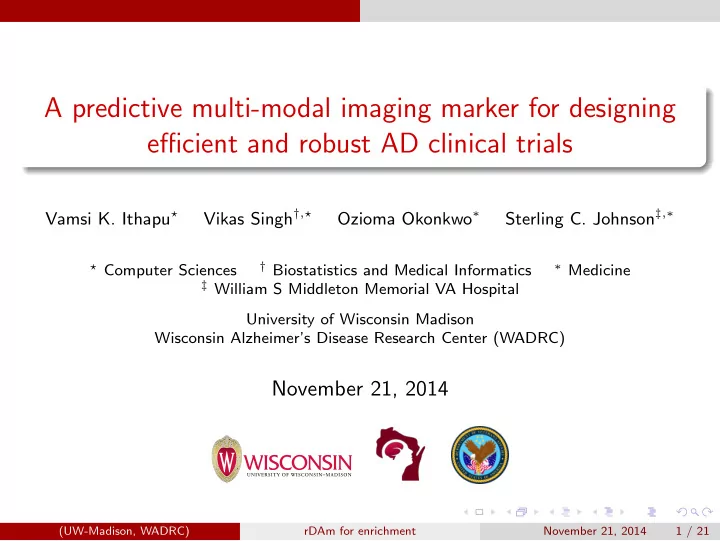
A predictive multi-modal imaging marker for designing efficient and robust AD clinical trials

Vamsi K. Ithapu⋆ Vikas Singh†,⋆ Ozioma Okonkwo∗ Sterling C. Johnson‡,∗

⋆ Computer Sciences † Biostatistics and Medical Informatics ∗ Medicine ‡ William S Middleton Memorial VA Hospital

University of Wisconsin Madison Wisconsin Alzheimer’s Disease Research Center (WADRC)

November 21, 2014

(UW-Madison, WADRC) rDAm for enrichment November 21, 2014 1 / 21

slide-2
SLIDE 2

Landscape of AD Clinical Trials

As of October 2014, Clinicaltrials.gov lists 255 studies that are recruiting 125 in US and 86 in Europe; 35 are in Phase III

(UW-Madison, WADRC) rDAm for enrichment November 21, 2014 2 / 21

slide-3
SLIDE 3

Landscape of AD Clinical Trials

As of October 2014, Clinicaltrials.gov lists 255 studies that are recruiting 125 in US and 86 in Europe; 35 are in Phase III More than 400 trials since 2002 – Very little success (Cummings 2014)

(UW-Madison, WADRC) rDAm for enrichment November 21, 2014 2 / 21

slide-4
SLIDE 4

Landscape of AD Clinical Trials

As of October 2014, Clinicaltrials.gov lists 255 studies that are recruiting 125 in US and 86 in Europe; 35 are in Phase III More than 400 trials since 2002 – Very little success (Cummings 2014) Right Target, Right Drug, Right Stage (Sperling 2011) ... why do we keep testing drugs aimed at the initial stages of the disease process in patients at the end-stage of the illness ?

(UW-Madison, WADRC) rDAm for enrichment November 21, 2014 2 / 21

slide-5
SLIDE 5

Landscape of AD Clinical Trials

As of October 2014, Clinicaltrials.gov lists 255 studies that are recruiting 125 in US and 86 in Europe; 35 are in Phase III More than 400 trials since 2002 – Very little success (Cummings 2014) Right Target, Right Drug, Right Stage (Sperling 2011) ... why do we keep testing drugs aimed at the initial stages of the disease process in patients at the end-stage of the illness ? Choosing the Right Stage Mild Cognitive Impairment (MCI), Pre-symptomatic or Pre-clinical

(UW-Madison, WADRC) rDAm for enrichment November 21, 2014 2 / 21

slide-6
SLIDE 6

Landscape of AD Clinical Trials – Right Stage

However, the annual conversion rate from MCI to AD is 3 − 20% (Mitchell 2009)

(UW-Madison, WADRC) rDAm for enrichment November 21, 2014 3 / 21

slide-7
SLIDE 7

Landscape of AD Clinical Trials – Right Stage

However, the annual conversion rate from MCI to AD is 3 − 20% (Mitchell 2009) The effect of a drug (if there is one) is diminished. = ⇒ Right stage is not right enough!

(UW-Madison, WADRC) rDAm for enrichment November 21, 2014 3 / 21

slide-8
SLIDE 8

Landscape of AD Clinical Trials – Right Stage

However, the annual conversion rate from MCI to AD is 3 − 20% (Mitchell 2009) The effect of a drug (if there is one) is diminished. = ⇒ Right stage is not right enough! According to FDA, enrichment entails to ... the prospective use of any “patient characteristic” to select a study population in which detection of a drug effect (if one is in fact present) is more likely than it would in an unselected population.

(UW-Madison, WADRC) rDAm for enrichment November 21, 2014 3 / 21

slide-9
SLIDE 9

Population enrichment – continued

Worsening Disease Healthy AD (Enrichment Criterion)

Enrichment Cut-Off

Included Discarded

(UW-Madison, WADRC) rDAm for enrichment November 21, 2014 4 / 21

slide-10
SLIDE 10

Population enrichment – continued

Worsening Disease Healthy AD (Enrichment Criterion)

Enrichment Cut-Off

Included Discarded

Good enrichment criterion ⇐ ⇒ High correlation with disease Practical enrichment criterion ⇐ ⇒ High predictive power

(UW-Madison, WADRC) rDAm for enrichment November 21, 2014 4 / 21

slide-11
SLIDE 11

Population enrichment – Existing Work

CSF based markers (Holland 2012) Normalization issues (i.e., batch processing), preferred as outcome

(UW-Madison, WADRC) rDAm for enrichment November 21, 2014 5 / 21

slide-12
SLIDE 12

Population enrichment – Existing Work

CSF based markers (Holland 2012) Normalization issues (i.e., batch processing), preferred as outcome Imaging based ROI summaries (Lorenzi 2010) Not voxel–wise, too much information loss, Mostly use future time-point data

(UW-Madison, WADRC) rDAm for enrichment November 21, 2014 5 / 21

slide-13
SLIDE 13

Population enrichment – Existing Work

CSF based markers (Holland 2012) Normalization issues (i.e., batch processing), preferred as outcome Imaging based ROI summaries (Lorenzi 2010) Not voxel–wise, too much information loss, Mostly use future time-point data Voxel–wise summaries (Kohannim 2010) Mostly use future time-point data Designed for classification/regression problems, not trial enrichment

(UW-Madison, WADRC) rDAm for enrichment November 21, 2014 5 / 21

slide-14
SLIDE 14

Population enrichment – Existing Work

CSF based markers (Holland 2012) Normalization issues (i.e., batch processing), preferred as outcome Imaging based ROI summaries (Lorenzi 2010) Not voxel–wise, too much information loss, Mostly use future time-point data Voxel–wise summaries (Kohannim 2010) Mostly use future time-point data Designed for classification/regression problems, not trial enrichment Not explicitly designed to result in small sample (high power) trials

(UW-Madison, WADRC) rDAm for enrichment November 21, 2014 5 / 21

slide-15
SLIDE 15

Designing a good enricher

In this work, we construct a predictive multi-modal imaging marker that is explicitly designed for conducting “efficient” clinical trial and uses only baseline data

(UW-Madison, WADRC) rDAm for enrichment November 21, 2014 6 / 21

slide-16
SLIDE 16

Designing a good enricher

In this work, we construct a predictive multi-modal imaging marker that is explicitly designed for conducting “efficient” clinical trial and uses only baseline data Consider the setup of a clinical trial δ – the change in trial outcome for the placebo group η – the hypothesized decrease in the change of outcome due to the drug/treatment

(UW-Madison, WADRC) rDAm for enrichment November 21, 2014 6 / 21

slide-17
SLIDE 17

Designing a good enricher

In this work, we construct a predictive multi-modal imaging marker that is explicitly designed for conducting “efficient” clinical trial and uses only baseline data Consider the setup of a clinical trial δ – the change in trial outcome for the placebo group η – the hypothesized decrease in the change of outcome due to the drug/treatment To detect this drug effect of 1 − η with statistical power of 1 − β, Samples per arm, s = 2(Zα + Z1−β)σ2 (1 − η)2δ2 σ2 – pooled variance of the outcome

(UW-Madison, WADRC) rDAm for enrichment November 21, 2014 6 / 21

slide-18
SLIDE 18

Designing a good enricher – continued

Samples per arm, s = 2(Zα + Z1−β)σ2 (1 − η)2δ2 s decreases if δ increases and σ2 decreases

(UW-Madison, WADRC) rDAm for enrichment November 21, 2014 7 / 21

slide-19
SLIDE 19

Designing a good enricher – continued

Samples per arm, s = 2(Zα + Z1−β)σ2 (1 − η)2δ2 s decreases if δ increases and σ2 decreases

H0 = δpb − δtr = 0 H0 = δpb − δtr = (1 − η)δ Critical Value α/2 α/2 Power = 1 − β β

(UW-Madison, WADRC) rDAm for enrichment November 21, 2014 7 / 21

slide-20
SLIDE 20

Designing a good enricher – continued

Samples per arm, s = 2(Zα + Z1−β)σ2 (1 − η)2δ2 s decreases if δ increases and σ2 decreases

H0 = δpb − δtr = 0 H0 = δpb − δtr = (1 − η)δ Critical Value α/2 α/2 Power = 1 − β β

(UW-Madison, WADRC) rDAm for enrichment November 21, 2014 8 / 21

slide-21
SLIDE 21

Designing a good enricher – continued

= ⇒ we want the trial outcome to have large δ and small σ

(UW-Madison, WADRC) rDAm for enrichment November 21, 2014 9 / 21

slide-22
SLIDE 22

Designing a good enricher – continued

= ⇒ we want the trial outcome to have large δ and small σ = ⇒ The trial population should be “filtered” with some enrichment criterion that results in large δ and small σ for any given outcome

(UW-Madison, WADRC) rDAm for enrichment November 21, 2014 9 / 21

slide-23
SLIDE 23

Designing a good enricher – continued

= ⇒ we want the trial outcome to have large δ and small σ = ⇒ The trial population should be “filtered” with some enrichment criterion that results in large δ and small σ for any given outcome A good inclusion criterion should small variance on the trial population correlate very strongly to spectrum of dementia (unbiased) i.e. a minimum variance unbiased (MVUB) estimator is desired

(UW-Madison, WADRC) rDAm for enrichment November 21, 2014 9 / 21

slide-24
SLIDE 24

randomized denoising autoencoders (rDA)

Novel machine learning model based on Stacked Denoising Autoencoders (Bengio 2009)

(UW-Madison, WADRC) rDAm for enrichment November 21, 2014 10 / 21

slide-25
SLIDE 25

randomized denoising autoencoders (rDA)

Novel machine learning model based on Stacked Denoising Autoencoders (Bengio 2009) L-layered Stacked Denoising Autoencoder:

Layer 1 Layer 2 Layer 3 Layer L Inputs Outputs (UW-Madison, WADRC) rDAm for enrichment November 21, 2014 10 / 21

slide-26
SLIDE 26

randomized denoising autoencoders (rDA)

(UW-Madison, WADRC) rDAm for enrichment November 21, 2014 11 / 21

slide-27
SLIDE 27

randomized denoising autoencoders (rDA)

L layered SDA L layered SDA L layered SDA

Block 1

T networks

T outputs

(UW-Madison, WADRC) rDAm for enrichment November 21, 2014 11 / 21

slide-28
SLIDE 28

randomized denoising autoencoders (rDA)

L layered SDA L layered SDA L layered SDA L layered SDA L layered SDA L layered SDA

Block 1 Block 2

T networks T networks

T outputs T outputs

(UW-Madison, WADRC) rDAm for enrichment November 21, 2014 11 / 21

slide-29
SLIDE 29

randomized denoising autoencoders (rDA)

L layered SDA L layered SDA L layered SDA L layered SDA L layered SDA L layered SDA L layered SDA L layered SDA L layered SDA

Block 1 Block 2 Block B

T networks T networks T networks

T outputs T outputs T outputs

f1 f1 f2f4 f5 f3 f6 fB f2 fB

(UW-Madison, WADRC) rDAm for enrichment November 21, 2014 11 / 21

slide-30
SLIDE 30

randomized denoising autoencoders (rDA)

Linear Combination

Final Output

L layered SDA L layered SDA L layered SDA L layered SDA L layered SDA L layered SDA L layered SDA L layered SDA L layered SDA

Block 1 Block 2 Block B

T networks T networks T networks

T outputs T outputs T outputs

(UW-Madison, WADRC) rDAm for enrichment November 21, 2014 11 / 21

slide-31
SLIDE 31

randomized denoising autoencoder (rDA) marker (rDAm)

SDAs model complex concepts (Bengio 2009) – Predictions are unbiased Averaging “uncorrelated” data reduces variance = ⇒ rDA outputs (∈ [0, 1]) are MVUB estimators.

(UW-Madison, WADRC) rDAm for enrichment November 21, 2014 12 / 21

slide-32
SLIDE 32

randomized denoising autoencoder (rDA) marker (rDAm)

SDAs model complex concepts (Bengio 2009) – Predictions are unbiased Averaging “uncorrelated” data reduces variance = ⇒ rDA outputs (∈ [0, 1]) are MVUB estimators. rDA for enrichment Train multimodal rDA: For each input imaging modality

Train a rDA on AD (labeled 0) and CN (labeled 1) subjects

Combine the outputs across all modalities Predict the trained model on MCI – rDA marker (rDAm) Choose a cut-off t ∈ [0, 1], and filter “out” subjects with rDAm > t

(UW-Madison, WADRC) rDAm for enrichment November 21, 2014 12 / 21

slide-33
SLIDE 33

Experiments

Data (ADNI2) T1 MRI and PET (FDG, florbetapir) of 516 subjects (median age 72.46, 38% female) 101 AD, 148 CN, 131 early MCI, 136 late MCI (at baseline) 174 FH positive, 141 APOEe4 positive Standard SPM8 pre-processing on all images

(UW-Madison, WADRC) rDAm for enrichment November 21, 2014 13 / 21

slide-34
SLIDE 34

Experiments

Data (ADNI2) T1 MRI and PET (FDG, florbetapir) of 516 subjects (median age 72.46, 38% female) 101 AD, 148 CN, 131 early MCI, 136 late MCI (at baseline) 174 FH positive, 141 APOEe4 positive Standard SPM8 pre-processing on all images Evaluations Predictive power of “baseline” rDAm Sample sizes (by fixing the desired power) using “baseline” rDAm vs. alternate enrichers

(UW-Madison, WADRC) rDAm for enrichment November 21, 2014 13 / 21

slide-35
SLIDE 35

Predictive power of “baseline” rDAm – Correlations

Spearman correlation coefficient (and p-value) of baseline rDAm with change in other markers from baseline to 12 and 24 months Marker 12m 24m MMSE 0.2123, p = 0.0008 0.3311, p = 0.0003 ADAS 0.2139, p = 0.0007 0.5300, p < 10−4 MOCA 0.0568, p > 0.1 0.5952, p = 10−4 RAVLT 0.1285, p = 0.04 0.5702, p = 0.0008 PsyMEM 0.2811, p < 10−4 0.4207, p = 0.001 HippoVol 0.3262, p ≪ 10−4 0.4744, p ≪ 10−4 CDR-SB 0.3643, p ≪ 10−4 0.5344, p ≪ 10−4 DXConv1 > 20, p ≪ 10−4 > 20, p ≪ 10−4

1ANOVA test results are reported since this variable is categorical (UW-Madison, WADRC) rDAm for enrichment November 21, 2014 14 / 21

slide-36
SLIDE 36

Predictive power of “baseline” rDAm – Correlations

Spearman correlation coefficient (and p-value) of baseline rDAm with change in other markers from baseline to 12 and 24 months Marker 12m 24m MMSE 0.2123, p = 0.0008 0.3311, p = 0.0003 ADAS 0.2139, p = 0.0007 0.5300, p < 10−4 MOCA 0.0568, p > 0.1 0.5952, p = 10−4 RAVLT 0.1285, p = 0.04 0.5702, p = 0.0008 PsyMEM 0.2811, p < 10−4 0.4207, p = 0.001 HippoVol 0.3262, p ≪ 10−4 0.4744, p ≪ 10−4 CDR-SB 0.3643, p ≪ 10−4 0.5344, p ≪ 10−4 DXConv1 > 20, p ≪ 10−4 > 20, p ≪ 10−4

1ANOVA test results are reported since this variable is categorical (UW-Madison, WADRC) rDAm for enrichment November 21, 2014 14 / 21

slide-37
SLIDE 37

Predictive power of “baseline” rDAm – Correlations

Spearman correlation coefficient (and p-value) of baseline rDAm with change in other markers from baseline to 12 and 24 months Marker 12m 24m MMSE 0.2123, p = 0.0008 0.3311, p = 0.0003 ADAS 0.2139, p = 0.0007 0.5300, p < 10−4 MOCA 0.0568, p > 0.1 0.5952, p = 10−4 RAVLT 0.1285, p = 0.04 0.5702, p = 0.0008 PsyMEM 0.2811, p < 10−4 0.4207, p = 0.001 HippoVol 0.3262, p ≪ 10−4 0.4744, p ≪ 10−4 CDR-SB 0.3643, p ≪ 10−4 0.5344, p ≪ 10−4 DXConv1 > 20, p ≪ 10−4 > 20, p ≪ 10−4

1ANOVA test results are reported since this variable is categorical (UW-Madison, WADRC) rDAm for enrichment November 21, 2014 14 / 21

slide-38
SLIDE 38

Predictive power of “baseline” rDAm – Correlations

Spearman correlation coefficient (and p-value) of baseline rDAm with change in other markers from baseline to 12 and 24 months Marker 12m 24m MMSE 0.2123, p = 0.0008 0.3311, p = 0.0003 ADAS 0.2139, p = 0.0007 0.5300, p < 10−4 MOCA 0.0568, p > 0.1 0.5952, p = 10−4 RAVLT 0.1285, p = 0.04 0.5702, p = 0.0008 PsyMEM 0.2811, p < 10−4 0.4207, p = 0.001 HippoVol 0.3262, p ≪ 10−4 0.4744, p ≪ 10−4 CDR-SB 0.3643, p ≪ 10−4 0.5344, p ≪ 10−4 DXConv1 > 20, p ≪ 10−4 > 20, p ≪ 10−4

1ANOVA test results are reported since this variable is categorical (UW-Madison, WADRC) rDAm for enrichment November 21, 2014 14 / 21

slide-39
SLIDE 39

Predictive power of “baseline” rDAm – Correlations

Spearman correlation coefficient (and p-value) of baseline rDAm with change in other markers from baseline to 12 and 24 months Marker 12m 24m MMSE 0.2123, p = 0.0008 0.3311, p = 0.0003 ADAS 0.2139, p = 0.0007 0.5300, p < 10−4 MOCA 0.0568, p > 0.1 0.5952, p = 10−4 RAVLT 0.1285, p = 0.04 0.5702, p = 0.0008 PsyMEM 0.2811, p < 10−4 0.4207, p = 0.001 HippoVol 0.3262, p ≪ 10−4 0.4744, p ≪ 10−4 CDR-SB 0.3643, p ≪ 10−4 0.5344, p ≪ 10−4 DXConv1 > 20, p ≪ 10−4 > 20, p ≪ 10−4 In general, very strong correlations across all markers

1ANOVA test results are reported since this variable is categorical (UW-Madison, WADRC) rDAm for enrichment November 21, 2014 14 / 21

slide-40
SLIDE 40

Predictive power of “baseline” rDAm – Change plots

Mean longitudinal change in MMSE, ADAS-Cog, MOCA and RAVLT vs. baseline rDAm enrichment cut-off t ∈ [0, 1] (0 – AD, 1 – healthy)

0.2 0.4 0.6 0.8 1 −4 −3.5 −3 −2.5 −2 −1.5 −1 −0.5 rDAm Cut−Off MMSE Change 12m 24m 0.2 0.4 0.6 0.8 1 −0.5 0.5 1 1.5 2 2.5 3 3.5 rDAm Cut−Off ADAS Change 12m 24m 0.2 0.4 0.6 0.8 1 −4 −3 −2 −1 1 rDAm Cut−Off MOCA Change 12m 24m 0.2 0.4 0.6 0.8 1 −8 −6 −4 −2 2 4 6 8 rDAm Cut−Off RAVLT Change 12m 24m

(UW-Madison, WADRC) rDAm for enrichment November 21, 2014 15 / 21

slide-41
SLIDE 41

Predictive power of “baseline” rDAm – Change plots

Mean longitudinal change in Hippo. Vol, PsyMEM, CDR-SB and DxConv

  • vs. baseline rDAm enrichment cut-off t ∈ [0, 1] (0 – AD, 1 – healthy)

0.2 0.4 0.6 0.8 1 −1.4 −1.2 −1 −0.8 −0.6 −0.4 −0.2 rDAm Cut−Off PsychMEM Change 12m 24m 0.2 0.4 0.6 0.8 1 −900 −800 −700 −600 −500 −400 −300 −200 −100 rDAm Cut−Off Hippo Vol Change 12m 24m 0.2 0.4 0.6 0.8 1 1 2 3 4 5 rDAm Cut−Off CDR Change 12m 24m 0.2 0.4 0.6 0.8 1 0.1 0.2 0.3 0.4 0.5 rDAm Cut−Off DX Change 12m 24m

(UW-Madison, WADRC) rDAm for enrichment November 21, 2014 16 / 21

slide-42
SLIDE 42

Baseline rDAm for enrichment

Sample sizes per arm using rDAm enrichment vs. no enrichment on several

  • utcomes (at 80% power and drug effect of 0.25)

Outcome None Bottom 20% Bottom 25% Bottom 33% Bottom 50% measure rDAm< 0.41 rDAm< 0.46 rDAm< 0.52 rDAm< 0.65 MMSE 1367 200 239 371 566 ADAS > 2000 775 945 >2000 >2000 MOCA > 2000 449 674 960 1919 RAVLT > 2000 591 1211 >2000 >2000 PsyMEM > 2000 420 690 786 1164 PsyEF > 2000 > 2000 > 2000 > 2000 > 2000 HippoVol > 2000 543 1504 1560 1675 CDR-SB 1586 281 317 430 433 DxConv 895 230 267 352 448

(UW-Madison, WADRC) rDAm for enrichment November 21, 2014 17 / 21

slide-43
SLIDE 43

Baseline rDAm for enrichment

Sample sizes per arm using rDAm enrichment vs. no enrichment on several

  • utcomes (at 80% power and drug effect of 0.25)

Outcome None Bottom 20% Bottom 25% Bottom 33% Bottom 50% measure rDAm< 0.41 rDAm< 0.46 rDAm< 0.52 rDAm< 0.65 MMSE 1367 200 239 371 566 ADAS > 2000 775 945 >2000 >2000 MOCA > 2000 449 674 960 1919 RAVLT > 2000 591 1211 >2000 >2000 PsyMEM > 2000 420 690 786 1164 PsyEF > 2000 > 2000 > 2000 > 2000 > 2000 HippoVol > 2000 543 1504 1560 1675 CDR-SB 1586 281 317 430 433 DxConv 895 230 267 352 448

(UW-Madison, WADRC) rDAm for enrichment November 21, 2014 17 / 21

slide-44
SLIDE 44

Baseline rDAm for enrichment

Sample sizes per arm using rDAm enrichment vs. no enrichment on several

  • utcomes (at 80% power and drug effect of 0.25)

Outcome None Bottom 20% Bottom 25% Bottom 33% Bottom 50% measure rDAm< 0.41 rDAm< 0.46 rDAm< 0.52 rDAm< 0.65 MMSE 1367 200 239 371 566 ADAS > 2000 775 945 >2000 >2000 MOCA > 2000 449 674 960 1919 RAVLT > 2000 591 1211 >2000 >2000 PsyMEM > 2000 420 690 786 1164 PsyEF > 2000 > 2000 > 2000 > 2000 > 2000 HippoVol > 2000 543 1504 1560 1675 CDR-SB 1586 281 317 430 433 DxConv 895 230 267 352 448

(UW-Madison, WADRC) rDAm for enrichment November 21, 2014 17 / 21

slide-45
SLIDE 45

Baseline rDAm for enrichment

Sample sizes per arm using rDAm enrichment vs. no enrichment on several

  • utcomes (at 80% power and drug effect of 0.25)

Outcome None Bottom 20% Bottom 25% Bottom 33% Bottom 50% measure rDAm< 0.41 rDAm< 0.46 rDAm< 0.52 rDAm< 0.65 MMSE 1367 200 239 371 566 ADAS > 2000 775 945 >2000 >2000 MOCA > 2000 449 674 960 1919 RAVLT > 2000 591 1211 >2000 >2000 PsyMEM > 2000 420 690 786 1164 PsyEF > 2000 > 2000 > 2000 > 2000 > 2000 HippoVol > 2000 543 1504 1560 1675 CDR-SB 1586 281 317 430 433 DxConv 895 230 267 352 448

(UW-Madison, WADRC) rDAm for enrichment November 21, 2014 17 / 21

slide-46
SLIDE 46

Baseline rDAm for enrichment

Sample sizes per arm using rDAm enrichment vs. no enrichment on several

  • utcomes (at 80% power and drug effect of 0.25)

Outcome None Bottom 20% Bottom 25% Bottom 33% Bottom 50% measure rDAm< 0.41 rDAm< 0.46 rDAm< 0.52 rDAm< 0.65 MMSE 1367 200 239 371 566 ADAS > 2000 775 945 >2000 >2000 MOCA > 2000 449 674 960 1919 RAVLT > 2000 591 1211 >2000 >2000 PsyMEM > 2000 420 690 786 1164 PsyEF > 2000 > 2000 > 2000 > 2000 > 2000 HippoVol > 2000 543 1504 1560 1675 CDR-SB 1586 281 317 430 433 DxConv 895 230 267 352 448

(UW-Madison, WADRC) rDAm for enrichment November 21, 2014 18 / 21

slide-47
SLIDE 47

Baseline rDAm for enrichment

Sample sizes per arm using rDAm enrichment vs. no enrichment on several

  • utcomes (at 80% power and drug effect of 0.25)

Outcome None Bottom 20% Bottom 25% Bottom 33% Bottom 50% measure rDAm< 0.41 rDAm< 0.46 rDAm< 0.52 rDAm< 0.65 MMSE 1367 200 239 371 566 ADAS > 2000 775 945 >2000 >2000 MOCA > 2000 449 674 960 1919 RAVLT > 2000 591 1211 >2000 >2000 PsyMEM > 2000 420 690 786 1164 PsyEF > 2000 > 2000 > 2000 > 2000 > 2000 HippoVol > 2000 543 1504 1560 1675 CDR-SB 1586 281 317 430 433 DxConv 895 230 267 352 448

About 5 times reduction with 1-in-5, 1-in-4 enrichment

(UW-Madison, WADRC) rDAm for enrichment November 21, 2014 18 / 21

slide-48
SLIDE 48

Baseline rDAm enrichment vs. alternate enrichers

Sample sizes per arm using rDAm vs. other imaging-derived enrichers (at 80% power and drug effect of 0.25)

Sample Outcome measure enricher MMSE ADAS MOCA RAVLT PsyMEM HipVol CDR-SB DxConv HipVol 500 >2000 1005 1606 1009 >2000 389 420 FDG 384 1954 579 >2000 832 752 415 371 AV45 224 >2000 875 >2000 826 698 382 443 FAH 296 >2000 705 >2000 826 722 397 402 MKLm 2 228 874 827 896 487 877 295 284 rDAm 200 775 449 591 420 543 281 230

2MKLm is the current state-of-the-art based on SVMs (UW-Madison, WADRC) rDAm for enrichment November 21, 2014 19 / 21

slide-49
SLIDE 49

Baseline rDAm enrichment vs. alternate enrichers

Sample sizes per arm using rDAm vs. other imaging-derived enrichers (at 80% power and drug effect of 0.25)

Sample Outcome measure enricher MMSE ADAS MOCA RAVLT PsyMEM HipVol CDR-SB DxConv HipVol 500 >2000 1005 1606 1009 >2000 389 420 FDG 384 1954 579 >2000 832 752 415 371 AV45 224 >2000 875 >2000 826 698 382 443 FAH 296 >2000 705 >2000 826 722 397 402 MKLm 2 228 874 827 896 487 877 295 284 rDAm 200 775 449 591 420 543 281 230

2MKLm is the current state-of-the-art based on SVMs (UW-Madison, WADRC) rDAm for enrichment November 21, 2014 19 / 21

slide-50
SLIDE 50

Baseline rDAm enrichment vs. alternate enrichers

Sample sizes per arm using rDAm vs. other imaging-derived enrichers (at 80% power and drug effect of 0.25)

Sample Outcome measure enricher MMSE ADAS MOCA RAVLT PsyMEM HipVol CDR-SB DxConv HipVol 500 >2000 1005 1606 1009 >2000 389 420 FDG 384 1954 579 >2000 832 752 415 371 AV45 224 >2000 875 >2000 826 698 382 443 FAH 296 >2000 705 >2000 826 722 397 402 MKLm 3 228 874 827 896 487 877 295 284 rDAm 200 775 449 591 420 543 281 230

rDAm has smallest estimates across all outcomes

3MKLm is the current state-of-the-art based on SVMs (UW-Madison, WADRC) rDAm for enrichment November 21, 2014 20 / 21

slide-51
SLIDE 51

Baseline rDAm enrichment vs. alternate enrichers

Sample sizes per arm using rDAm vs. other imaging-derived enrichers (at 80% power and drug effect of 0.25)

Sample Outcome measure enricher MMSE ADAS MOCA RAVLT PsyMEM HipVol CDR-SB DxConv HipVol 500 >2000 1005 1606 1009 >2000 389 420 FDG 384 1954 579 >2000 832 752 415 371 AV45 224 >2000 875 >2000 826 698 382 443 FAH 296 >2000 705 >2000 826 722 397 402 MKLm 3 228 874 827 896 487 877 295 284 rDAm 200 775 449 591 420 543 281 230

3MKLm is the current state-of-the-art based on SVMs (UW-Madison, WADRC) rDAm for enrichment November 21, 2014 20 / 21

slide-52
SLIDE 52

Conclusions & Future Work

Existing markers are not explicitly designed for clinical trials Novel learning model (rDA) and a multimodal disease marker (rDAm) that predicts future decline confidently Smaller sample sizes (2 − 5) compared to alternate enrichers

< 320 with 1-in-4 enrichment (MMSE, CDR-SB, DxConv outcomes) RAVLT and ADAS; > 1600 using ROIs, 775 and 591 using rDAm DxConv; > 400 using ROIs, 230 using rDAm

Project webpage http://pages.cs.wisc.edu/~vamsi/rda.html

(UW-Madison, WADRC) rDAm for enrichment November 21, 2014 21 / 21

slide-53
SLIDE 53

Conclusions & Future Work

Existing markers are not explicitly designed for clinical trials Novel learning model (rDA) and a multimodal disease marker (rDAm) that predicts future decline confidently Smaller sample sizes (2 − 5) compared to alternate enrichers

< 320 with 1-in-4 enrichment (MMSE, CDR-SB, DxConv outcomes) RAVLT and ADAS; > 1600 using ROIs, 775 and 591 using rDAm DxConv; > 400 using ROIs, 230 using rDAm

Project webpage http://pages.cs.wisc.edu/~vamsi/rda.html Future directions Improving rDA (model complexity, architecture etc.) Improving rDAm by using co-variate information like age, gender, education and CSF levels, genetic data etc

(UW-Madison, WADRC) rDAm for enrichment November 21, 2014 21 / 21

slide-54
SLIDE 54

Conclusions & Future Work

Existing markers are not explicitly designed for clinical trials Novel learning model (rDA) and a multimodal disease marker (rDAm) that predicts future decline confidently Smaller sample sizes (2 − 5) compared to alternate enrichers

< 320 with 1-in-4 enrichment (MMSE, CDR-SB, DxConv outcomes) RAVLT and ADAS; > 1600 using ROIs, 775 and 591 using rDAm DxConv; > 400 using ROIs, 230 using rDAm

Project webpage http://pages.cs.wisc.edu/~vamsi/rda.html Future directions Improving rDA (model complexity, architecture etc.) Improving rDAm by using co-variate information like age, gender, education and CSF levels, genetic data etc Thank you. Questions ?

(UW-Madison, WADRC) rDAm for enrichment November 21, 2014 21 / 21