A Xz Of fixed points 3 Students HW example: # = For every - - PowerPoint PPT Presentation

a
SMART_READER_LITE
LIVE PREVIEW

A Xz Of fixed points 3 Students HW example: # = For every - - PowerPoint PPT Presentation

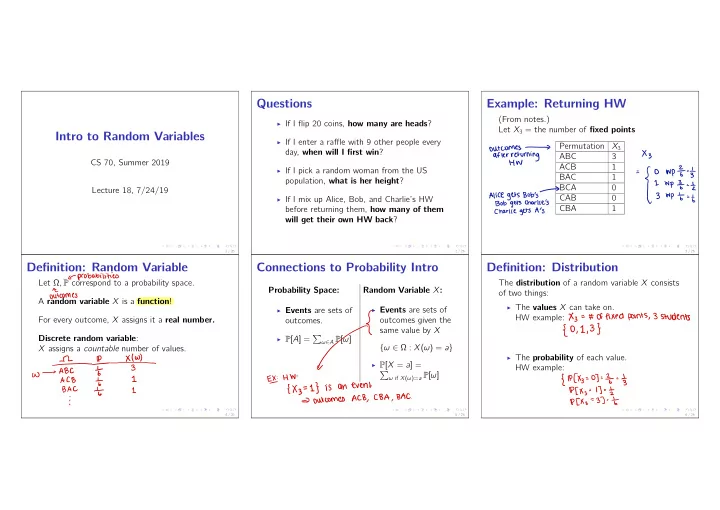
Questions Example: Returning HW (From notes.) I If I flip 20 coins, how many are heads ? Let X 3 = the number of fixed points Intro to Random Variables I If I enter a raffle with 9 other people every Permutation X 3 outcomes day, when will


slide-1
SLIDE 1

Intro to Random Variables

CS 70, Summer 2019 Lecture 18, 7/24/19

1 / 26

Questions

I If I flip 20 coins, how many are heads? I If I enter a raffle with 9 other people every

day, when will I first win?

I If I pick a random woman from the US

population, what is her height?

I If I mix up Alice, Bob, and Charlie’s HW

before returning them, how many of them will get their own HW back?

2 / 26

Example: Returning HW

(From notes.) Let X3 = the number of fixed points Permutation X3 ABC 3 ACB 1 BAC 1 BCA CAB CBA 1

3 / 26

  • utcomes

after returning

X 3

' HW =

nice

gets

. . .

  • .

I! :;÷÷

.

Wp 'T

'
  • to

Bob

gets

Charlie

's

Charlie

gets

A 's

Definition: Random Variable

Let Ω, P correspond to a probability space. A random variable X is a function! For every outcome, X assigns it a real number. Discrete random variable: X assigns a countable number of values.

4 / 26 ←

probabilities

a
  • utcomes

r p

X I w )

  • w

ABC

f-

3 A CB

t

I

6

BAC

I

1 ;

6 (

Connections to Probability Intro

Probability Space:

I Events are sets of

  • utcomes.

I P[A] = P

!2A P[!]

Random Variable X:

I Events are sets of

  • utcomes given the

same value by X {! 2 Ω : X(!) = a}

I P[X = a] =

P

! if X(!)=a P[!]

5 / 26

A

EI

H

W

:

{115-1}

is

an event

  • utcomes

ACB

,

CBA

,

BAC

.

Definition: Distribution

The distribution of a random variable X consists

  • f two things:

I The values X can take on.

HW example:

I The probability of each value.

HW example:

6 / 26

Xz

=

#

Of fixed

points

,

3

Students

{ O

,

I

, 3 }

{ IP CXz

  • O ]
  • Z
  • I

p [ X ,

=

I ]

=

I

P [ X 3

=3 )

  • I
slide-2
SLIDE 2

Sanity Check!

I What should the probabilities sum to, across

all values X can take on?

I Can X take on negative values? I Can X take on an infinite number of values?

I Countable values? I Uncountable values? 7 / 26

1

Yes !

Raffle

:

can

win

for the first time after

any

#

Of

days

Height

in a

population

continuous RVs

Is

arts

!

(

Later ,

Working with RVs

Let X be a random variable with the following distribution: X = 8 > < > : 1 wp 0.4

1 2

wp 0.25 −1

2

wp 0.35 What is the probability that X is positive?

8 / 26

PEX >

O ]

=

DEX =L ]

t

PEX

  • I ]
=

0.4

t

0.25

=

0.65

Functions of RVs

Same definition for X X = 8 > < > : 1 wp 0.4

1 2

wp 0.25 −1

2

wp 0.35 Write the distribution of f (X), where f : R ! R.

9 / 26

Wp

0.4

aisoa.tv?Yt-f#Ywpo.zsfftz

)

w p

0.35

Functions of RVs

Same definition for X X = 8 > < > : 1 wp 0.4

1 2

wp 0.25 −1

2

wp 0.35 Write the distribution of X 2.

10 / 26

*

.

÷÷¥

.

. ⇐

:

: :

Bernoulli Random Variable

Models whether one biased coin flip is a head. = ) Models a yes/no-type question or event Possible values of X: P[X = ] = p Parameters: p Notation: X ∼ Bernoulli(p)

11 / 26

{ 0,25

" Yes " "

not

I PEX

=

03=1

  • p

Bernoulli Example: Indicators

If X ∼ Bernoulli(p), and X = 1 corresponds to an event A in an experiment: = ) We say that X is an indicator for A. Each day, if it is sunny in Berkeley with probability 0.8 and cloudy with probability 0.2. Indicator for a sunny day?

12 / 26

S

=

indicator

for

a

sunny

day

S= {to

Wp

.

0.8

w p .

0.2

slide-3
SLIDE 3

Binomial Random Variable

Models how many heads are in n biased coin flips = ) Models a sum of independent, identically distributed (i.i.d) Bernoulli(p) RVs. Possible values of X: P[X = i] = Parameters: n, p Notation: X ∼ Bin(n, p)

13 / 26

Ftp { 0

,

1

,

. . . , n }

IP fatter

?

Enos ]

  • f7) pill
  • PJ
  • i

Binomial Example: Weather I

Each day, it is sunny in Berkeley with probability 0.8 and cloudy with probability 0.2. Weather across days is independent. What is the probability that over a 10 day period, there are exactly 5 sunny days? n = , p =

14 / 26

S

=

#

sunny

  • ver

10

days

.

S

~

Binh

, p)

10

0.8

PCS ;

?

]

  • (

' f)

10.850.25

  • w
  • (ni )

pi

a

  • pgn
  • i

Let Si

  • Berto
. 8) .

Si

  • Iif

day i

is

5=5

, + Sat
  • .

tsn

sunny

.

Binomial Example: Weather II

What is the probability that over a 10 day period, there are at least two sunny days?

15 / 26

IPCSZ 2)

=

1

  • Pf SE

I ]

c-

complement

=

1-

PCS

  • O ]
  • PCS =D
  • use

distribution BINGO

, 0.8 )

IP[5--0]=(18/10.8)%0.2110--9

.

IF

PCS

  • 17=(1,0×0.8/40.2)

9

=

10

  • 0.8
  • 0.29

PCS

223=1-0.2

)

"
  • 1010.8/10.239

Break

What is your real favorite movie, and what movie do you pretend is your favorite to sound cultured?

16 / 26

Geometric Random Variable

Models how many biased coin flips I need until my first head. = ) Models time until a “success” when performing i.i.d. trials with success probability p Possible values of X: P[X = i] = Parameters: Success probability p Notation: X ∼ Geometric(p)

17 / 26

PCH ]

  • up
.

1) 2,3

,

. . .

positive

integers

.

pfi

  • I

fall

,

win mens%fe.gs/=H-PXtp7...Ci-p)p--Ci-p)i-lp

.

Probabilities Sum To 1?

Not obvious that the probabilities sum to 1.

1

X

i=1

(1 − p)i−1p = Each term is the previous × the same multiplier. {a, ar, ar 2, ar 3, . . .} is a geometric sequence.

1

X

i=1

ar i−1 = a 1 − r

18 / 26

X

  • Geomlp )

pcx=i

]

P

) ~

ptcl

  • p )

Ptu

  • p5pt
. . .

stgtafigge Fratto

"

need

ftp.ya.FI#..1

slide-4
SLIDE 4

Aside: The Formula

An easy way to recreate the formula? Let S = a + ar + ar 2 + . . . Key Idea: r · S = ar + ar 2 + ar 3 + · · · = Solve for S!

19 / 26

SUM Of all terms

.

distributing

r d →

S

  • a

r S

  • S
  • a

a

=

S

  • S

r

a

=

sci

  • r ,

I

s

=

Fr

If

I r I

21

, "

S

=

a

"

doesn't

work

.

Geometric Example: Raffle I

I enter a raffle with 9 other people every day. Each day, a winner is chosen independently, and with equal probability. What is the probability that I win for the first time on the 5th day? p =

20 / 26

W

= day
  • f

first

WIN

.

÷

Ipfw

  • 5 ]
=

( fo )4(wt)

Geometric Example: Raffle II

What is the probability that I win the raffle some time on or before the 8th day?? If X ∼ Geometric(p), then: P[X i] =

21 / 26

iorartsfetime

.

Dfw -581=1

  • pfWZ9 ]

=L

  • lpftogsersfordays)

=L

  • CFol

'

I

PC iwtses]

  • Ci
  • p )

" I

Poisson Random Variable

Models number of rare events over a time period = ) Use the “rate” of event per unit time. Possible values of X: P[X = i] = λi i! e−λ Parameters: Rate λ Notation: X ∼ Poisson(λ)

22 / 26

/

at

,

2

,

. . .

noinnings

:S

.

a

Probabilities Sum To 1?

Again, not obvious that the probabilities sum to 1.

1

X

i=0

λi i! e−λ = Taylor Series for ex: ex =

1

X

i=0

xi i!

23 / 26

Tiki ,

e

'

" €7

xme

  • f

et

=

e

"

. e
  • X
=

I

Poisson Example: Typos

(Notes.) We make on average 1 typo per page. The number of typos per page is modeled by a Poisson(λ) random variable. What is the probability that a single page has exactly 5 typos? λ =

24 / 26

T

=

#

typos

per page

.

I

BET

=

s ]

= if ,

e-

'

= to

e-

'

= Toe
slide-5
SLIDE 5

Poisson Example: Typos

We type 200 pages. The pages are all

  • independent. What is the probablity that at least
  • ne page has exactly 5 typos?

25 / 26

p [

at

teas ! f-

Pg

. ] =

z

  • p [
n
  • f

? F)

=

I

  • [ p [

1

fazes y)

200

I Ya

"

g es

. =

I

  • [ I
  • ,

#

"

°

I

previous

page

Summary

I Random variables assign numbers to

  • utcomes.

I Treat X = i as any ordinary event. I Bernoulli, Binomial, and Geometric RVs have

nice interpretations via biased coin flips.

I Practice modeling real world events as

Bernoulli, Binomial, Geometric, Poisson.

26 / 26