SLIDE 1
Sunday, February 12, 2017 36th Annual First Year Experience Conference
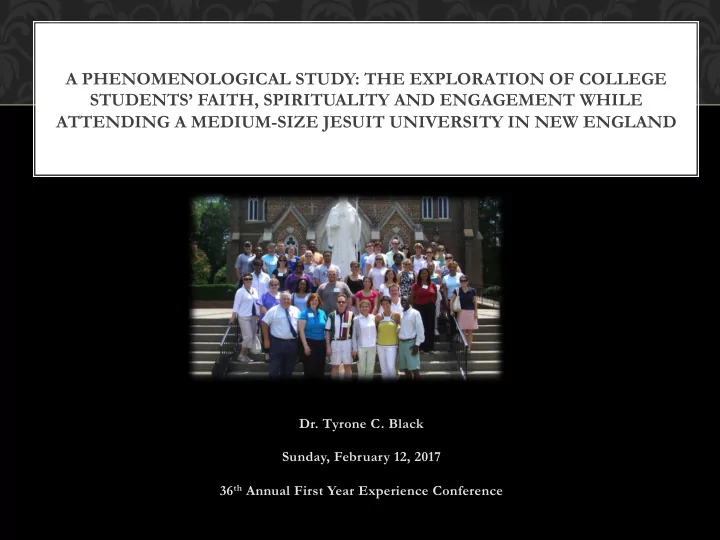
A PHENOMENOLOGICAL STUDY: THE EXPLORATION OF COLLEGE STUDENTS’ FAITH, SPIRITUALITY AND ENGAGEMENT WHILE ATTENDING A MEDIUM-SIZE JESUIT UNIVERSITY IN NEW ENGLAND
SLIDE 2
The purpose of this social phenomenological study is to explore closely how a small group of traditional age college students’ faith, spirituality and overall engagement have evolved over time while attending a medium-sized Jesuit university in the New England region of the United States. While various researchers have written articles, journals, and books on spiritual development and religion, very few have explored how spirituality and faith have impacted the undergraduate experience, the student’s overall engagement, identity authentication, and human development.
PURPOSE OF THE STUDY
SLIDE 3
How do a small group of traditional age college students attending a medium size Jesuit university experience the evolution of their faith, spirituality, identity, and engagement while enrolled in college?
OVERARCHING RESEARCH QUESTION
SLIDE 4
- 1. How do these students describe their faith and
spirituality?
- 2. How have their faith and spirituality shaped their
identity?
- 3. What experiences or events while in college, both
challenging and supportive, affected their change and growth over time?
RESEARCH SUB-QUESTIONS
SLIDE 5
- 4. How do these students describe their engagement while
in college?
- 5. From the students’ perspectives, what changes in their
faith and spirituality have occurred since their enrollment in college?
- 6. How has their enrollment at a Jesuit institution
influenced their faith, spirituality, identity, and engagement?
RESEARCH SUB-QUESTIONS
SLIDE 6
q To support the efforts taken by institutions of higher education to attend more purposefully to students’ spiritual development q To contribute to a greater understanding of a broader definition of faith and spirituality q To foster a belief that spirituality is essential to students’ lives and can have a major impact on students’ experiences while in college q To provide answers to questions that are directly relevant to the development of students’ personal qualities, such as self-understanding, empathy, caring, and social responsibility q To provide support to a large number of Catholic universities, other religiously affiliated institutions, and non-sectarian colleges that may be looking to reevaluate their curricular and co-curricular offerings. q To challenge college administrators and faculty to assess whether or not their course offerings and established co-curricular activities are in alignment with their mission.
SIGNIFICANCE OF THE STUDY
SLIDE 7
q Self-Actualization/Student Identity/Student Development q Faculty and Staff Influence q Curricular and Co-curricular Design q Integration of Faith and Learning/Spirituality in the Classroom q Service Learning q Student Engagement
REVIEW OF THE LITERATURE
SLIDE 8 q To conduct this qualitative study, a social phenomenological approach was used.
Ø Qualitative research is a type of educational research in which the researcher relies
- n the views of participants; asks broad, general questions; collects data consisting
largely of words (or text) from participants; describes and analyzes these words for themes; and conducts the inquiry in a subjective manner (Creswell, 2008, p. 46). Ø Social phenomenology is an approach in research which aims to reveal what role human awareness plays in the production of social action, social situations, and social worlds. By using this approach, the researcher is looking for common exchanges or interfaces that occurred during human action (Crossman, 2014).
q Through this phenomenological study, the goal was to understand the common influences that faith and spirituality have had on students’ lives and their college experience.
METHODOLOGY
SLIDE 9
Conceptual Framework Due to the nature of this study, which incorporates detailed descriptions of students’ experiences and perceptions, a social constructivist framework was used to guide this research.
Ø Social constructivists view learning as neither solely intrinsic nor purely extrinsic, but, rather, as a contiguous process that exists each time people willfully interact with each other in the world around them (Bronack, Riedl, & Tashner, 2006, p. 221).
METHODOLOGY
SLIDE 10
q Information was gained through in-depth interviews and document analysis, which helped in understanding student engagement and each student’s spiritual journey.
Ø In-depth interviews allowed each participant to share how faith and spirituality affected their college experience and shaped their overall identity and engagement.
DATA COLLECTION & DATA ANALYSIS
SLIDE 11
The Site Selection Ø Medium-size, Jesuit University in New England Ø Founded by the Society of Jesus Ø Coeducational institution of higher learning Ø Mission: * develop the creative intellectual potential of its students * foster ethical and religious values * foster a sense of social responsibility Ø Offers bachelor’s and master’s degrees Ø Suburban setting Ø Close to 5,000 undergraduate students enrolled Ø 85% of the student population live in residential housing
DATA COLLECTION & DATA ANALYSIS
SLIDE 12 Selection of Participants
- The sample for this study consisted of 11 undergraduate
students, both men and women, enrolled at the study site.
- All participants met the following criteria: (a) are full-time,
undergraduate students; (b) belong to the age group between 18 to 23 years old; and (c) practice some type of faith or engage in some level of spirituality. Students who were interviewed are juniors and seniors in college.
DATA COLLECTION & DATA ANALYSIS
SLIDE 13 PROFILE OF PARTICIPANTS
Name Age Ethnicity/Race Gender First in family to attend college Level of College Academic Major Anif
20
African American/ Black M No Junior Psychology Cathy
21
Caucasian F No Senior Psychology/English/ Professional Writing Christina
21
Caucasian F No Senior Sociology Claretta
20
African American/ Black M Yes Junior Political Science Jake
21
Caucasian M Yes Senior Economics Jessica
21
Latina/Hispanic F No Senior English John
20
Caucasian M No Junior Psychology Joshua
21
Caucasian M No Junior Communication Katherine
21
Caucasian F No Senior Psychology Sohail
21
Asian M No Senior International Studies Tracey
20
Latina/Hispanic & Multi-racial F No Junior Music Management
SLIDE 14 PROFILE OF PARTICIPANTS
Name Religious Affiliation List of clubs, organizations, and committees in which you participate. What is your current housing arrangement? Anif
Roman Catholic Student Government; Academic Immersion; Project Excel; Rugby Live on campus
Cathy
Roman Catholic Psychology Club; Head Start; Alliance on Mental Illness; Service Trips Live on campus
Christina
Christian/Non- denominational Campus Ministry; Student Senate; Theatre; Glee Club; Alliance; College Democrats; Tour Ambassadors Live on campus
Claretta
Anglican Christian Inter-Residential Housing Association; Student Conduct Board; Peer Student Conduct Board; President Initiative Diversity Council Live on campus
Jake
Roman Catholic Lectors; Alumni Mentor to Residential College; College Republicans; Omicron Delta Epsilon; Economics Club Live on campus
Jessica
Roman Catholic Eucharistic Minister; Sorority; Italian Club; Kairos Live on campus
John
Protestant Christian Young Life; Best Buddies; Rugby Live on campus
Joshua
Ignostic Intramural Sports Live on campus
Katherine
Roman Catholic Student Government; Career Planning; Campus Ministry; Alliance Live on campus
Sohail
Muslim Common Ground; Muslim Student Association; South Asian Student Association Live on campus Roman Catholic Lectors Live at home with family
SLIDE 15
Three major themes and eleven sub-themes related to the overarching research question and sub-questions were identified.
THEMATIC FINDINGS
SLIDE 16 Theme 1: Ways of Viewing Faith and Spirituality Ø The majority of the students in this study shared that they view faith and spirituality in several ways: (a) as part of one’s personal identity; (b) as a set of beliefs passed on by one’s family; and (c) as sacred symbols that are representations of their faith and spirituality. q “Faith and spirituality means putting your trust in one thing. . . . You can have faith in friends and in everything that you do. . . . A person’s spirituality is through God.” – Anif q “I know by definition that faith is believing in something that you cannot really
- prove. . . . It’s not like a factual thing. . . . It’s believing in the abstract, which is
completely opposite of science.” - John
THEMATIC FINDINGS
SLIDE 17
Theme 2: My Spirituality and Identity Have Changed Ø Eight participants expressed that they experienced significant growth in their spiritual life which directly affected their identity. q “If you had asked me during my freshman year why I believe in certain things, my answer would have been because my mom and dad believe. But now I have a more independent mindset. I have to admit that I attribute most of my spiritual growth and changes to the courses in my psychology major.” –Katherine q “I considered myself to be spiritual and quite religious before entering college. But in actuality, I was only going through the motions. I didn’t really have a deep relationship with God. I feel like the service trips that were offered through Campus Ministry really challenged my faith and made me more serious in my spiritual walk.” - Cathy
THEMATIC FINDINGS
SLIDE 18 Theme 2: My Spirituality and Identity Have Changed q “I am quite thankful that I attend a Jesuit institution. Since my freshman year, I have experienced a complete 180 degree change in my spiritual life, identity, and level of
- engagement. I grew up both Protestant and Catholic with a very structured life. I
believe that by being at a Jesuit institution, where religious beliefs are not forced upon you, it has caused me to really embrace developing a more intimate relationship with God and to see the importance of growing spiritually rather than denominationally.” - Christina
THEMATIC FINDINGS
SLIDE 19
Theme 3: Spiritual Development: Part of the Human Experience Ø All of the participants in this study said that spiritual development is a necessary part of personal development; however, 10 of the 11 participants who were interviewed emphasized that developing spiritually is one of the most important aspects in their life. q “Every person has to devote themselves to a spiritual and faith walk in order for these aspects to grow and strengthen. Spiritual growth does not happen from external influences alone. There must be some level of commitment on the part of the individual.” – Katherine q “Spirituality gives purpose to your daily life and gives you better understanding as to why being in college is important.” - Jessica
THEMATIC FINDINGS
SLIDE 20
Theme 3: Spiritual Development: Part of the Human Experience q “Developing in this manner is part of developing one’s own character and sense of self in relation to the world. If you are spiritual, you have a better understanding of your place amongst everything, or at least you are okay with questioning everything. It establishes your foundation for being a human being. My spirituality provides meaning for what I do. Coming to college has really helped me to value my own personal faith and spiritual growth. I am definitely more connected to my values just by observing what others believe and value.” - Sohail
THEMATIC FINDINGS
SLIDE 21 Ways of Viewing Faith and Spirituality
Sub-themes: 1. Symbols: Part of One’s Spiritual and Religious Identity
* Ten out of the 11 participants have in their possession an item that
not only represents who they are as a person, but serves as a constant reminder of their commitment to their spiritual or faith-based walk.
- “My grandmother gave me this cross, and I wear it as a part of who I am, and as a
reminder of all the lessons and values that my family has instilled in me.” - Jake
- “My Claddagh ring, which was purchased for me while in Ireland, represents my
grandfather, a very religious man who emigrated from Ireland to give his family a better life. Whenever I wear this ring, I am constantly reminded of his struggles, sacrifices, and undying love and commitment to the Roman Catholic Church.” - Katherine
THEME 1
SLIDE 22
- 2. Faith and Spirituality: A Part of One’s Personal Identity
* Eight of the 11 participants shared in various ways how their outward expression of faith and spirituality are a part of who they are.
- “I have strong beliefs, which is due to my faith in God and being Roman Catholic. . . .
And because I hold close my beliefs, they have given me a stronger inner purpose, which is my spirituality.” - Jessica
THEME 1
SLIDE 23 3. Faith and Spirituality: A Set of Beliefs Often Passed on by One’s Family * Five out of 11 participants acknowledged that religious and spiritual beliefs of their family still strongly influence how they interacted with
- ther students as well as lived their own daily lives amidst such a social
environment.
- “I was raised in a very ultra-conservative home, and it was expected that everyone in my
home practiced the religious beliefs that my parents practiced. . . . Being faithful to the family religion was very important.” - Jake
THEME 1
SLIDE 24 4. Faith and Spirituality: A Support System * Three out of the 11 participants view their personal faith and spirituality as a constant support system which helps them grow multi- dimensionally.
- “My faith helps me cope with tough situations and helps me find reason in all things. It
is the bridge in my relationship with God. But in order for my relationship with God to be strengthened and grow, I must devote myself wholeheartedly to a lifelong spiritual and faith walk.” - Katherine
THEME 1
SLIDE 25
My Spirituality and Identity Have Changed
Sub-themes: 1. Values and Personal Beliefs Have Changed During College
* Eight of the 11 participants openly expressed how their values and
personal beliefs have changed since enrolling in college. Ø “I have become more accepting of other peoples’ religious practices and have become much more respectful of their religious practices, though I still struggle with what I believe.” - Joshua
THEME 2
SLIDE 26 My Spirituality and Identity Have Changed
Sub-themes: 1. Faith and Spirituality Have Influenced Social Behavior * Eight of the 11 participants shared how faith and spirituality influenced how they thought, interacted with others, and engaged in social settings. Ø “My little guilt, which is my faith, makes me have discussions with myself before making a decision in the party scene and hook-up culture. I tend not to make awful decisions because
- f my faith and how I was raised. My faith always reminds me of who I represent, which
is not just myself but God and my parents.” - Jake
THEME 2
SLIDE 27
My Spirituality and Identity Have Changed
Sub-themes: 2. Faith and Spirituality Have Influenced Social Behavior Ø “I do not follow the crowd and go to parties and act reckless or display risky behavior. My faith makes me think more and more about my behavior and possible consequences.” - Claretta
THEME 2
SLIDE 28
Spiritual Development: Part of the Human Experience
Sub-themes: 1. Meaningful Conversations Promoted Spiritual Growth
* Nine of the 11 participants passionately shared how important it was
to engage in constant conversations about life, purpose, faith, and spirituality. Ø “Yes! In fact, I live in one of the three residential colleges that was centered on learning about social justice and diversity. We are constantly talking about being agents of change and living the Ignatius value of setting the world aflame.” – Katherine Ø “Having conversations with peers during a retreat is enlightening. I never thought by coming to college that I would be able to sit in the cafeteria or at a retreat and talk about the meaning of life. . . . I have had some meaningful and worthwhile conversations that I will never forget.” – Jake
THEME 3
SLIDE 29 Spiritual Development: Part of the Human Experience
Sub-themes: 2. Faculty and Staff Significantly Influenced their Spiritual Journey * Eight of the 11 participants stated that they experienced spiritual growth and change due to their interactions with faculty and staff. Ø “I think, at a Jesuit university, professors feel free to ask thought-provoking questions. These questions make you analyze every relationship and conversation and why that person
- r conversation is important to your life at that time. I like how the professors do not settle
for general answers; they want answers that show that you have been thinking about the topic all day and night.” – Katherine Ø “My professor made me really think and question my thoughts like: ‘What my purpose is?’ ‘What am I on this earth to do?’ ‘What do I want to do with my life?’ and ‘How does faith tie into answering these questions?’ - Christina
THEME 3
SLIDE 30 Spiritual Development: Part of the Human Experience
Sub-themes: 3. Events That Promoted Spiritual Growth * Eight of the 11 participants spoke in great depth on significant events that promoted their spiritual growth. Ø “During my freshman year, I went to visit with my mother, who lives in Sweden. To make a long story short, I ended up toppling over a sixth floor balcony and falling 50 feet on to concrete. I broke my left foot and shattered my left heel; broke my left leg; broke my pelvic bone in four places; shattered my rib cage; ruptured my liver and kidneys; broke both arms; and broke both
- hands. I was clinically dead for 25 seconds, revived, dead again for 15 seconds, and then revived
- again. I was out cold for the first two weeks while I fought for my life, and that is where my
understanding of spirituality really took root. Again, not really knowing if that power was God, I just felt that there was a higher power in control and gave me a second chance at life. This power gave me the strength to push forward, day by day. This was one of the biggest experiences of my life. It was sort of that ‘ah ha’ moment.” - Joshua
THEME 3
SLIDE 31 Spiritual Development: Part of the Human Experience
Sub-themes: 4. Co-Curricular Activities Enhanced Their Spiritual Journey * Eight of the 11 participants spoke to their involvement in student
- rganizations that they felt enhanced their spiritual journey.
Ø “I attended the Kairos Retreat during the first semester of my freshman year. There were 15 others in my class who attended as well. Everyone who attended returned to campus with a closer bond and a greater sense of accountability. We all also found a deeper reason to attend Mass throughout the week. “ - Jessica
THEME 3
SLIDE 32
Spiritual Development: Part of the Human Experience
Sub-themes: 5. Challenging One’s Faith in the Classroom * Four of the 11 participants shared in great detail those college courses that
made them really ponder and think about their own spiritual journey.
Ø “The course introduced us to documents written by Popes before they were Popes. Some of what they wrote was kind of controversial, talking about things like homosexuality and hot button topics that cause you to relook at things to see if there is a right or wrong answer to these topics. . . . We always debated things, such as right and wrong, and whether anyone has the right to call things right or wrong.” - Jessica
THEME 3
SLIDE 33 CURRENT LITERATURE REFERENCES It is important to integrate spirituality into Bryant & Schwartz (2006) the college curriculum and then reinforce whatever has been taught by carrying the dialogue into the co-curricular experience. New Findings: Spiritual retreats sponsored by the university, according to participants, helped them to: (a) learn how to cope with past traumatic experiences; (b) consider others and their feelings, especially when going through catastrophic moments in life; and (c) be more disciplined in their spiritual walk by spending time in prayer and away from social media, technology, and
- ther external distractions.
- XI. FINDINGS & CURRENT
LITERATURE
SLIDE 34 CURRENT LITERATURE REFERENCES Faculty and staff have a significant Love & Talbot (1999) influence on the spiritual journey and development of their students. Student engagement happens when Welch & Koth (2009) students begin to develop a strong sense of connection with an experience and fully integrate that experience into their life.
LITERATURE
SLIDE 35 § The results of this study demonstrate that the influence of faculty and staff both inside and outside the classroom, conversations with peers, and
- pportunities through various college events have the greatest effect on
how students develop spiritually as well as in their faith walk. § Continuing conversations of religion, faith, and spirituality from the classroom to living learning communities, residence halls, retreats, and student clubs and organizations was quite critical in showing how faith and spirituality can move from theory and philosophy to application and practice. § By encouraging students to join clubs and organizations early on in college, they are more likely to take ownership of their own self-exploration and spiritual journey and be more intentional about the conversations in which they will engage, the courses in which they will enroll, the clubs and
- rganizations they will join, and the spiritual and personal growth retreats
they will attend.
IMPLICATIONS
SLIDE 36 Based on the findings of this study, the following recommendations are suggested for administrators and faculty in both academic and student affairs at religiously affiliated institutions, especially Catholic colleges and universities. Administrators and faculty at non- sectarian colleges who seek additional ways to purposefully assist college students in their spiritual evolution could also benefit from the following recommendations. Ø The faculty, especially those who have strong religious ties to their beliefs, should be willing and encouraged to express their spiritual identity through their teaching and advising. Ø A mentoring program would be ideal for promoting ongoing, intentional, meaningful dialogue and conversations between students, faculty, and staff. It would also create opportunities for faculty and staff to help students set spiritual goals for themselves throughout the year. Ø Senior officers from both student and academic affairs, including the university president, could make opportunities to share with students their
- wn personal journeys, struggles, and lifelong goals.
RECOMMENDATIONS
SLIDE 37 Continued Ø The six participants who spoke highly of their experiences on spiritual retreats suggested they be a bit more ecumenical in design. Ø All participants in this study suggested that there should be more
- pportunities to have one-on-one conversations with the Jesuit Priests.
Ø Colleges may want to begin engaging students in meaningful, faith-based dialogue and activities during new student orientation.
SLIDE 38
From the day of new student orientation to commencement ceremonies, a
student’s identity changes significantly. His or her critical thinking skills have developed, their emotional capacity has been challenged and ultimately redefined, and their morals, values and religious beliefs have been tested. The person with whom they identified as a freshman will soon become an apparition as they grow closer to the day of graduation. The new identity surfaces as a result of interacting with other cultures, attending classes with faculty who engage their students in intense self-exploration, and participating in activities which promote community and service to others. Contact: tcb_1972@hotmail.com (860)803-6309 (cell)
QUESTIONS/COMMENTS
SLIDE 39
SLIDE 40 Allen, K. & Kellom, G. (2001). The role of spirituality in student affairs and staff
- development. New Direction for Student Services. 95(1), 47-55.
Astin, A. (2004). Why spirituality deserves a central place in higher education. Spirituality in Higher Education Newsletter 1 (1), 1-12. Astin, A., Astin, H., Chopp, R., Delbanco, A., & Speers, S. (2007). A forum on helping students engage the “big questions”. Liberal Education. 93(2), 28-33. Astin, A., Astin, H., & Lindholm, J. (2011). Cultivating the spirit: How college can enhance students’ inner lives. San Francisco, California. Jossey-Bass. Braskamp, L., Trautvetter, L., & Ward, K. (2006). Putting students first: how colleges develop students purposefully. Bolton, Massachusetts. Anker Publishing Company.
REFERENCES FOR THE DEFENSE
SLIDE 41
Bronack, S., Riedl, R., Tashner, J. (2006). Learning in the zone: A social constructivist framework for distance education in a 3-dimensional virtual world. Interactive Learning Environments. 14(3), 219-232. Bryant, A. & Schwartz, L. (2006). Spirituality in higher education: Integrating spirituality into the campus curriculum and co-curriculum, National Institute on Spirituality in Higher Education. Creswell, J. W. (2007). Qualitative inquiry & research design: Choosing among five approaches (2nd ed.). Thousand Oaks: Sage Publications. Creswell, J. (2008). Educational research: planning, conducting, and evaluating quantitative and qualitative research. Upper saddle River, New Jersey. Pearson-Merrill Prentice Hall. Crossman, A. (2014). Social phenomenology: An overview. Retrieved from http://sociology.about.com/od/Sociological-Theory/a/Social- Phenomenology.htm REFERENCES FOR THE DEFENSE
SLIDE 42 Dockery, D. (2000). Integrating faith and learning in higher education. The Research Institute of the Ethics and Religious Liberty Commission Fall Meeting. Gray, M. & Cidade, M. (2010). Catholicism on campus: Stability and change in catholic student faith by college type. Catholic Education: A Journal of Inquiry and Practice 14(2), 212-237. Jacoby, B. (1996). The role of service-learning programs: CAS standards contextual
- statement. CAS Professional Standards for Higher Education.
Lee, A. (2008). Integrating spiritual issues into the classroom curriculum. Retrieved from h ttp://www.intervarsity.org/gfm/faculty/resource/spiritual-issues- in-the- classroom-curriculum
REFERENCES FOR THE DEFENSE
SLIDE 43 Lindholm, J. (2007). Spirituality in the academy: Reintegrating our lives and the lives of
- ur students. About Campus.
Lindholm, J., Millora, M., Schwartz, L., & Spinosa, H. (2011). A guidebook of promising practices: Facilitating college students’ spiritual development. Regents of the University of California. Love, P. & Talbot, D. (1999). Defining spiritual development: A missing consideration for student affairs. NASPA Journal. 37(1), 361-375. Maslow, A. (2011). Toward a psychology of being. Floyd, VA: Sublime Books.
REFERENCES FOR THE DEFENSE
SLIDE 44 Moustakas, C. E. (1994). Phenomenological research methods. Thousand Oaks, CA: Sage Publications. Roberts, C. (2010). The dissertation journey. A practical and comprehensive guide to planning, writing, and defending your dissertation. Thousand Oaks,
- California. Corwin-A Sage Company.
Shenton, A. (2004). Strategies for ensuring trustworthiness in qualitative research
- projects. Education for Information. 22, 63-75.
REFERENCES FOR THE DEFENSE
SLIDE 45 Sorrentino, P. (2010). What do college students want? A student-centered approach to multifaith involvement. Journal of Ecumenical Studies. 45(1), 79-96. Watson, E. (2013). Religious activity rebounds on college campuses. Retrieved from http://diverseeducation.com/article/52087/ Welch, M. & Koth, K. (2009). Spirituality and service-learning: Parallel frameworks for understanding students’ spiritual development. Spirituality in Higher
REFERENCES FOR THE DEFENSE