A New Way of Stormwater Management Applying Asset Management to - - PowerPoint PPT Presentation

a new way of stormwater management
SMART_READER_LITE
LIVE PREVIEW

A New Way of Stormwater Management Applying Asset Management to - - PowerPoint PPT Presentation

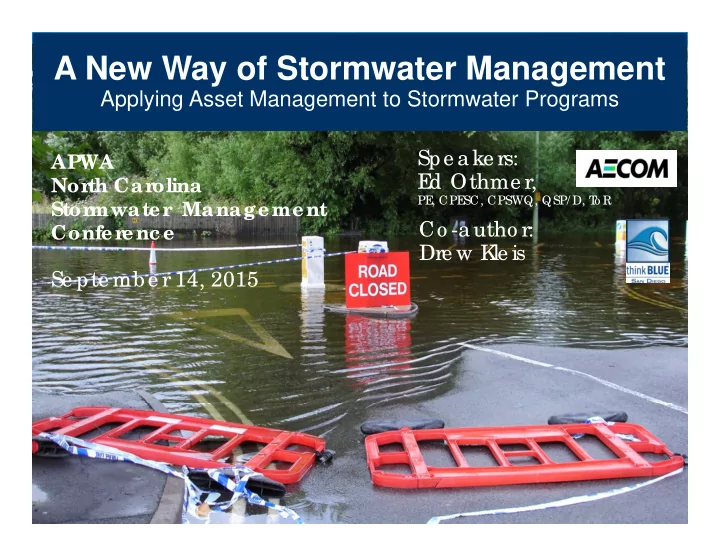
A New Way of Stormwater Management Applying Asset Management to Stormwater Programs Spe ake rs: APWA E d Othme r, Nor th Car olina PE , CPE SC, CPSWQ, QSP/ D, T o R Stor mwater Management Co -autho r: Confer ence Dre w K le is


slide-1
SLIDE 1

A New Way of Stormwater Management

Applying Asset Management to Stormwater Programs

Spe ake rs: E d Othme r,

PE , CPE SC, CPSWQ, QSP/ D, T

  • R

Co -autho r: Dre w K le is

APWA Nor th Car

  • lina

Stor mwater Management Confer ence

Se pte mbe r 14, 2015

slide-2
SLIDE 2

Agenda

1. Emerging Business Conditions 2. Approach 3. Future Investment Needs (Example)

slide-3
SLIDE 3

Emerging Business Conditions

slide-4
SLIDE 4

http://www.colbertnation.com/

Emerging Business Conditions

Source: http://www.colbertnation.com/the‐colbert‐report‐ videos/425692/april‐22‐2013/tiny‐triumphs‐‐‐infrastructure‐‐‐river‐pollution

slide-5
SLIDE 5
  • Increasingly stringent regulations
  • Aging infrastructure
  • Flood planning disconnected from water

quality planning

  • Customer base not aware of all services

provided

  • Changing Boards and Councils
  • Limited resources
  • Key employees are retiring
  • Renewed focus on accountability

Emerging Business Conditions

slide-6
SLIDE 6

Approach

slide-7
SLIDE 7

What is Asset Management?

  • Clearly communicates

– What we need & why we need it – Long term funding needs to sustain the services – Consequences & risks

  • Sound basis for prioritizing work
  • Transparent, balanced
slide-8
SLIDE 8

OLD

  • Budget based on last year
  • Little knowledge of system

risks

Backward Looking

  • Projects determined as

problems arise during the year

Reactive

  • Do as many projects as

you can afford each year

Budget Constrained

  • Money is spent but overall

risk may not have been reduced much

Ignores asset and system risks

NEW

  • Based on asset risk scores and

cost

Forward Looking

  • High risk assets slotted for

renewal before failure occurs

Proactive

  • Budget could be determined

based on agreed risk targets for system

Risk or Budget Constrained

  • High risk assets addressed first
  • Budget may rise or fall to meet

risk targets

Focused on risk management

Risk‐Based Planning Represents a New Focus

slide-9
SLIDE 9

What Is Failure?

Desired Condition? Minimum Standard?

slide-10
SLIDE 10

Levels of Service

slide-11
SLIDE 11

Step 6: Business Risk Evaluation Steps 7, 8, & 9: Optimize Investments and Fund Steps 1 – 5 Asset Registry & Levels of Service

slide-12
SLIDE 12

Mission, Goals, and Core Principles

slide-13
SLIDE 13

Watershed Asset Management Plan

Cond. Assessment

TMDLs

Flood Risk Mgmt

Program Integration “Holistic Approach”

Best Available Science NPDES Storm water as Resource

slide-14
SLIDE 14

Asset Management Overview

1. What do we own / manage? 2. What is its required level of service? 3. Which assets are critical?

a. Condition b. Business Risk Exposure

4. What are my optimized management strategies?

a. What needs to be done? b. When? c. Costs?

5. What do I need to do to fund it?

Inventory Assets Determine Residual Life Set Target Levels of Service Assign Risk Rating (Criticality) Determine Management Strategy Determine Appropriate CIP Fund Your Strategy Build the AMP Determine Replacement Costs Identify Failure Modes

slide-15
SLIDE 15

Asset Definition & Hierarchy

Right-of-Way

slide-16
SLIDE 16

Asset Definition & Hierarchy

slide-17
SLIDE 17

What’s More Important?

Source: City of Raleigh, Update on Integrated Stormwater Project Prioritization Model

slide-18
SLIDE 18

Business Risk Exposure (BRE) Analysis:

  • The most powerful element in asset management!
  • Not all asset are equal!
  • Used for prioritization of activities with limited funding

What Is The Risk Associated With My Assets?

Triple Bottom Line Consequences

  • f Failure

Consequence

  • f Failure (CoF)

CoF

Business Risk Exposure

BRE =

Condition, Reliability, Performance Probability

  • f Failure (PoF)

x PoF

slide-19
SLIDE 19

Triple Bottom Line for CoF

  • Balanced
  • Transparent
  • Recognizes

all concerns

  • Doesn’t borrow

from future generations

slide-20
SLIDE 20

Business Risk Exposure

slide-21
SLIDE 21

Inputs and Outputs

Asset Management Database Watershed Asset Management Plans Water Quality Improvement Plans TMDL Compliance Data Natural Assets Soft Assets Hard Assets Staff

slide-22
SLIDE 22

Future Investment Needs (Example)

slide-23
SLIDE 23

Where’s the money coming from?

What’s this gonna cost me? How am I going to pay for this?

The Operations Manager The Finance Manager

slide-24
SLIDE 24

$0 $100,000,000 $200,000,000 $300,000,000 $400,000,000 $500,000,000 $600,000,000 2014 2016 2018 2020 2022 2024 2026 2028 2030 2032 2034 2036 2038 2040 2042 2044 2046 2048 2050 2052 2054 2056 2058 2060 2062 2064 2066 2068 2070 2072 2074 2076 2078 2080 2082 2084 2086 2088 2090 2092 2094 2096 2098 2100 2102 2104 2106 2108 2110 2112

Asset Type Summary

Hard Assets (including shared) Soft Assets Natural Assets Average

Long Range Capital Needs by Asset Type

Year Asset Name Action Type Action Cost Risk Score 2014 Metal pipes LIN-HAS-78 Replace $340,000 25 2014 Metal pipes LIN-HAS-92 Replace $176,000 25 2014 Metal pipes LIN-HAS-114 Replace $49,000 20 2014 Pump #2 Oak St. PS Rehab $20,000 20 2014 GenSet Vine Rd. PS Replace $80,000 15 …
slide-25
SLIDE 25

Average: $199.8 M $7,460 $4,225 $2,603 $3,701 $854 $1,134

$‐ $1,000 $2,000 $3,000 $4,000 $5,000 $6,000 $7,000 $8,000 $9,000 $10,000 San Diego Bay San Diego River Mission Bay Penasquitos San Dieguito Tijuana River Total Investment (Million)

Hard Assets Soft Assets Natural Assets Average Total

Long Range Capital Needs by Watershed

slide-26
SLIDE 26

Funding Scenarios

$- $500 $1,000 $1,500 $2,000 $2,500 $3,000 $3,500 $4,000 $4,500 $5,000 2014 2019 2024 2029 2034 2039 2044 2049 2054 2059 2064 2069 2074 2079 2084 2089 2094 2099

Total Backlog ($ Million)

Scenario 1 - Full Service Level Attainment Scenario 2 - Current Budget ($34.5M) Scenario 3 - Increase $2 M for 5 years Scenario 4 - Increase $6 M for 5 years Scenario 5 - Increase $8 M for 5 years Scenario 6 - Increase $10 M for 5 years

slide-27
SLIDE 27

How to get started…

1. A basic inventory can give enough data to justify investment 2. Asset management should not operate remotely 3. Senior management understanding the concept is critical to success 4. Staff should be involved and included in developing the program and compiling data 5. Software does not need be complex 6. You can manage the program

JUST GET STARTED

slide-28
SLIDE 28

Q&A

Ed Othmer, PE, CPSWQ, CPESC, QSD/P, ToR, QISP ToR AECOM Ed.Othmer@aecom.com www.aecom.com