for Climate Change Assessment Dhruba Pant, Ph.D Launching Workshop - - PowerPoint PPT Presentation

for climate change assessment
SMART_READER_LITE
LIVE PREVIEW

for Climate Change Assessment Dhruba Pant, Ph.D Launching Workshop - - PowerPoint PPT Presentation

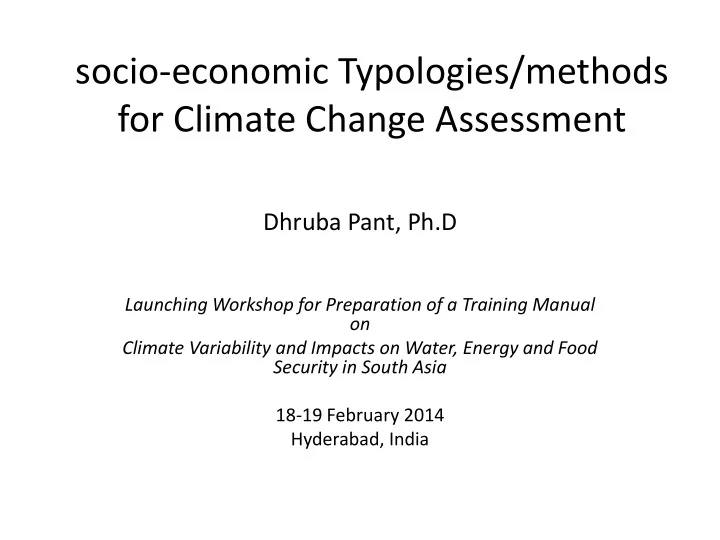
socio-economic Typologies/methods for Climate Change Assessment Dhruba Pant, Ph.D Launching Workshop for Preparation of a Training Manual on Climate Variability and Impacts on Water, Energy and Food Security in South Asia 18-19 February 2014


slide-1
SLIDE 1

socio-economic Typologies/methods for Climate Change Assessment

Dhruba Pant, Ph.D

Launching Workshop for Preparation of a Training Manual

  • n

Climate Variability and Impacts on Water, Energy and Food Security in South Asia 18-19 February 2014 Hyderabad, India

slide-2
SLIDE 2

Natural endowment parameters and Methods

Resource mapping :Identify spatial distribution/location of roads, forests, water resources, farmlands, etc.

slide-3
SLIDE 3

Social parameters and Methods

  • Stakeholder analysis: identify types of

stakeholders and stakes in NRM (CBOs,I/ NGOs, developmental agencies, etc.);

  • Identify key social actors and their

relationships between village and local people.

slide-4
SLIDE 4

Social parameters and Methods

  • Social mapping: map social institutions

and organisations (such as schools, post office, telecommunication, police post)

  • Identifying ethnic and caste groups

clusters (main settlements).

slide-5
SLIDE 5

Social parameters and Methods

  • Wealth ranking: list out local people’s

criteria of wealth and well-being;

  • Identifying relative wealth and

different socio-economic characteristics (categories/classes) of households.

  • List problems and prioritize problems

experienced by them.

slide-6
SLIDE 6

Capital Assets Methods

Human Resource

  • Capacity status in the communities: list of

skills and knowledge (literacy levels and workability by gender);

  • Mobility mapping: social and gender

equities/inequities in terms of contact with the outside world (markets, etc.).

  • Number of people in foreign employment
slide-7
SLIDE 7

Capital Assets Methods

Physical

  • Infrastructures mapping social

institutions and organisations (access to infrastructure such as transport, water supply, irrigation, etc.)

  • Trend line: developmental

infrastructures (bridges, drinking water, roads, etc.)

slide-8
SLIDE 8

Capital Assets Methods

Financial

  • Average income levels of different

livelihood groups, consumption loan and borrowed by sample households; remittances

  • Market structures present in the study area:

labour market, nature of migration, wage rate received in different types of work

slide-9
SLIDE 9

Livelihoods opportunities and strategies Method

  • a. Productivity from existing activities
  • Agricultural productivity, small businesses,

ability to save, access and opportunity to capital-credit;

  • b. Health and food security
  • Child and infant mortality (probably from

secondary sources), morbidity from diseases, environmental conditions, nutrition and balanced diets

slide-10
SLIDE 10
  • C. Vulnerability and Resilience
  • Occurrence and vulnerability to natural

disasters (landslides, floods, environmental degradation, deforestation, loss of ecosystem integrity, social, political and market disruption)

slide-11
SLIDE 11

Institutional Environment

  • External institutional environment: local

governance (local level empowerment, public awareness, political environment, development priorities and implementation priority, modality and types and status of development programs, governance structures, etc.)

  • Coping strategies of households: numbers of

alternative livelihoods adopted by households

slide-12
SLIDE 12

Participatory Action Plan

  • Process and contents of the Action Plan can

be developed based on the following analyses:

– List of major problems and solutions identified from analysis of both primary and secondary information. – Understanding opportunities, alternatives and

  • ptions for improved livelihoods and

infrastructures development.

slide-13
SLIDE 13

Thank You