A new EU energy technology policy towards 2050: Which way to go? - - PDF document

a new eu energy technology policy towards 2050 which way
SMART_READER_LITE
LIVE PREVIEW

A new EU energy technology policy towards 2050: Which way to go? - - PDF document

A new EU energy technology policy towards 2050: Which way to go? Sophia Ruester Universit degli Studi di Firenze 9 Ottobre 2013 Liberalization of the electricity sector 1996 - 2003 - 2009 Independent (inter-)national regulators Retail and


slide-1
SLIDE 1

1

A new EU energy technology policy towards 2050: Which way to go?

Sophia Ruester

Università degli Studi di Firenze 9 Ottobre 2013

www.florence-school.eu

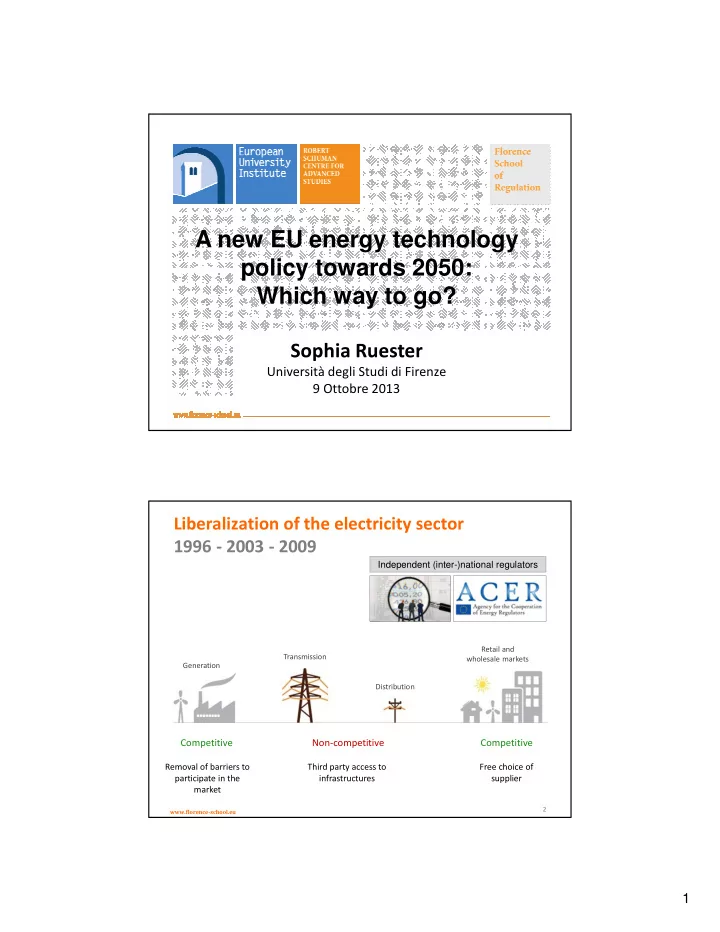
Liberalization of the electricity sector 1996 - 2003 - 2009

2

Generation Transmission Distribution Retail and wholesale markets

Competitive Non-competitive Competitive

Third party access to infrastructures Removal of barriers to participate in the market Free choice of supplier Independent (inter-)national regulators

slide-2
SLIDE 2

2

www.florence-school.eu

Electricity generation by source 2012 data (Eurostat database)

3

ITALY

Total: 285,000 GWh

EU-27

Total: 3,086,000 GWh

www.florence-school.eu

THINK Report #9

“A new EU energy technology policy towards 2050: Which way to go?“ (Published in February 2013)

4

Project leader: Matthias Finger Research team: Sophia Ruester, Sebastian Schwenen and Jean- Michel Glachant

slide-3
SLIDE 3

3

www.florence-school.eu

1 – Background

The decarbonization objective Different scenarios for decarbonization Need for a new EU energy technology policy

5

www.florence-school.eu

The 20-20-20 targets … by 2020

Set in 2007… … and enacted through the “EU Climate and Energy Package” in 2009

  • Revision and strengthening of EU ETS (Directive 2009/29/EC)
  • Effort Sharing Agreement governing GHG emissions from sectors not covered by the EU ETS

(Decision 406/2009/EC)

  • Binding national targets for renewable energy (Directive 2009/28/EC)

6

20%

reduction in EU GHG emissions compared to 1990 levels

20%

share of EU energy consumption produced from RES

20%

improvement in the EU's energy efficiency

slide-4
SLIDE 4

4

www.florence-school.eu

Commitment to the low-carbon economy … by 2050

  • In 2009, the European Council set the abatement objective for Europe at 80-95%

below 1990 levels

  • In 2011, the European Commission adopted the EU "Energy Roadmap 2050“

7

GHG reductions compared to 1990 2005 2030 2050 Power

CO2

  • 7%
  • 54 to -68%
  • 93 to -99%

Industry

CO2

  • 20%
  • 34 to -40%
  • 83 to -87%

Transport (incl. aviation, excl. maritime)

CO2

30% +20 to -9%

  • 54 to -67%

Residential and services

CO2

  • 12%
  • 37 to -53%
  • 88 to-91%

Agriculture

Non-CO2

  • 20%
  • 36 to -37%
  • 42 to -49%

Other Non-CO2 emissions

Non-CO2

  • 30%
  • 72 to -73%
  • 70 to -78%

www.florence-school.eu

Background The decarbonization objective

  • “2050 objective”: Commitment to

reduce GHG emissions to 80-95% below 1990 levels by 2050

8

Very high degree of decarbonization of the electricity sector

  • Electrification of other sectors

– Uncertain at which pace and to which extent

See e.g. visions regarding the penetration of electric vehicles:

Every policy must allow for such electrification

Source: EC (2011 - COM(2011) 112 final) Source: Kampman et al. (2011)

implies

slide-5
SLIDE 5

5

www.florence-school.eu

Background A menu of decarbonization technologies

a) Consumption-oriented:

– Increase in energy efficiency – Behavioral changes

b) Production-oriented:

– Low-carbon generation (RES, nuclear) – Decarbonization of fossil fuels (CCS)

9

www.florence-school.eu

Background A menu of decarbonization technologies

  • Huge uncertainty regarding the 2050 system…
  • … coming from both internal and external factors

10

2020 2030 2050 Technology paths roughly known Technology paths relatively uncertain Technology paths basically unknown

slide-6
SLIDE 6

6

www.florence-school.eu

Background Selected scenarios for 2050

11

Energy Roadmap 2050:

  • … or
  • “The energy transition will primarily result from

countless private decisions on energy supply and use, shaped by the entrepreneurial actions of private innovators” (Lester and Hart, 2012)

  • High energy efficiency

www.florence-school.eu

  • Energy efficiency improvements of utmost importance
  • Three main variables are on the production side:
  • Shares of (1) RES, (2) nuclear and (3) CCS
  • Way towards 2050, in any case, should
  • Be cost-efficient and
  • Foster European competitiveness

Background Other roadmaps

  • Differ in assumptions, baseline and

concrete 2050 scenarios

  • … but all have some aspects in common

12

slide-7
SLIDE 7

7

www.florence-school.eu

Background Four kinds of reasons for policy intervention

13

Environmental externality

Reduction of GHG emissions is a global pubic good

Innovation externalities

Spillover effects and related appropriability problem

Capital market imperfections

… and resulting funding gap

Increasing global competition

Challenge: “remain at forefront of booming international market” at a time when MS curtail public spendings

Market failures

Strategic trade and policy issues

www.florence-school.eu

Background European players face global competition, but…

14

Wind sector:

  • Top-European turbine manufacturers see reduction in

their global market share

– 67% (2007) – 58% (2008) – 46% (2009) trend likely to continue – Chinese manufacturers gain (production 30% cheaper than in

  • ther regions)
  • BUT: only European manufacturers active in offshore

wind market Chance to use this advantage of being ‘pioneer’? … and benefit from (1) domestic technology adoption and (2) exporting the technology

slide-8
SLIDE 8

8

www.florence-school.eu

Background European players face global competition, but…

15

Solar PV sector:

  • Manufacturing of cells and modules: EU loses market

shares

  • BUT: still strong position of European firms in solar

PV manufacturing equipment (high-tech segment) … which is sold to Asian countries, too Argument for public support to keep this competitive advantage? … and strengthen the industrial base and benefit from economies of scale/scope

www.florence-school.eu

Existing policies EU Emission Trading Scheme (Directive 2009/28/EC)

  • Launched in 2005; major revision in 2009
  • Cap-and-trade principle with a single (EU-wide) cap
  • Covers about half of EU GHG emissions

16 Source: http://www.eea.europa.eu Source: http://www.eex.com

slide-9
SLIDE 9

9

www.florence-school.eu

Existing policies Renewables Directive (Directive 2009/28/EC)

  • Mandatory national targets for the overall share of energy from RES in

gross final consumption:

17

www.florence-school.eu

“Technology pillar” of the EU's energy and climate policy, launched in 2008 SETIS

(SET Information System) PROVIDE DATA AND MONITOR

  • Data and information system

hosted by EU and JRC

EERA

(European Energy Research Alliance) CONDUCT JOINT RESEARCH

  • Alliance of European research
  • rganizations (‘joint programming’)

to align RD&D activities to SET-Plan priorities

EIIs

(European Industrial Initiatives) DEVELOP TECHNOLOGIES

  • Bring together industry, academia,

MSs and the EC

  • Implementation plans (cover 3a,

annually revised)

4 MAIN OUTPUTS: Technology Mapping

(state of the art, current RD&D, industry structure, etc.)

Capacity Mapping

(Review current R&D spending)

Technology Roadmaps

(Putting forward action plans)

Review of SET-Plan

(Monitor progress)

CCS Wind Solar …

6 (+3) EIIs exist

Existing policies Strategic Energy Technology Plan (COM(2007) 723)

slide-10
SLIDE 10

10

www.florence-school.eu

Existing policies Limitations

  • Lack of one single and adequate carbon price

– EU ETS covers only a subset of emissions – Prices argued to be too low and too volatile – Heterogeneity of national approaches regarding non-ETS sectors and RES support policies

  • EU’s Strategic Energy Technology (SET) Plan

Bringing stakeholders together, more coordinated planning, joining of forces – BUT: limited time horizon (2020) – Within-sector approach regarding planning and priority setting

  • No adequate remedies to address new context

– EU financial crisis and institutional frictions – Increasing global competition

19

www.florence-school.eu

2 – Possible paths for a new EU energy technology policy

Three policy paths Is one path superior to the others?

20

slide-11
SLIDE 11

11

www.florence-school.eu

A new EU energy technology policy … can be described using a ‘toolkit’

  • Market pull instruments (“creating markets”)

a) Building on strong price signals and/or b) Providing signals through quantitative targets

  • Technology push instruments (“direct support to innovation”)

a) Directed technology push and/or b) Technology-neutral support to innovation

  • Governance of instruments

a) … decentralized national action and/or b) … centralized

21

www.florence-school.eu

A new EU energy technology policy Three (polar) policy paths

22

Policy path

1

Reference case

... continuation and extrapolation of current policies – replicate SET plan for 2050 horizon

  • Market pull: Hybrid

‘Weak’ carbon price, EU level targets for RES and EE (à la 20-20-20), national energy policies to meet national targets

  • Technology push: Hybrid

Information exchange, planning and priority setting within European Industrial Initiatives Some directed TP as well as funds for which innovation projects compete

  • Governance: Hybrid

Centralized (e.g. EU ETS, Framework Programmes, EERA, etc.) … as well as decentralized instruments (e.g. non-ETS emissions, RES support policies, etc.)
slide-12
SLIDE 12

12

www.florence-school.eu

Market pull: hybrid Technology push: hybrid Governance: hybrid

23

Where do we come from? Where else could we go?

Path 1 – “Reference case”

… continuation of the status quo

Path 2 – Departing from a strong carbon price Path 3 – Departing from a weak carbon price

… strong carbon price and technology- neutral support to innovation … sectoral targets and directed push targeting prioritized technologies

www.florence-school.eu

Three policy paths

Implications for the Strategic Energy Technology Plan

24 Platform for stakeholder coordination & cooperation Platform for stakeholder coordination & cooperation Platform for stakeholder coordination & cooperation Basis for planning / priority setting

(within sectors)

Basis for planning / priority setting

(across sectors)

Basis for target setting Basis for allocation of EU funds

(based on

  • ptimal techn.

portfolio)

Platform for

  • pen access

information Basis for allocation of EU funds Path 2 SET Plan “Light” Path 1 SET Plan “BAU” Path 3 SET Plan “Advanced” Platform for

  • pen access

information Platform for

  • pen access

information

slide-13
SLIDE 13

13

www.florence-school.eu

What way to go? Evaluation criteria

Assumption: Decarbonization objective can be reached under all policies … alternative policies then can be evaluated based on a set of criteria:

  • Green growth
  • Robustness to EU financial crisis and institutional frictions
  • Cost-efficiency
  • Implementability

25

www.florence-school.eu

What way to go? Policy evaluation

Path 3 best able to support green growth

  • Strong role of directed technology push
  • Possibility to explicitly support domestic firms

Path 3 most robust to crises

  • Sectoral targets provide stable investment signals
  • Ability to account for different national technology push programs and adjust the

burden of decarbonization among Member States

Path 2 most cost-efficient solution

  • Abatement costs across all sectors and abatement channels are minimized

Path 1 most easy to implement

  • Implementation efforts are low
  • Subsidiarity compatibility is given

26

1

Reference case

3

Technology targets and directed push

2

Strong price signals

slide-14
SLIDE 14

14

www.florence-school.eu

3 – EU technology push in an uncertain policy context

Uncertainties not recognized in the 2050 Energy Roadmap Recommendations for a renewed SET Plan and technology push

27

www.florence-school.eu

Uncertainties not recognized in the 2050 Roadmap Technological revolutions

Technological revolutions could have important and unpredictable impact on (a) the available set of and (b) the relative cost of decarbonization technologies:

  • Shocks might eliminate technology options

– E.g. Fukushima accident

  • ... or add new means of decarbonization

– E.g. a global shale gas revolution

‘Rational’ price of carbon might fall extremely low

Shale gas may substitute for dirty coal but also for expensive RES … but gas still is a fossil fuel…

28

slide-15
SLIDE 15

15

www.florence-school.eu

Uncertainties not recognized in the 2050 Roadmap There are three EU energy policy objectives

Alternative policy objectives could outrank decarbonization:

  • Competitiveness could rank particularly high on political agenda

– Possible negative impacts of a unilateral climate policy on competitiveness of the regulated agents – Can hamper successful implementation of decarbonization policies

  • Supply security could rank particularly high

– A balanced portfolio ensuring a well-diversified supply mix calls for stronger (also directed) push policies

29

www.florence-school.eu

Recommendations A renewed SET Plan

  • Should allow for all possible future policy paths
  • Should be more focused than the current SET Plan and provide the basis

for planning and prioritization among decarbonization technologies

30

Step 1: Identification of technological progress and future research needs within Industrial Initiatives Identification of priority technologies* based on a comprehensive approach across sectors

* technologies (a) being key to achieve 2050, and/or (b) helping to support growth within the Union

Determination of selected technology targets and EU funding of innovation – in line with SET Plan prioritization Step 2: Step 3:

slide-16
SLIDE 16

16

www.florence-school.eu

Recommendations Corresponding technology push

Several reasons justify some directed technology push (TP):

1. Certain low-carbon technologies – … are key to achieve 2050 objectives – … reasonable concerns that they will not developed and deployed at the necessary scale / on time – E.g. CCS 2. European technology push to respond to fierce global competition and to help to keep wealth within the EU – Directed TP can be designed such that it favors domestic players – BUT: BEWARE! Industry- and trade policy measures are a possible “regret measure”

31

www.florence-school.eu

Recommendations Push consumption-oriented measures

Prioritization of production-oriented technologies bears risk of “picking the wrong winners” In contrast, pushing consumption-oriented measures is

  • Politically feasible:

– Consensus about importance of these measures – Benefits all EU industries – Rather labor-intensive instead of manufacturing-oriented – creates jobs throughout all Member States

  • Robust with respect to future energy market developments:

– Consuming less is always a no-regret policy

32

slide-17
SLIDE 17

17

www.florence-school.eu

  • Also pushing enabling technologies is a no-regret policy
  • But, the appropriate magnitude of investment will depend on the

– amount and – type … of RES that enters the system E.g. electricity grids: Optimal system architecture will depend on whether we move a. Towards ‘European-wide energy superhighways’ or b. Towards a system of rising local energy autonomy, featured also by widespread demand side management

Recommendations Push enabling technologies

33

www.florence-school.eu

Recommendations

Create options for technology breakthroughs

  • Also the creation of options is a no-regret policy

… not leading to lock-in effects or stranded investments

  • For all technologies early in the innovation chain, the argument that
  • ne or another might be more feasible to be pushed and more

likely to create green growth stimuli does not apply

  • Broad technology funding

… over time and as the probability of success increases, funds should become more concentrated

34

slide-18
SLIDE 18

18

www.florence-school.eu

To conclude

  • 2050 climate objective = huge challenge
  • There are possible futures not yet recognized in the EU Energy Roadmap 2050
  • No policy path is clearly superior to another

1. A renewed, post-2020 SET Plan should

– Allow for all possible future paths – Offer a basis for planning and prioritization among decarbonization technologies

2. Pushing energy efficiency enhancing and enabling technologies dominates

  • ther push strategies

3. Creation of options for technology breakthroughs has to be a main pillar in any future SET-Plan

35

www.florence-school.eu

36

Thank you for your attention

Contact: sophia.ruester@eui.eu

http://think.eui.eu