Early development and evaluation of technological devices A - - PowerPoint PPT Presentation

early development and evaluation of
SMART_READER_LITE
LIVE PREVIEW

Early development and evaluation of technological devices A - - PowerPoint PPT Presentation

Early development and evaluation of technological devices A Piau1,2, F Nourhashemi1,3 1 CHU de Toulouse, Gerontople, UPS, F-31400 Toulouse, France 2 CNRS, LAAS, F-31400 Toulouse, France 3 INSERM, UMR 1027, UPS, F-31400 Toulouse, France


slide-1
SLIDE 1

A Piau1,2, F Nourhashemi1,3

1 CHU de Toulouse, Gerontopôle, UPS, F-31400 Toulouse, France 2 CNRS, LAAS, F-31400 Toulouse, France 3 INSERM, UMR 1027, UPS, F-31400 Toulouse, France piau.a@chu-toulouse.fr
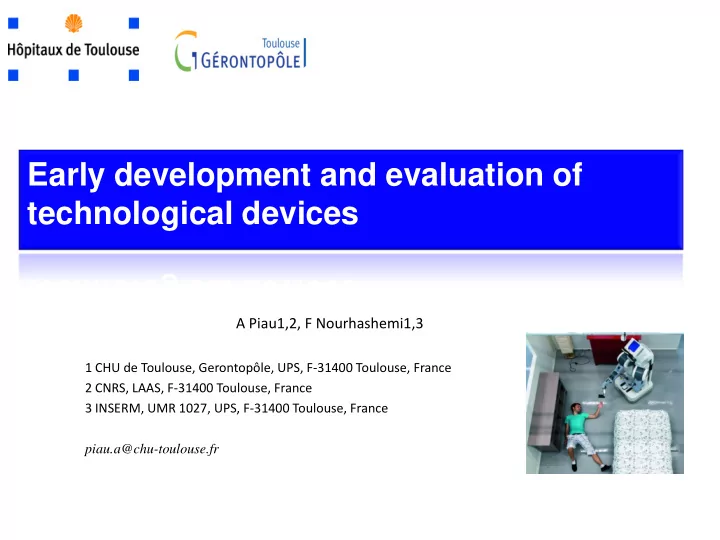
Early development and evaluation of technological devices

slide-2
SLIDE 2

Background

Commercial market of aging care remains poorly developed since introduction of low-technology devices decades ago

  • 1. 1. A lack of early multidimensional reflexion during

technology development (leading to irrelevant tools)

  • 2. 2. A lack of evaluation (e.g. Cohrane « Smart Homes »)

This deficiency is due to the confrontation of two worlds:

  • technology = not yet well versed in the field of healthy aging

intervention = techno-push strategy

  • medical = mainly uses the linear pharmaceutical drug

development model

slide-3
SLIDE 3

Background SILVER ECONOMY

????

 We need to develop more relevant devices = « techno-pull strategy»  Many methods are proposed for multidimensional evaluation of health technologies, they do not address the early development and evaluation processes

slide-4
SLIDE 4

Home computer = Touch-pad

  • Patient interface
  • Data collection
  • Pre-treatment

MD computer = Dash-board

  • Frailty indicators trends
  • Medical relevant events
  • Intervention adherence
  • Alerts

Software

Internet secured transmission to database

Hardware Connected Medical device

  • Failure alert
  • Maintenance reminders

Communication device

  • Ergonomic upgrade cell-phone

Monitoring devices

  • Gait speed
  • Weight…

Intervention devices

  • Wii
  • Fitness devices

Medication devices

  • Pill-box

Social network

  • Family and relative
  • Social caregivers coordination

Feed-back software

  • Performance indicators

presentation Connected Medical device software

  • Failure alert
  • Maintenance reminders

Motivationnal coaching software

  • Nutrition
  • Physic exercice
  • Therapeutic education

Socio-cultural software

  • Transport
  • Culture
  • Shopping, home delivery

Where to start? Not with the technologies but from what we need !!

slide-5
SLIDE 5

Method and results

Our goal was to build a one-page “pocket work plan” for health technology development for people who want to develop a health device but do not exactly know how to do (e.g. young start-uppers). It could be used by all kind of stakeholder, whatever their culture (technical, human sciences, etc.) and their

  • rganization (e.g. academic, SME’s).
  • First we have described the different dimensions of evaluation to

identify essential partners to built an efficient consortium

  • Secondly we have proposed different critical phases for the

technological development and evaluation

  • Then we Have proposed a framework to describe relationships

between development phases and evaluation dimensions  this is the basis of a concrete working plan (e.g. work-packages )

slide-6
SLIDE 6

Results

Characteristics of health technologies as compared with drug development:

  • Evaluation of technology is multidimensional and

multidisciplinary;

  • Results are more dependent on the implementation context of

the technology;

  • Technology evaluation is non-linear, more iterative (feed feedback

loops);

  • Quantitative research strategies need to be combined with

qualitative strategies;

  • Less time is available for technology evaluation because of the

quickly changing market, etc.

slide-7
SLIDE 7

Results

A basis to: (i) identify the relevant partners for a consortium, (ii) built a first draft

  • f a work plan, (iii) and provide a first idea of each partner tasks.
slide-8
SLIDE 8

Results

This multi-phased design, from lab test to field tests, allow to perform iterative modifications of thte devices hanks to end user’s recommendations. e.g. young volunteers in a lab (technical performances of the first prototype) e.g. healthy old people in a living lab (acceptability of the second prototype) e.g. frail individuals in a clinical comparative study at home (acceptability in real-life conditions)

slide-9
SLIDE 9

Discussion and conclusion

Our method is successfully tested through several completed or

  • ngoing3 projects that have been funded by health authorities and

ratified by clinical research ethical committee. No matter the type of technology, its development stage, and the clinical application, our method was easily adaptable, flexible and scalable. Our proposed “pocket tool” is a valuable support, for example during a first meeting with a technical partner (not yet versed in health technology development and assessment), to evaluate the feasibility of a project and is also the basis of a first concrete working plan (e.g. work-packages).

3.Piau A, Charlon E, Campo E, Vellas B, Nourhashemi F. A Smart Insole to Promote Healthy Aging for Frail Elderly Individuals: Specifications, Design, and Preliminary Results. JMIR Rehabilitation and Assistive Technologies 2015;2(1): e5 p.1; doi:10.2196/rehab.4084