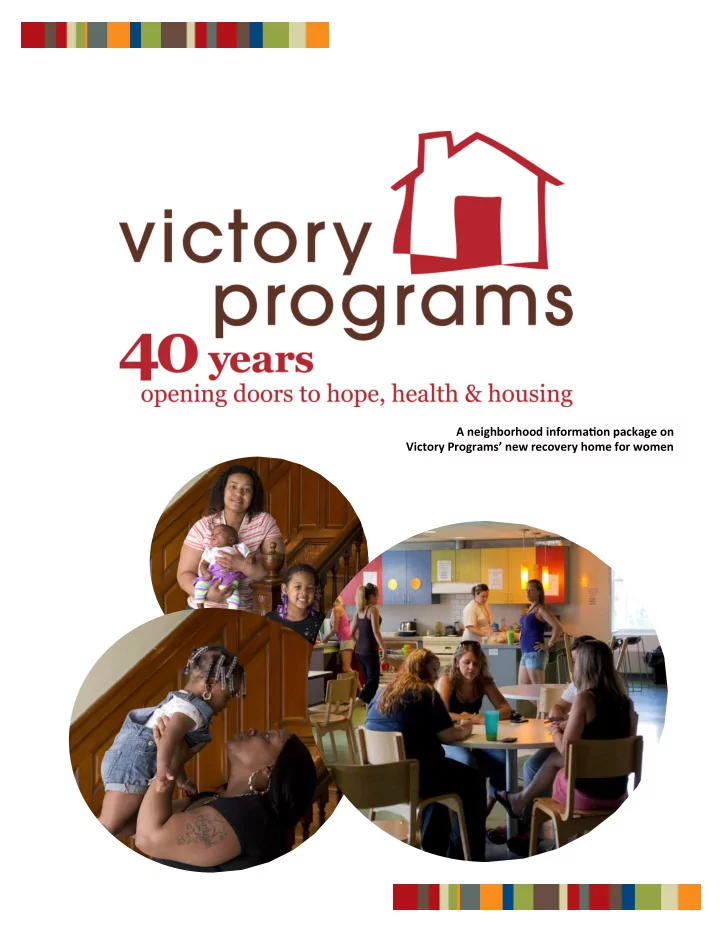
A neighborhood informatjon package on Victory Programs’ new recovery home for women
A neighborhood informatjon package on Victory Programs new recovery - - PDF document
A neighborhood informatjon package on Victory Programs new recovery home for women VICTORY PROGRAMS : REPSONDING TO THE OPIATE CRISIS FULFILLING A NEED Opioids kill more people in Massachusetts than car accidents and guns combined. Detox
VICTORY PROGRAMS: REPSONDING TO THE OPIATE CRISIS—FULFILLING A NEED
- Opioids kill more people in Massachusetts than car
accidents and guns combined.
- Detox programs in Boston are operating at 97 percent
capacity, and individuals seeking treatment in residential programs in 2014 waited an average of more than three weeks for a detox bed to become available.
- There were 1,008 deaths from opioid overdoses in the
Bay State in 2014, a 33% jump from 2012.
- In the first three months of 2015 alone, there was an
average of two deaths a day across Massachusetts from heroin overdoses.
- When the Bridge to Long Island closed on October 8,
2014, Boston lost 70% of its women’s recovery beds – leaving a gaping hole in the fight against heroin addiction in the Commonwealth.
- Persons receiving treatment for addiction to alcohol or
drugs are disabled individuals under the Americans with Disabilities Act.
- Founded in 1975 as a private,
non‐profit organization
- Began as a single program in Boston for
Vietnam veterans with drug and alcohol addiction
- Now includes 17 programs in Boston,
Cambridge & Topsfield
- Serves 2,300 women, children and families
annually
- Provides licensed health and housing
programs for people who are homeless, in addiction recovery or living with chronic illnesses like HIV/AIDS
- Receives funding and operating support from
city, state and federal sources as well as private grants and donations
ABOUT VICTORY PROGRAMS
AGENCY MAP
Lost our 47‐bed recovery program for women when the Long Island Bridge was closed in October 2014 Currently operating 7 programs and our Administrative Office in Roxbury and Dorchester
VICTORY PROGRAMS IN THE COMMUNITY
- We pride ourselves on being respectful
and responsive neighbors, and have built a reputation city‐wide.
- We get active in neighborhood association
meetings, crime watch groups, and neighborhood clean‐ups.
- We ensure immediate sidewalk snow
removal, participate in activities that promote a healthy community and respects our neighbors.
- Some examples of neighborhood
associations we closely work with include: Virginia Street, Chester Square, Chamblet Street, Hartford Street, Fabyan Street and Uphams Corner Westside.
- Our treatment centers are all licensed for
safety and personnel by the Massachusetts Department of Public Health.
NEIGHBORHOOD PROGRAM HIGHLIGHTS
In 2008, Victory Programs opened Victory Housing on Warren Street in Roxbury. Warren Street is a permanent housing program for 14 men and women who struggle with chronic homelessness. Victory Housing on Warren Street was the agency’s first permanent housing program. This program has a history of success, with many residents gaining stability and fully integrating into the community.
In 2005, Victory Programs brought ReVision Family Home & ReVision Urban Farm in Dorchester under its umbrella. ReVision Family Home is a 22 family shelter program for pregnant and parenting women and their
- children. Residents are generally between the ages
- f 18‐22.
ReVision Urban Farm provides free and reduced cost produce to residents of ReVision Family Home and the local community of Dorchester and Mattapan. ReVision Family Home provides a daycare center for the children of our clients, to help ease the burden
- f childcare costs.
NEIGHBORHOOD PROGRAM HIGHLIGHTS
In 2014, Victory Programs opened Chamblet Family Home, for pregnant and parenting women and their children, in Dorchester. Chamblet Family Home provides transitional housing for 14 families. Victory Programs has a 90% success rate when families leave our shelters for permanent housing. Victory Programs’ three family shelter programs house up to 43 families at any given time.
NEIGHBORHOOD PROGRAM HIGHLIGHTS
LONG ISLAND
In 2007, Victory Programs opened a state‐of‐the art addiction recovery program for women on Boston’s Long Island. This program served up to 47 women at any given time – mostly young mothers
- r women with an HIV diagnosis.
While in residence, clients worked on their recovery, found jobs and worked to reunify their families. Thousands of women were served at this program over its 7‐year span
until…
LONG ISLAND
In October 2014, the City of Boston closed the Long Island Bridge, effectively closing all of the programs on the Island. When the Bridge closed, Boston lost 70%
- f its women’s recovery beds – leaving a
gaping hole in the fight against heroin addiction in the Commonwealth. Today, men’s recovery programs still
- utnumber women’s 10:1 in
Massachusetts. The Commonwealth is seeing a marked increase in overdoses among women, with few programs able to address their specific needs.
‐ Yvonne Abraham Globe Columnist April 05, 2015
FINDING A NEW HOME
Since the closure of the Bridge in October, Victory Programs has worked tirelessly to find a new home for our women. Ideal location:
- Is in close proximity to public
transportation, local businesses and community health resources.
- Has outdoor space for family visits
with children.
- Provides a safe and homey space for
the women in residence.
- Is large enough to house up to 25
women comfortably.
ABOUT THE NEW PROPERTY
The new property will provide beds for 24 women from Boston in need of recovery services with 24‐hour a day/7‐day a week professional on‐site staff. Women live in residence for 6‐8 months. Family reunification is part of our commitment to pregnant and parenting women. Children and families visit during the day on the weekends. Built on 3 lots, it has a large, green buffer zone from the street, and space for off‐street parking. Substantial interior repairs and rehab will take up to a year, with an opening expected in December 2016. The site is zone by the City of Boston as a Multi Family Residential (MFR), which allows for a group residence, limited use.
NEIGHBORHOOD IMPACT
- Once renovated, this community‐
based building will be an important neighborhood home for women in recovery.
- Renovations expected to be
complete by December 2016.
- Our priority and commitment is to
always support local businesses, hire local talent, offer treatment and recovery to Boston women seeking addiction treatment and affiliate with neighborhood health centers/social services
- rganizations.
HOW WE OPERATE
We Don’t: We Do: Administer methadone or opiate Lock and log all life‐saving medications including ‐based narcotic (e.g., Oxycontin) on heart disease, blood pressure, diabetes and/or site. HIV meds on site. These are closely monitored at all times by professionally trained staff. Allow unplanned, unscheduled Offer child reunification and family support . visitors to the program. Visitation to women in our programs is monitored by staff. Ignore our neighborhood. Build caring communities in our single homes for women trying to start new lives without drugs or alcohol. Ever leave the facility without a Our facility is staffed 24 hours a day/7 days a professional staff presence. Week/ 365 days a year, with at least two people at all times.
HOW WE OPERATE
We Don’t: We Do:
Operate unlicensed and unregulated Operate Massachusetts Department of Public Health ‘sober homes.’ licensed and regulated addiction treatment programs. Allow residents to have cars. Design our buildings with on‐site/off‐street parking to accommodate the appropriate number of spaces for staff members to park. Allow smoking anywhere on the Offer services on smoking cessation. property. Leave trash/rubbish in piles. Remove all program trash timely. Perform regular landscaping , including snow removal and monitor property management needs consistently. All work is done by Victory’s facility team. Tolerate loud noise on the property. Ensure all neighbors have the right to quiet enjoyment
- f their community.
OUR TEAM
Jonathan D. Scott President & CEO Sarah Porter Vice President & COO Tammy Simmons‐Dixon Director of Victory Housing Cecile Durham Director of Human Resources Angela Headley Program Director Shepherd House Torleah Washington Program Director Portis & Chamblet Family Homes Monicka Hassan Program Director ReVision Family Home John O’Connor Director of Facilities