A Hazard Assessment of Mount Etna: Inference from Evolution & - - PowerPoint PPT Presentation

a hazard assessment of mount etna inference from
SMART_READER_LITE
LIVE PREVIEW

A Hazard Assessment of Mount Etna: Inference from Evolution & - - PowerPoint PPT Presentation

A Hazard Assessment of Mount Etna: Inference from Evolution & Geochemical Data Oliver Charles Wright Hemis 339860 Project Aims Research the eruptive history of Mount Etna Analyse the volcanic hazards and from this create a

slide-1
SLIDE 1

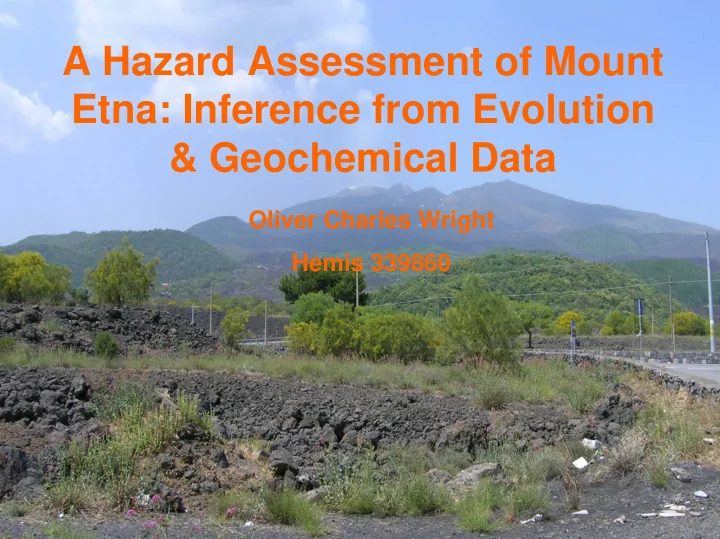
A Hazard Assessment of Mount Etna: Inference from Evolution & Geochemical Data

Oliver Charles Wright Hemis 339860

slide-2
SLIDE 2

Project Aims

  • Research the eruptive history of Mount

Etna

  • Analyse the volcanic hazards and from

this create a hazard map

  • Discuss remediation and mitigation

measures

slide-3
SLIDE 3

Logistics

  • Fieldwork 13th June – 10th July 2006
  • Catania used as a base
  • Hire car used for transport
  • Cable car at Rifugio Sapienza used to

reach summit & Valle del Bove

  • Detailed literature study of 130+ papers on

return

slide-4
SLIDE 4

Location

  • Etna lies on the east coast of Sicily near

Messina & Catania

  • N 37º45 E 14º59
  • Covers 1,190km², circumference 140km, 3350m

high

Multimap.com (2003)

slide-5
SLIDE 5

Tectonic Setting

  • ‘Slab-Window theory (Doglioni et al, 2001)

creating magma through rollback of lithosphere

  • Patane et al (2006) believe rollback occurs along

the Malta Escarpment

Above: Doglioni et al (2001); Right: Behncke (2001)

slide-6
SLIDE 6

Ancient Activity

  • Basal Tholeiite Volcanics 500ka-170ka

producing pillow lavas and intrusives

  • Trifoglietto 170ka-25ka producing

hawaiites & mugearites, caldera collapse & block and ash deposits

slide-7
SLIDE 7

Ancient Activity

  • Ancient Mongibello 25ka-5ka

producing hawaiites, basic mugearites, mugearites &

  • benmoreites. Evidence of caldera

collapse from Biancavilla ignimbrites

  • Mongibello 5ka-1ka producing
  • hawaiites. Caldera collapse to form

Valle del Bove, allowing older products to be observed

slide-8
SLIDE 8

Historical & Present Day

  • Hawaiites & Trachybasalts
  • 4 Active summit craters

constantly degassing. Can produce strombolian eruptions and up to 7km lava flows

  • Flank activity produces larger

volumes and higher effusion rates, generating more evolved lava flow fields

  • Eruptions of between 0-3 VEI

Behncke et al (2006)

slide-9
SLIDE 9

Eruptive Characteristics

  • Flow length dependent on eruptive

volume, slope angle, effusion rate and composition

  • Majority of flows are aa lavas, with major

lengthening in 48 hours

  • Channelling and tube-fed flow fronts allow

further extension than in open channels

  • Complex flow systems
slide-10
SLIDE 10

2001 Eruption

  • Most explosive event in

living memory

  • 7 vents formed a 6.9km

flow field, destroying a road and cable car station

  • Ash caused closure of

Catania airport, and reached 500km from Etna

  • Summit-lateral and

eccentric eruptions

  • ccurred together, only

seen before in 1974

Behncke and Neri (2003)

slide-11
SLIDE 11

Pyroclastic Flows

  • Remain uncommon, but continue to occur
  • 1999 flow from Bocca Nuova Crater reached 700m in length

covering 20m/s

  • Similar pyroclastic flow advanced 1km from SE crater in 2000

Behncke et al (2003)

slide-12
SLIDE 12

Thin section Analysis

  • 5 lava thin sections: 170ka, 1950, 1983, 1992, 2001
  • All samples silica undersaturated
  • Abundant olivine gives way to augite and plagioclase
  • Recent lavas abundant in phenocrysts, forming

glomerolar textures, which suggests a crystal mush forms beneath the surface

170ka lava scale in 0.2mm increments 1992 lava

slide-13
SLIDE 13

TAS Discrimination Diagram

35 45 55 65 75 5 10 15 SiO (wt %)

2

Na O + K O (wt %)

2 2

Rhyolite Phonolite Tephri- Phonolite Phono- Tephrite Tephrite (Ol<10%) Basanite (Ol>10%) Picra- Basalt Basalt Basaltic Andesite Andesite Dacite Trachyte (Q<20%) Trachydacite (Q>20%) Trachy- Andesite Basaltic Trachy- Andesite TB

  • cw500ka
  • cw170
  • cw1950
  • cw1983
  • cw1992
  • cw1993
  • cw2001A
  • cw2001B

Key:

413 623 605 09.10.92 23.01.93 180701A 260701C

  • After Le Maitre (1989)
  • Over time magma has evolved from basaltic to trachybasaltic
slide-14
SLIDE 14

AFM Discrimination diagram

Na O + K O

2 2

MgO FeO* Tholeiitic Calc-Alkaline

  • cw500ka
  • cw170
  • cw1950
  • cw1983
  • cw1992
  • cw1993
  • cw2001A
  • cw2001B

Key:

413 623 605 09.10.92 23.01.93 180701A 260701C

  • After Irvine and Baragar (1971)
  • Shows activity has moved from a tholeiitic to calc-alkaline trend
  • Suggests that the ‘Slab Window’ Theory is correct, as it contrasts with thin

section findings, suggesting a subduction relationship

slide-15
SLIDE 15

Major Element Variation Diagrams

44 45 46 47 48 49 50 SiO ( wt %) 2 1 2 TiO (wt %) 2 9 11 13 15 17 19 21 22 Al O (wt %) 2 3 8 9 10 11 12 13 14 FeO* (wt %) 2 4 6 8 10 12 0.1 0.2 MgO (wt %) MnO (wt %) 8 10 12 14 CaO (wt %) 2 3 4 5 6 Na O (wt %) 2 1 2 3 4 K O (wt %) 2 2 4 6 8 10 12 0.1 0.2 0.3 0.4 0.5 0.6 0.7 0.8 0.9 1 MgO (wt %) P O (wt %) 2 5
  • Two activity cycles of

eruptions observed

  • Cycles from 1950-1992

and 1993-present

  • CaO, FeO, & TiO2

decrease throughout a cycle

  • SiO2, Al2O3, & Na2O

increase throughout a cycle

  • cw500ka
  • cw170
  • cw1950
  • cw1983
  • cw1992
  • cw1993
  • cw2001A
  • cw2001B

Key:

413 623 605 09.10.92 23.01.93 180701A 260701C

slide-16
SLIDE 16

Cyclic Behaviour

  • Project confirms the findings of Behncke and Neri

(2003), who suggested the same cycles

  • Three cycle phase:

1) Degassing of summit area 2) Strombolian summit activity with short lava flows 3) Flank eruptions producing lava flows. Increased explosivity of summit craters

  • Cycle ends with voluminous eruption, e.g. 1950-51 &

1991-1993 flows

  • Third stage of current cycle began in 2001?
slide-17
SLIDE 17

Contour Map in 250m increments

Population Centre

Key

Summit Craters

2km

N

slide-18
SLIDE 18

Number-Density Distribution of Vents

10+ 8-9 6-7 4-5 2-3

The number-density distribution of vents per 4km

2 2km

N

slide-19
SLIDE 19

Final Hazard Map

Strombolian eruptions and Pyroclastic Flows Lava flows from summit craters Lava flows from flank eruptions

Key

Summit Craters

2km

N

slide-20
SLIDE 20

Mitigation and Management

  • Before an Eruption
  • Tourist area should be protected by lava barriers
  • Shelters built to protect tourists from summit eruptions
  • Warning system and education for locals

Barriers installed before the 2001 eruption (Barberi et al, 2003)

slide-21
SLIDE 21

Mitigation and Management

  • During an Eruption
  • Alerts given if threat to population or

explosive activity such as 2001 & 2002-03 via TV radio and possibly text message

  • Barriers can be installed at lower

altitudes

  • Breaking of lava channels is

successful

  • Lava cooling is not feasible due to

lack of water

Lava diversion through explosives (Romano, 1992)

slide-22
SLIDE 22

Mitigation and Management & Future Work

  • After an Eruption
  • All shelters and lava diversions should be checked for

damage and restored

  • Hazard map should be updated
  • Future Work
  • Hazard map requires use of smaller contour intervals
  • Continued tests on lavas to better understand Etna’s

hazards

  • Creation of a GIS model to aid hazard map and produce

vulnerability and risk maps

slide-23
SLIDE 23

Conclusions

  • Present day lavas are predominantly trachybasaltic aa

flows

  • Cyclic activity producing:
  • Strombolian products and Pyroclastic Flows close to

summit areas

  • Extensive lava flow fields from flank vents produced

along fault zones

  • Possible but rare ash falls to the SE
  • An alert system and shelters should be installed
  • Hazard map should be updated after each eruption
slide-24
SLIDE 24

References

  • Barberi, F., Brondi, F., Carapezza, M.L., Cavarra, L., & Murgia, C. (2003) Earthen barriers to

control lava flows in the 2001 eruption of Mt. Etna.

  • Behncke, B. (2001) http://boris.vulcanoetna.com/ETNA_evolution.html
  • Behncke, B., & Neri, M. (2003) The July-August 2001 eruption of Mt. Etna (Sicily). Bulletin of

Volcanology, Volume 65, pp 461-476.

  • Behncke, B., Neri, M., & Carniel, R. (2003b) An exceptional case of endogenous lava dome

growth spawning pyroclastic avalanches: the 1999 Bocca Nuova eruption of Mt. Etna (Italy). Journal of Volcanology and Geothermal Research, Volume 124 pp 115-128.

  • Behncke, B., Neri, M., Pecora, E., & Zanon, V. (2006) The exceptional activity and growth of the

Southeast Crater, Mount Etna (Italy), between 1996 and 2001. Bulletin of Volcanology, Volume 69, pp 149-173.

  • Doglioni, C., Innocenti, F., & Mariotti, G. (2001) Why Mt Etna? Terra Nova, Volume 13, pp 25-31.
  • Irvine, T.N., & Baragar, W.R.A. (1971) A guide to the chemical classification of the common

volcanic rocks. Canadian Journal of Earth Sciences, Volume 8, pp 523-548.

  • Le Maitre, R.W. (1989) A Classification of Igneous Rocks and Glossary of Terms. Cambridge:

Cambridge University Press.

  • Multimap.com (2003) Map of Italy. Retrieved on 24th April, 2007, from

http://www.multimap.com/map/browse.cgi?client=public&X=1800000&Y=4500000&width=700&hei ght=400&gride=&gridn=&srec=0&coordsys=mercator&db=IT&addr1=&addr2=&addr3=&pc=&adva nced=&local=&localinfosel=&kw=&inmap=&table=&ovtype=&keepicon=&zm=0&scale=2000000&l eft.x=4&left.y=146. Last updated in 2003.

  • Patanè, G., La Delfa, S. & Tanguy, J-C. (2006) Volcanism and mantle-crust evolution: The Etna
  • case. Earth and Planetary Science Letters, Volume 241, pp 831-843
  • Romano, R. (1992) Continued lava production from SE flank fissure; Lava diversion summarised.

BGVN 17:07

slide-25
SLIDE 25

Any Questions?