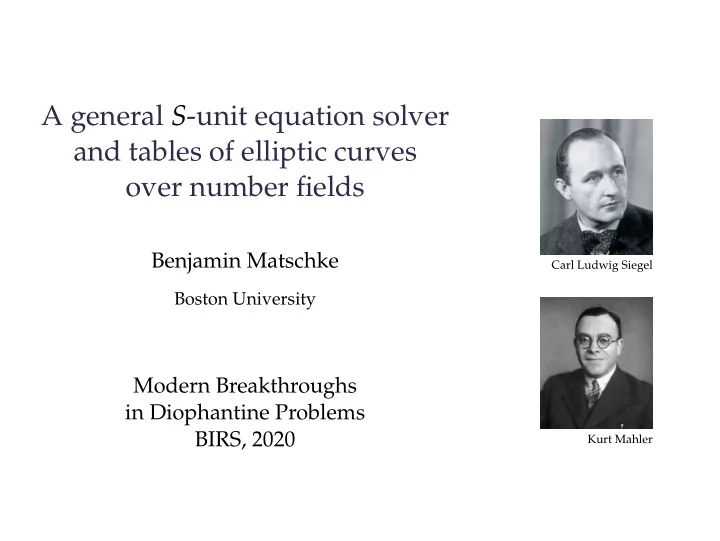
SLIDE 1 A general S-unit equation solver and tables of elliptic curves
Benjamin Matschke
Boston University
Modern Breakthroughs in Diophantine Problems BIRS, 2020
Carl Ludwig Siegel Kurt Mahler
SLIDE 2
S-UNIT EQUATIONS
S-unit equations
SLIDE 3 S-UNIT EQUATIONS
Let ◮ K be a number field, ◮ S a finite set of primes of K, ◮ OK the ring of integers of K, ◮ OK,S = OK[1/S] the ring of S-integers of K, ◮ O×
K,S the group of S-units of K.
Let a, b ∈ K×. S-unit equation: ax + by = 1, x, y ∈ O×
K,S.
[Siegel], [Mahler]: Finiteness of solution set.
SLIDE 4
S-UNIT EQUATIONS
Relevance: ◮ abc-conjecture [Masser, Oesterl´ e] ◮ many diophantine equations reduce to S-unit equations: Thue-, Thue–Mahler-, Mordell-, generalized Ramanujan–Nagell- equations, index form equations; Siegel method for superelliptic equations ◮ asymptotic Fermat over number fields [Freitas, Kraus, ¨ Ozman, S ¸eng¨ un, Siksek] ◮ tables of (hyper-)elliptic curves over number fields [Parshin, Shafarevich, Smart, Koutsianas]
SLIDE 5 CLASSICAL APPROACHES
Classical algorithms: ◮ /O×
◗,S [de Weger]
◮ /O×
K
[Wildanger] ◮ /O×
K,S [Smart]
- 1. Initial height bound: h(x), h(y) ≤ H0 (via bounds in linear
forms in logarithms [Baker], [Yu])
- 2. Reduction of local height bounds “via LLL”.
- 3. Sieving.
- 4. Enumeration of tiny solutions.
SLIDE 6 NEW IDEAS
- 1. Efficient estimates (e.g. no unnecessary norm conversions).
- 2. Refined sieve [von K¨
anel–M.]/◗: Sieve with respect to several places. Can be extended/K.
- 3. Fast enumeration [von K¨
anel–M.]/◗. Can be extended/K!
- 4. Separate search spaces for ax, 1 − ax, 1/(1 − ax),
1 − 1/(1 − ax), 1 − 1/ax, 1/ax.
- 5. Optimize ellipsoids (extending on Khachiyan’s ellipsoid
method).
- 6. Constraints (e.g. Galois symmetries, if possible).
- 7. More efficient handling of torsion.
- 8. Timeouts.
- 9. Generic code, suitable for extensions.
Difficulty: Balancing.
SLIDE 7 COMPARISON OF S-UNIT EQUATION SOLVERS
Comparison with ◮ [von K¨ anel–M.]: x + y = 1 over ◗. ◮ [Alvarado-Koutsianas–Malmskog– Rasmussen–Vincent–West]: x + y = 1 over K. Comparison for x + y = 1 over ◗:
Solver {2} {2, 3} {2, 3, 5} {2, 3, 5, 7} {2, 3, 5, 7, 11} [vKM] 0.01 s 0.03 s 0.12 s 0.3 s 1.0 s [AKMRVW] 0.1 s 23 min > 30 days (7.2 GB) [M.] 1.8 s 3.0 s 6.2 s 15.4 s 47 s
Comparison for x + y = 1 over S = {primes above 2, 3}:
Solver K = ◗[x]/(x6 − 3x3 + 3) [AKMRVW] 3.6 · 1017 candidates left [M.] 29 s
SLIDE 8
ELLIPTIC CURVES OVER NUMBER FIELDS
Elliptic curves over number fields
SLIDE 9 ELLIPTIC CURVES OVER NUMBER FIELDS
Goal: Compute all elliptic curves/K with good reduction
Approach: [Parshin, Shafarevich, Elkies, Koutsianas] ◮ Write E : y2 = x(x − 1)(x − λ) (Legendre form). ◮ λ + (1 − λ) = 1 ( S-unit equation over L = K(E[2])) ◮ Set of possible K(E[2]) is finite, computable via Kummer theory. [Koutsianas]: ◮ K = ◗ and S = {2, 3, 23} ◮ K = ◗(i) and S = {prime above 2}
SLIDE 10
ELLIPTIC CURVES OVER NUMBER FIELDS
Disclaimer:∗ will refer to: ◮ assuming GRH ◮ modulo a bug in UnitGroup (Sage 9.0/9.1, using Pari 2.11.2), which I detected only through heuristics. Fixed in Pari 2.11.4, soon in Sage 9.2. ◮ modulo computations in Magma (proprietary, closed-source).
SLIDE 11
ELLIPTIC CURVES/◗
All elliptic curves/◗ with good reduction outside the first n primes: ◮ n = 0: attributed to Tate by [Ogg] ◮ n = 1: [Ogg] ◮ n = 2: [Coghlan], [Stephens] ◮ n = 3, 4, 5: [von K¨ anel–M.], recomputed by [Bennett–Gherga–Rechnitzer] ◮ n = 6: [Best–M.] (heuristically) ◮ n = 7, 8: [M.]* Number of curves: 217, 923, 072. Maximal conductor: N = 162, 577, 127, 974, 060, 800.
SLIDE 12
ELLIPTIC CURVES OVER NUMBER FIELDS
Same over number fields: All* elliptic curves/K with good reduction outside S [M.]: ◮ K = ◗(i), S = {primes above 2, 3, 5, 7, 11}. ◮ K = ◗( √ 3), S = {primes above 2, 3, 5, 7, 11}. ◮ Many fields K, S = {primes above 2}, including one of deg K = 12.
Corollary ([M.])
All* elliptic curves/K with everywhere good reduction for all K with |disc(K)| ≤ 20000.
SLIDE 13
ELLIPTIC CURVES/◗
Cremona’s DB: N ≤ 500, 000. [von K¨ anel–M.]: radical(N) ≤ 1, 000. [M.]:* radical(2N) ≤ 1, 000, 000. Comparison: ◮ Cremona’s table ⊂ [M.]. ◮ radical(2N) ≤ 30 requires curves with N = 1, 555, 200. ◮ Maximal conductor: N = 1, 727, 923, 968, 836, 352. Alternative approach to compute elliptic curves via Thue–Mahler equations [Bennett–Gherga–Rechnitzer]. Together with Gherga, von K¨ anel, Siksek, we are working on a new Thue–Mahler solver; one goal is to extend Cremona’s DB.
SLIDE 14 CONJECTURES
abc-conjecture: lim sup
gcd(a,b)=1 log max(a,b,a+b) log radical(ab(a+b)) ≤ 1.
Szpiro’s conjecture: lim sup
E/◗ log |∆E| log N
≤ 6. Conjecture 1: (updated) lim sup
j∈◗
inf
E/◗: j(E)=j log |∆E| log radical(N) ≤ 6
SLIDE 15
Thank you
SLIDE 16 OMISSIONS
S-unit equations:
◮ Height bounds via linear forms in logarithms: [Baker], [Yu], [Gy˝
◮ Height bounds via modularity: [von K¨ anel], [Murty–Pasten], [von K¨ anel–M.], [Pasten] ◮ Number of solutions: [Gy˝
◮ Algorithms: [Tzanakis–de Weger], ◮ Finiteness (+ algorithms?): [Faltings], [Kim], [Corwin–Dan-Cohen], [Lawrence–Venkatesh]
Elliptic curve tables:
◮ [Setzer], [Stroeker], [Agrawal–Coates–Hunt–van der Poorten], [Takeshi], [Kida], [Stein–Watkins], [Cremona–Lingham], [Cremona], [Bennett–Gherga–Rechnitzer], [LMFDB], . . . ◮ Frey–Hellegouarch curves: Reduce S-unit equations to elliptic curve tables.