A Dirac Operator for Extrinsic Shape Analysis Hsueh - Ti Derek Liu 1 - - PowerPoint PPT Presentation

a dirac operator for extrinsic shape analysis
SMART_READER_LITE
LIVE PREVIEW

A Dirac Operator for Extrinsic Shape Analysis Hsueh - Ti Derek Liu 1 - - PowerPoint PPT Presentation

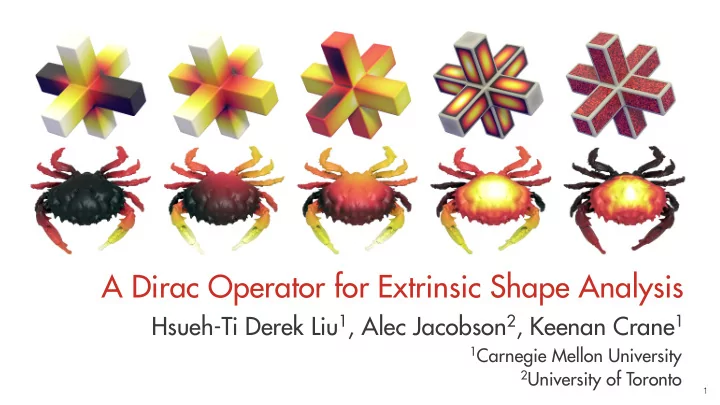
relative Dirac operator Laplace-Beltrami A Dirac Operator for Extrinsic Shape Analysis Hsueh - Ti Derek Liu 1 , Alec Jacobson 2 , Keenan Crane 1 1 Carnegie Mellon University 2 University of Toronto 1 Outline Goal : extend spectral geometry


slide-1
SLIDE 1

1

A Dirac Operator for Extrinsic Shape Analysis

Hsueh-Ti Derek Liu1, Alec Jacobson2, Keenan Crane1

Laplace-Beltrami relative Dirac operator

1Carnegie Mellon University 2University of Toronto
slide-2
SLIDE 2

Outline

2

Goal: extend spectral geometry processing

  • Traditionally: intrinsic only (point-to-point distance)
  • Today: extrinsic information (bending in space)

Basic idea: develop new differential operators

  • Instead of standard Laplacian, use relative Dirac operator

Applications:

  • Classification, segmentation, correspondence
slide-3
SLIDE 3

What is Spectral Geometry Processing?

3

differential

  • perator

eigenvalues eigenvectors

slide-4
SLIDE 4

What is Spectral Geometry Processing?

4

Analogy: “Fourier transform” for surfaces

= …

max min

slide-5
SLIDE 5

Why - Coordinate Invariant

5

#

5 10 15

eigen value

5 10 15

#

5 10 15

eigen value

5 10 15

eigenvalues eigenvalues

slide-6
SLIDE 6

#

5 10 15

eigen value

5 10 15 20 25 30

#

5 10 15

eigen value

5 10 15 20 25 30

Why - (Almost) Invariant to Tessellation

6

eigenvalues eigenvalues

slide-7
SLIDE 7

#

5 10 15

eigen value

5 10 15 20 25 30

#

5 10 15

eigen value

5 10 15 20 25 30

Why - (Almost) Invariant to Tessellation

7

eigenvalues eigenvalues

slide-8
SLIDE 8

Why - Isometry Invariant

8

Benefits from Laplace-Beltrami operator

5 10 15 10 20 30 40 50 60 70 5 10 15 10 20 30 40 50 60 70 5 10 15 10 20 30 40 50 60 70
slide-9
SLIDE 9

9

Isometry Invariance Is it a feature or a bug?

slide-10
SLIDE 10

10

Sensitivity to Metric Distortion

https://en.wikipedia.org/wiki/USP2

slide-11
SLIDE 11

(Discrete) Differential Operators

11

slide-12
SLIDE 12

Laplace-Beltrami Operator (intrinsic)

12

  • Discrete cotangent Laplacian

Solomon, et al. 2014

∆pi = 1 2Ai X

j∈N (i)

(cot αij + cot βij)(pi − pj)

slide-13
SLIDE 13

Laplace-Beltrami Operator (intrinsic)

13

  • Discrete cotangent Laplacian
  • Key idea: 


Laplace only depends on edge lengths!
 Edge length is a intrinsic quantity 


Solomon, et al. 2014

∆pi = 1 2Ai X

j∈N (i)

(cot αij + cot βij)(pi − pj)

i)

(cot αij + cot βij)(

slide-14
SLIDE 14

Not Purely Intrinsic Operators

14

  • Mixture of intrinsic and

extrinsic information

  • Existing operators:

  • Anisotropic Laplace

  • Modified Dirichlet energy


5 10 15 10 20 30 40 50 60 70

anisotropic Laplace

Andreux et al. 2014, Hildebrandt et al. 2012

How sensitive?

slide-15
SLIDE 15

Quaternionic Dirac Operator

15

  • Definition:

Crane, et al. 2011

slide-16
SLIDE 16

Quaternionic Dirac Operator

16

  • Definition:

Crane, et al. 2011

slide-17
SLIDE 17
  • Discrete Dirac:
  • Key idea: 


depends on edge vectors 
 (rather then edge length)

Quaternionic Dirac Operator

17

Crane, et al. 2011

slide-18
SLIDE 18

Square of Dirac Operator

18

intrinsic extrinsic

Laplace Normal

Relative Dirac Operator

  • Crane. 2013
slide-19
SLIDE 19

Discretization

19

  • Discrete relative Dirac
  • Matrix form
slide-20
SLIDE 20

Basic Properties of Relative Dirac

20

Crane, et al. 2011

DNψ = −dN ∧ dψ |d f|2

(Dirac) (relative Dirac)

slide-21
SLIDE 21

Basic Properties of Relative Dirac

21

Crane, et al. 2011

DNψ = −dN ∧ dψ |d f|2

(Dirac) (relative Dirac)

  • First order, self-adjoint and elliptic operator


countable eigenvalues and eigenvectors

slide-22
SLIDE 22

Basic Properties of Relative Dirac

22

Crane, et al. 2011

  • First order, self-adjoint and elliptic operator


countable eigenvalues and eigenvectors

  • The operator is not coordinate invariant


eigenvalues are coordinate invariant 
 eigenvectors are determined up to a constant

DNψ = −dN ∧ dψ |d f|2

(Dirac) (relative Dirac)

slide-23
SLIDE 23

Basic Properties of Relative Dirac

23

Crane, et al. 2011

  • First order, self-adjoint and elliptic operator


countable eigenvalues and eigenvectors

  • The operator is not coordinate invariant


eigenvalues are coordinate invariant 
 eigenvectors are determined up to a constant

DNψ = −dN ∧ dψ |d f|2

(Dirac) (relative Dirac)

slide-24
SLIDE 24

Basic Properties of Relative Dirac

24

Crane, et al. 2011

  • First order, self-adjoint and elliptic operator


countable eigenvalues and eigenvectors

  • The operator is not coordinate invariant


eigenvalues are coordinate invariant 
 eigenvectors are determined up to a constant

DNψ = −dN ∧ dψ |d f|2

(Dirac) (relative Dirac)

N

  • t

i s

  • m

e t r y i n v a r i a n t ! !

slide-25
SLIDE 25

From Intrinsic to Extrinsic

25

Laplace relative Dirac

slide-26
SLIDE 26

Applications

26

slide-27
SLIDE 27

Surface Texture Classification

27

slide-28
SLIDE 28

Patch Classification

28

slide-29
SLIDE 29

Laplace

29

eigenvalues

slide-30
SLIDE 30

Infinite Potential Well

30

  • Modified sigmoid function
  • Operator with potential well


Ex:

slide-31
SLIDE 31

31

eigenvalues

Laplacian with Infinite Potential Well

slide-32
SLIDE 32

Patch Classification

32

Maaten, et al. 2008

slide-33
SLIDE 33

Segmentation

33

Step 1: Adapt global point signature to the magnitude

  • f Dirac

Rustamov, et al. 2007

point on the surface eigenvalues eigenvectors

slide-34
SLIDE 34

Segmentation

34

Step 2: Apply the consensus segmentation algorithm

Rodola, et al. 2014

random initialized k-means

slide-35
SLIDE 35

35

modified Dirichlet anisotropic Laplace Dirac (ours)

Segmentation

slide-36
SLIDE 36

Segmentation

36

Modified Dirichlet Anisotropic Laplace Dirac (ours)

slide-37
SLIDE 37

Segmentation

37

Modified Dirichlet Anisotropic Laplace Dirac (ours)

slide-38
SLIDE 38
  • Laplace cannot differentiate between bumped out/in

Correspondence

38

?

slide-39
SLIDE 39

Heat Kernel Signature

39

Sun, et al. 2009

slide-40
SLIDE 40

Correspondence

40

  • Adapt heat kernel signature to the Dirac operator

heat kernel signature Dirac kernel signature

slide-41
SLIDE 41

Correspondence

41

  • Adapt heat kernel signature to the Dirac operator

heat kernel signature Dirac kernel signature

slide-42
SLIDE 42

Correspondence

42

heat kernel signature Dirac kernel signature

slide-43
SLIDE 43

Conclusion

  • Extrinsic properties play an important role in shape

analysis

43

slide-44
SLIDE 44

Conclusion

  • Extrinsic properties play an important role in shape

analysis

  • Our family of operators gives user the flexibility to

emphasize intrinsic/extrinsic properties

44

slide-45
SLIDE 45

Conclusion

  • Extrinsic properties play an important role in shape

analysis

  • Our family of operators gives user the flexibility to

emphasize intrinsic/extrinsic properties

  • Many other possible applications (machine learning?

quad mesh?)

45

slide-46
SLIDE 46

Conclusion

  • Extrinsic properties play an important role in shape

analysis

  • Our family of operators gives user the flexibility to

emphasize intrinsic/extrinsic properties

  • Many other possible applications (machine learning?

quad mesh?)

  • What are other operators can we use to capture

different geometric quantities?

46

slide-47
SLIDE 47

Conclusion

  • Extrinsic properties play an important role in shape

analysis

  • Our family of operators gives user the flexibility to

emphasize intrinsic/extrinsic properties

  • Many other possible applications (machine learning?

quad mesh?)

  • What are other operators can we use to capture

different geometric quantities?

47

https://github.com/alecjacobson/gptoolbox.git

slide-48
SLIDE 48

Thank you!

Hsueh-Ti Derek Liu, hsuehtil@andrew.cmu.edu

Laplace-Beltrami relative Dirac operator