Computer Vision Computer Vision Samer M Abdallah, PhD Faculty of - - PowerPoint PPT Presentation

computer vision computer vision
SMART_READER_LITE
LIVE PREVIEW

Computer Vision Computer Vision Samer M Abdallah, PhD Faculty of - - PowerPoint PPT Presentation

Computer Vision Computer Vision Samer M Abdallah, PhD Faculty of Engineering and Architecture American University of Beirut Beirut, Lebanon Geometric Camera Calibration Geometric Camera Calibration September 2, 2004 1 EE141 Geometric


slide-1
SLIDE 1

EE141

1

Computer Vision Geometric Camera Calibration 1 S.M. Abdallah

Computer Vision Computer Vision

Geometric Camera Calibration Geometric Camera Calibration

Samer M Abdallah, PhD Faculty of Engineering and Architecture American University of Beirut Beirut, Lebanon

September 2, 2004

slide-2
SLIDE 2

EE141

2

Computer Vision Geometric Camera Calibration 2 S.M. Abdallah

Series outline Series outline

Cameras and lenses Geometric camera models Geometric camera calibration Stereopsis

slide-3
SLIDE 3

EE141

3

Computer Vision Geometric Camera Calibration 3 S.M. Abdallah

Lecture outline Lecture outline

The calibration problem Least-square technique Calibration from points Radial distortion A note on calibration patterns

slide-4
SLIDE 4

EE141

4

Computer Vision Geometric Camera Calibration 4 S.M. Abdallah

Camera calibration Camera calibration

Camera calibration is determining the intrinsic and extrinsic parameters of the camera.

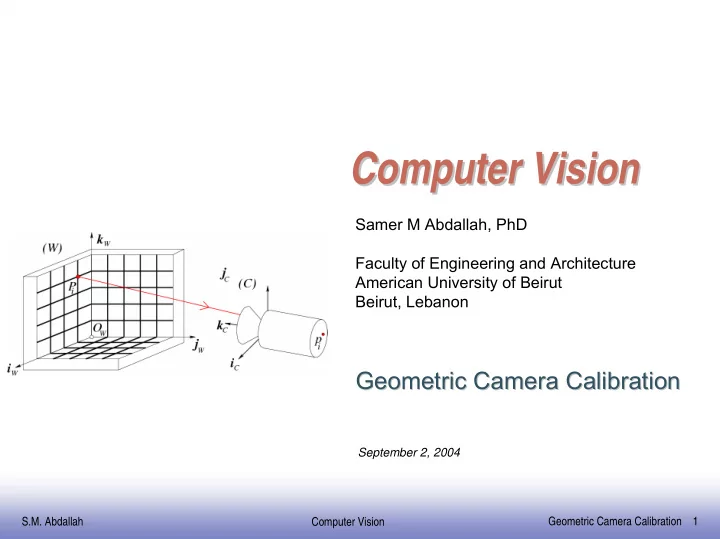
The are three coordinate systems involved: image, camera, and world. Key idea: to write the projection equations linking the known coordinates of a set of 3-D points and their projections, and solve for the camera parameters.

slide-5
SLIDE 5

EE141

5

Computer Vision Geometric Camera Calibration 5 S.M. Abdallah

Projection matrix Projection matrix

M is only defined up to scale in this setting.

slide-6
SLIDE 6

EE141

6

Computer Vision Geometric Camera Calibration 6 S.M. Abdallah

The calibration problem The calibration problem

slide-7
SLIDE 7

EE141

7

Computer Vision Geometric Camera Calibration 7 S.M. Abdallah

Linear systems Linear systems

A x b = A x b =

Square system:

  • Unique solution
  • Gaussian elimination

Rectangular system:

  • underconstrained: Infinity of solutions
  • Overconstrained: no solution

Minimize |Ax-b|2

slide-8
SLIDE 8

EE141

8

Computer Vision Geometric Camera Calibration 8 S.M. Abdallah

How do you solve overconstrained linear equations? How do you solve overconstrained linear equations?

slide-9
SLIDE 9

EE141

9

Computer Vision Geometric Camera Calibration 9 S.M. Abdallah

Homogeneous linear equations Homogeneous linear equations

A x = A x =

Square system:

  • Unique solution = 0
  • Unless Det(A) = 0

Rectangular system:

  • 0 is always a solution

Minimize |Ax|2 under the constraint |x|2 = 1

slide-10
SLIDE 10

EE141

10

Computer Vision Geometric Camera Calibration 10 S.M. Abdallah

How do you solve overconstrained homogeneous linear equations? How do you solve overconstrained homogeneous linear equations?

The solution is the eigenvector e1 with least eigenvalue of UT U.

slide-11
SLIDE 11

EE141

11

Computer Vision Geometric Camera Calibration 11 S.M. Abdallah

Example: Line fitting Example: Line fitting

Problem: minimize with respect to (a,b,d).

  • Minimize E with respect to d:
  • Minimize E with respect to a,b:

where and

slide-12
SLIDE 12

EE141

12

Computer Vision Geometric Camera Calibration 12 S.M. Abdallah

Estimation of the projection matrix Estimation of the projection matrix

The constraints associated with the n points yield a system of 2n homogeneous linear equations in the 12 coefficients of the matrix M, When n ≥ 6, homogeneous linear least-square can be used to compute the value of the unit vector m (hence the matrix M) that minimizes |Pm|2 as the solution of an eigenvalue problem. The solution is the eigenvector with least eigenvalue of PTP.

slide-13
SLIDE 13

EE141

13

Computer Vision Geometric Camera Calibration 13 S.M. Abdallah

Once M is known, you still got to recover the intrinsic and extrinsic parameters! This is a decomposition problem, NOT an estimation problem. Intrinsic parameters Extrinsic parameters

ρ

Estimation of the intrinsic and extrinsic parameters Estimation of the intrinsic and extrinsic parameters

slide-14
SLIDE 14

EE141

14

Computer Vision Geometric Camera Calibration 14 S.M. Abdallah

Estimation of the intrinsic and extrinsic parameters Estimation of the intrinsic and extrinsic parameters

Write M = (A, b), therefore Using the fact that the rows of a rotation matrix have unit length and are perpendicular to each other yields and

slide-15
SLIDE 15

EE141

15

Computer Vision Geometric Camera Calibration 15 S.M. Abdallah

Estimation of the intrinsic and extrinsic parameters Estimation of the intrinsic and extrinsic parameters

slide-16
SLIDE 16

EE141

16

Computer Vision Geometric Camera Calibration 16 S.M. Abdallah

Taking radial distortion into account Taking radial distortion into account

P M z p ⎟ ⎟ ⎟ ⎠ ⎞ ⎜ ⎜ ⎜ ⎝ ⎛ = 1 1 1 1 λ λ

Assuming that the image centre is known (u0 = v0 = 0), model the projection process as: where λ is a polynomial function of the squared distance d 2 between the image centre and the image point p. It is sufficient to use low-degree polynomial: ) , , 1 ( ts coefficien distortion the and 3 with , 1

1 2

q p q d

p q p p p

K = ≤ + =

=

κ κ λ

2 2 2

ˆ ˆ v u d + =

This yields highly nonlinear constraints on the q + 11 camera parameters.
slide-17
SLIDE 17

EE141

17

Computer Vision Geometric Camera Calibration 17 S.M. Abdallah

Calibration pattern Calibration pattern

The accuracy of the calibration depends on the accuracy of the measurements of the calibration pattern.

slide-18
SLIDE 18

EE141

18

Computer Vision Geometric Camera Calibration 18 S.M. Abdallah

Line intersection and point sorting Line intersection and point sorting

Extract and link edges

using Canny;

Fit lines to edges using

  • rthogonal regression;

Intersect lines.

slide-19
SLIDE 19

EE141

19

Computer Vision Geometric Camera Calibration 19 S.M. Abdallah

References References

“Computer Vision: A Modern Approach”. D.

Forsyth and J. Ponce, Prentice Hall, 2003

“Introductory Techniques for 3-D Computer

Vision”. E. Trucco and A. Verri, Prentice Hall, 2000

“Geometric Frame Work for Vision – Lecture

Notes”. A. Zisserman, University of Oxford