A Conversation with You How can we as a Neighborhood Neighborhood - - PowerPoint PPT Presentation

a conversation with you
SMART_READER_LITE
LIVE PREVIEW

A Conversation with You How can we as a Neighborhood Neighborhood - - PowerPoint PPT Presentation

A Conversation with You How can we as a Neighborhood Neighborhood community reduce school School absenteeism? Parent Student 6/25/2015 1 A Study of Student Absenteeism in Pinellas County 6/25/2015 2 Attending school every day


slide-1
SLIDE 1

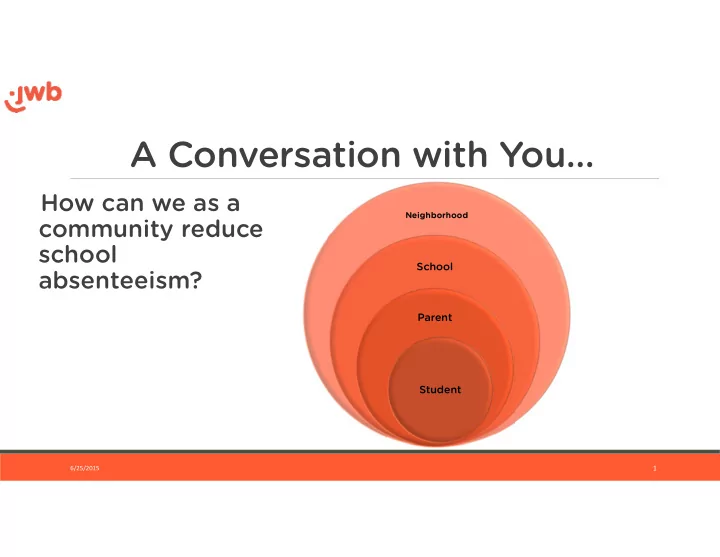
How can we as a community reduce school absenteeism?

A Conversation with You…

6/25/2015

1

Neighborhood Neighborhood

School Parent Student
slide-2
SLIDE 2

A Study of Student Absenteeism in Pinellas County

6/25/2015

2

slide-3
SLIDE 3

6/25/2015

3

  • Attending school every day matters.
  • School systems built on assumption: children attend— and

learn—every single day. Classes held 180 days a year.

  • Chronically absent students:
  • Perform worse on standardized tests of reading and math
  • More likely to drop out of school
  • Less likely to graduate on time
slide-4
SLIDE 4

6/25/2015

4

Current Situation in Pinellas County

Florida Department of Education Statistics Percent Absent 21 Days or More All Students (Kindergarten – Grade 12) School Year 2013‐2014: Florida 9.5% Pinellas County: 12.8% (15,545 students) Pinellas County higher rate than Florida for at least the last five years (since 2009‐2010 School Year).

slide-5
SLIDE 5

Current efforts to Improve School Attendance Include:

Pinellas County School District

  • Child Study Teams
  • Teen Court, Truancy Court, Magistrate Grant
  • Walking School Bus
  • Truancy Intervention Program, Teen Parent Programs

Juvenile Welfare Board

  • PEMHS System Navigators + Scale Up for Success
  • Truancy Intervention Program (Sanderlin)
  • Safe Place 2B
  • Behavioral Evaluation
  • School engagement integrated into other JWB-funded School Success and

Prevention of Child Abuse and Neglect (PCAN) programs

6/25/2015

5

slide-6
SLIDE 6

Childr Children: Individual, P n: Individual, Parent, School, and nt, School, and Neighborhood Influenc Neighborhood Influences es

Neighborhood Neighborhood

School Parent Student

6/25/2015

6

slide-7
SLIDE 7

6/25/2015

7

Children in this Study

They are a cohort: Followed from kindergarten to end of 8th grade. All of the children in this study were enrolled in a Pinellas County school continuously from kindergarten through 8th grade (6,169 children) Race: Ethnicity: White 60.0% Hispanic 9.6% Black 20.0% Other Race 19.5%

slide-8
SLIDE 8

6/25/2015

8

5.17 4.69 4.54 3.99 4.32 4.26 5.37 5.91 7.01 4.01 4.01 3.66 3.16 3.54 4.13 3.01 3.58 3.98

0.00 1.00 2.00 3.00 4.00 5.00 6.00 7.00 8.00

k 1 2 3 4 5 6 7 8

Average Number of Days Absent each School Year Kindergarten Through 8th Grade Unexcused Excused

slide-9
SLIDE 9

6/25/2015

9

Does being absent affect students’ school achievement? Yes (at least as measured by the FCAT). Regardless of the type of absence—excused or unexcused—more absences decreased the likelihood that students would pass their FCAT in Math. More unexcused absences decreased the likelihood that students would pass their FCAT in Reading. We saw this trend consistently—beginning in third grade.

slide-10
SLIDE 10

6/25/2015

10

Students:

  • Mental health (Baker Act)
  • African‐American
  • Medicaid medical history
  • Emergency medical services
  • JWB‐funded service/program
  • # of child maltrtment reports
  • Free/reduced lunch eligible
  • Older for grade
  • Hispanic ethnicity

Parents:

  • Severe

mental illness

  • Doctor visits

(physical health)

Characteristics Related to Unexcused Absences

School Characteristics:

  • Number of

students with

  • ut‐of‐school

suspensions (elementary)

  • No middle

school factors Neighborhood Characteristics:

  • Level of

educational

  • pportunity
  • Social &

economic characteristics

slide-11
SLIDE 11

6/25/2015 11

slide-12
SLIDE 12

Preliminary Recommendations:

  • Maintain an IDS with timely and regularly updated data

that has the capacity to answer critical policy questions

  • Develop multifaceted approach to reducing absenteeism

that includes a place-based perspective

  • Engage the community in the Campaign for Grade Level

Reading, with a focus on school attendance

  • Include an Equity Assessment in policy and program

reviews

Policy Development

6/25/2015

12

slide-13
SLIDE 13

Policy Development

Preliminary Recommendations:

  • Increase the number of children who attend preschool/nursery
  • Increase the number of quality early learning environments in areas of

greatest need

  • Monitor absence closely on an individual child basis for days absent and

class absence

  • Target attendance efforts beginning in PreSchool and/or Kindergarten

focused on the parent

  • Target attendance efforts focused on the child beginning in fifth grade

6/25/2015

13

slide-14
SLIDE 14

Policy Development

Preliminary Recommendations:

  • Emphasize the importance of school attendance across all of JWB’s

programs

  • Develop mechanisms to identify children with mental health

and/substance abuse problems as early as possible

  • Provide help to minority parents to navigate the school system’s

attendance rules

  • Take a community collaborative approach to ensuring that all children

and youth benefit from being in school

6/25/2015

14

slide-15
SLIDE 15

How can we as a community reduce student absenteeism?

A Conversation with You…

6/25/2015

15

Neighborhood Neighborhood

School Parent Student