A challenge to downgradient diffusion: Countergradient heat - - PowerPoint PPT Presentation

a challenge to downgradient diffusion countergradient
SMART_READER_LITE
LIVE PREVIEW

A challenge to downgradient diffusion: Countergradient heat - - PowerPoint PPT Presentation

A challenge to downgradient diffusion: Countergradient heat transport In dry convective boundary layer, deep eddies transport heat This breaks correlation between local gradient and heat flux LES shows slight q min at z=0.4h, but w


slide-1
SLIDE 1

Atm S 547 Lecture 8, Slide 1

A challenge to downgradient diffusion: Countergradient heat transport

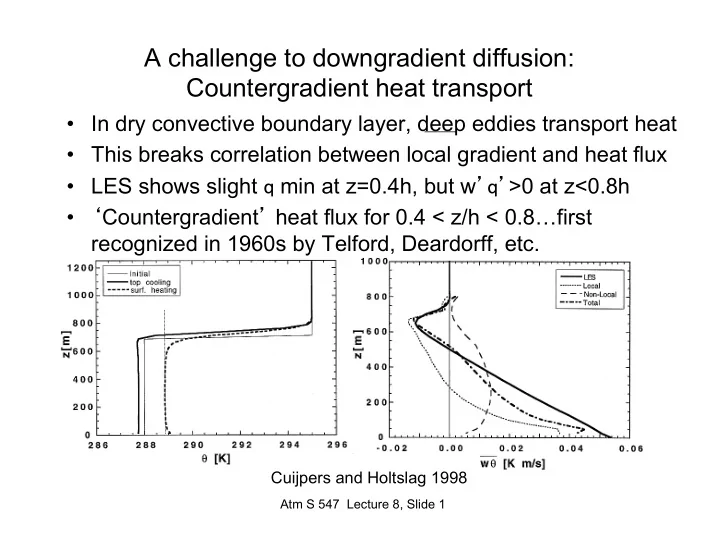
  • In dry convective boundary layer, deep eddies transport heat
  • This breaks correlation between local gradient and heat flux
  • LES shows slight q min at z=0.4h, but w’q’>0 at z<0.8h
  • ‘Countergradient’ heat flux for 0.4 < z/h < 0.8…first

recognized in 1960s by Telford, Deardorff, etc.

Cuijpers and Holtslag 1998

slide-2
SLIDE 2

Atm S 547 Lecture 8, Slide 2

Nonlocal K-profile schemes

(Holtslag-Boville in CAM3/4, YSU in WRF, EDMF in ECMWF):

′ w ′ a = −K a (z ) ∂a ∂z + another 'nonlocal' term

slide-3
SLIDE 3

Atm S 547 Lecture 8, Slide 3

Derivation of nonlocal schemes

Heat flux budget:

Holtslag and Moeng (1991)

∂ ∂t ′ w ′ θ = − ′ w ′ w ∂θ ∂z − ∂ ′ w ′ w ′ θ ∂z + g θ0 ′ θ ′ θ − 1 ρ0 ′ θ d ′ p dz

M T

B

P

S

Neglect storage S Empirically:

′ w ′ θ = − τ 2 ′ w ′ w

KH (z)

   ∂θ ∂z + τ w*

2θ*

h

T ≈ B + 2 w*

2θ*

h

P = −aB − ′ w ′ θ τ

For convection, a=0.5, so Take τ = 0.5h/w* to get zero θ gradient at 0.4h.

slide-4
SLIDE 4

Atm S 547 Lecture 8, Slide 4

Nonlocal parameterization, continued

This has the form ′ w ′ θ = −KH (z) ∂θ ∂z − γ θ ⎛ ⎝ ⎜ ⎞ ⎠ ⎟ γ θ = 2w*

2θ*

′ w ′ w h where Although the derivation suggests γθ is a strong function of z, the parameterization treats it as a constant evaluated at z = 0.4h to obtain the correct heat flux there with dθ/dz = 0: ′ w ′ w (0.4h) = 0.4w*

2

⇒ γ θ = 5θ* h. The eddy diffusivity can be parameterized from vert. vel. var.:

′ w ′ w (z) = 2.8w*

2Z(1− Z)2,

Z = z h ⇒ KH (z) = 0.7w*z(1− Z)2

With cleverly chosen velocity scales, this can be seamlessly combined with a K-profile for stable BLs to give a generally applicable parameterization (Holtslag and Boville 1993).

slide-5
SLIDE 5

Atm S 547 Lecture 8, Slide 5

CBL comparison

  • Sfc heating of 300 W m-2
  • No moisture or mean wind
  • UW TKE scheme with entrainment closure and HB scheme give

similar results at both high and low res.

  • Overall, can get comparably good results from TKE and profile-

based schemes on these archetypical cases.

Bretherton and Park 2009

slide-6
SLIDE 6

EDMF

Atm S 547 Lecture 8, Slide 6

z K w ∂ ∂ − ≅ ′ ′ φ φ

) ( φ φ φ − ≅ ′ ′

u

M w