A 61 year-old man with 61 year-old man with hypertension - - PowerPoint PPT Presentation

a 61 year old man with
SMART_READER_LITE
LIVE PREVIEW

A 61 year-old man with 61 year-old man with hypertension - - PowerPoint PPT Presentation

2/10/2017 Case Presentation A 61 year-old man with 61 year-old man with hypertension exercise-induced muscle 1 year ago: tingling in the hands, which then spasms spread to neck, arms, and legs Diagnosed with B12 deficiency (149


slide-1
SLIDE 1

2/10/2017 1

A 61 year-old man with exercise-induced muscle spasms

Jeffrey Ralph, MD RAIN 2017

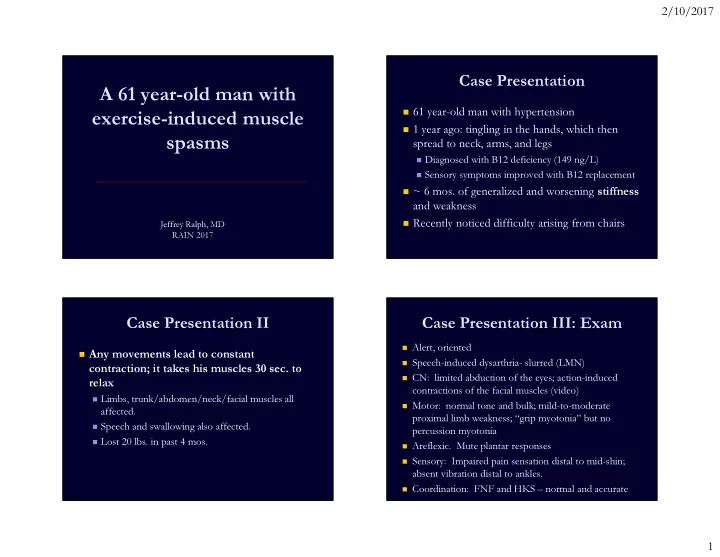
Case Presentation

61 year-old man with hypertension 1 year ago: tingling in the hands, which then

spread to neck, arms, and legs

Diagnosed with B12 deficiency (149 ng/L) Sensory symptoms improved with B12 replacement

~ 6 mos. of generalized and worsening stiffness

and weakness

Recently noticed difficulty arising from chairs

Case Presentation II

Any movements lead to constant

contraction; it takes his muscles 30 sec. to relax

Limbs, trunk/abdomen/neck/facial muscles all

affected.

Speech and swallowing also affected. Lost 20 lbs. in past 4 mos.

Case Presentation III: Exam

Alert, oriented Speech-induced dysarthria- slurred (LMN) CN: limited abduction of the eyes; action-induced

contractions of the facial muscles (video)

Motor: normal tone and bulk; mild-to-moderate

proximal limb weakness; “grip myotonia” but no percussion myotonia

  • Areflexic. Mute plantar responses

Sensory: Impaired pain sensation distal to mid-shin;

absent vibration distal to ankles.

Coordination: FNF and HKS – normal and accurate

slide-2
SLIDE 2

2/10/2017 2

Video I

Other information:

Elevated anti-GAD antibodies (>250 IU/mL) Normal MRI imaging of the brain and cervical

spinal cord

TRANSFER TO UCSF: STIFF PERSON SYNDROME

What would you do next?

  • A. 1. Full serum paraneoplastic panel
  • B. 2. Lumbar puncture for CSF analysis
  • C. 3. Toxicology consultation
  • D. 4. Genetic testing

All good answers, but something else done in this case…

  • 1. Full serum paraneopla...
  • 2. Lumbar puncture for ...
  • 3. Toxicology consultation
  • 4. Genetic testing

54% 14% 5% 27%

Always do an EMG/NCS first!

Nerve Conduction Studies – abnormal findings:

Reduced motor nerve conduction velocities in two

nerve segments (R median elbow-axillary and R ulnar AE-axillary segment)

Prolonged F waves for 2/4 nerves Absent SNAPs in the lower extremities

EMG very abnormal…

* Just kidding…sort of

*

slide-3
SLIDE 3

2/10/2017 3

Video II: EMG

Which is most likely?

  • A. Positive Caspr2 Abs
  • B. A CTG trinucleotide repeat expansion
  • C. Frequently consumes local seafood
  • D. Multiple sclerosis

P

  • s

i t i v e C a s p r 2 A b s A C T G t r i n u c l e

  • t

i d e r e p e . . F r e q u e n t l y c

  • n

s u m e s l

  • c

a . . . M u l t i p l e s c l e r

  • s

i s

59% 0% 6% 35%

What was that EMG?

Electrographic Neuromyotonia

Miss Him

The discharges remind me of Isaacs Syndrome

Electrographic Neuromyotonia

  • A burst of motor unit action potentials which
  • riginates in motor axons firing at high rates (150

to 300 Hz) for a few seconds

  • Sounds like a Formula 1 Car
  • Often start and stop abruptly.
  • The amplitude of the waveforms typically wanes.
  • Discharges may occur spontaneously or be

initiated by needle electrode movement, voluntary effort, ischemia, or percussion of the nerve.

  • These discharges should be distinguished from

myotonic discharges and complex repetitive discharges.

19,000 RPM x 1 min/60 sec = 317 Hz

slide-4
SLIDE 4

2/10/2017 4

Sections from longer continuous EMG recordings illustrating decremental patterns and varying partial motor unit size occurring within high frequency bursts of neuromyotonia.

Maddison P. Neuromyotonia Clinical Neurophysiology, Volume 117, Issue 10, 2006, 2118–2127

Neuromyotonic Discharge, II

On motor nerve conduction studies, trains of after- discharges are often seen after supramaximal stimulation of nerves.

Tibial motor nerve conduction study

Additional Results

  • VGKC, VGCC, Hu, Yo, Ri –

negative

  • CSF WBC 2 protein 45 mg/dL;

glucose 64 mg/dL

  • CK - 181
  • Hemoglobin A1c - 5.2 (6/2)
  • TSH - 8.22, T3 3, T4 9
  • Anti-thyroglobulin antibodies -

2.21

  • Anti-thyroperoxidase antibodies

167

  • B12 - >2000
  • HIV - neg

TPA - neg SPEP - Hypoalbuminemia,

normal pattern

Light chains - WNL IFE - Neg Anti-Intrinsic Factor:

Positive

Anti-GAD65 > 250 ESR 39 PET/CT – neg for

hypermetabolic lesions

Neuromyotonia

Clinical neuromyotonia includes the following:

Muscle twitches Muscle stiffness Cramps Hyperhidrosis Pseudo-myotonia

Fasciculations or Cramps or Cramp Fasciculation Syndrome Doublets, Triplets Myokymia Neuromyotonia Activity-induced neuromyotonia. Only seen in a minority of patients. PERIPHERAL NERVE HYPEREXCITABILITY SPECTRUM Peripheral Nerve Hyperexcitability

  • Causes
  • Immune
  • Genetic
  • Idiopathic/Miscellaneous
slide-5
SLIDE 5

2/10/2017 5

Neuromyotonia

Generalized Neuromyotonia = Isaacs Syndrome

Muscle twitches, Muscle stiffness, Cramps,

Hyperhidrosis, Pseudo-myotonia

Morvan’s fibrillary chorea

Morvan in 1890: “La chorée fibrillaire” Clinical features:

Neuromyotonia Insomnia Delirium Dysautonomia

Disease Associations with Neuromyotonia

Autoimmune

Myasthenia gravis Diabetes mellitus CIDP/GBS Celiac disease Pernicious Anemia Hyperthyroidism/hypothyroidism Vitiligo

Infections

Staphylococcal infections

Toxins

Herbicides, insecticides, toluene,

timber rattle snake

Paraneoplastic

Small cell lung carcinoma Lymphoma Plasmacytoma Thymoma (with or without

MG)

Drugs

Gold, oxaliplatin

Genetic

Hereditary neuropathy,

KCNA1 mutations

Clinical Course

Chronic Progressive Relapsing-Remitting

Symptoms Symptoms Time Time Monophasic K+ “Channelopathy”

Neuromyotonia

Sodium Channelopathy Chloride Channelopathy

Myotonia

Channels and Nerve/Muscle Hyperexcitability

slide-6
SLIDE 6

2/10/2017 6

Scatter plot of serum VGKC antibody titres in 39 patients with the neuromyotonia phenotype of autoimmune peripheral nerve

  • hyperexcitability. Patients with thymoma are shown separately.

Titres were considered positive if more than the mean plus 3 SDs. Maddison P. Neuromyotonia. Clinical Neurophysiology, Volume 117, Issue 10, 2006, 2118–2127

VGKCs and Neuromyotonia

Antibody in neuromyotonia

discovered when dendrotoxin used in radiolabeled immunoprecipitation assay

VGKCs found in about

40% of patients with neuromyotonia

Limited yield partially related

to dendrotoxin failure to block all members of the VGKC family

The Expanding World of Auto- antibodies

VGKC ABS Caspr2 Abs Lgi1 Abs

Lgi1 = leucine-rich glioma inactivated 1 Caspr2 = contactin- associated protein-like 2 Turns out that the VGKC antibodies are mostly targeting non-channel proteins complexed with Kv1

The Expanding World of Auto-antibodies

  • LGI1 – Is the main autoantigen of limbic encephalitis previously attributed to

VGKCs

  • CASPR2 – Is the autoantigen of encephalitis and PNH previously attributed to

VGKCs

  • It is possible (rare) to have antibodies to LGI1 and CASPR2 but not VGKCs
  • Positive VGKCs but negative LGI1 and CASPR2 of debatable clinical

significance.

  • TAKE HOME: If neuromyotonia Check VGKC and CASPR2

(Many patients with neuromyotonia are negative for both VGKC and CASPR2) CNS dysfunction/ Limbic Encephalitis Neuromyotonia

LGI1 Caspr2

Which would be the wrong treatment for the patient?

  • A. 3,4 Diaminopyridine
  • B. Dronabinol
  • C. Gabapentin
  • D. Carbamazepine

3 , 4 D i a m i n

  • p

y r i d i n e D r

  • n

a b i n

  • l

G a b a p e n t i n C a r b a m a z e p i n e

43% 30% 14% 13%

slide-7
SLIDE 7

2/10/2017 7

Neuromyotonia Treatments

Symptomatic

Sodium Channel Blockers

Carbamazepine, Phenytoin

Miscellaneous

Dronabinol (cannabinoid) Gabapentin

Immune

In paraneoplastic form, removal of neoplasm usually

minimal effect

PLEX more effective than IVIG Prednisone, azathioprine

Patient Follow-Up

Initial diagnosis was stiff person syndrome

Referring Hospital

Valium and IVIG prescribed no benefit

UCSF

Carbamazepine 400 mg twice daily marked improvement PLEX additional improvement

Outpatient – still symptomatic but not limited in his activities

PLEX 1.5 plasma volume x 4, repeated monthly CBZ 400 mg three times daily Azathioprine 200 mg QD

Acknowledgements

Laura Rosow Kaitlin Greene Claire Clelland Maulik Shah

Thanks for your attention!