8-wk module 8-wk module 8-wk module 8-wk module October 15 3 - - PDF document

8 wk module 8 wk module 8 wk module 8 wk module october
SMART_READER_LITE
LIVE PREVIEW

8-wk module 8-wk module 8-wk module 8-wk module October 15 3 - - PDF document

TASFAA Annual Conference March 25-27, 2019 Modules and TIV Advanced Concepts Modules and Title IV: Advanced Concepts David Bartnicki | March 25-27, 2019 U.S. Department of Education TASFAA Annual Conference Modules and Standard Term


slide-1
SLIDE 1

TASFAA Annual Conference March 25-27, 2019 U.S. Department of Education 1 Modules and TIV – Advanced Concepts For Discussion Purposes Only

David Bartnicki | March 25-27, 2019 U.S. Department of Education TASFAA Annual Conference

Modules and Title IV:

Advanced Concepts

2

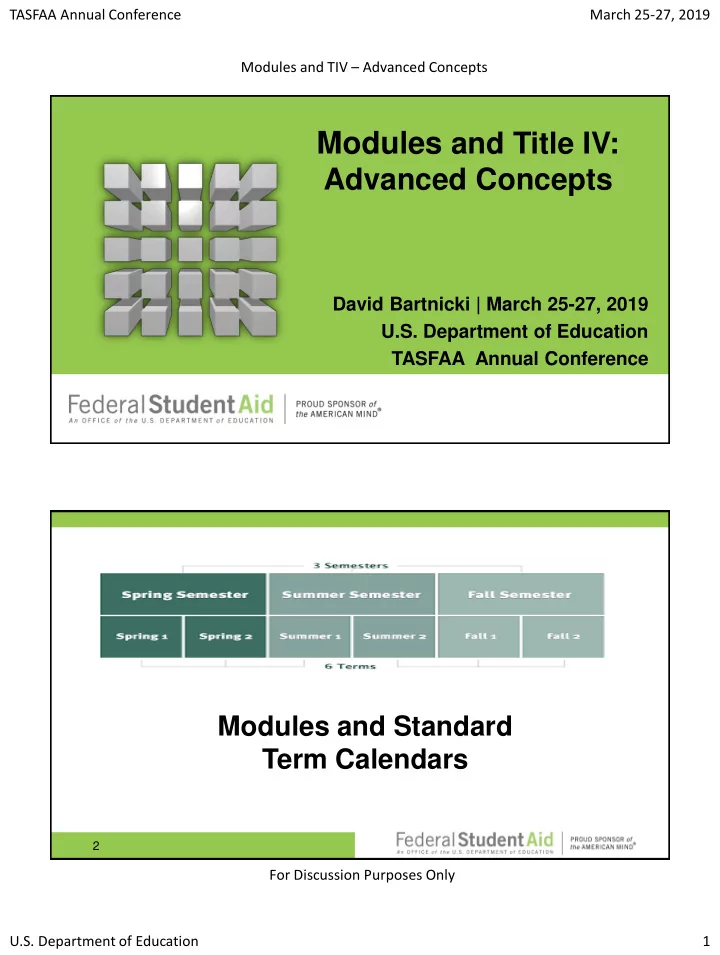
Modules and Standard Term Calendars

slide-2
SLIDE 2

TASFAA Annual Conference March 25-27, 2019 U.S. Department of Education 2 Modules and TIV – Advanced Concepts For Discussion Purposes Only

Standard Term Calendar Used In Examples

3

  • Standard term, semester-based program
  • Academic year is 32 weeks, consisting of two 16 week semesters
  • Semester contains two 8 week modules
  • Classes may last the entire term or occur within modules
  • Students may enroll in any combination of classes
  • Full-time enrollment is 12 semester hours

Fall 16 wks Spring 16 wks 8-wk module 8-wk module 8-wk module 8-wk module

October 15

Disbursement Considerations

4

  • Payment period is the entire standard term (semester)
  • Regardless of student’s enrollment in classes over the entire

semester, modules, or both

  • Payment of Title IV aid (except Federal Work-Study) is

calculated on a payment period basis, not by individual module

  • However, it is allowable to break up the payment for the payment

period into multiple disbursements

  • Earliest disbursement date is 10 days before the first day of

classes for a student within a payment period

slide-3
SLIDE 3

TASFAA Annual Conference March 25-27, 2019 U.S. Department of Education 3 Modules and TIV – Advanced Concepts For Discussion Purposes Only

Federal Pell Grant Program Considerations

5

  • Federal Pell Grant recalculation policy may affect enrollment

flexibilities

  • Acme School of Culinary Arts uses Example 1 calendar and has one

Pell Grant recalculation date of September 21, which falls before the start of Module 2

  • As of Pell Grant recalculation date, Janet is enrolled for nine credits
  • On September 23, two days after the Pell Grant recalculation date,

Janet adds three credits from Module 2; Pell Grant enrollment status must not be changed to add the additional credits due to school’s policy

Example 1 Pell Grant Considerations

6

  • Student must begin every class used to determine enrollment status

– Cindy at Acme (using Example 1 calendar and single Pell recalculation date) enrolls for six credits in Module 1 and six credits in Module 2 – As of the September 21 Pell Grant recalculation date, she is still enrolled for all 12 credits (enrollment status = full time) with a disbursement made based on that enrollment status – However, on September 25, she drops the six credits in Module 2 – Although the Pell Grant recalculation date is past, her enrollment status must be adjusted to ½ time and her award recalculated because she never attended any class(es) in Module 2 – This is a mandatory Pell Grant Recalculation

slide-4
SLIDE 4

TASFAA Annual Conference March 25-27, 2019 U.S. Department of Education 4 Modules and TIV – Advanced Concepts For Discussion Purposes Only

Example 2 Pell Grant Considerations

7

  • Pell Grant recalculation policy may affect enrollment

flexibilities

  • Borax School of Mining uses our example calendar and uses multiple Pell

Grant recalculation dates and must recalculate Pell Grants up to the Pell Grant recalculation date for the last class in which the student enrolls

  • September 7 for Module 1 (Red arrow)
  • September 21 for the full semester (Green arrow)
  • November 1 for Module 2 (Blue arrow)

Fall 16 wks 8-wk module 8-wk module

Example 2 Pell Grant Considerations

8

  • Borax School of Mining PRDs
  • September 7 for Module 1 (Red arrow)
  • September 21 for the full semester (Green arrow)
  • November 1 for Module 2 (Blue arrow)
  • As of September 21 Pell Grant recalculation date,

student enrolled for, and began 12 credits from full semester

  • On October 3, he drops six credits
  • On October 15, he adds three credits from Module 2 (and attends Mod 2)
  • As of the November 1 Pell Grant recalculation date for Module 2, he is

enrolled for nine credits; final Pell Grant enrollment status is ¾ time Fall 16 wks 8-wk module 8-wk module

slide-5
SLIDE 5

TASFAA Annual Conference March 25-27, 2019 U.S. Department of Education 5 Modules and TIV – Advanced Concepts For Discussion Purposes Only

William D. Ford Federal Direct Loan Considerations

9

  • Loan period
  • Shortest period for which a loan may be originated is the

term, not a module

  • Student enrolls for Spring semester only, taking

six credits all from Module 1; loan period is the entire semester, not Module 1

  • Loan eligibility for a term-only loan is

COA − EFC (if subsidized) − EFA up to the applicable annual loan limit, not one half or some other portion of the annual loan limit

Direct Loan Considerations

10

  • Enrollment status

– Census date or PRD is not applicable to Direct Loan, only Pell Grant/TEACH Grant/Iraq-Afghanistan Service Grant – Recalculations not required – Enrollment status is checked at the time of disbursement – Student enrolls for six credits (three in Module 1 and three in Module 2); student begins attendance in Module 1; loan is disbursed (enrollment status ½ time); student never begins attendance in Module 2

  • Loan disbursement is okay; no adjustment or recovery of funds
  • Possible Return of Title IV funds (R2T4) issues associated with student not

taking all modules she was scheduled to take
slide-6
SLIDE 6

TASFAA Annual Conference March 25-27, 2019 U.S. Department of Education 6 Modules and TIV – Advanced Concepts For Discussion Purposes Only

11

Cost of Attendance (COA) Changes

COA Review

12

  • COA for Pell Grant and Iraq & Afghanistan Service Grant is based on full-

year costs for a full-time student

  • COA for Campus-Based, TEACH Grant, and DL/DL PLUS Loan is based
  • n student’s actual cost for the period for which the aid is intended

– Must exclude costs for periods student will not attend – Enrollment status is a factor

  • COA for less than half-time enrollment

– Only tuition and fees, books and supplies, transportation, room and board for limited duration*, and dependent care are included –

  • Misc. and personal expenses may not be included

* Up to three semesters (or equivalent) with no more than two semesters being consecutive

slide-7
SLIDE 7

TASFAA Annual Conference March 25-27, 2019 U.S. Department of Education 7 Modules and TIV – Advanced Concepts For Discussion Purposes Only

COA Changes – Pell Grant

13

  • No requirement to recalculate Pell award for COA changes

during an award year

– Example – Student accepted into on-campus housing after fall term and budget for on-campus housing is lower – If you chose to recalculate for changes in cost, that recalculation policy must be consistently applied

  • If Pell is recalculated because of an enrollment status change,

changes in cost must be taken into account

– Only an issue if student drops to less-than-half-time since Pell COA is always full-year/full-time

COA Changes – Campus-Based

14

  • COA for the Campus-Based programs must reflect changes to

costs, and exclude costs for periods a student will not attend – School must determine if need for CB aid still exists (no

  • veraward) once cost changes are factored in

– Example – Student enrolls for Modules 1, 2 and 3 of the fall semester but drops all classes from Module 3

  • COA must be adjusted to exclude costs from Module 3
  • Campus-Based award amounts are not dependent on

enrollment status, but are made in consideration actual costs

slide-8
SLIDE 8

TASFAA Annual Conference March 25-27, 2019 U.S. Department of Education 8 Modules and TIV – Advanced Concepts For Discussion Purposes Only

COA Changes – Direct Loan

15

  • Originating a Direct Loan

– COA based on actual costs, excluding costs for periods won’t attend

  • School may not originate based on projected enrollment status
  • Must have some documented indication of enrollment in order to

determine costs

  • Documented enrollment status for initial term may be projected over the loan period
  • No requirement to recalculate for any reason after loan is
  • riginated
  • Example – Loan originated based on costs for enrollment in Modules 1, 2

and 3 of fall semester but the student drops all classes from Module 3

  • DL award does not have to be recalculated

COA and EFC Example 3 Calendar

16

  • Standard term, semester-based program
  • Academic year is 32 weeks, consisting of two 16 week

semesters

  • Semester contains two 8 week modules
  • Classes may last the entire term or occur within modules
  • Students may enroll in any combination of classes
  • Full-time enrollment is 12 semester hours

Fall 16 wks Spring 16 wks 8-wk module 8-wk module 8-wk module 8-wk module

slide-9
SLIDE 9

TASFAA Annual Conference March 25-27, 2019 U.S. Department of Education 9 Modules and TIV – Advanced Concepts For Discussion Purposes Only

Example 3 COA and EFC - Adrianna

17

  • Adrianna is going to attend Fall and Spring Semesters
  • BUT, in Fall she is ½ time and she is only attending

classes in Module 1

  • What is Adrianna’s loan period?
  • What is her COA and EFC?

Fall 16 wks Spring 16 wks 8-wk module

Example 3 COA and EFC - Adrianna

18

What is Adrianna’s loan period?

Her loan period is from the first day of Fall to the last day of Spring (assuming Summer is not a factor)

Fall 16 wks Spring 16 wks 8-wk module

slide-10
SLIDE 10

TASFAA Annual Conference March 25-27, 2019 U.S. Department of Education 10 Modules and TIV – Advanced Concepts For Discussion Purposes Only

Example 3 COA and EFC - Adrianna

19

What is her COA?

  • COA will reflect her costs for entire loan period minus any time

during an academic term that we know she will not be attending

  • So, Adrianna’s costs will be from the beginning of Fall to the

end of Spring minus the costs attributable to Fall Module 2, when she is not attending

Fall 16 wks Spring 16 wks 8-wk module

Example 3 COA and EFC - Adrianna

20

What is her COA?

  • What costs are used for Spring when originating the DL at the

beginning of Fall?

  • We know Adrianna is a ½ time student for Fall so we can use

the costs associated with that enrollment status for both academic terms

Fall 16 wks Spring 16 wks 8-wk module

slide-11
SLIDE 11

TASFAA Annual Conference March 25-27, 2019 U.S. Department of Education 11 Modules and TIV – Advanced Concepts For Discussion Purposes Only

Example 3 COA and EFC - Adrianna

21

  • Adrianna is a ½ time student for Fall so we can use the costs

associated with that enrollment status for both academic terms

  • The school can change the Spring COA, and loan amount, if applicable,

if enrollment status changes when the Spring semester starts

  • School policy
  • PJ
  • Not at all
  • School must not assume an enrollment status for Spring with no reason

Fall 16 wks Spring 16 wks 8-wk module

Example 3 COA and EFC - Adrianna

22

What is her EFC?

  • School has latitude
  • EFC for number of months from beginning of Fall to end of Spring
  • EFC from Fall to Spring but back out break between semesters
  • EFC from Fall to Spring but back out the Fall – Module 2

Fall 16 wks Spring 16 wks 8-wk module

slide-12
SLIDE 12

TASFAA Annual Conference March 25-27, 2019 U.S. Department of Education 12 Modules and TIV – Advanced Concepts For Discussion Purposes Only

Standard Term - Quarters

23

  • Standard term, quarter-based program

– Academic year is 36 weeks, consisting of three 12 week quarters

  • Quarter contains three 4 week modules and two 6 week modules
  • Classes may last the entire term or occur within modules

– Students may enroll in any combination of classes

  • Full-time enrollment is 12 quarter hours per term

Fall 12 wks Winter 12 wks Spring 12 wks 4 wks 4 wks 4 wks 4 wks 4 wks 4 wks 4 wks 4 wks 4 wks 6 wks 6 wks 6 wks 6 wks 6 wks 6 wks

Standard Term – Quarters – Disbursements

24

  • Maria has a three credit-hour class in the second 6 week

module

  • Maria has a three credit-hour class in the second 4 week

module and the third 4 week module

  • What is the earliest Maria’s Title IV disbursement can occur?

Fall 12 wks 4 wks 4 wks 4 wks 6 wks 6 wks

Example 4

slide-13
SLIDE 13

TASFAA Annual Conference March 25-27, 2019 U.S. Department of Education 13 Modules and TIV – Advanced Concepts For Discussion Purposes Only

Standard Term – Quarters – Disbursements

25

  • What is the earliest Maria’s Title IV disbursement can occur?
  • 10 days before the start of Maria’s first class which, for Maria,

is in the second 4 week module

– School’s option to disburse this early, can be later Fall 12 wks 4 wks 4 wks 6 wks

Example 4

Standard Term – Quarters – Origination

26

  • Andre has a three credit-hour class in the first 4 week module

and a three credit-hour class in the second 4 week module

  • Andre has no classes in the third 4 week module
  • Andre has received no DL funds for this AY…yet

Spring 12 wks 4 wks 4 wks 4 wks 6 wks 6 wks

Example 5

slide-14
SLIDE 14

TASFAA Annual Conference March 25-27, 2019 U.S. Department of Education 14 Modules and TIV – Advanced Concepts For Discussion Purposes Only

Standard Term – Quarters – Origination

27

  • Andre comes to you during the third module of the Spring term

after completing Mods 1 and 2 and says he is going to need a student loan to help meet the costs of attending school

  • Can you originate a DL for Andre during the third module of the

Spring Term?

Spring 12 wks 4 wks 4 wks

Example 5

Standard Term – Quarters – Origination

28

  • Can you originate a DL for Andre during the third module of the Spring

Term? – Yes! – Assuming Andre has not graduated or withdrawn, he is still enrolled as a half-time student for Spring – The DL can be originated and disbursed – This is NOT a late disbursement Spring 12 wks 4 wks 4 wks

Example 5

slide-15
SLIDE 15

TASFAA Annual Conference March 25-27, 2019 U.S. Department of Education 15 Modules and TIV – Advanced Concepts For Discussion Purposes Only

29

What Does Summer Have to do With Modules? Summer Terms

30

  • Most Summer terms contain multiple or mini-sessions

(e.g., Summer 1, Summer 2, and Summer 3)

  • These are considered modules
  • School has options
  • Combine mini-sessions into a single term
  • Treat as stand-alone terms
  • Could result in entire program being a nonstandard term program
  • Awards of Title IV aid must be made for Summer
  • Option to not pay Title IV aid for enrollment in Summer,

intersessions, J terms, Maymester, etc., does not exist

slide-16
SLIDE 16

TASFAA Annual Conference March 25-27, 2019 U.S. Department of Education 16 Modules and TIV – Advanced Concepts For Discussion Purposes Only

Summer Terms: Pell Grant

31

  • If a combined mini-session term crosses over the award

year, the combined term is treated as a crossover payment period, regardless of what classes the student attends

  • If mini-sessions are not combined into a single term:
  • Each mini-session is generally treated as a separate

nonstandard term

  • Pell Grant Formula 3 must be used
  • Exception: If full-time for each mini-session is defined as

12 credit-hours, Formula 1 may be used

Summer Terms: Direct Loans

32

  • Scheduled Academic Year (SAY) and mini-sessions
  • May be grouped together into either a header or trailer to the SAY
  • May be treated separately and assigned to different SAYs
  • Borrower Based Academic Year #1 (BBAY1) and mini-sessions
  • Must be grouped together as a single term in order to use BBAY
  • Loan period
  • Shortest period of time a loan may be originated for is the term
  • Even if the student is attending fewer mini-sessions than comprise the term
  • COA for Summer cannot include costs for mini-sessions the

student is not expected to be enrolled

slide-17
SLIDE 17

TASFAA Annual Conference March 25-27, 2019 U.S. Department of Education 17 Modules and TIV – Advanced Concepts For Discussion Purposes Only

Summer Example Calendar

33

  • Summer mini-sessions 1, 2, and 3 combined to

make one Summer payment period (term)

  • Full-time enrollment is defined as 12 semester

hours

Summer 1 4 wks Summer 2 4 wks Summer 3 4 wks

July 1

Summer Example 6 - Thomas

34

  • Thomas taking six credits all in Summer 1 - awarded a Summer
  • nly loan and has Pell Grant as header to upcoming award year
  • Enrollment status is ½ time
  • Loan period comprises entire Summer term
  • If school is required to make multiple disbursements, second

disbursement will not be made until the calendar midpoint: after the student has completed classes

  • Summer 1 does not have to crossover for student to receive a Pell

Grant disbursement from upcoming award year because combined Summer term is a crossover payment period

slide-18
SLIDE 18

TASFAA Annual Conference March 25-27, 2019 U.S. Department of Education 18 Modules and TIV – Advanced Concepts For Discussion Purposes Only

35

Standard Terms: Intersessions

36

  • How to deal with intersessions or other additional terms and

keep your program standard?

  • J-terms
  • Maymester
  • Mini-session
  • Add the intersession to one standard term or the other > > >
  • Treat the entire combined term as one payment period

Fall Semester Spring Semester

Intersession

slide-19
SLIDE 19

TASFAA Annual Conference March 25-27, 2019 U.S. Department of Education 19 Modules and TIV – Advanced Concepts For Discussion Purposes Only

What’s the Loan Period?

37

  • The minimum loan period in a standard term

calendar is one of the standard terms

  • When an intersession is attached to a standard

term, it may, or may not, affect the length of the loan period

Standard Terms: Intersessions

38

  • Sometimes the intersession will overlap with the

term to which it is attached and the other term

  • That’s not okay
  • These are now overlapping terms and
  • verlapping terms create a non-term calendar

Fall Semester Spring Semester

Intersession

slide-20
SLIDE 20

TASFAA Annual Conference March 25-27, 2019 U.S. Department of Education 20 Modules and TIV – Advanced Concepts For Discussion Purposes Only

39

Explanatory Guidance- The Two Week Tolerance

ALLOWED Explanatory Guidance – Two Week Tolerance

40

  • Two week tolerance for standard terms
  • Normally, classes offered in a standard term calendar are

expected to take place within the confines of a standard term

  • Those classes may be a module or not
  • If the class or classes, within an academic program, exceed

the confines of the standard term by more than two weeks, it renders the term nonstandard and the program will be nonstandard

  • If the class or classes, within an academic program, exceed

the confines of the standard term by two weeks or less (and does not overlap any other terms), the term remains standard

slide-21
SLIDE 21

TASFAA Annual Conference March 25-27, 2019 U.S. Department of Education 21 Modules and TIV – Advanced Concepts For Discussion Purposes Only

Explanatory Guidance –Two Week Tolerance

41

  • It is a TOTAL of two weeks
  • Not two weeks per class
  • If History 201 extends the semester by one week

at the end and Geology 201 starts 10 days before the semester AND these are part of the same academic program, the two week tolerance has been exceeded since we are looking at 17 days

  • The two weeks must be contiguous to the term
  • No unreasonable breaks between the class

extensions and the term itself

Explanatory Guidance – Two Week Tolerance

42

  • The two weeks must not overlap another term
  • History 201, a Spring Semester class is not exceeding the two

week tolerance and it is not overlapping another term

Fall Semester Spring Semester

Two week extension of History 201

History 201

slide-22
SLIDE 22

TASFAA Annual Conference March 25-27, 2019 U.S. Department of Education 22 Modules and TIV – Advanced Concepts For Discussion Purposes Only

Explanatory Guidance – Two Week Tolerance

43

  • The two weeks must not overlap another term
  • Math 201, a Spring Semester class is not exceeding the two

week tolerance but it is overlapping another term

  • Overlapping terms = a non-term calendar/program

44

Consortium Agreements When One School Has Modules and the Other School Does Not

slide-23
SLIDE 23

TASFAA Annual Conference March 25-27, 2019 U.S. Department of Education 23 Modules and TIV – Advanced Concepts For Discussion Purposes Only

Consortium Agreements – Academic Calendar

45

  • Institution that awards Title IV should

award based on its own calendar

  • Earliest disbursement date is 10 days

before earlier of the start date at either the home or host school

  • COD limitations may apply

Consortium Agreements – Academic Calendar

46

  • Program’s academic year is not affected if

coursework taken at a host school overlaps or does not take place in the same timeframe as the home school’s normal terms

  • If the home school is awarding aid, it must include

credits taken at the host school in the student’s enrollment status for a term that occurs at a time reasonably similar to the timeframe for the host school’s coursework

slide-24
SLIDE 24

TASFAA Annual Conference March 25-27, 2019 U.S. Department of Education 24 Modules and TIV – Advanced Concepts For Discussion Purposes Only

Consortium Agreements – SAP

47

  • SAP must be evaluated by the home school using its
  • wn standards
  • A different timeframe may be established if a student is in a

consortium agreement; the institution must publish clear information about the intervals for students in a consortium

  • If a student is still engaged in coursework at the host school

when the home school evaluates SAP, the coursework must be treated according to the institution’s policies for incomplete coursework under an SAP evaluation

Consortium Agreements – R2T4

48

  • R2T4 calculation must be completed by the institution that

awards and disburses the student’s Title IV aid

  • Denominator includes all the days the student is scheduled to

attend at both the home and host school

  • Numerator includes all the days attended at either institution
  • Institutional charges are those assessed the student by either

institution

  • Requirements for programs offered in modules apply
  • Any coursework taken at either the home or host school that

does not span the length of the payment period is considered a module

slide-25
SLIDE 25

TASFAA Annual Conference March 25-27, 2019 U.S. Department of Education 25 Modules and TIV – Advanced Concepts For Discussion Purposes Only

Written Arrangements – Study Abroad

49

  • Written arrangements between eligible U.S. institutions

and foreign institutions are not consortium agreements because the foreign institution is considered to be an ineligible entity

  • Such written arrangements are contractual agreements
  • Home school is always the eligible U.S. institution
  • Study abroad programs provided by the home school

via an overseas location are not considered to be written arrangements

  • For such programs, rules apply as they would to any normal

program, including the implications of overlapping terms

Reporting for Consortium Agreements

50

  • School that awards TIV aid is responsible for reporting to COD
  • Academic year, loan period, and disbursement dates reported to

COD should be those of the school which is awarding the aid

  • Enrollment Reporting data must always be reported to NSLDS

by the home institution

  • Home institution is responsible for prompt and accurate reporting

to NSLDS of a student’s withdrawal or graduation dates, changes in enrollment status

  • Must be accomplished under the Department’s normal requirements

for such reporting

slide-26
SLIDE 26

TASFAA Annual Conference March 25-27, 2019 U.S. Department of Education 26 Modules and TIV – Advanced Concepts For Discussion Purposes Only

Training Feedback

To ensure quality training we ask all participants to please fill out an online session evaluation

  • All registrants for this session will receive an email with a link

to an electronic evaluation that we ask you to complete

  • This feedback tool will provide a means to educate and

inform areas for improvement and support an effective process for “listening” to our customers

  • To register please go to - https://cvent.me/k2mPk

51

Ask A Fed goes online!

FSA has implemented a new resource to assist Financial Aid Administrators obtain guidance about the FSA programs. Based

  • n the popularity and effectiveness of the Ask A Fed desk at the

annual FSA Training Conference, we have instituted a similar process using email. Please send your inquiries about Title IV regulations to AskAFed@ed.gov The Ask A Fed email box is staffed every business day by a team of FSA Training Officers and they are ready to assist schools with their questions.