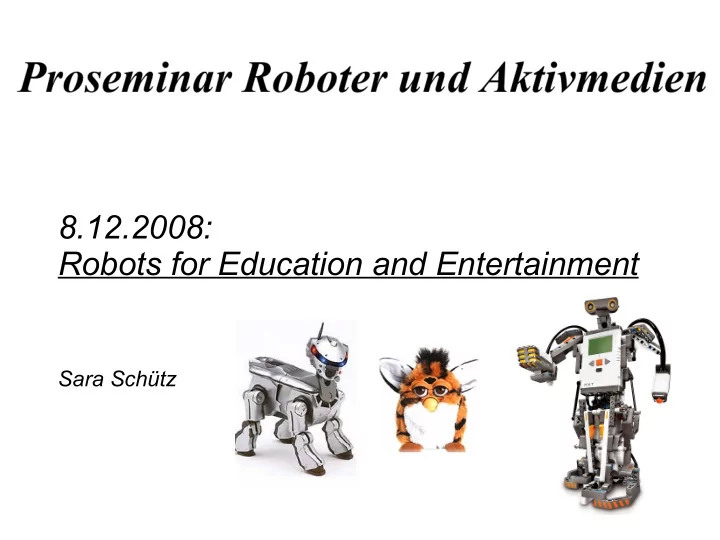
8.12.2008: Robots for Education and Entertainment Sara Schtz Table - - PowerPoint PPT Presentation

8 12 2008 robots for education and entertainment
SMART_READER_LITE
LIVE PREVIEW

8.12.2008: Robots for Education and Entertainment Sara Schtz Table - - PowerPoint PPT Presentation

8.12.2008: Robots for Education and Entertainment Sara Schtz Table of Contents What means Robot for Education&Entertainment? Educational Robots: The Telebots Project -Introduction -How it works Entertainment Robots:


slide-1
SLIDE 1

8.12.2008: Robots for Education and Entertainment

Sara Schütz

slide-2
SLIDE 2

08.12.2008 Robots for Education&Entertainment 2

Table of Contents

  • What means „Robot for Education&Entertainment“?
  • Educational Robots: The Telebots Project
  • Introduction
  • How it works
  • Entertainment Robots: Examples
  • Tiger Electronics/Hasbro
  • Sony
  • WowWee
  • Edutainment Robots: LEGO Mindstorms
  • History
  • How it works
  • For further information...
slide-3
SLIDE 3

08.12.2008 Robots for Education&Entertainment 3

What means a „Robot for Education and Entertainment“?

It is a robot designed for educational or entertainment purposes.

  • Educational purpose means: teach how to

program a robot.

  • Entertainment purpose means: not designed for

utilitarian use. In some cases, these two purposes are combined Edutainment Robots

slide-4
SLIDE 4

08.12.2008 Robots for Education&Entertainment 4

The Telebots-Project (TAMS-Group)

  • Educational robot system which was designed

for teaching students how to build and program a robot

  • Based on LEGO bricks
slide-5
SLIDE 5

08.12.2008 Robots for Education&Entertainment 5

The Telebot-System

  • How does it work?
slide-6
SLIDE 6

08.12.2008 Robots for Education&Entertainment 6

Entertainment Robots

slide-7
SLIDE 7

08.12.2008 Robots for Education&Entertainment 7

Tiger Electronics/Hasbro (US)

  • TE was founded in 1978 by Randy Rissman&Roger

Shiffman

  • bought by toy production company Hasbro in 1998
  • most famous robotic products:

The I-Dog Series Furby Furreal Friends

slide-8
SLIDE 8

08.12.2008 Robots for Education&Entertainment 8

Furby

  • First public appearance at the International Toy

Fair in 1998

  • Communicates via infrared
  • Cams&gears move mouth,ears
  • Speaks its own language,is able to learn the

national language

  • Reacts to several pre-programmed sentences
  • Reacts to light
slide-9
SLIDE 9

08.12.2008 Robots for Education&Entertainment 9

Furby´s sensors

Back sensor Beak sensor

Microphone Tummy sensor Tilting sensor

slide-10
SLIDE 10

08.12.2008 Robots for Education&Entertainment 10

The i-Dog

  • Reacts to music from an external source
  • „dances“ to the beat of the music
  • Has several buttons to allow interaction with the user
  • Shows various „emotions“ by varying light patterns
  • There are several different shapes of the concept

such as i-Cat,i-Cy(Penguin shaped),Spi-Dog etc.

slide-11
SLIDE 11

08.12.2008 Robots for Education&Entertainment 11

Entertainment Robots developed by Sony

AIBO QRIO

slide-12
SLIDE 12

08.12.2008 Robots for Education&Entertainment 12

AIBO-Artificial Intelligence RoBOt

  • first sold on the internet in 1999
  • recognizes voices
  • regognizes its charging

station

  • can be extended

by AIBOware

  • can be modified by

Sony´s „R-Code“ language

slide-13
SLIDE 13

08.12.2008 Robots for Education&Entertainment 13

QRIO-Quest for CuRIOsity

  • first introduced in 2000,successor in 2002
  • 58 cm tall,weighing 7 kg
  • recognizes voices and faces
  • japanese word pool of about 60.000 words
  • the first and fastest running humanoid robot

(Guinness World Record 2005)

  • other features: jumping,story telling,stair climbing,

singing,dancing etc.

slide-14
SLIDE 14

08.12.2008 Robots for Education&Entertainment 14

WowWee

  • was founded in 1988
slide-15
SLIDE 15

08.12.2008 Robots for Education&Entertainment 15

The Tri-Bot

  • successor of the RoboSapien
  • high mobility,3-wheeled,can move

in 8 directions

  • has a „pop-top“ head and animated

eyebrows

  • fast talking
  • movement-sensor
  • reacts to the environment by giving comments
  • controlled by a tilt-sensitive remote-control
  • can also move autonomously
  • includes a game function&an alarm function
slide-16
SLIDE 16

08.12.2008 Robots for Education&Entertainment 16

Edutainment Robots: LEGO Mindstorms

slide-17
SLIDE 17

08.12.2008 Robots for Education&Entertainment 17

The History of LEGO Mindstorms

  • 1998: The Robotics Invention

System (RIS)

  • based on the programmable

brick RCX

  • the RCX is programmed by

downloading a program from a PC by infrared technology

  • interaction between two or

more RCX bricks is possible

slide-18
SLIDE 18

08.12.2008 Robots for Education&Entertainment 18

The History of LEGO Mindstorms

  • 2006: LEGO Mindstorms NXT,the NXT brick
  • gets input from up tp four sensors

Sensor Ports NXT Buttons Loudspeaker USB-Port 3 Motor Ports Interactive Servo Motors Ultrasonic Sensor Light Sensor Sound Sensor Touch Sensor

slide-19
SLIDE 19

08.12.2008 Robots for Education&Entertainment 19

How LEGO Mindstorms works

1.Design and build your robot 2.Program your robot 3.Communicate with your robot

  • per USB
  • r
  • per Bluetooth

4.Test and improve your robot

slide-20
SLIDE 20

08.12.2008 Robots for Education&Entertainment 20

For further information

Please visit

http://tams-www.informatik.uni-hamburg.de/ http://en.wikipedia.org/wiki/Entertainment_robot http://en.wikipedia.org/wiki/Aibo http://de.wikipedia.org/wiki/Aibo http://en.wikipedia.org/wiki/Qrio http://mindstorms.lego.com/ http://www.wowwee.com/ http://www.hasbro.com/tiger/idog/

and enjoy!There´s so much more to discover!

slide-21
SLIDE 21

08.12.2008 Robots for Education&Entertainment 21

Thanks for your attention! Questions?