Shalimo November 2014 In t In this p is presen esenta1 - - PDF document

shalimo november 2014 in t in this p is presen esenta1
SMART_READER_LITE
LIVE PREVIEW

Shalimo November 2014 In t In this p is presen esenta1 - - PDF document

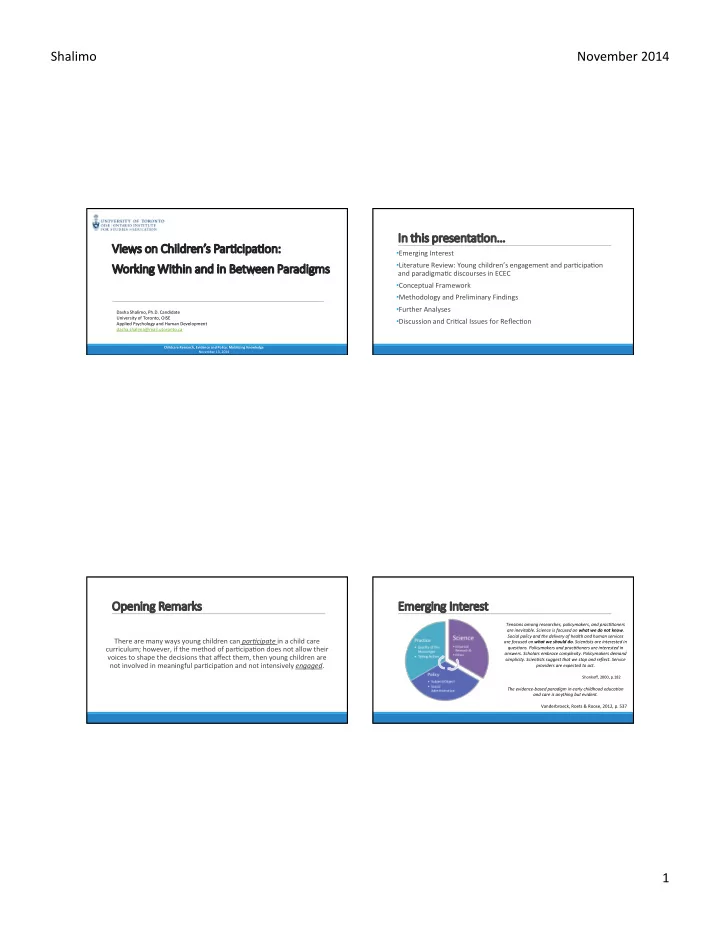
Shalimo November 2014 In t In this p is presen esenta1 a1on on Vi Views on on Ch Children ens P Par1ci cipa1on on: Emerging Interest Paradigms Literature


slide-1
SLIDE 1

Shalimo ¡ November ¡2014 ¡ 1 ¡

Vi Views ¡on ¡on ¡Ch ¡Children en’s ¡P ¡Par1ci cipa1on

  • n: ¡ ¡

¡ ¡ Wo Working ¡ ¡Within ¡ ¡and ¡ ¡in ¡ ¡Between ¡ ¡Paradigms ¡

Childcare ¡Research, ¡Evidence ¡and ¡Policy: ¡Mobilizing ¡Knowledge ¡ November ¡13, ¡2014 ¡

Dasha ¡Shalimo, ¡Ph.D. ¡Candidate ¡ University ¡of ¡Toronto, ¡OISE ¡ Applied ¡Psychology ¡and ¡Human ¡Development ¡ ¡ dasha.shalima@mail.utoronto.ca ¡ ¡

In In ¡t ¡this ¡p is ¡presen esenta1 a1on

  • n…
  • Emerging ¡Interest ¡ ¡
  • Literature ¡Review: ¡Young ¡children’s ¡engagement ¡and ¡parPcipaPon ¡

and ¡paradigmaPc ¡discourses ¡in ¡ECEC ¡

  • Conceptual ¡Framework ¡
  • Methodology ¡and ¡Preliminary ¡Findings ¡
  • Further ¡Analyses ¡
  • Discussion ¡and ¡CriPcal ¡Issues ¡for ¡ReflecPon ¡

Op Open ening ¡R ¡Rema emarks

There ¡are ¡many ¡ways ¡young ¡children ¡can ¡par$cipate ¡in ¡a ¡child ¡care ¡ curriculum; ¡however, ¡if ¡the ¡method ¡of ¡parPcipaPon ¡does ¡not ¡allow ¡their ¡ voices ¡to ¡shape ¡the ¡decisions ¡that ¡affect ¡them, ¡then ¡young ¡children ¡are ¡ not ¡involved ¡in ¡meaningful ¡parPcipaPon ¡and ¡not ¡intensively ¡engaged. ¡

Emer Emerging ¡In ging ¡Inter eres est

Tensions ¡among ¡researches, ¡policymakers, ¡and ¡prac$$oners ¡ are ¡inevitable. ¡Science ¡is ¡focused ¡on ¡what ¡we ¡do ¡not ¡know. ¡ Social ¡policy ¡and ¡the ¡delivery ¡of ¡health ¡and ¡human ¡services ¡ are ¡focused ¡on ¡what ¡we ¡should ¡do. ¡Scien$sts ¡are ¡interested ¡in ¡ ques$ons. ¡Policymakers ¡and ¡prac$$oners ¡are ¡interested ¡in ¡

  • answers. ¡Scholars ¡embrace ¡complexity. ¡Policymakers ¡demand ¡
  • simplicity. ¡Scien$sts ¡suggest ¡that ¡we ¡stop ¡and ¡reflect. ¡Service ¡

providers ¡are ¡expected ¡to ¡act. ¡ ¡ ¡ ¡ ¡ ¡ ¡ ¡ ¡ ¡ ¡ ¡Shonkoff, ¡2000, ¡p.182 ¡ The ¡evidence-­‑based ¡paradigm ¡in ¡early ¡childhood ¡educa$on ¡ and ¡care ¡is ¡anything ¡but ¡evident. ¡ ¡ ¡ Vanderbroeck, ¡Roets ¡& ¡Roose, ¡2012, ¡p. ¡537 ¡

slide-2
SLIDE 2

Shalimo ¡ November ¡2014 ¡ 2 ¡

Emer Emerging ¡In ging ¡Inter eres est

Whose ¡knowledge ¡and ¡ ¡ whose ¡voices ¡are ¡not ¡being ¡heard? ¡ Child ¡ PracPce ¡ Science ¡ Policy ¡

The ¡degree ¡to ¡which ¡children ¡should ¡have ¡a ¡ voice ¡in ¡anything ¡is ¡a ¡subject ¡of ¡strongly ¡ divergent ¡opinion ¡(Hart, ¡1992, ¡p. ¡5). ¡

Lit Liter eratur ture ¡R e ¡Revie view: ¡ w: ¡ Ch Children en’s ¡P ¡Par1ci cipa1on

  • n: ¡T

¡Typ ypol

  • log
  • gy

Hart ¡(1992) ¡Ladder ¡of ¡Young ¡People’s ¡ParPcipaPon ¡ Shier ¡(2001) ¡Pathways ¡to ¡ParPcipaPon ¡

Lit Liter eratur ture ¡R e ¡Revie view: ¡ w: ¡ Paradigms ms: ¡ ¡Typology

Roots ¡of ¡Paradigms ¡ ¡ Paradigms ¡ Author ¡

Cultural ¡TradiPons ¡ ¡ Pre-­‑Primary ¡& ¡Social-­‑Pedagogy ¡ ¡ Benned, ¡J. ¡(2005) ¡ TheorePcal ¡PerspecPve ¡ ¡ ¡ Developmental ¡& ¡PosfoundaPonal/ Postmodern ¡ Moss, ¡P. ¡(2007) ¡ ¡ ¡ Historical-­‑theorePcal ¡PerspecPve ¡ Conforming, ¡Reforming, ¡& ¡Transforming ¡ McNaughton, ¡G. ¡(2003) ¡ InformaPve ¡PerspecPve ¡ Theory ¡& ¡PracPce ¡ Taguchi, ¡L. ¡(2008) ¡ Social ¡PosiPoning ¡of ¡the ¡Profession ¡ PerspecPve ¡ Exchange ¡& ¡Gij ¡giving ¡ Vaughan, ¡G. ¡(1999) ¡ Views ¡on ¡the ¡Child ¡PerspecPve ¡ Child ¡as ¡nature ¡ Child ¡as ¡reproducer ¡of ¡culture ¡& ¡ knowledge ¡ Dahlberg, ¡G. ¡& ¡Taguchi, ¡L. ¡(1994); ¡Hultqvist, ¡K. ¡(1990); ¡ Taguchi, ¡L. ¡(2000); ¡Nordin-­‑Hultman, ¡(2004) ¡ Overarching ¡Four ¡Core ¡PerspecPves ¡ Developmental ¡ PoliPcal ¡& ¡Economic ¡ Social ¡& ¡Cultural ¡ Human ¡Rights ¡ Woodhead, ¡M. ¡(2006) ¡ Children’s ¡Input ¡in ¡Curriculum ¡ PerspecPve ¡ Logical ¡ RhizomaPc ¡ Sellers, ¡M. ¡(2013) ¡

Conceptual ¡ ¡Fr Frame mework

Post-­‑Modern ¡ Paradigm ¡ Individual's ¡ SubjecPvism ¡ Social ¡& ¡Historical ¡ Pedagogical ¡ Contextualism ¡ Distributed ¡Pluralism ¡ CriAcal ¡-­‑ ¡Dialogic ¡Paradigm ¡ ParPcipatory ¡Learning ¡ AcPon ¡ Social ¡& ¡Ecological ¡TransformaPon ¡ Modern ¡Paradigm ¡ ScienPfic ¡ObjecPvism ¡ Pedagogical ¡ Universalism ¡ Hierarchal ¡Structurism ¡ ConstrucPvism ¡ Developmental ¡ Socio-­‑Historical ¡

Young ¡Children’s ¡ engagement ¡ ¡ & ¡parAcipaAon ¡

Edutainment ¡as ¡Engagement ¡ Mere ¡ParPcipaPon ¡ Intense ¡Engagement ¡ AcPve ¡ParPcipaPon ¡

slide-3
SLIDE 3

Shalimo ¡ November ¡2014 ¡ 3 ¡

Mo Modern ¡P dern ¡Par aradigm: ¡Cri1c adigm: ¡Cri1cal ¡A al ¡Appr ppraisal aisal

¡ Developmentalism ¡or ¡scienPfic ¡posiPvism ¡has ¡a ¡disPnct ¡vocabulary: ¡words ¡ like ¡“development”, ¡“improvement ¡of ¡quality ¡standards”, ¡“readiness ¡for ¡ school”, ¡“best ¡pracPce”, ¡“outcomes”. ¡ ¡ ¡ It ¡draws ¡on ¡a ¡few ¡disciplinary ¡perspecPves, ¡notably ¡child ¡development ¡and ¡

  • economics. ¡ ¡

¡ It ¡privileges ¡instrumental ¡raPonality ¡and ¡technical ¡pracPce. ¡Its ¡prime ¡ quesPons ¡being: ¡“what ¡are ¡the ¡outcomes?” ¡and ¡“what ¡works?”. ¡ ¡ ¡In ¡doing ¡so, ¡it ¡sets ¡up ¡a ¡binary ¡opposiPon ¡between ¡process ¡and ¡outcomes. ¡ ¡ ¡ ¡ ¡ ¡ ¡ ¡ ¡ ¡(Moss, ¡2007, ¡p. ¡229) ¡ ¡Educators ¡do ¡a ¡good ¡job ¡for ¡and ¡about ¡children, ¡but ¡Early ¡Childhood ¡ EducaPon ¡and ¡Care ¡is ¡about ¡doing ¡things ¡with ¡children ¡(MacNaughton, ¡ 2008). ¡ ¡ ¡

Con Constru ruc1 c1vism: ¡Cri1 vism: ¡Cri1cal ¡Ap al ¡Appraisal ¡ aisal ¡

¡ Hruby( ¡2001) ¡defined ¡construcPvism ¡as ¡a ¡“process ¡inside ¡the ¡head” ¡ and ¡construcPonism ¡as ¡an ¡“outside-­‑the-­‑head, ¡social ¡process ¡ between ¡people ¡in ¡social ¡relaPonships” ¡(p. ¡51). ¡ ¡ Popkewitz ¡(1998) ¡quesPoned ¡whether ¡construcPvism, ¡as ¡it’s ¡ understood ¡and ¡implemented ¡by ¡many, ¡discursive ¡imaginaries ¡that ¡ can ¡produce ¡social ¡change. ¡He ¡concluded ¡that ¡contemporary ¡ discussions ¡of ¡construcPvism ¡produce ¡rather ¡academically ¡neutral ¡ relaPonships ¡than ¡criPcal ¡and ¡social. ¡That ¡is, ¡construcPvism ¡produces ¡ a ¡mind/society ¡binary. ¡

Po Postmodern ¡ ¡Pa Paradigm: ¡ ¡Cri1cal ¡ ¡Appraisal ¡ ¡

¡ McLaren ¡(2000) ¡argues ¡that ¡postmodern ¡paradigm, ¡while ¡it ¡makes ¡ suggesPve ¡arguments ¡that ¡challenge ¡modernist ¡assumpPons ¡and ¡ addresses ¡the ¡power/knowledge ¡problem ¡in ¡modernist ¡hegemony, ¡ suffers ¡from ¡a ¡profoundly ¡anemic ¡abstracPon ¡from ¡the ¡poliPcal ¡and ¡ social ¡context ¡of ¡the ¡very ¡issues ¡it ¡raises. ¡ ¡ Specifically, ¡McLaren ¡claims ¡that ¡“postmodern ¡theory ¡has ¡failed ¡to ¡ provide ¡an ¡effecPve ¡counterstrategy ¡to ¡the ¡spread ¡of ¡neoliberal ¡ ideology ¡that ¡currently ¡holds ¡educaPonal ¡policy ¡and ¡pracPce ¡in ¡its ¡ thrall” ¡(McLaren ¡& ¡Farahmandpur, ¡2000, ¡p. ¡28) ¡

Cri1 Cri1cal ¡– ¡Dialogic ¡P al ¡– ¡Dialogic ¡Par arad adigm igm

¡ Habermas, ¡J. ¡(1996): ¡communicaPve ¡reason ¡ ¡ Freire ¡(1997; ¡2007): ¡ ¡dialogue ¡& ¡praxis ¡ ¡ Giroux, ¡H., ¡A. ¡& ¡McLaren, ¡P. ¡(1992): ¡radical ¡pedagogy ¡& ¡criPcal ¡cultural ¡studies ¡

  • They ¡argued ¡that ¡radical ¡pedagogy ¡is ¡the ¡one ¡that ¡has ¡a ¡potenPal ¡to ¡revise ¡modernist ¡binaries ¡in ¡social ¡
  • pracPces. ¡It ¡has ¡strength ¡to ¡explain ¡how ¡individuals ¡within ¡a ¡system ¡can ¡effect ¡change ¡while ¡also ¡

demonstraPng ¡the ¡mechanisms ¡of ¡that ¡system ¡of ¡power. ¡ ¡ Cannella, ¡G., ¡S. ¡(1997) ¡

  • The ¡most ¡criPcal ¡voices ¡that ¡are ¡silent ¡in ¡our ¡construcPons ¡of ¡early ¡childhood ¡educaPon ¡are ¡the ¡children ¡

with ¡whom ¡we ¡work. ¡Our ¡construcPons ¡of ¡research ¡have ¡not ¡fostered ¡methods ¡that ¡facilitate ¡hearing ¡their ¡ voices ¡(p. ¡10). ¡ ¡ Bloch, ¡M., ¡N., ¡Swadener, ¡B., ¡B. ¡& ¡Cannella, ¡G., ¡S. ¡(2014): ¡deconstrucPng ¡& ¡reconceptualizing ¡early ¡childhood, ¡ child-­‑centred ¡curriculum, ¡and ¡developmental ¡psychology ¡ ¡ Palaiologou, ¡I. ¡(2012): ¡ethical ¡issues ¡in ¡research ¡with ¡children; ¡ethical ¡praxis; ¡ethical ¡issues ¡in ¡policy ¡and ¡pracPce ¡

slide-4
SLIDE 4

Shalimo ¡ November ¡2014 ¡ 4 ¡

Me Metho thodo dolo logy gy

¡ The ¡study ¡is ¡framed ¡as ¡a ¡qualitaPve ¡research ¡with ¡underlying ¡elements ¡of ¡criPcal ¡ theory ¡that ¡understands ¡educaPon, ¡and ¡pedagogy ¡specifically, ¡as ¡an ¡extremely ¡ poliPcal ¡process ¡where ¡educators ¡struggle ¡with ¡the ¡complexiPes ¡of ¡power ¡relaPons ¡

  • f ¡early ¡childhood ¡pedagogy ¡under ¡the ¡veil ¡of ¡neutrality ¡(Steinberg ¡& ¡Cannella, ¡

2012). ¡ ¡ ¡ ¡ ¡ The ¡study ¡uPlizes ¡such ¡elements ¡of ¡criPcal ¡research ¡as ¡respect ¡for ¡mulPple ¡sources ¡

  • f ¡knowledge ¡and ¡the ¡call ¡for ¡transformaPve ¡acPon ¡(Quintero, ¡2009). ¡UlPmately, ¡

the ¡study ¡“tend[s] ¡to ¡locate ¡the ¡foundaPons ¡of ¡truth ¡in ¡specific ¡historical, ¡economic, ¡ […], ¡and ¡social ¡infrastructures” ¡(Lincoln ¡& ¡Guba, ¡2000, ¡p.177). ¡Furthermore, ¡the ¡ study ¡incorporates ¡mulPple ¡voices ¡– ¡voices ¡of ¡the ¡ELFs’ ¡author ¡(s), ¡voices ¡of ¡ECE ¡ respondents, ¡and ¡a ¡voice ¡of ¡the ¡researcher ¡(Hertz, ¡1997). ¡ ¡

Ama Amalgama ma1on

  • n ¡of

¡of ¡mu ¡mul1ple ¡t e ¡truths ¡a ¡and ¡mu ¡mul1ple ¡ e ¡ vo voices ¡ ¡benefi fits ¡ ¡the ¡ ¡study ¡ ¡in ¡ ¡following ¡ ¡ways: ¡ ¡

  • The ¡study ¡allocates ¡the ¡children’s ¡engagement/parPcipaPon ¡phenomenon ¡within ¡ECEC ¡paradigms, ¡

analyses ¡and ¡interprets ¡the ¡presentaPon ¡of ¡those ¡in ¡the ¡Early ¡Learning ¡Frameworks ¡(ELF). ¡

  • The ¡study ¡is ¡mulP-­‑disciplinary ¡(in ¡this ¡case ¡bridging ¡the ¡fields ¡of ¡Psychology, ¡Philosophy, ¡Curriculum ¡

Studies, ¡Sociology ¡of ¡Childhood ¡and ¡PoliPcal ¡Science). ¡

  • The ¡study ¡creates ¡link ¡between ¡text ¡(ELF) ¡and ¡society, ¡Early ¡Childhood ¡Educators ¡(ECE). ¡
  • The ¡study ¡addresses ¡chronological ¡formaPon ¡of ¡the ¡ECEC ¡Early ¡Learning ¡Framework ¡documents. ¡ ¡
  • The ¡study ¡does ¡not ¡aim ¡to ¡compare ¡and ¡contrast ¡the ¡ELF ¡documents; ¡it ¡rather ¡adempts ¡to ¡do ¡a ¡

criPcal-­‑theorePcal ¡work ¡by ¡analyzing ¡why ¡certain ¡paradigms ¡take ¡a ¡predominant ¡stance ¡when ¡it ¡ comes ¡to ¡pracPcal ¡applicaPons ¡of ¡ECEC ¡pedagogy. ¡ ¡

  • The ¡study ¡not ¡only ¡considers ¡the ¡texts ¡as ¡semioPcs, ¡but ¡also ¡analyses ¡acPons ¡of ¡social ¡groups ¡

expressed ¡through ¡wriden ¡and ¡spoken ¡languages. ¡ ¡

Wh Why ¡is ¡it ¡impo y ¡is ¡it ¡import rtan ant ¡t t ¡to ¡disc ¡discuss? uss?

Curriculum ¡in ¡general ¡and ¡ECEC ¡frameworks ¡in ¡parPcular ¡are ¡ understood ¡as ¡a ¡“disciplinary ¡technology ¡that ¡directs ¡how ¡the ¡ individual ¡to ¡act, ¡feel, ¡and ¡‘see’ ¡the ¡world ¡and ¡self. ¡As ¡such ¡[they] ¡are ¡ the ¡forms ¡of ¡social ¡regulaPon” ¡(Popkewitz, ¡1996, ¡p.2) ¡ ¡

ELF ELFs’ ¡T s’ ¡Theo heore1c e1cal ¡Mo al ¡Models dels ¡ Resource: ¡Review ¡of ¡Early ¡Learning ¡Frameworks ¡in ¡Canada

ELF ¡ TheorePcal ¡Model ¡ ¡ Department ¡of ¡EducaPon ¡and ¡Early ¡Childhood ¡Development. ¡(2008). ¡New ¡Brunswick ¡Curriculum ¡ Framework ¡for ¡Early ¡Learning ¡and ¡Child ¡Care: ¡English: ¡Fredericton, ¡NB. ¡ ¡ ¡ English ¡Version ¡ TheorePcal ¡model ¡– ¡a ¡holisAc/socio-­‑cultural ¡model ¡with ¡goals ¡specific ¡to ¡communicaPon ¡and ¡ literacies ¡throughout ¡the ¡document. ¡It ¡is ¡also ¡influenced ¡by ¡the ¡criAcal ¡and ¡post-­‑structural ¡image ¡of ¡ the ¡powerful, ¡competent ¡child. ¡ ¡ ¡ PEI ¡Department ¡of ¡EducaPon ¡and ¡Early ¡Childhood ¡Development ¡(2011). ¡PEI ¡Early ¡Learning ¡Framework: ¡ RelaPonships, ¡Environments, ¡Experiences. ¡The ¡Curriculum ¡Framework ¡of ¡the ¡Preschool ¡Excellence ¡

  • IniPaPve. ¡ ¡

Social ¡pedagogical ¡approach ¡ ¡ ¡ ConstrucAvist ¡Approach-­‑influenced ¡by ¡developmental ¡theories ¡of ¡Jean ¡Piaget ¡and ¡Lev ¡Vygotsky ¡ ¡ ¡ ¡ Ministry ¡of ¡Families, ¡(2007). ¡MeePng ¡Early ¡Childhood ¡Needs: ¡Québec’s ¡EducaPonal ¡Program ¡for ¡ Childcare ¡Services ¡Update. ¡Quebec ¡City, ¡Quebec: ¡Ministère ¡de ¡la ¡Familie ¡et ¡des ¡Aînés. ¡ ¡ ¡ English ¡Version ¡ TheorePcal ¡model: ¡holisAc/socio-­‑cultural ¡with ¡some ¡elements ¡of ¡pre-­‑primary ¡ ¡ Framework ¡states ¡that ¡it ¡supports ¡two ¡main ¡theories: ¡ ¡ 1) ¡Ecological ¡approach ¡2) ¡ALachment ¡theory ¡ ¡ ¡ ¡ ¡ Best ¡Start ¡Expert ¡Panel ¡on ¡Early ¡Learning. ¡(2007). ¡Early ¡Learning ¡for ¡Every ¡Child ¡Today: ¡A ¡framework ¡ for ¡Ontario ¡early ¡childhood ¡se}ngs. ¡Ontario ¡Government. ¡ ¡ ¡ Ministry ¡Of ¡EducaPon. ¡(2014). ¡How ¡Does ¡Learning ¡Happen? ¡Ontario’s ¡Pedagogy ¡for ¡the ¡Early ¡Years. ¡ Ontario ¡Government. ¡ ¡ ¡ ELECT: ¡TheorePcal ¡model ¡based ¡on ¡a ¡developmental ¡theoreAcal ¡model ¡in ¡combinaPon ¡with ¡socio-­‑ cultural, ¡criAcal ¡and ¡post-­‑structural ¡theory. ¡ ¡ How ¡Does ¡Learning ¡Happen: ¡TheorePcal ¡model ¡based ¡on ¡a ¡developmental ¡theoreAcal ¡model ¡in ¡ combinaAon ¡with ¡socio-­‑behaviorist, ¡socio-­‑cultural, ¡and ¡criAcal ¡theory. ¡ ¡ ¡ ¡ Manitoba ¡Child ¡Care ¡Program. ¡(2011). ¡Early ¡Returns: ¡Manitoba’s ¡ELCC ¡Curriculum ¡Framework ¡for ¡ Preschool ¡Centres ¡and ¡Nursery ¡Schools. ¡ ¡ ¡ The ¡theorePcal ¡model ¡is ¡holisAc/socio-­‑cultural. ¡ ¡ ¡ ¡ ¡ Saskatchewan ¡Ministry ¡of ¡EducaPon. ¡(2008) ¡Play ¡and ¡ExploraPon: ¡Early ¡Learning ¡Program ¡Guide. ¡ Regina, ¡SK: ¡Early ¡Learning ¡and ¡Child ¡Care ¡Branch, ¡Ministry ¡of ¡EducaPon. ¡Reprint ¡2013. ¡ ¡ ¡ HolisAc ¡learning ¡and ¡development, ¡influenced ¡by ¡the ¡criAcal ¡and ¡post-­‑structural ¡image ¡of ¡the ¡ powerful, ¡competent ¡child. ¡ ¡ ¡ ¡ BriPsh ¡Columbia ¡Ministry ¡of ¡Health ¡and ¡Ministry ¡of ¡Children ¡and ¡Family ¡Development. ¡(2008) ¡BriPsh ¡ Columbia ¡Early ¡Learning ¡Framework. ¡Victoria, ¡BC: ¡Ministry ¡of ¡Health ¡and ¡Ministry ¡of ¡Children ¡and ¡ Family ¡Development ¡ ¡ HolisAc/socio-­‑cultural ¡with ¡a ¡focus ¡on ¡languages ¡and ¡literacies ¡as ¡one ¡of ¡the ¡four ¡areas ¡of ¡early ¡

  • learning. ¡It ¡also ¡takes ¡a ¡criAcal ¡and ¡post-­‑structural ¡view ¡of ¡children ¡as ¡powerful ¡and ¡competent. ¡

¡ ¡

McCuaig, ¡K. ¡(2014) ¡

slide-5
SLIDE 5

Shalimo ¡ November ¡2014 ¡ 5 ¡

Pr Preliminar eliminary ¡Findings: ¡De y ¡Findings: ¡Develo elopmen pmental ¡ al ¡ Pe Perspec1ve Pr Preliminar eliminary ¡Findings ¡c y ¡Findings ¡cont. t.

Prelimi minary ¡ ¡Fi Findings ¡ ¡cont.

Edutainment ¡as ¡ Engagement ¡ Mere ¡ParPcipaPon ¡ Intense ¡Engagement ¡ AcPve ¡ParPcipaPon ¡

Prelimi minary ¡ ¡Fi Findings: ¡ ¡ Summa mmary

  • Social ¡Pedagogy ¡
  • Transforming ¡
  • Child ¡as ¡reproducer ¡of ¡culture ¡& ¡knowledge ¡
  • Human ¡Rights ¡& ¡beyond ¡
  • RhizomaPc ¡

Post-­‑ modern ¡ Paradigm ¡ ¡

  • Pre-­‑Primary ¡
  • Conforming, ¡Reforming ¡
  • Developmental ¡
  • Child ¡as ¡nature ¡
  • Logical ¡

Modern ¡ Paradigm ¡

3 ¡C’s ¡Concept ¡ CriPcal-­‑Dialogic ¡ Paradigm ¡ When ¡it ¡comes ¡ to ¡ implementaPon ¡

slide-6
SLIDE 6

Shalimo ¡ November ¡2014 ¡ 6 ¡

Further ¡Analyses

¡ The ¡paper ¡uPlizes ¡CriPcal ¡Discourse ¡Analysis ¡tools, ¡as ¡proposed ¡by ¡Gee ¡(2011) ¡of ¡ ‘social ¡language’ ¡and ¡‘intertexuality’ ¡to ¡further ¡examine: ¡ ¡ (1) ¡what ¡resources ¡are ¡referenced ¡to ¡raPonalize ¡the ¡ELFs’ ¡posiPon ¡on ¡early ¡ childhood ¡pedagogy ¡(intertexuality); ¡ ¡ (2) ¡what ¡pedagogical ¡vocabulary ¡ ¡as ¡it ¡is ¡related ¡to ¡young ¡children’s ¡engagement ¡ and ¡parPcipaPon ¡concept ¡the ¡ELFs ¡use ¡to ¡guide ¡ECE’s ¡day-­‑to-­‑day ¡pracPces; ¡ ¡ (3) ¡empirical ¡findings ¡of ¡the ¡online ¡standardized ¡open-­‑ended ¡survey ¡and ¡follow-­‑ up ¡informal ¡semi-­‑structured ¡interviews. ¡

“A ¡criPque ¡is ¡not ¡a ¡mader ¡of ¡saying ¡that ¡things ¡are ¡not ¡right ¡as ¡they ¡

  • are. ¡It ¡is ¡a ¡mader ¡of ¡poinPng ¡out ¡on ¡what ¡kinds ¡of ¡assumpPons, ¡what ¡

kinds ¡of ¡familiar, ¡unchallenged, ¡unconsidered ¡modes ¡of ¡thought ¡the ¡ pracPces ¡that ¡we ¡accept ¡rest.” ¡ ― ¡Michel ¡Foucault ¡ ¡ Dialogic ¡environment ¡could ¡help ¡to ¡create ¡a ¡more ¡inclusive, ¡tolerant, ¡ and ¡accepPng ¡society ¡where ¡educaPon ¡is ¡radical ¡and ¡democraPc ¡and ¡ where ¡the ¡child’s ¡rights ¡are ¡fundamentally ¡rethought ¡in ¡light ¡of ¡ responses ¡to ¡social ¡otherness ¡and ¡civil, ¡parPcipatory ¡significance. ¡ ¡

¡

Discussio Discussion ¡and ¡Cri1c n ¡and ¡Cri1cal ¡Issues ¡f al ¡Issues ¡for ¡R r ¡Reflec1o eflec1on ¡

  • Increased ¡governmental ¡control ¡(values ¡from ¡above) ¡and ¡less ¡space ¡for ¡consultaPon, ¡specifically ¡with ¡

children ¡(values ¡as ¡a ¡result ¡of ¡negoPaPon ¡process) ¡

  • Schoolreadiness ¡or ¡Pedagogy ¡of ¡Listening ¡& ¡Care ¡
  • Why ¡is ¡developmental ¡theory ¡and ¡quanPtaPve/posiPvist ¡research ¡sPll ¡dominant ¡and ¡dominaPng ¡

noPons ¡of ¡truth ¡in ¡early ¡childhood ¡research, ¡policy, ¡pedagogy, ¡curriculum, ¡and ¡theory? ¡

  • What ¡is ¡important ¡ ¡
  • to ¡create ¡ELF ¡for ¡ECEs ¡about ¡children? ¡
  • to ¡create ¡ELF ¡in ¡consultaPon ¡with ¡children? ¡ ¡
  • EducaAonal ¡Values ¡or ¡Economic ¡NecessiAes: ¡In ¡which ¡ways ¡has ¡work ¡represented ¡over ¡the ¡years ¡helped ¡

to ¡resolve ¡criPcal ¡curriculum ¡and ¡policy ¡studies ¡related ¡to ¡early ¡childhood, ¡given ¡globalizing ¡capital ¡and ¡ neoliberal ¡narrowing ¡possibiliPes? ¡

  • DemocraAc ¡deficiency: ¡criPcal ¡– ¡democraPc ¡engagement, ¡parPcipatory ¡learning, ¡ ¡

creaPng ¡new ¡paradigm ¡??? ¡

slide-7
SLIDE 7

Shalimo ¡ November ¡2014 ¡ 7 ¡

Re References:

Benned, ¡J. ¡(2005). ¡As ¡cited ¡in ¡Report ¡of ¡The ¡Standing ¡Senate ¡Commidee ¡on ¡Social ¡Affairs, ¡Science ¡and ¡Technology: ¡Early ¡Childhood ¡EducaPon ¡and ¡Care: ¡Next ¡Steps, ¡p. ¡32, ¡April ¡2009 ¡ Bloch, ¡M., ¡N., ¡Swadener, ¡B., ¡B. ¡& ¡Cannella, ¡G., ¡S. ¡(2014). ¡Reconceptualizing ¡early ¡childhood ¡care ¡and ¡educa$on. ¡A ¡reader. ¡Cri$cal ¡ques$ons, ¡new ¡imaginaries ¡and ¡social ¡ac$vism. ¡Peter ¡ Lang ¡Publishing: ¡New ¡York. ¡ Canella, ¡G. ¡S. ¡(1997). ¡Deconstruc$ng ¡Early ¡Childhood ¡Educa$on: ¡Social ¡jus$ce ¡and ¡revolu$on. ¡New ¡York: ¡Peter ¡Lang ¡Publishing. ¡ Cohen, ¡L., ¡Manion, ¡L. ¡& ¡Morrison, ¡K. ¡(2007). ¡Research ¡methods ¡in ¡educaPon. ¡(6th ¡ed.). ¡Routledge: ¡New ¡York ¡& ¡London. ¡ Dahlberg, ¡G. ¡& ¡Moss, ¡P. ¡(2005). ¡Ethics ¡and ¡poli$cs ¡in ¡early ¡childhood ¡educa$on. ¡London ¡and ¡New ¡York: ¡RoutledgeFalmer. ¡ ¡ Dahlberg, ¡G. ¡& ¡Moss, ¡P. ¡(2012). ¡Contes$ng ¡early ¡childhood ¡and ¡opening ¡for ¡change. ¡London ¡and ¡New ¡York: ¡RoutledgeFalmer. ¡ ¡ Farquhar, ¡B. ¡& ¡Fitzsimons, ¡P. ¡(2008). ¡(Eds.). ¡Philosophy ¡of ¡early ¡childhood ¡educa$on. ¡Transforming ¡narra$ves. ¡Blackwell ¡Publishing. ¡ Freire, ¡P. ¡(1997). ¡Pedagogy ¡for ¡the ¡oppressed. ¡New ¡York: ¡The ¡ConPnuum ¡Publishing ¡Group ¡Inc. ¡ Freire, ¡P. ¡(2007). ¡Pedagogy ¡of ¡the ¡heart.New ¡York, ¡London: ¡The ¡ConPnuum ¡Publishing ¡Group ¡Inc. ¡ Gee, ¡J. ¡P. ¡(2011). ¡How ¡to ¡do ¡discourse ¡analysis: ¡A ¡toolkit. ¡Routledge: ¡New ¡York ¡& ¡London. ¡ Giroux, ¡H. ¡(1983). ¡Theories ¡of ¡reporoduc$onand ¡resistance ¡in ¡the ¡new ¡sociology ¡of ¡educa$on. ¡A ¡cri$cal ¡analysis. ¡Harvard ¡EducaPonal ¡Review, ¡53, ¡p. ¡257-­‑293. ¡ Giroux, ¡H., ¡A. ¡& ¡McLaren, ¡P. ¡(1992). ¡WriPng ¡from ¡the ¡margins: ¡Geographies ¡of ¡idenPty, ¡pedagogy, ¡and ¡power. ¡Journal ¡of ¡Educa$on, ¡174 ¡(1), ¡p. ¡7-­‑30. ¡ Guba ¡E., ¡G. ¡& ¡Lincoln, ¡Y., ¡S. ¡(2000). ¡ParadigmaPc ¡controversies, ¡contradicPons, ¡and ¡emerging ¡confluences. ¡In ¡N. ¡K. ¡Denzin ¡& ¡Y. ¡S. ¡Lincoln ¡(Eds.), ¡Handbook ¡of ¡qualitaPve ¡research. ¡ (2nd ¡ed.), ¡(pp.163-­‑188). ¡Sage: ¡Thousand ¡Oak, ¡CA. ¡ ¡ Habermas, ¡J. ¡(1996). ¡The ¡philosophical ¡discourse ¡of ¡modernity: ¡Twelve ¡lectures. ¡Cambridge, ¡MA: ¡MIT ¡Press. ¡ Hart, ¡R. ¡(1992). ¡InnocenP ¡essays: ¡Children’s ¡parPcipaPon ¡from ¡tokenism ¡to ¡ciPzenship. ¡UNICEF. ¡ Hertz, ¡R. ¡(1997). ¡IntroducPon: ¡Reflexivity ¡and ¡voice. ¡In ¡R. ¡Hertz ¡(Ed.), ¡Reflexivity ¡and ¡voice. ¡Sage: ¡Thousand ¡Oak, ¡CA. ¡ Hultqvist, ¡K. ¡& ¡Dahlberg, ¡G. ¡(2001). ¡Governing ¡the ¡child ¡in ¡the ¡new ¡millennium. ¡RoutledgeFalmer: ¡New ¡York ¡& ¡London. ¡ Hruby, ¡G., ¡C. ¡(2001). ¡Sociological, ¡postmodern, ¡and ¡new ¡realism ¡perspecPves ¡in ¡social ¡construcPonism: ¡ImplicaPons ¡for ¡literacy ¡research. ¡Reading ¡Research ¡Quarterly, ¡36, ¡p. ¡48-­‑62 ¡ McLaren, ¡P. ¡(1988). ¡Schooling ¡the ¡postmodern ¡body: ¡CriPcal ¡pedagogy ¡and ¡the ¡poliPcs ¡of ¡enfleshment. ¡Journal ¡of ¡EducaPon, ¡170, ¡53–83. ¡ McLaren, ¡P. ¡& ¡Farahmandpur, ¡R. ¡(2000). ¡Reconsidering ¡Marx ¡in ¡post-­‑marxist ¡Pmes: ¡A ¡requiem ¡for ¡postmodernism? ¡EducaPonal ¡Researcher, ¡25–33. ¡ Mac ¡Naugton, ¡G. ¡(2003). ¡Shaping ¡Early ¡Childhood: ¡Learners, ¡Curriculum ¡and ¡Contexts. ¡McGraw ¡Hill: ¡Open ¡University ¡Press. ¡ Mac ¡Naughton, ¡G. ¡(2008). ¡Early ¡Childhood ¡EducaPon ¡Conference. ¡Video ¡exempt. ¡Retrieved ¡from ¡hdps://www.youtube.com/watch?v=i0H5I1pkp40 ¡ ¡ McCuaig, ¡K. ¡(2014). ¡Review ¡of ¡Early ¡Learning ¡Frameworks ¡in ¡Canada. ¡Atkinson ¡Centre, ¡OISE. ¡ Moss, ¡P. ¡(2007). ¡MeePng ¡across ¡the ¡paradigmaPc ¡divide. ¡Educa$onal ¡Philosophy ¡and ¡Theory. ¡39:3, ¡229-­‑245. ¡doi: ¡10.1111/j.1469-­‑5812.2007.00325.x ¡ Palaiologou, ¡I. ¡(2012). ¡Ethical ¡Prac$ce ¡in ¡Early ¡Childhood. ¡Sage: ¡Los ¡Angeles, ¡London, ¡New ¡Delhi, ¡Singapore, ¡Washington ¡DC. ¡ Popkewitz, ¡T. ¡(1996). ¡The ¡producPon ¡of ¡reason ¡and ¡power: ¡Curriculum ¡history ¡and ¡intercultural ¡tradiPons. ¡Paper ¡presented ¡at ¡the ¡American ¡EducaPonal ¡Research ¡AssociaPon, ¡New ¡York, ¡NY. ¡ Popkewitz, ¡T. ¡(1998). ¡Dewye, ¡Vygotsky, ¡and ¡the ¡social ¡administraPon ¡of ¡the ¡individual: ¡ConstrucPvist ¡pedagogy ¡as ¡systems ¡of ¡ideas ¡in ¡historical ¡spaces. ¡American ¡Educa$onal ¡Research ¡Journal, ¡35, ¡p. ¡ 535-­‑570. ¡ Quintero, ¡E. ¡P. ¡(2009) ¡Cri$cal ¡Literacy ¡in ¡Early ¡Childhood ¡Educa$on: ¡ArMul ¡Story ¡& ¡the ¡Integrated ¡Curriculum. ¡New ¡York: ¡Lang ¡Publishing. ¡ Shier ¡, ¡H.(2001). ¡Pathways ¡to ¡ParPcipaPon: ¡Openings, ¡opportuniPes ¡and ¡obligaPons. ¡Children ¡and ¡Society: ¡15, ¡107-­‑117. ¡ Seller, ¡M. ¡(2013). ¡Young ¡children ¡becoming ¡curriculum. ¡Deluze, ¡Te ¡Whāriki ¡and ¡curricular ¡understandings. ¡Routledge: ¡London ¡& ¡New ¡York. ¡ Taguchi, ¡H., ¡L. ¡(2010). ¡Going ¡beyond ¡the ¡theory/prac$ce ¡divide ¡in ¡early ¡childhood ¡educa$on. ¡Introducing ¡an ¡intra-­‑ac$ve ¡pedagogy. ¡Routledge: ¡London ¡& ¡New ¡York. ¡ Steinberg, ¡Sh. ¡R. ¡& ¡Cannella, ¡S. ¡G. ¡(2012). ¡(Eds.). ¡Cri$cal ¡qualita$ve ¡research ¡reader. ¡Peter ¡Lang: ¡New ¡York, ¡Washington, ¡D. ¡C./ ¡BalPmore, ¡Bern, ¡Frankfurt, ¡Berlin, ¡Vienna, ¡Oxford. ¡ Vanderbroeck, ¡M., ¡Roets, ¡G. ¡& ¡Roose, ¡R. ¡(2012). ¡Why ¡the ¡evidence-­‑based ¡paradigm ¡in ¡Early ¡childhood ¡educaPon ¡and ¡care ¡is ¡anything ¡but ¡evident. ¡European ¡Early ¡Childhood ¡Educa$on ¡Research ¡Journal ¡Vol. ¡ 20, ¡No. ¡4,p. ¡537–552 ¡