7/13/2019 Welcome to the Nevada Camera Club Presentation Share - - PDF document

7 13 2019
SMART_READER_LITE
LIVE PREVIEW

7/13/2019 Welcome to the Nevada Camera Club Presentation Share - - PDF document

7/13/2019 Welcome to the Nevada Camera Club Presentation Share What is Known Continue to Learn Two general meetings a month, exception of Education through speakers at General December Meetings Second and Fourth Fridays of the


slide-1
SLIDE 1

7/13/2019 1

Share What is Known Continue to Learn

Welcome to the Nevada Camera Club

Presentation

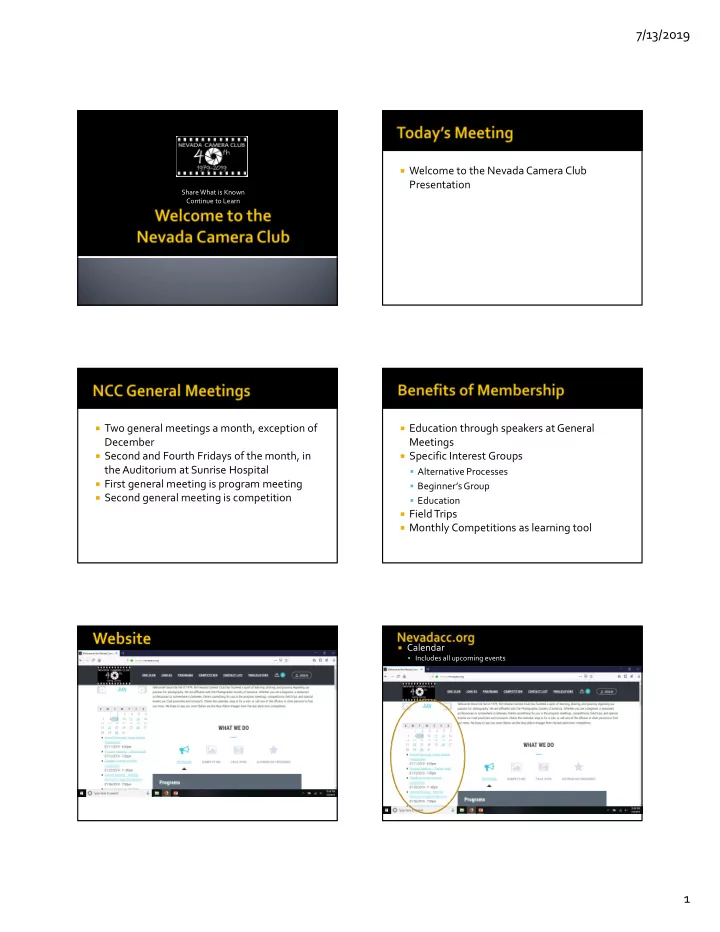
Two general meetings a month, exception of

December

Second and Fourth Fridays of the month, in

the Auditorium at Sunrise Hospital

First general meeting is program meeting Second general meeting is competition Education through speakers at General

Meetings

Specific Interest Groups

  • Alternative Processes
  • Beginner’s Group
  • Education

Field Trips Monthly Competitions as learning tool Nevadacc.org

Calendar

  • Includes all upcoming events
slide-2
SLIDE 2

7/13/2019 2

Our Club

Contact List Publications Page Members Only

Click here to login. Click here to login.

Members Only Portal

slide-3
SLIDE 3

7/13/2019 3

Access to Forum

  • You must

subscribe to receive E- Notice or Community Notices!

  • This is done

when your account is

  • riginally set

up.

Special Competitions

  • Annual Print
  • Annual Electronic
  • Juried Exhibition

Monthly Competitions

  • Electronic
  • Print

Alternates between Electronic and Print

Competitions, starting annually with Electronic.

Two entries per member from 12 regular

categories, PLUS one entry in club challenge theme category

$2 per entry Great learning tool: learn how to improve

your images from judges comments on your images as well as others.

Can be found in the member handbook and

  • n the publications page on the website

Many photographs may fit into more than

  • ne category. It is up to the photographer to

choose which category to compete in

2 divisions

  • Color
  • Monochrome
slide-4
SLIDE 4

7/13/2019 4

There are several categories where any

change that alters the truth of the photographic statement renders the photo ineligible

  • Documentary-record without embellishment.
  • Nature/Wildlife-organisms living free and

unrestrained in natural or adopted habitat. Human elements should not be present.

  • Photojournalism-depicts a photographic story of

an event and its impact.

People-Features one or more persons where

the lighting and subject matter are not necessarily under the control of the photographer.

Portraiture-Any photograph of persons

and/or animals with the lighting and subject matter under the control of the photographer.

Choose your class according to your age, experience

and knowledge. At any time, you may choose to advance to a higher class, however, with exception of Master Class, you can’t go down in classification.

  • Junior
  • Beginner
  • Intermediate
  • Advanced
  • Master

While in Beginner or Intermediate class, winning ten

first place ribbons will automatically advance you to the next higher class.

Members may enter the Master class on a

voluntary basis. A Master classified member shall be defined as a photographer whose skill level of the craft has placed that person above the level of the advanced class.

Members submitting entries in the Master

class must personally do all the steps from conception to display.

To make sure your images have the correct

tonality and contrast, use either Levels or Curves (or both) to make your images really pop! Especially for the electronic image competitions.

Both the Levels and the Curves allow you to

alter the black and white end points of the tonal range in the image.

Both commands also allow you to change the

appearance of the intermediate, or grey, tones in-between the black and white end points.

slide-5
SLIDE 5

7/13/2019 5

Levels adjustment proportionally changes all

  • f the tones in the tonal range.

The Levels is a linear adjustment . Curves allow you to choose which portion of

the tone scale you wish to adjust.

Curves are a geometric adjustment.

Use Levels when:

You only want to adjust the black or white

end points to adjust global contrast

You want to lighten or darken the entire tonal

  • range. This is normal to adjust exposure

errors.

You want to maintain the visual relationship

  • f the values of the intermediate tones.

Open Your Image in Photoshop Select Image- Adjustments-Levels OR for non-destructive editing, select Layer- New Adjustment Layer-Levels

Look at the histogram that come up.

In this example, the histogram does not go all the way to both ends. To improve the image, we need to move the black and white arrow sliders towards the middle to the edge of the histogram. Here we moved the sliders inward. The left slider was moved more than the right. We can also move the middle slider to adjust midtones. You can also adjust color in

  • levels. Instead of

adjusting the RGB Levels, here we adjusted the green channel. Notice we moved the black slider to the right, and moved the midtone slider to the left a bit.

slide-6
SLIDE 6

7/13/2019 6

Before After

Use Curves when:

You want to subtly adjust the visual relationship of the

tone values. For example lighten the lights and darken the shadows. This usually requires an 'S' shaped curve adjustment.

You want to adjust only the light tones or only the

dark tones.

You want to adjust the tones in only a small section of

the overall tonal range.

You want complete control of your tonal editing.

Open Your Image in Photoshop Select Image- Adjustments- Curves OR for non- destructive editing, select Layer-New Adjustment Layer-Curves Look at the graph that came

  • up. Again there is a histogram.

Notice the straight diagonal line thru the center. In this image, the histogram does not go all the way to the left side. Start by moving the slider to the edge of the histogram. Now you can adjust the curve. For most pictures, a gentle S curve will work. Pick several points along the diagonal line and curve them up or down. On the right side, with the highlights, you may want to curve up. On the left side, pull down and make adjustments for midtones.

slide-7
SLIDE 7

7/13/2019 7

Before After

Levels and curves in other programs work

similarly.

The handout describes how to get to Levels

and Curves in some common editing programs.

Maximum image width is 1920 pixels Maximum image height is 1200 pixels Check image edges for white areas Convert image to sRGB. If image isn’t tagged

with ICC profile, don’t tag it

Disable soft proofing Save image with a unique title as a jpeg file

for entry.

Vertical Image

Height is set at 1200. Constrain proportions is checked, width sets at 631.

Before submitting your entry, read the Monthly

Competition Rules found under Club Publications on the website.

Entries are submitted through the Members

Only Portal Page

Entries are due the Monday night before the

Friday competition.

Entry Fees ($2 per submitted image) are due at

the Competition Meeting between 6:15 PM and 6:45 PM. Entries without paid fees will be disqualified.

Members must be logged in to be able to enter.

slide-8
SLIDE 8

7/13/2019 8

The blue description is a hotlink to the entry form.

You will get a Thank You notification that your

pictures were entered once you click submit photos.

If you wish to make changes prior to the

deadline, login, click on My Entries, and make the changes. Remember to SAVE.

Prints must be mounted Flush mounted prints are allowed Prints may be matted, multiple mats are allowed Long edge of the print must be at least 8 inches Maximum size allowed for the print, mount, or

matting is 16x20. If the print is 16x20, it must be flush mounted

Entry is done through the monthly competitions

entry page on the website exactly as the electronic entries are done EXCEPT no image needs to be uploaded.

Member need to arrive early to pay for their entries

and to receive stickers with the entry information to be affixed to the back of their images.

Entries are then turned in by display order number

to the take in team.

Three of five judges will score each individual

photo on its own merit, based upon peer group skill level

Each judge will score up to a maximum of 9

points

Scores from the three judges will be added

together for a maximum of 27 points

The total score is an appraisal of the entry on

its own merit, based on classification/peer group skill level

slide-9
SLIDE 9

7/13/2019 9

Scores are based 80% + on impact and appeal Judges are going to look at:

  • Composition
  • Technical Execution
  • Quality
  • Presentation
  • Title Appropriateness

Comments and critiques by the judges are to be

taken as constructive criticism and as a learning tool for improving images.

After the scoring phase, the top scoring entries in a

class/category/division are selected for ribbon placement

The placement is an indication of how the entry compares

with other entries submitted for that class/category/division

The placement AND score determine the actual ribbon

awarded

Only one first, one second, and one third place ribbon can

be awarded

Placement determines the order that ribbons are awarded After considering placement, the highest ribbon that an entry

can receive is determined by the total score: Minimum Total Score Highest Ribbon 24 First Place (Blue) 21 Second Place (Red) 18 Third Place (White)

It is possible for an entry which is awarded a lower technical

score to received top placement. The top placing entry receives the ribbon based on its score.

If only one entry is received in a category, a first place ribbon is

not guaranteed. Ribbon/placement is based upon score.

Image A Image B Image C Score 26 Score 25 Score 21 Placed First Placed Second Placed Third Image A receives a Blue Ribbon due to placing first AND having a score above 24. Image B receives a Red Ribbon due to placing second AND having a score above 21. Image C receives a White Ribbon due to placing third despite having a score of 21. Image A Image B Image C Score 23 Score 24 Score 23 Placed First Placed Third Placed Second Image A receives a Red Ribbon due to placing first AND having a score between 21 and 24. Image C receives a White Ribbon due to placing second, even though scored 23. Image B does not receive a Ribbon despite having a score of 24. Image A Image B Image C Score 27 Score 27 Score 27 Placed First Placed Third Placed Second Image A receives a Blue Ribbon due to placing first AND having a score of 27. Image C receives a Red Ribbon due to placing second, even though scored 27. Image B receives a White Ribbon despite having a score of 27. Only one Blue, one Red and one White Ribbon can be awarded.

slide-10
SLIDE 10

7/13/2019 10

Image A Image B Score 20 Score 25 Placed Second Placed First Image B receives a Blue Ribbon due to placing first AND having a score over 24. Image A receives a White Ribbon, even though it placed second, it didn’t score high enough for a Red Ribbon. Must have a 21 or higher for a Red Ribbon, a score of 20 only qualifies you for a White Ribbon. Image A Score 20 Image A receives a White Ribbon, even though it was only image in the category, (technically first place) it only qualified for a white ribbon due to the score of 20.

You can resubmit images in the monthly

competitions as long as the image hasn’t received a blue ribbon.

  • Enter in different categories in other monthly

competitions to try to get blue ribbon.

  • Can enter as electronic and print.
  • Blue ribbon means the image must be retired.

The purpose of this award is to stimulate members to

expand their areas of photographic expertise by enticing them to enter all categories of competition.

When a member receives a blue ribbon in a minimum

  • f ten different monthly competition categories, they

are awarded a plaque at the annual banquet. The plaque will have spaces for all thirteen categories which can be filled in.

Blue Ribbons do not need to be earned in the same

year to be awarded Kaleidoscope of Blues. This is

  • ver the course of one’s membership.

Once a member receives 27 scores of a 27

they receive a plaque at the annual awards banquet.

Accumulates over the course of membership,

starting in 2012.

Once a member receives 30 blue ribbons in a

single category, they receive a plaque at the annual awards banquet.

Accumulates over the course of membership,

starting in 2012.

slide-11
SLIDE 11

7/13/2019 11

The Merit Award System provides recognition to members

for their service to the club, participation in club activities, involvement in photographic education and participation in photographic competitions and exhibitions.

Specific point values are detailed on the website. It is up to the member to claim merits for items other than

attendance, club service and NCC competitions.

Merit reporting form is available on website under

publications tab.

Merit points are counted over the course of one’s

membership, not annually. Club members who reach a particular merits

level are awarded a pin and the appropriate bar.

Merits 200 500 1000 1500 2500 4000 10000 Designation on Bar 200 500 Master Associate Fellow Horizon Diamond Additional Award Plaque Plaque Plaque Plaque, Lifetime Membership Diamond Trophy The NCC member with the highest total of merit

points earned from NCC monthly competition awards and NCC sanctioned competitions is awarded the NCC Photographer of the Year. (Not all merit points earned go towards POY totals)

A plaque is awarded at the NCC Awards Banquet A gallery of the POY’s work is displayed on the

website and at the annual electronic competition exhibition

Learn New Techniques Ideas from Competitions Meet new people with similar interests MAKE NEW FRIENDS!!!!! To Julie Chadburn for providing a previous

presentation from which to base this one.