6th Grade Fraction & Decimal Computation 2015-10-20 - - PDF document

6th grade
SMART_READER_LITE
LIVE PREVIEW

6th Grade Fraction & Decimal Computation 2015-10-20 - - PDF document

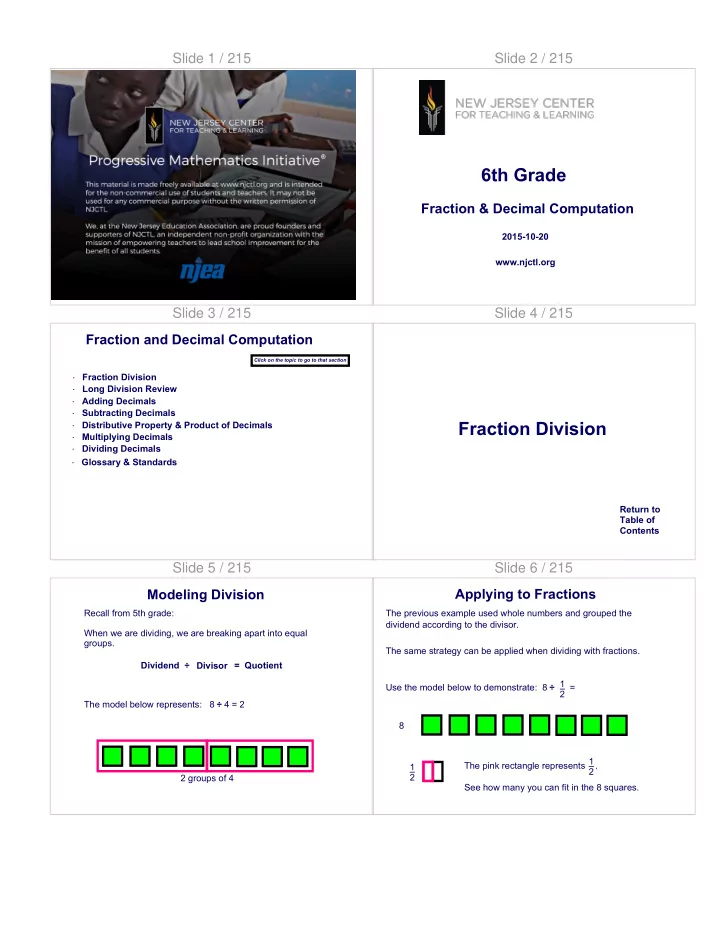
Slide 1 / 215 Slide 2 / 215 6th Grade Fraction & Decimal Computation 2015-10-20 www.njctl.org Slide 3 / 215 Slide 4 / 215 Fraction and Decimal Computation Click on the topic to go to that section Fraction Division Long Division


slide-1
SLIDE 1

Slide 1 / 215 Slide 2 / 215

6th Grade

Fraction & Decimal Computation

2015-10-20 www.njctl.org

Slide 3 / 215 Fraction and Decimal Computation

· Long Division Review · Adding Decimals · Subtracting Decimals

Click on the topic to go to that section

· Multiplying Decimals · Dividing Decimals · Glossary & Standards · Fraction Division · Distributive Property & Product of Decimals

Slide 4 / 215

Fraction Division

Return to Table of Contents

Slide 5 / 215 Modeling Division

Recall from 5th grade: When we are dividing, we are breaking apart into equal groups. The model below represents: 8 ÷ 4 = 2 2 groups of 4 Dividend ÷ Divisor = Quotient

Slide 6 / 215 Applying to Fractions

The previous example used whole numbers and grouped the dividend according to the divisor. The same strategy can be applied when dividing with fractions. Use the model below to demonstrate: 8 ÷ = 8 The pink rectangle represents . See how many you can fit in the 8 squares. 1 2 1 2 1 2

slide-2
SLIDE 2

Slide 7 / 215 Example

Use the model below to demonstrate 2 ÷ = 2 1 3 1 3

Slide 8 / 215

1

Evaluate the following problem using the model below. 3 1 4 3 ÷ = 1 4

Slide 9 / 215

2

Evaluate the following problem using the model below. 5 1 2 5 ÷ = 1 2

Slide 10 / 215

A fraction can be divided by a whole number using the following visual model. 3/5 ÷ 4 Divide into 4 groups 1 2 3 4

Visual Model Slide 11 / 215

The previous expression can be represented by the following word problem: How much will each person receive if 4 friends share a 3/5 pound bag of popcorn? 1 2 3 4 Each friend will receive 3/20 lb. of popcorn.

Word Problem Slide 12 / 215

slide-3
SLIDE 3

Slide 13 / 215 Slide 14 / 215 Slide 15 / 215 Slide 16 / 215 Slide 17 / 215 Slide 18 / 215

slide-4
SLIDE 4

Slide 19 / 215 Vocabulary Review

Complex Fraction: A fraction with another fraction in the numerator, denominator or both. Original Number 4 Reciprocal 2 Reciprocal: The inverse of a number/fraction.

Slide 20 / 215 Patterns

Do you notice a pattern between the division of fractions and their solution?

Slide 21 / 215

If you think about it, we are dividing by a fraction which creates a complex fraction. You need to eliminate the fraction in the denominator in order to solve the problem. To do this, multiply the numerator and denominator of the complex fraction by the reciprocal of the denominator (making the denominator = 1). You can then simplify the fraction by rewriting it without the denominator of 1 and solve the new multiplication problem.

Slide 22 / 215

source - http://www.helpwithfractions.com/dividing-fractions.html

There are rules that can be applied to fraction division problems to eliminate steps from this lengthy procedure. 1 2 x 3 2 = 1 2 2 3 = 1 2 2 3 = 1 2 2 3 x 3 2 x 3 2 = 1 2 x 3 2

1

Original Problem Complex Fraction Multiply by Reciprocal Simplify Denominator Rewrite Without 1

Example Slide 23 / 215

Algorithm Step 1: Leave the first fraction the same. Step 2: Multiply the first fraction by the reciprocal of the second fraction. Step 3: Simplify your answer.

Dividing Fractions Algorithm

1 5 x 2 1 = 1 x 2 5 x 1 = 2 5 1 5 1 2 =

Slide 24 / 215

Some people use the saying " Keep Change Flip" to help them remember the algorithm. 3 5 x 8 7 = 3 x 8 5 x 7 = 24 35 3 5 7 8 = Kept Changed Flipped Keep Change Flip

Dividing Fractions Algorithm

slide-5
SLIDE 5

Slide 25 / 215 Slide 26 / 215 Checking Your Answer

To check your answer, use your knowledge of fact families. 3 5 7 8 24 35 ÷ = 3 5 = 24 35 7 8 x 3 5 is 7 8

  • f

24 35

Slide 27 / 215

7 ) True False 8 10 = 5 4 x 8 10 4 5

Slide 28 / 215

8 ) True False 2 7 = 3 4

2 7

8

Slide 29 / 215

9 ) 39 40 8 10 = 4 5 40 42 A 1 B C

Slide 30 / 215

10 )

slide-6
SLIDE 6

Slide 31 / 215

11 )

Slide 32 / 215

Sometimes you can cross simplify prior to multiplying. without cross simplifying with cross simplifying

3 1 2 5

Simplify Slide 33 / 215

12 Can this problem be cross simplified? Yes No

Slide 34 / 215

13 Can this problem be cross simplified? Yes No

Slide 35 / 215

14 Can this problem be cross simplified? Yes No

Slide 36 / 215

15 Can this problem be cross simplified? Yes No

slide-7
SLIDE 7

Slide 37 / 215

16 )

Slide 38 / 215

17 )

Slide 39 / 215

18 )

Slide 40 / 215

19 )

Slide 41 / 215

A mixed number can be divided by a mixed number using the following visual model. First find the least common denominator (LCD) which is 6. If every 6 lines represents a whole, then how many lines should we draw to make sure both mixed numbers fit?

Visual Model Slide 42 / 215

1 2 3 4 5 6 7 8 9 10 11 12 13 14 15 16 17 18

Since our LCD is 6, every 6 lines is considered a whole. 1 1/2 is equivalent to 9 sections on the number line. 1 1/2 2 2/3 is equivalent to 16 sections on the number line. So 1 1/2 ÷ 2 2/3 = 9/16 2 2/3

Visual Model

slide-8
SLIDE 8

Slide 43 / 215

1 2 3 4 5 6 7 8 9 10 11 12 13 14 15 16 17 18

1 1/2 2 2/3 1 1/2 What if the problem were written as ? How many times does 1 1/2 divide into 2 2/3?

Visual Model Slide 44 / 215

Step 1: Rewrite the Mixed Number(s) as an improper fraction(s). (write whole numbers / 1) Step 2: Follow the same steps for dividing fractions

Dividing Mixed Numbers Algorithm

6 1 x 2 3 = 12 3 = 6 1 2 1 6 1 3 2 = = 4

Slide 45 / 215

5 3 x 2 7 = 10 21 2 3 = 1 1 2 3 5 3 7 2 =

Example

Evaluate:

Slide 46 / 215

20 ) = 1 2

2 2

3

1 Slide 47 / 215

21 ) = 1 2

5 2 Slide 48 / 215

22 ) = 2 5

5 1

2

4

slide-9
SLIDE 9

Slide 49 / 215

23 ) = 1 2

2 3

8

3 Slide 50 / 215

Winnie needs pieces of string for a craft project. How many 1/6 yd pieces of string can she cut from a piece that is 2/3 yd long? 1 6 2 3 ÷ 2 3 x 6 1 12 3 = = 4 pieces 4 1

  • r

2 3 x 6 1 = 1 2 4 1 = 4 pieces

Application Problem Slide 51 / 215

One student brings 1/2 yd of ribbon. If 3 students receive an equal length of the ribbon, how much ribbons will each student receive? 1 2 ÷ 3 1 2 x 1 3 1 6 yards of ribbon =

Application Problem Slide 52 / 215

Kristen is making a ladder and wants to cut ladder rungs from a 6 ft

  • board. Each rung needs to be 3/4 ft long. How many ladder rungs

can she cut? 6 ÷ 3 4 6 1 ÷ 3 4 6 1 x 4 3 = 24 3 8 1 8 rungs = =

Application Problem Slide 53 / 215

A box weighing 9 1/3 lb contains toy robots weighing 1 1/6 lb

  • apiece. How many toy robots are in the box?

9 1 3 1 1 6 ÷ 28 3 7 6 ÷ 6 7 28 3 x 1 4 1 2 = 8 1 8 robots =

Application Problem Slide 54 / 215

24 Robert bought 3/4 pound of grapes and divided them into 6 equal portions. What is the weight of each portion? A 8 pounds B 4 1/2 pounds C 2/5 pounds D 1/8 pound

slide-10
SLIDE 10

Slide 55 / 215

25 A car travels 83 7/10 miles on 2 1/4 gallons of fuel. Which is the best estimate

  • f the number miles the car travels on
  • ne gallon of fuel?

A 84 miles B 62 miles C 42 miles D 38 miles

Slide 56 / 215

26 One tablespoon is equal to 1/16 cup. It is also equal to 1/2 ounce. A recipe uses 3/4 cup of flour. How many tablespoons of flour does the recipe use? A 48 tablespoons B 24 tablespoons C 12 tablespoons D 6 tablespoons

Slide 57 / 215

27 A bookstore packs 6 books in a box. The total weight of the books is 14 2/5

  • pounds. If each book has the same

weight, what is the weight of one book? A 5/12 pound B 2 2/5 pounds C 8 2/5 pounds D 86 2/5 pounds

Slide 58 / 215

28 There is gallon of distilled water in the class science supplies. If each pair of students doing an experiment uses gallon of distilled water, there will be gallon left in the supplies . How many students are doing the experiments?

Slide 59 / 215

29 Carol makes cups of snack mix. She puts all the snack mix into plastic bags. She puts cup of the snack mix in each bag. How many plastic bags does Carol need? Enter your answer in the box. bags

From PARCC EOY sample test non-calculator #9

Slide 60 / 215

30 Part A A group of hikers buy 8 bags of trail mix. Each bag contains cups of trail mix. The trail mix is shared evenly among 12 hikers. How many cups of trail mix will each hiker receive? Show your work or explain your answer.

From PARCC PBA sample test calculator #10

slide-11
SLIDE 11

Slide 61 / 215

31 Part B The hikers plan to visit a scenic lookout. They will rest after they hike 2 miles. Then they will hike the remaining miles to the

  • lookout. The trail the hikers will use to return

from the lookout is mile shorter than the trail they will use to go to the lookout. Each hiker will bring gallon of water for each mile to and from the lookout. · Determine the total distance each hiker will hike. Show your work or explain your answer.

From PARCC PBA sample test calculator #10

Slide 62 / 215

32 Part B (continued) · Determine the total number of gallons of water each hiker will bring. Show your work or explain your answer.

From PARCC PBA sample test calculator #10

Slide 63 / 215

33 This diagram shows a number line. Part A James has a board that is 3/4 foot long. He wants to cut the board into pieces that are each 1/8 foot long. How many pieces can James cut from the board? Explain how James can use the number line diagram to determine the number of pieces he can cut from the board.

From PARCC PBA sample test calculator #8

Slide 64 / 215

34 Part B Write an equation using division that represents how James can find the number of pieces he can cut from the board.

From PARCC PBA sample test calculator #8

Slide 65 / 215

Long Division Review

Return to Table of Contents

Slide 66 / 215 Some division terms to remember....

· The number to be divided into is known as the dividend · The number which divides the other number is known as the divisor · The answer to a division problem is called the quotient

divisor 5 20 dividend

4 quotient 20 ÷ 5 = 4 20

__

5

= 4

slide-12
SLIDE 12

Slide 67 / 215

When we are dividing, we are breaking apart into equal groups EXAMPLE 1 Find 132 3 Step 1: Can 3 go into 1, no so can 3 go into 13, yes 4

  • 12

1 3 x 4 = 12 13 - 12 = 1 Compare 1 < 3 3 132 3 x 4 = 12 12 - 12 = 0 Compare 0 < 3

  • 12

Step 2: Bring down the 2. Can 3 go into 12, yes 2 4

Click for step 1

Click for step 2

Slide 68 / 215

Step 3: Check your answer. 44

x 3

132

click

Slide 69 / 215 Estimating Your Answer

Before any calculations, estimate your answer to make sure you are on the right track. What place value should we round to? Round to the largest place value. 357 rounds to ____ 15 rounds to ____ Our answer should approximately be ... 20 357 ÷ 15 click click

Slide 70 / 215

EXAMPLE 2 (change pages to see each step) Step 1: Can 15 go into 3, no so can 15 go into 35, yes 2

  • 30

5 15 x 2 = 30 35 - 30 = 5 Compare 5 < 15 15 357

Slide 71 / 215

2

  • 30

5 15 357 15 x 3 = 45 57 - 45 =12 Compare 12 < 15 7

  • 45

12 Step 2 : Bring down the 7. Can 25 go into 207, yes 3 EXAMPLE 2 (change pages to see each step)

Slide 72 / 215

2

  • 30

5 15 357.0 7

  • 45

120

  • 120

3 Step 3: You need to add a decimal and a zero since the division is not complete. Bring the zero down and continue the long division. 15 x 8 = 120 120 - 120 = 0 Compare 0 < 15 .8 EXAMPLE 2 (change pages to see each step) Is our answer close to our estimate?

slide-13
SLIDE 13

Slide 73 / 215

Check your answer. 23.8

x 15

357

click

Slide 74 / 215

Estimate the following problems. Discuss your answers with your group. 35 300 15 20

click click click click

Slide 75 / 215

Now solve the following problems. Discuss your answers with your group. 41 324 19.5 23.2

click click click click

Slide 76 / 215

35 Estimate the quotient. 779 ÷ 19

Slide 77 / 215

36 Compute. 779 ÷ 19 =

Slide 78 / 215

37 Estimate the quotient. 1,551 ÷ 55

slide-14
SLIDE 14

Slide 79 / 215

38 Compute. 1,551 ÷ 55 =

Slide 80 / 215

39 Estimate the quotient. 1,288 ÷ 35

Slide 81 / 215

40 Compute. 1,288 ÷ 35 =

Slide 82 / 215

41 The school concert hall contains 312 chairs in 12 rows. Estimate how many chairs are in each row.

Slide 83 / 215

42 The school concert hall contains 312 chairs in 12 rows. How many chairs are in each row?

Slide 84 / 215

43 Compute. 4706 ÷ 104 =

slide-15
SLIDE 15

Slide 85 / 215

44 The local Italian restaurant receives the same number of visitors every day. If 343 people visit the restaurant over the course of one week, how many visitors visit each day?

Slide 86 / 215

45 Compute. 1032 ÷ 24 =

Slide 87 / 215

46 Compute. 4922 ÷ 92 =

Slide 88 / 215

47 Enter your answer in the box. 34,992 ÷ 81 =

From PARCC EOY sample test non-calculator #18

Slide 89 / 215

Adding Decimals

Return to Table of Contents

Slide 90 / 215

If you know how to add whole numbers then you can add

  • decimals. Just follow these few steps.

Step 1: Put the numbers in a vertical column, aligning the decimal points. Step 2: Add each column of digits, starting on the right and working to the left. Step 3: Place the decimal point in the answer directly below the decimal points that you lined up in Step 1.

Adding Decimals

slide-16
SLIDE 16

Slide 91 / 215

When adding or subtracting decimals, always remember to align the decimals vertically... 0.25 0.25 0.25 0.25 1.00 +

Adding Decimals Slide 92 / 215 Estimating Your Answer

Before any calculations, estimate your answer to make sure you are on the right track. What place value should we round to? Round to the nearest whole number. 5.1 rounds to ____ 1.25 rounds to ____ 0.04 rounds to ____ 1.99 rounds to ____ Our answer should approximately be ... 8 5.1 + 1.25 + 0.04 + 1.99 click click

Slide 93 / 215

Now, try this - Don't forget - LINE THEM UP 5.1 + 1.25 + 0.04 + 1.99 5.10 1.25 0.04 1.99 + 8.38 You can add a zero as a place holder to help line your numbers up.

Adding Decimals Slide 94 / 215

TRY THESE. Estimate the following sums in your notebook. Check with the rest

  • f your group.

1) 8.23 + 4.125 + 0.1189 2) 3.178 + 12.28 + 9 3) 17.009 + 2.965 + 8.4 4) 9.999 + 3.1567 + 4.5656 8 + 4 + 0 = 12 3 + 12 + 9 = 24 17 + 3 + 8 = 28 10 + 3 + 5 = 18

click click click click

Slide 95 / 215

TRY THESE. Complete in your notebook then check with the rest of your group. 1) 8.23 + 4.125 + 0.1189 2) 3.178 + 12.28 + 9 8.23 3.178 4.125 12.28 + 0.1189 + 9. 12.4739 24.458 3) 17.009 + 2.965 + 8.4 4) 9.999 + 3.1567 + 4.5656 17.009 9.999 2.965 3.1567 + 8.4 + 4.5656 28.374 17.7213

click click click click

Slide 96 / 215

48 Add the following: 0.6 + 0.55 = A 6.1 B 0.115 C 1.15 D 0.16

slide-17
SLIDE 17

Slide 97 / 215

49 Joanne and Peter are working together to solve the problem 0.6 + 0.55. Joanne says that the sum should be approximately 2. Peter disagrees and says the sum should be approximately 0. Who is correct? Why? A Joanne B Peter

Slide 98 / 215

50 Find the sum. 1.025 + 0.03 + 14.0001 =

Slide 99 / 215

51 Franco went to buy new video games. He bought MaxRush for $19.95, Duplo Race for $23.95 and Garage Mate for $21.95. Estimate how much Franco spent on the video games.

Slide 100 / 215

52 Franco went to buy new video games. He bought MaxRush for $19.95, Duplo Race for $23.95 and Garage Mate for $21.95. How much did he spend on video games?

Slide 101 / 215

53 What is the sum of 12.034 and 0.0104? A 12.1344 B 12.0444 C 12.138 D 1.20444

Slide 102 / 215

54 Estimate the sum. 8.5 + 0.042 + 12.31 A 20 B 21 C 22 D 23

slide-18
SLIDE 18

Slide 103 / 215

55 Find the sum. 8.5 + 0.042 + 12.31 = A 13.58 B 21.23 C 20.852 D 20.14

Slide 104 / 215

56 Five students collected paper to be recycled. Shelly's stack was .008 cm. thick; Ken's stack was .125 cm. thick; Joe's stack was .150 cm. thick; Betty's stack was .185 cm. thick; Mary's stack was .005

  • cm. thick. What was the

thickness of the papers collected to be recycled? A .561 cm. B .452 cm. C .480 cm. D .473 cm.

Slide 105 / 215

57 Find the sum. 5 + 100.145 + 57.8962 + 2.312 =

Slide 106 / 215

58 What is the sum of 74.835 and 2.67? Enter your answer in the box.

From PARCC EOY sample test non-calculator #19

Slide 107 / 215

Let's go to Cool Math and practice addition. Cool Math Link

Web Link Slide 108 / 215

Subtracting Decimals

Return to Table of Contents

slide-19
SLIDE 19

Slide 109 / 215

If you know how to subtract whole numbers then you can subtract decimals. Just follow these few steps. Step 1: Put the numbers in a vertical column, aligning the decimal points. Step 2: Subtract the numbers from right to left using the same rules as whole numbers. Step 3: Place the decimal point in the answer directly below the decimal points that you lined up in Step 1. 1.1

  • 0.3

1.1

  • 0.3

0.8 0 1

Subtracting Decimals Slide 110 / 215 Estimating Your Answer

Before any calculations, estimate your answer to make sure you are on the right track. 21.7 - 8.21 What place value should we round to? Round to the nearest whole number. 21.7 rounds to ____ 8.21 rounds to ____ Our answer should approximately be ... 14 click click

Slide 111 / 215

What do we do if there aren't enough decimal places when we subtract? 21.7 - 8.21 Don't forget...Line Them Up! 21.7 8.21 What goes here? 21.70 8.21 13.49 61 11

Subtracting Decimals Slide 112 / 215

TRY THESE. Estimate the following differences in your notebook. Then check with the rest of your group. 1) 8.23 - 0.1189 2) 12.283 - 9.025 3) 17.009 - 8.4 4) 9.999 - 4.5656 8 - 0 = 8 12 - 9 = 3 10 - 5 = 5 17 - 8 = 9

click click click click

Slide 113 / 215

TRY THESE. Complete in your notebook then check with the rest of your group. 1) 8.23 - 0.1189 2) 12.283 - 9.025 8.23 12.283

  • 0.1189
  • 9.025

8.1111 3.258 3) 17.009 - 8.4 4) 9.999 - 4.5656 17.009 9.999

  • 8.4
  • 4.5656

8.609 5.4334

click click click click

Slide 114 / 215

59 ) 5 - 0.238 =

slide-20
SLIDE 20

Slide 115 / 215

60 ) 12.809 - 4 =

Slide 116 / 215

61 Sally won $25.00 for her science fair project. Her project cost $12.57 to prepare. What is the estimate of Sally's profit? A $20 B $18 C $13 D $12

Slide 117 / 215

62 Sally won $25.00 for her science fair project. Her project cost $12.57 to prepare. How much did Sally actually make as a profit ? A $37.57 B $12.43 C $13.57 D $12.00

Slide 118 / 215

63 ) 1897.112 - 0.647 =

Slide 119 / 215

64 The Johnson twins raced each other in the 200-meter

  • dash. Jordan finished in 23.48 seconds, and Max

finished in 26.13 seconds. How much faster was Jordan than Max?

Slide 120 / 215

65 Timothy is working on the problem 4.1 - 0.094. He estimates his answer before solving and rounds the numbers to the nearest tenths. He uses 4.1 and 0.1 to estimate the answer. Is he correct in doing so? Why or why not? Yes No

slide-21
SLIDE 21

Slide 121 / 215

66 ) 4.1 - 0.094 =

Slide 122 / 215

67 ) 17 - 13.008 =

Slide 123 / 215

68 Which problem below would give you two different estimates when you either round to the nearest whole

  • r round to the nearest tenths?

A 27.85 - 12.91 B 14.17 - 8.2 C 7.9 - 3.88 D 21.25 - 18.16

Slide 124 / 215

69 If you buy two movie tickets for $8.25 each, what will your change be from $20?

Slide 125 / 215

Cool Math Link Let's go to Cool Math and practice subtraction.

Web Link Slide 126 / 215

The Distributive Property and the Product of Decimals

Return to Table of Contents

slide-22
SLIDE 22

Slide 127 / 215

If you know how to multiply whole numbers then you can multiply decimals. Just follow these few steps. Step 1: Ignore the decimal points. Step 2: Multiply the numbers using the same rules as whole numbers. Step 3: Count the total number of digits to the right of the decimal point. Put that many digits to the right of the decimal point in your answer.

Multiplication Slide 128 / 215

Evaluate 200 x 41.5 8,300 We can also use the distributive property to calculate the product. 200 x 41.5 200 x (41 + 0.5) (200 x 41) + (200 x 0.5) 8,200 + 100 = 8,300 Separate 41.5 into an addition expression with two addends Apply the distributive property Apply the order of operations click

Distributive Property Slide 129 / 215

Evaluate 400 x 18.33 400 x ( ________ + ________ ) (400 x ________ ) + (400 x ________ ) ________ + ________ = ________ 7332 This method is known as partial products.

Distributive Property Slide 130 / 215

How can we use partial products to calculate the area of the rectangle shown below? 58 ft 200 ft 0.6 ft 200 x 58.6 200 x ( ________ + ________ ) (200 x ________ ) + (200 x ________ ) ________ + ________ = ________ 11,720 Click to reveal 58.6 ft 200 ft

Distributive Property Slide 131 / 215

70 ) 12(43) = 12(40) x 12(3) True False

Slide 132 / 215

71 Use the distributive property to rewrite the expression. 3(76.8)

Students type their answers here

slide-23
SLIDE 23

Slide 133 / 215

72 Calculate the product using partial products. 5(48)

Slide 134 / 215

73 Calculate the product using partial products. 13(5.2)

Slide 135 / 215

74 Calculate the product using partial products. 300(7.4)

Slide 136 / 215

75 Calculate the product using partial products. 200(6.5)

Slide 137 / 215

76 Calculate the area of the rectangle using partial products. 300 units 43.9 units

Slide 138 / 215

Multiplying Decimals

Return to Table of Contents

slide-24
SLIDE 24

Slide 139 / 215

Convert the following decimal numbers into fractions. 0.7 x 0.09 What is the product? 63 1000 We multiplied seven tenths by nine hundredths. What place value will the last digit in the product be in if we convert it into a decimal number? Thousandths click click

Multiplication Slide 140 / 215 Try These!

What place value will the last digit be in for the following problems? Don't forget to convert them to fractions first. Fractions Product Place Value 1) 0.3 x 0.7 2) 0.2 x 0.13 3) 0.08 x 0.231

Slide 141 / 215

Do you notice a pattern for multiplying decimals? 3.5 x 1.72 3 5 10 1 72 100 x 35 10 x 172 100 6020 1000 Where does the decimal point go? Drag the decimal point. 6 0 2 0

Multiplication Slide 142 / 215

If you know how to multiply whole numbers then you can multiply decimals. Just follow these few steps. Step 1: Ignore the decimal points. Step 2: Multiply the numbers using the same rules as whole numbers. Step 3: Count the total number of digits to the right of the decimal points in both numbers. Put that many digits to the right of the decimal point in your answer.

Multiplication Slide 143 / 215

3.21 x .04 .1284 There are a total of four digits to the right of the decimal points. There must be four digits to the right

  • f the decimal point in the answer.

} 2 digits

Multiplication

} 2 digits

Slide 144 / 215 Estimate Your Answer

Before any calculations, estimate your answer to make sure you are on the right track. 23.2 x 4.04 What place value should we round to? Round to the nearest whole number. 23.2 rounds to ____ 4.04 rounds to ____ Our answer should approximately be ... 92 click click

slide-25
SLIDE 25

Slide 145 / 215

23.2 x 4.04 928 92800 0000 93.728 } 1 digit There are a total of three digits to the right of the decimal points. There must be three digits to the right of the decimal point in the answer. Estimating helps us recognize where the decimal point belongs!

Exact Answer

} 2 digits

Slide 146 / 215

Estimate your answer for the following problem by rounding the numbers to the nearest whole number. 9.5 x 0.05 9.5 rounds to _____ 0.05 rounds to _____ What is your estimate? For problems like these, use your number sense! You are multiplying 9.5 by 0.05 which means you are taking a part (fraction) of 9.5. So your answer must be smaller than 9.5! click

Estimate Your Answer Slide 147 / 215

smaller than 3.214 TRY THESE. Estimate the following products in your notebook then check with the rest of your group. 1) 14.512 2) 8.31 x 4.21 x 1.008 3) 7.0045 4) 3.214 x 5.2 x 0.0034 15 x 4 = 60 8 x 1 = 8 7 x 5 = 35

click click click click

Slide 148 / 215

TRY THESE. Complete in your notebook then check with the rest of your group. 1) 14.512 2) 8.31 x 4.21 x 1.008 14512 290240 5804800 61.09552 3) 7.0045 4) 3.214 x 5.2 x 0.0034 140090 3502250 36.42340 6648 0000 00000 831000 8.37648 12856 96420 0.0109276

click click click click

Slide 149 / 215

77 Estimate the product. 0.42 x 0.032 A The product will be less than 1 B The product will be equal to 1 C The product will be greater than 1

Slide 150 / 215

78 The product of 0.42 x 0.032 will have 4 digits to the right of the decimal point. True False

slide-26
SLIDE 26

Slide 151 / 215

79 Multiply 0.42 x 0.032

Slide 152 / 215

80 Multiply 3.452 x 2.1

Slide 153 / 215

81 You need to buy 6 notebooks that cost $0.87 each. If you have $5, do you have enough money? Estimate to determine your answer. Do not solve. Yes No

Slide 154 / 215

82 You need to buy 6 notebooks that cost $0.87 each. How much will this cost?

Slide 155 / 215

83 Multiply 53.24 x 0.089

Slide 156 / 215

84 The regular price of a pair of jeans is $29.99.

  • Mrs. Jones has four children for

whom she must buy new jeans. The jeans are on sale for $22.50. What would the total cost be of four pairs

  • f jeans on sale?

A $119.96 B $90.00 C $86.00 D $52.49

slide-27
SLIDE 27

Slide 157 / 215

85 How many digits will be to the right of decimal point in the product for the problem 4.0156 x 7.8? A 2 B 3 C 4 D 5

Slide 158 / 215

86 Multiply 4.0156 x 7.8

Slide 159 / 215

87 Multiply 0.012 x 0.21

Slide 160 / 215

88 Enter your answer in the box. 18.3 x 4.39 =

From PARCC EOY sample test non-calculator #7

Slide 161 / 215

89 Thomas buys a case of bottled water. A case contains 36 bottles of water and costs $4.69. Thomas will sell each bottle

  • f water for $0.75 at a school event.

How much profit, in dollars, will Thomas earn if he sells all the bottles of water? Enter your answer in the box. $

From PARCC EOY sample test non-calculator #17

Slide 162 / 215

Dividing Decimals

Return to Table of Contents

slide-28
SLIDE 28

Slide 163 / 215 Divide Decimals by Whole Numbers

56.08 28 04 2 Step 1: Use long division. Step 2: Bring the decimal point up into the quotient.

Slide 164 / 215 Try This!

12.45 ÷ 5 =

Slide 165 / 215 The Power of Ten

10

Multiplying by a power of ten makes dividing by decimals easier! 1) 13 x 10 = _______ 2) 94 x 100 = _______ 3) 28 x 1000 = _______ 4) 6.2 x 10 = _______ 5) 4.78 x 100 = _______ 6) 51.293 x 1000 = _______ Do you see a pattern for multiplying by a power of ten? The decimal point moves to the right depending

  • n the number of zeros in the power of ten!

Click to Reveal

Slide 166 / 215

Divisor Dividend Step 1: Change the divisor to a whole number by multiplying by a power of 10. Step 2: Multiply the dividend by the same power of 10. Step 3: Use long division. Step 4: Bring the decimal point up into the quotient.

Divide by Decimals

Quotient

Slide 167 / 215

15.6 6.24 Multiply by 10, so that 15.6 becomes 156 6.24 must also be multiplied by 10 156 62.4 .234 23.4 Multiply by 1000, so that .234 becomes 234 23.4 must also be multiplied by 1000 234 23400 Try rewriting these problems so you are ready to divide!

Power of Ten Slide 168 / 215

6789.21 09 415 25020 Rewrite each problem after multiplying by a power of 10. 1) 2) 3) 4) 250.2 ÷ 4.15 .008 0.9 68.342 ÷ 2.2 4.2 678.921 4200 008 22 683.42

Power of Ten

click click click click

slide-29
SLIDE 29

Slide 169 / 215 Estimating Your Answer

Before any calculations, estimate your answer to make sure you are on the right track. 23.2 ÷ 4.04 What place value should we round to? Round to the nearest whole number. 23.2 rounds to ____ 4.04 rounds to ____ Our answer should approximately be ... 5 click click

Slide 170 / 215

4.04 23.2

Try This!

Be sure to round your answer to the thousandths. 5.743 click

Slide 171 / 215

Estimate your answer for the following problem by rounding the numbers to the nearest whole number. 9.5 ÷ 0.05 9.5 rounds to _____ 0.05 rounds to _____ What is your estimate? For problems like these, use your number sense! If you are dividing 9.5 by 0.05, then does that mean the quotient will be smaller than 9.5 or greater than 9.5? Your answer must be greater than 9.5! click

Estimate Slide 172 / 215

90 Divide 0.78 ÷ 0.02 =

Slide 173 / 215

91 Use estimation to figure out if the quotient will be A less than 4.866 B around 4.866 C greater than 4.866 4.866 ÷ 0.6

Slide 174 / 215

92 0.6 4.866

slide-30
SLIDE 30

Slide 175 / 215

93 ) 10 divided by 0.25 =

Slide 176 / 215

94 ) 12.03 ÷ 0.04 =

Slide 177 / 215

95 0.012 24.6

Slide 178 / 215

96 Estimate. 36 ÷ 1.2

Slide 179 / 215

97 Evaluate. 36 ÷ 1.2 =

Slide 180 / 215

98 Estimate. 9.116 ÷ 2.12

slide-31
SLIDE 31

Slide 181 / 215

99 Evaluate. 9.116 ÷ 2.12 =

Slide 182 / 215

100 Enter your answer in the box. 33.8 ÷ 32.5 =

From PARCC EOY sample test #2 non-calculator

Slide 183 / 215

There are two types of decimals - terminating and repeating. A terminating decimal is a decimal that ends. All of the examples we have completed so far are terminating. A repeating decimal is a decimal that continues forever with one

  • r more digits repeating in a pattern.

To denote a repeating decimal, a line is drawn above the numbers that repeat. However, with a calculator, the last digit is rounded.

Terminating and Repeating Slide 184 / 215

Let's consider the following... Click to Reveal

Terminating or Repeating Slide 185 / 215

63 48 45 39 36 32 27 51 45 60 54 6

Click to Reveal

Repeating Example Slide 186 / 215

6600 2342 2200 14200 13200 10000 8800 12000 11000 10000 8800 12000 11000

Click to Reveal

Repeating Example

slide-32
SLIDE 32

Slide 187 / 215

101 ) 15.5 ÷ 0.3

Slide 188 / 215

102 ) 0.8 ÷ 0.003 =

Slide 189 / 215

103 You need to put some gas in your car. Regular gasoline is $3.59 per gallon. You only have a $20 bill

  • n you. How many gallons can you buy?

Slide 190 / 215

104 ) 25 ÷ 1.1 = A 2.27 B 22.73 C 22.7 D 22.72

Slide 191 / 215

105

Slide 192 / 215

106 If 6 people are on an elevator and together they weigh 931.56 pounds, find the average weight of each person.

slide-33
SLIDE 33

Slide 193 / 215

107 ) 0.007 ÷ 0.9 =

Slide 194 / 215

108 Heather has 5.5 lbs of jelly beans. She will put them in 8.5 bags. How much will be in each bag?

Slide 195 / 215

109

Slide 196 / 215

110 ) 91.84 ÷ 4.8 =

Slide 197 / 215

111 Texas suffered through a heat wave in August 2011. The highest four temperatures (in degrees Fahrenheit) were 103.4, 102.8, 101.9 and 102.5. What was the average temperature for those four days?

Slide 198 / 215

112 For your sewing project at school, you need to purchase 3.5 yards of fabric. You spend $9.10 on

  • ne pattern and $8.40 on another. How much does
  • ne yard cost?
slide-34
SLIDE 34

Slide 199 / 215

113 ) 9 ÷ 0.22 A 40.9 B 40.90 C 40.91 D 40.9

Slide 200 / 215

Glossary & Standards

Return to Table of Contents

Slide 201 / 215

Algorithm

A step-by-step process to find a solution.

It's like a cooking recipe for mathematics.

24 + 12 =

Add the ones then add the tens

How to...

Step 1: Step 2: Step 3:

Back to Instruction

Slide 202 / 215

Average

3 + 4 + 2 = 9

= 9 3 = 3

The value/amount of each item when the total is distributed across each item equally.

Back to Instruction

Slide 203 / 215

Back to Instruction

A fraction whose numerator or denominator or both contain fractions.

3

1 5 1 5 2 3

=3

1 5

=

1 5 2 3

1 5 2 3

Must be written as a fraction.

Complex Fraction

Slide 204 / 215 Used to make operations with fractions easier. Divide the numerator of one fraction and the denominator of another fraction by their GCF. 1 5 15 20 + = 3 20

1+

1 5 15 20 +

1 3

GCF of 5 and 15 is 5.

Back to Instruction

Cross Simplify

slide-35
SLIDE 35

Slide 205 / 215

Back to Instruction

Distributive Property

5 (3 + 2) 3

3x5=3(3+2)

2(3+4)= (2x3)+(2x4)

2

3 4

a(b+c)=ab+ac

Multiplying a sum by a number is the same as multiplying each addend in the sum by the same number and then adding the products. a(b-c)=ab-ac

also applies to subtraction

Slide 206 / 215

Dividend

24 ÷ 8 = 3 24 8 3 24 8 = 3

Dividend Dividend Dividend

The number being divided in a division equation.

Back to Instruction

Slide 207 / 215

Divisor

24 8 3

25 8 = 3 R1

Divisor Divisor

The number the dividend is divided by. A number that divides another number without a remainder.

Must divide evenly.

Back to Instruction

24 ÷ 8 = 3 Slide 208 / 215

Back to Instruction

101 10

=

Power of 10

Any integer powers of the number ten. (Ten is the base, the exponent is the power.)

10

2 100

=

10

3 1,000

=

10x10 = 10 = 10x10x10 = Slide 209 / 215

Back to Instruction

Profit

The difference between the amount earned and the amount spent.

Earned Spent Profit

  • ______

$30 Washing

Cars

$12

  • ______

$18

Supplies

Profit

Slide 210 / 215

Back to Instruction

Quotient

The number that is the result of dividing one number by another.

12 ÷ 3 = 4

Quotient

12 4 3

Quotient

12

4

3 =

Quotient

slide-36
SLIDE 36

Slide 211 / 215

Reciprocal

One of two numbers whose product is one. 1 x 1 = 1

1 is the reciprocal of 1.

2 x 1

2 = 1

Number Reciprocal

r x r = 1

Back to Instruction

Slide 212 / 215

Back to Instruction

Repeating Decimal

A decimal with a digit or group

  • f digits that repeats endlessly.

3 1.0

.3

9

  • ___

1 3 ___ 9

  • 1

3 9 ___

  • 1

...

1 3 = .3

__

7 33 = .21

__

(.212121...)

Slide 213 / 215

Back to Instruction

Terminating Decimal

A decimal that ends and doesn't go

  • n forever.

3 1.0

.3

9

  • ___

1 3 ___ 9

  • 1

3 9 ___

  • 1

...

1/2 = .5 3/8 = .375

Slide 214 / 215

Back to Instruction

Vertical

In an up-down position. vertical horizontal diagonal Slide 215 / 215

Standards for Mathematical Practice MP1: Making sense of problems & persevere in solving them. MP2: Reason abstractly & quantitatively. MP3: Construct viable arguments and critique the reasoning of

  • thers.

MP4: Model with mathematics. MP5: Use appropriate tools strategically. MP6: Attend to precision. MP7: Look for & make use of structure. MP8: Look for & express regularity in repeated reasoning. Additional questions are included on the slides using the "Math Practice" Pull-tabs (e.g. a blank one is shown to the right on this slide) with a reference to the standards used. If questions already exist on a slide, then the specific MPs that the questions address are listed in the Pull-tab.