61A Lecture 15 Tuesday 6-8pm, Wednesday 5:30-7pm, Thursday 5-7pm - - PDF document

61a lecture 15
SMART_READER_LITE
LIVE PREVIEW

61A Lecture 15 Tuesday 6-8pm, Wednesday 5:30-7pm, Thursday 5-7pm - - PDF document

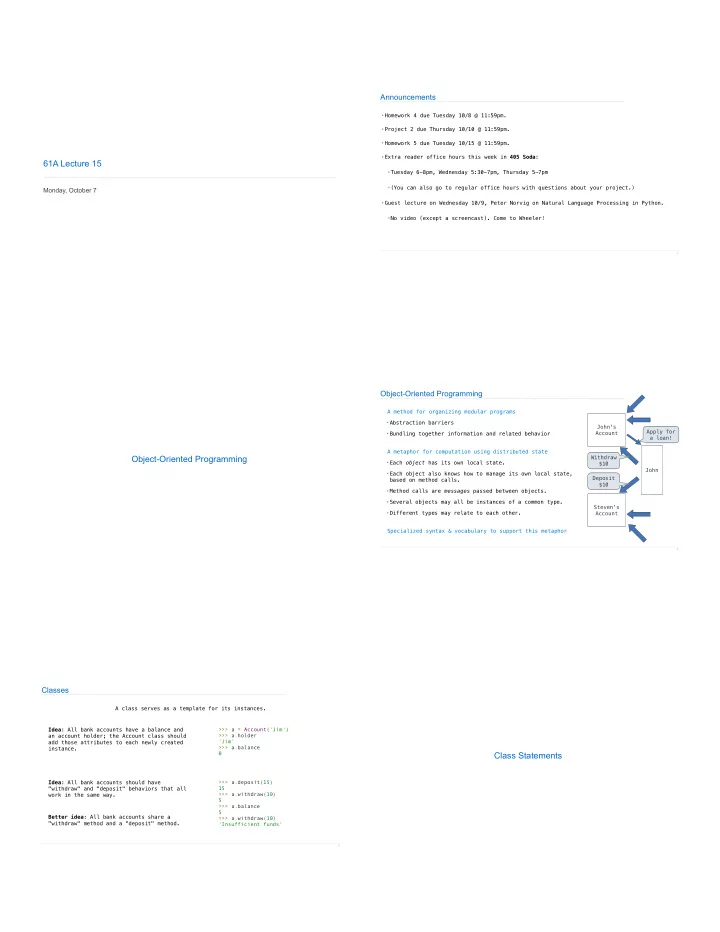
Announcements Homework 4 due Tuesday 10/8 @ 11:59pm. Project 2 due Thursday 10/10 @ 11:59pm. Homework 5 due Tuesday 10/15 @ 11:59pm. Extra reader office hours this week in 405 Soda : 61A Lecture 15 Tuesday 6-8pm, Wednesday


slide-1
SLIDE 1

61A Lecture 15

Monday, October 7

Announcements

  • Homework 4 due Tuesday 10/8 @ 11:59pm.
  • Project 2 due Thursday 10/10 @ 11:59pm.
  • Homework 5 due Tuesday 10/15 @ 11:59pm.
  • Extra reader office hours this week in 405 Soda:
  • Tuesday 6-8pm, Wednesday 5:30-7pm, Thursday 5-7pm
  • (You can also go to regular office hours with questions about your project.)
  • Guest lecture on Wednesday 10/9, Peter Norvig on Natural Language Processing in Python.
  • No video (except a screencast). Come to Wheeler!
2

Object-Oriented Programming

Object-Oriented Programming

A method for organizing modular programs

  • Abstraction barriers
  • Bundling together information and related behavior

A metaphor for computation using distributed state

  • Each object has its own local state.
  • Each object also knows how to manage its own local state,

based on method calls.

  • Method calls are messages passed between objects.
  • Several objects may all be instances of a common type.
  • Different types may relate to each other.

Specialized syntax & vocabulary to support this metaphor

4

John's Account Steven's Account John Withdraw $10 Deposit $10 Apply for a loan!

Classes

A class serves as a template for its instances. Idea: All bank accounts have a balance and an account holder; the Account class should add those attributes to each newly created instance. Idea: All bank accounts should have "withdraw" and "deposit" behaviors that all work in the same way. >>> a = Account('Jim') >>> a.holder 'Jim' >>> a.balance >>> a.deposit(15) 15 >>> a.withdraw(10) 5 >>> a.balance 5 >>> a.withdraw(10) 'Insufficient funds' Better idea: All bank accounts share a "withdraw" method and a "deposit" method.

5

Class Statements

slide-2
SLIDE 2

The Class Statement

A class statement creates a new class and binds that class to <name> in the first frame of the current environment. Statements in the <suite> create attributes of the class. As soon as an instance is created, it is passed to __init__, which is an attribute of the class called the constructor method. class <name>: <suite> class Account: def __init__(self, account_holder): self.balance = 0 self.holder = account_holder

7

The suite is executed when a class statement is evaluated. When a class is called: 1.A new instance of that class is created: 2.The constructor __init__ of the class is called with the new object as its first argument (named self), along with any additional arguments provided in the call expression.

Initialization

Idea: All bank accounts have a balance and an account holder; the Account class should add those attributes to each of its instances. >>> a = Account('Jim') >>> a.holder 'Jim' >>> a.balance class Account: def __init__(self, account_holder): self.balance = 0 self.holder = account_holder

8

{ } balance: 0, holder: 'Jim'

Object Identity

>>> a = Account('Jim') >>> b = Account('Jack') >>> a is a True >>> a is not b True Every object that is an instance of a user-defined class has a unique identity: Binding an object to a new name using assignment does not create a new object: Identity testing is performed by "is" and "is not" operators: >>> c = a >>> c is a True

9

Every call to Account creates a new Account

  • instance. There is only one Account class.

Methods

Methods

Methods are defined in the suite of a class statement class Account: def __init__(self, account_holder): self.balance = 0 self.holder = account_holder def deposit(self, amount): self.balance = self.balance + amount return self.balance def withdraw(self, amount): if amount > self.balance: return 'Insufficient funds' self.balance = self.balance - amount return self.balance These def statements create function objects as always, but their names are bound as attributes of the class.

11

Invoking Methods

All invoked methods have access to the object via the self parameter, and so they can all access and manipulate the object's state. class Account: ... def deposit(self, amount): self.balance = self.balance + amount return self.balance >>> tom_account = Account('Tom') >>> tom_account.deposit(100) 100 Dot notation automatically supplies the first argument to a method. Invoked with one argument Defined with two arguments

12
slide-3
SLIDE 3

Dot Expressions

Objects receive messages via dot notation. Dot notation accesses attributes of the instance or its class. <expression> . <name> The <expression> can be any valid Python expression. The <name> must be a simple name. Evaluates to the value of the attribute looked up by <name> in the object that is the value of the <expression>. tom_account.deposit(10) Dot expression Call expression

13

(Demo)

Attributes

Accessing Attributes

Using getattr, we can look up an attribute using a string >>> getattr(tom_account, 'balance') 10 >>> hasattr(tom_account, 'deposit') True getattr and dot expressions look up a name in the same way Looking up an attribute name in an object may return:

  • One of its instance attributes, or
  • One of the attributes of its class
15

Methods and Functions

Python distinguishes between:

  • Functions, which we have been creating since the beginning of the course, and
  • Bound methods, which couple together a function and the object on which that method

will be invoked. Object + Function = Bound Method >>> type(Account.deposit) <class 'function'> >>> type(tom_account.deposit) <class 'method'> >>> Account.deposit(tom_account, 1001) 1011 >>> tom_account.deposit(1000) 2011

16

Looking Up Attributes by Name

<expression> . <name> To evaluate a dot expression: 1.Evaluate the <expression> to the left of the dot, which yields the object of the dot expression. 2.<name> is matched against the instance attributes of that object; if an attribute with that name exists, its value is returned. 3.If not, <name> is looked up in the class, which yields a class attribute value. 4.That value is returned unless it is a function, in which case a bound method is returned instead.

17

Class Attributes

Class attributes are "shared" across all instances of a class because they are attributes of the class, not the instance. class Account: interest = 0.02 # A class attribute def __init__(self, account_holder): self.balance = 0 self.holder = account_holder # Additional methods would be defined here >>> tom_account = Account('Tom') >>> jim_account = Account('Jim') >>> tom_account.interest 0.02 >>> jim_account.interest 0.02 interest is not part of the instance that was somehow copied from the class!

18
slide-4
SLIDE 4

Attribute Assignment

Assignment Statements and Attributes

Assignment statements with a dot expression on their left-hand side affect attributes for the object of that dot expression

  • If the object is an instance, then assignment sets an instance attribute
  • If the object is a class, then assignment sets a class attribute

>>> jim_account = Account('Jim') >>> tom_account = Account('Tom') >>> tom_account.interest 0.02 >>> jim_account.interest 0.02 >>> Account.interest = 0.04 >>> tom_account.interest 0.04 >>> jim_account.interest = 0.08 >>> jim_account.interest 0.08 >>> tom_account.interest 0.04 >>> Account.interest = 0.05 >>> tom_account.interest 0.05 >>> jim_account.interest 0.08

20