
SLIDE 1
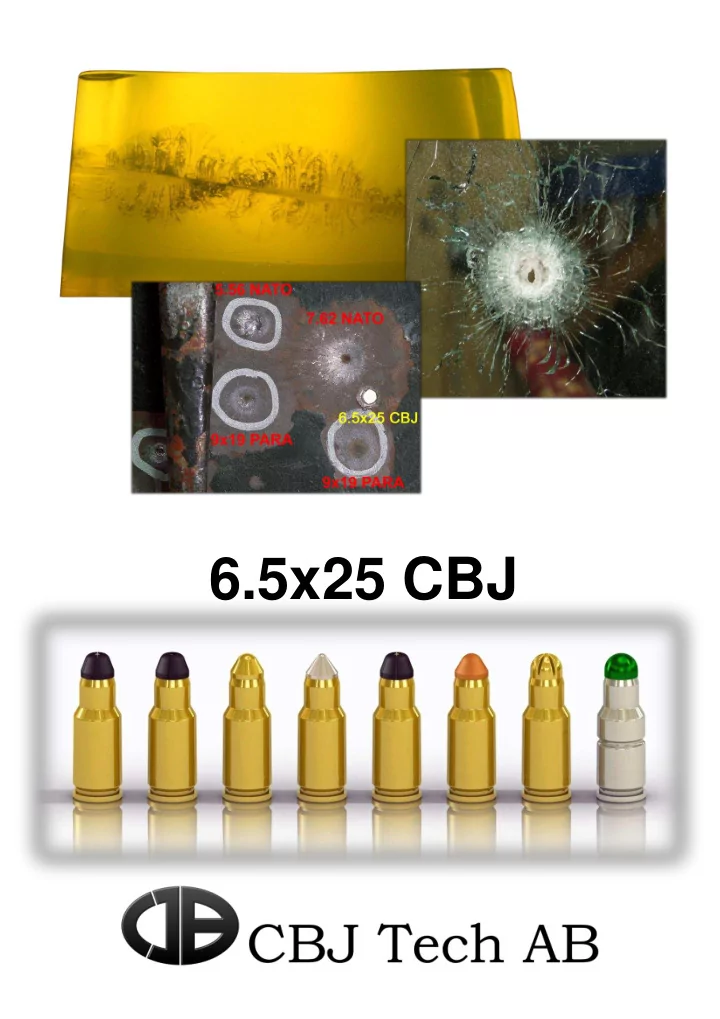
6.5x25 CBJ Pistols and submachine guns are weapons with distinct - - PDF document
6.5x25 CBJ Pistols and submachine guns are weapons with distinct benefits such as low weight, compact size and, in the case of submachine guns, high firepower. However, in modern combat these weapon systems, mainly based on the 9x19 Parabellum
Pistols and submachine guns are weapons with distinct benefits such as low weight, compact size and, in the case of submachine guns, high firepower. However, in modern combat these weapon systems, mainly based on the 9x19 Parabellum round, are proving less effective because of lack of penetration, limited effective range and poor wounding power. Assault rifles are increasingly used for applications that used to be typical for submachine guns, like close quarter battle etc. On the other hand, assault rifles too have important limitations. Firepower is reduced due to higher recoil and there are problems with overheating. They are heavy, and due to their length awkward to handle in vehicles and confined spaces. Attempts to make them more compact by shortening the barrel have resulted in significantly reduced wounding power, due to reduced muzzle velocity. Realizing this, CBJ Tech has developed a cartridge system based on the new caliber 6.5x25 CBJ, which, after changing the barrel, can be used in most weapons chambered for the 9x19
suitable weapons (like the CBJ MS shown in the picture, also developed by CBJ Tech AB), covers the full range of applications traditionally covered by everything from pistols up to and in most cases including assault rifles, and offers high firepower and superior penetration and wounding power at full combat ranges in any combat situation.
How the 6.5x25 CBJ solves it:
rapid firing at high precision, and in the case of fully automatic weapons, the ability to fire accurate bursts. Also, at longer ranges and at moving targets the high velocity of the bullet with resulting flat trajectory and short time of flight to the target reduces the need of compensation, which greatly simplifies aiming.
Weapon effectiveness
There are many factors that constitute weapon effectiveness, other than bullet performance in bare tissue even if this, of course, is critical. Weapon effectiveness can be defined as the ability of a soldier or policeman armed with a certain weapon system (weapon and cartridge) to defeat an enemy. This in turn is a function of how well the weapon system is adapted to the skills of the person using the weapon, the characteristics of the target and the combat environment. Focusing on the weapon system, this means there are three main aspects to consider, which are as follows in order of importance.
target to reach vital structures to incapacitate reliably.
needs more penetration than the average police
entire spectrum of penetration is covered, from maximum penetration against tough targets to minimum penetration against unprotected targets in sensitive environments.
the 6.5x25 CBJ have high energy and effective means to transfer it to soft tissue, resulting in a high wounding effect.
6.5x25 CBJ Ball 6.5x25 CBJ ST 6.5x25 CBJ HET 6.5x25 CBJ Subsonic AP
The 6.5x25 CBJ cartridge is of course primarily intended to be used in weapons designed and optimized for this caliber. However it is also designed to be used in 9x19 Parabellum weapons, converted by barrel change to the 6.5x25 CBJ. The cartridge generates the same level of impulse as the 9x19 Parabellum, which assures functioning of the weapons. The bolt face, groove and cartridge case up to the shoulder of the 6.5x25 CBJ are identical to the 9x19 Parabellum, as is the total length of the cartridge, 29.7mm. This makes the transition to the new caliber easy. Another benefit is that existing stocks of 9x19 Parabellum ammunition can still be used for training instead of being scrapped. There are many different potential users for the 6,5x25 CBJ, such as military, police, training units etc, with accordingly different demands. In order to be highly effective in all situations, the 6.5x25 CBJ has several cartridge alternatives, none of which contains any toxic material. For training, there are cost effective alternatives. For combat, there are different cartridge alternatives depending on the situation and desired performance. The development of the combat ammunition has followed a number of criteria, mainly; The bullet shall be effective within the entire desired combat range It must be able to penetrate any reasonable barrier typical for the application without breaking apart After penetrating such barriers it has to be able to penetrate at least 30cm of soft tissue to cause reliable incapacitation from any angle of impact After achieving the above, it shall have as high energy transfer to the target as possible
To assure effectiveness, extensive testing has been conducted. To test performance and assess energy transfer in soft tissue, 10% ordnance gelatin shot at 4°C has been used and the permanent and temporary cavities
by Fackler and Malinowski. Barriers in front of the soft tissue simulant have included various body armors (notably the NATO CRISAT), car windshields, building materials, APC armor plate, military aircraft titanium and aluminum plates etc. Also, realistic composite tests have been made with scenarios such as uniformed protected soldier with web gear, protected soldier inside vehicle etc. The results confidently confirm that all development criteria are met. To further assure effectiveness in real world combat, many side-by-side tests with the 6.5x25 CBJ and battle proven cartridges with known effects have been made, including 5.56x45 NATO, 7.62x51 NATO, various 9x19 cartridges, 7.62x39 and 5.45x39 shot from various weapons with different barrel lengths.
6.5x25 CBJ TRP 6.5x25 CBJ Frangible 6.5x25 CBJ Blank 6.5x25 CBJ Drill
6.5x25 CBJ Ball
The 6.5x25 CBJ Ball is the standard cartridge with a tungsten projectile enclosed in a discarding plastic sabot. Key benefits: High penetration High hit probability Long range High impact velocity at full ranges High wounding effect Low levels of barrel wear and corrosion Typical application: All-round military cartridge, used in varying combat environments where targets may appear at any range and with high levels of protection. Targets may include ground vehicles, helicopters and
require high endurance for prolonged firing. In a test of performance against hard targets, a hardened 7mm thick armor plate taken from a rear door of an MT-LB APC was fired at from a distance
the bullet retained considerable wounding potential, as was evident by a block of gelatin positioned behind the target. Standard military ball ammunition such as 5.56 NATO, 7.62 NATO and 9x19 Parabellum fail to penetrate this target at any distance.
2,5 5 7,5 10 5 10 15 20 25 30 35 (cm)
Illustrated below is the effect in soft tissue simulant (ordnance gelatin) of the 6.5x25 CBJ Ball after penetration
front of 20 layers of Kevlar. Below is the Wound Profile of the test, which visualizes the permanent and temporary cavities. The permanent cavity is outlined in the center, and is the remaining bullet hole. The outer cavity is the temporary tissue stretch from when the bullet passes the tissue simulant, and the plot is based on measurements taken of the radial cracks in the gelatin according to the aforementioned Wound Profile Method.
2,5 5 7,5 10 5 10 15 20 25 30 35 (cm)
6.5x25 CBJ ST
The 6.5x25 CBJ ST is exactly the same as the Ball cartridge except that the projectile has a spoon tip, which is a spoon- shaped asymmetry in the tip
the outer ballistics nor the penetration capability. The spoon tip causes the bullet to tumble quicker than normal in soft targets in order to assure effectiveness in hits with very short wound tracks, for instance extremity hits. The 6.5x25 Ball and ST work reliable in less-than- ideal impact situations, for instance when the bullet has been caused to tumble before reaching the target. This would be the case when the target is behind barriers, thick foliage etc. Below are the test results of a composite test with the 6.5x25 CBJ ST where the scenario is that the target has body armor (NATO CRISAT) and sits in the front seat of a
front of the CRISAT protection and gelatin block, and inclined 45° vertically and 15° to the left. Even though the windshield caused the bullet to tumble and impact the body armor sideways, the body armor and gelatin block (340mm) were fully penetrated with a substantial energy transfer to the tissue simulant.
2,5 5 7,5 10 5 10 15 20 25 30 35 (cm) The test result of the 6.5x25 CBJ ST when fired at bare gelatin is shown below.
6.5x25 CBJ HET
The 6.5x25 CBJ High Energy Transfer has a full caliber solid brass projectile with a hollow base. Key benefits: High wounding effect High hit probability Well balanced penetration Limited lethal range Typical application: All-round police bullet, used in urban environments with sensitive background. Targets are engaged at short range and have moderate levels of
include vehicles. The penetration capacity of the 6.5x25 CBJ HET is carefully balanced so that common barriers are defeated and wounding effect is assured at short range, while performance is greatly reduced beyond this and at greater range. A typical difficult situation in this application is a target inside a vehicle. Seen here are the test results of a simulation of such a situation. The windshield was penetrated as was the gelatin block behind (34cm). After this the bullet had negligible energy.
2,5 5 7,5 10 5 10 15 20 25 30 35 (cm) Shown below is the effect of the 6.5x25 CBJ HET in bare gelatin.
6.5x25 CBJ Subsonic AP
The 6.5x25 CBJ Subsonic AP fires a heavy, full caliber copper jacketed tungsten projectile at subsonic speed. Key benefits: Subsonic Good penetration Low velocity loss down range Typical application: Sound suppressed operations by military special forces or police SWAT teams. Targets may appear at short to medium range and carry body armor. The penetration capacity is less than that of the 6.5x25 CBJ Ball and ST, but sufficient to defeat most light body armors, notably the NATO CRISAT. The projectile is long and tumbles in the target which produces a substantial permanent cavity, thus creating a high wounding effect considering the low velocity of the bullet.
6.5x25 CBJ TRP
The 6.5x25 CBJ Training Reduced Penetration has a sabot containing a non- tungsten metal projectile. Key benefits: High hit probability Long range Increased safety during training Reduced wear on training facilities Low levels of barrel wear and corrosion Typical application : Standard training round for full ranges. The 6.5x25 CBJ TRP is the training cartridge for full combat ranges. It closely duplicates the outer ballistics of the Ball and ST cartridges, but lacks their penetration capacity and decreases its lethality at a higher rate at extended ranges.
6.5x25 CBJ Frangible
The 6.5x25 CBJ Frangible has a full caliber projectile made of a polymer with metal powder added to increase density. The bullet has very low penetration and completely disintegrates when hitting a hard
Key benefits: Low cost High hit probability High wounding effect Limited lethal range Minimum penetration of hard
Increased safety during training Low wear on training facilities Low levels of barrel wear and corrosion Typical training application: Short range (up to 100m) training round, used primarily in urban warfare training facilities. Typical combat application: Very sensitive environments, such as public areas,
with presence of civilians etc. Targets appear at short range and without protection and in most cases there is a need for instant incapacitation of the target. The 6.5x25 CBJ Frangible will disintegrate when striking hard
when passing clothes or soft
bullet will have sufficient penetration in soft tissue to be an effective combat cartridge against unprotected targets within combat ranges up to 50m.
2,5 5 7,5 10 5 10 15 20 25 30 35 (cm) Shown below is the effect of the 6.5x25 CBJ Frangible in bare gelatin.
6.5x25 CBJ Blank
This is a conventional cartridge developed for training purposes, such as double sided exercises etc. A blank firing device needs to be attached in order to have a fully functioning cycling.
6.5x25 CBJ Drill
This cartridge is an inert dummy cartridge intended for training purposes such as loading and unloading drills, actions during stoppage etc. Soldiers and policemen must be skilled marksmen who can effectively apply their shooting skills in
training and application of basic marksmanship
means more accurate and effective fire in combat. The low cost for training ammunition allows more extensive training.
100 200 300 400 500 600 700 800 900 1000 7.62 NATO and Assault Rifle 5.56 NATO and Assault Rifle 9mm Parabellum and CBJ MS 6.5x25 CBJ and CBJ MS In magazines Otherwise
Regarding weight, not only the weight of the ammunition itself but also the weight of the weapon has to be considered. A typical 7.62 NATO assault rifle with 100 rounds in magazines weighs approximately 8.4kg. At the same weight a 5.56 NATO assault rifle allows for up to three times more ammunition to be carried. A submachine gun weighing 3kg, like the CBJ MS, chambered for 9x19 Parabellum will allow even more rounds to be carried, owing to the lighter weight of the weapon. When the same weapon is chambered for the 6.5x25 CBJ the amount of ammunition that can be carried is three times that of a 5.56 NATO weapon system, or nine times that of a 7.62 NATO system. Many tactical benefits granted by the 6.5x25 CBJ stems from high firepower, that is the ability to accurately fire many rounds in a short period of time. This however requires that an ample supply of ammunition can be carried by the soldier without increasing weight
In a pouch designed for 5.56 NATO magazines, twice as many magazines and rounds of the 6.5x25 CBJ or 9x19 Parabellum can be stored. The picture shows three 30 round 5.56 NATO magazines in one pouch, and six 30 round 6.5x25 CBJ magazines in the
Weapons that can use the 6.5x25 CBJ
Most weapons in 9x19 Parabellum can be rebarelled for the 6.5x25 CBJ cartridges. This includes pistols, PDW’s, submachine guns and carbines, examples of which are shown below.
Trajectory height [mm] Range [m] Published data is used for the 4.6x30 and SS190
6.5x25 CBJ Technical Data
Cartridge name 6.5x25 CBJ 6.5x25 CBJ ST 6.5x25 CBJ HET 6.5x25 CBJ Subsonic AP 6.5x25 CBJ TRP 6.5x25 CBJ Frangible Case weight, g 4.5 4.5 4.5 4.5 4.5 4.5 Cartridge weight, g 7.5 7.5 7.5 12.5 6.4 7.5
11.6 11.6 12.8 17.7 11.6 14.4
4.0 4.0 6.5 6.5 4.0 6.5
2.0 2.0 2.5 8 0.9 2.5
Below figures apply when shot from a 120mm pistol barrel / 150mm pistol barrel
V0, m/s 730 / 780 730 / 780 730 / 780 300 / 310 850 / 870 730 / 780 E0, J 533 / 608 533 / 608 666 / 761 360 / 384 325 / 341 666 / 761
Below figures apply when shot from a 200mm submachine gun barrel
V0, m/s 830 830 830 320 900 830 E0, J 689 689 861 410 365 861
Below figures apply when shot from a 300mm carbine barrel
V0, m/s 900 900 900 325 1050 900 E0, J 810 810 1013 423 496 1013
100 200 50 100 150 200 250 300 350 400
6.5x25 CBJ Ball - Steyr AUG 325mm Barrel - V0=900m/s Zero=200m 5.56x45 - Colt M4 14.5"/360mm Barrel - V0=850m/s Zero=200m 6.5x25 CBJ Ball - CBJ MS 200mm Barrel - V0=830m/s Zero=200m 5.56x45 - H&K 53 210mm Barrel - V0=705m/s Zero=200m SS190 AP Ball - FN P90 263mm Barrel - V0=716m/s Zero=200m 4.6x30 DM11 - H&K MP7 180mm Barrel - V0=685 m/s Zero=200m SS190 AP Ball - FN P90 263mm Barrel - V0=716m/s Zero=100m 4.6x30 DM11 - H&K MP7 180mm Barrel - V0=685 m/s Zero=100m 6.5x25 CBJ Frangible - CBJ MS 200mm Barrel - V0=830m/s Zero=100m 9x19 Norma TC - CBJ MS 170mm Barrel - V0=390 m/s Zero=100m
Trajectories
Zeroing: 100m and 200m
The image to the left shows a typical pattern with the 6.5x25 CBJ Frangible fired at 50m with a CBJ MS. The pattern fits in a circle with a diameter of 52mm.
Energy [J] Published data is used for the 4.6x30 and SS190 Range [m]
6.5x25 CBJ Accuracy
The image to the right shows a typical pattern with the 6.5x25 CBJ Frangible fired at 100m with a Steyr AUG under field conditions. The pattern width is 193mm and height is 89mm.
Published data is used for the 4.6x30 and SS190 Range [m] Velocity [m/s]
100 200 300 400 500 600 700 800 900 1000 1100 1200 1300 1400 1500 50 100 150 200 250 300 350 400 5.56x45 - Colt M4 14.5''/360mm Barrel - V0=850 m/s 5.56x45 - H&K 53 210mm Barrel - V0=705 m/s 6.5x25 CBJ Ball - Steyr AUG 325mm Barrel - V0=900m/s 6.5x25 CBJ Ball - CBJ MS 200mm Barrel - V0=830m/s 9x19 Norma TC - CBJ MS 170mm Barrel - V0=390m/s SS190 AP Ball - FN P90 263mm Barrel - V0=716m/s 4.6x30 DM11 - H&K MP7 180mm Barrel - V0=685m/s 6.5x25 CBJ Frangible - CBJ MS 200mm Barrel - V0=830m/s
Energies
Ø 52mm
100 150 200 250 300 350 400 450 500 550 600 650 700 750 800 850 900 950 50 100 150 200 250 300 350 400 6.5x25 CBJ Ball - Steyr AUG 325mm Barrel - V0=900m/s 5.56x45 - Colt M4 14.5''/360mm Barrel - V0=850m/s 6.5x25 CBJ Ball - CBJ MS 200mm Barrel - V0=830m/s 5.56x45 - H&K 53 210mm Barrel - V0=705m/s SS190 AP Ball - FN P90 263mm Barrel - V0=716m/s 4.6x30 DM11 - H&K MP7 180mm Barrel - V0=685m/s 9x19 Norma TC - CBJ MS 170mm Barrel - V0=390m/s 6.5x25 CBJ Frangible - CBJ MS 200mm Barrel - V0=830m/s
Velocities
193mm 89mm
This is a typical 10 shot pattern with the 6.5x25 CBJ Ball fired at 300m under field
pattern is 390mm and the height is 420mm. The weapon used was a Steyr AUG as seen on the picture below. This is a typical 10 shot pattern with the 6.5x25 CBJ Ball fired at 100m under field
pattern is 102mm and the height is 87mm. The weapon used was a CBJ MS as seen on the picture below.
390mm 420mm 102mm 87mm
www.cbjtech.com
Technical specifications and numerical data are given as an indication only and are of no contractual nature, as all items are still under development.