SLIDE 1
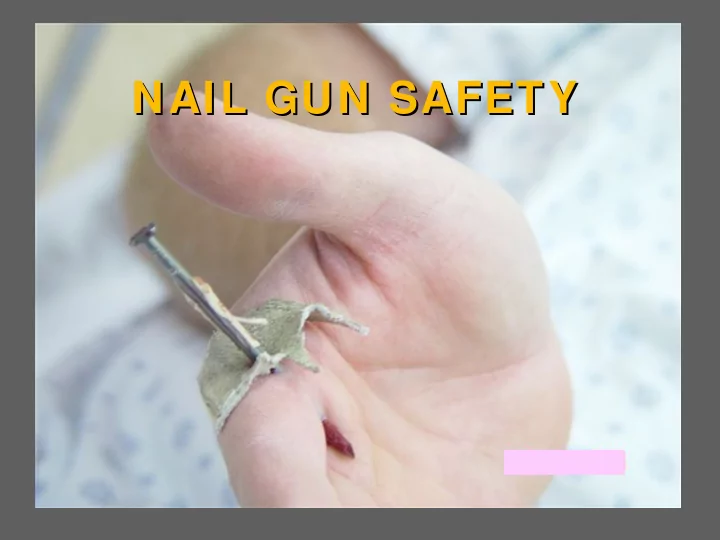
NAIL GUN SAFETY NAIL GUN SAFETY
SLIDE 2
Nail Guns Safety Nail Guns Safety
“A nail gun is an aptly named tool – it operates like a hand gun, but shoots nails instead of bullets.”
Some Nail gun Facts: Powerful tools can fire up to nine nails per second Velocities as high as 1,400 ft. per second
In 1997 - estimated 8,700 injuries In 1998, there were more than 10,500 In 2001 there were more than 14,600. How many this year??????
SLIDE 3
A Sign of a Serious Problem A Sign of a Serious Problem
Nail Gun Accidents make the news regularly…
PLYMOUTH, Mass., May 2 0 0 4 –
“A carpenter driving nails with a high-powered nail gun died after one pierced his heart.”
LOS ANGELES, CA., April 2 0 0 4 -
“A construction worker in Los Angeles had six nails driven into his head in an accident with a high- powered nail gun. Doctors expect him to recover fully.”
SLIDE 4 A Sign of a Serious Problem A Sign of a Serious Problem
Nail Gun Accidents make the news regularly…
DENVER, CO., August 2002 —
“A man is lucky to survive a freak nail gun accident that lodged a nail in his skull.”
ATLANTA, GA., Novem ber
2 0 0 3 – “The dog, named Caesar, was in his own backyard according to his owners, when he was shot by a construction worker next door.”
SLIDE 5
Nail Guns Safety Nail Guns Safety
Common Injuries Injuries to the extremities such as
hands, feet, arms and legs.
Potentially fatal injuries to the
head, neck and heart.
Workers have also been injured from concrete
and wood chips flying from the nailed surface.
Injuries are just as common to others in work
area.
It is a dangerous tool if not used properly!
SLIDE 6 OSHA Hazard Alert OSHA Hazard Alert OSHA Hazard Alert OSHA Hazard Alert
In 2001 the Occupational Safety and Health
Administration (OSHA) issued a hazard alert to warn about the dangers of pneumatic nail guns.
Recent injury accidents involving the use of pneumatic
nail guns, have raised concerns about safe operating
- procedures. These injury accidents could have been
easily prevented by adhering to the following simple safety procedures for the use of air nailers:
SLIDE 7 Safety Procedures for the Use of Air Nailers: Safety Procedures for the Use of Air Nailers:
Review the owner's manual carefully with all
Have someone who is familiar with the tool
demonstrate safe operating procedures. Then have each employee take a turn on the tool, and watch how each one performs.
Always wear safety glasses.
Training is the Key: Training is the Key:
SLIDE 8
Safety Procedures for the Use of Air Nailers: Safety Procedures for the Use of Air Nailers:
Do not hold the trigger down unless you're
purposefully firing the tool. This is especially important when descending ladders.
Workers often carry
the gun with their finger on the trigger.
It is a comfortable
carrying position, but very unsafe.
SLIDE 9
Safety Procedures for the Use of Air Nailers: Safety Procedures for the Use of Air Nailers:
Workers often check for air pressure by pulling
the trigger (A short hiss will sound if there is pressure)
When doing this, the gun may also discharge if
safety tip is stuck in the engaged position.
Dirt or small rocks can get in it if they lay it on the ground often Is the Spring in it? Gun maintenance Operator experience
SLIDE 10
Safety Procedures for the Use of Air Nailers: Safety Procedures for the Use of Air Nailers:
Exercise extreme caution when using an air tool around
another worker.
Who is on other side of a wall or under sheathing.
Never point the tool at anyone. Treat the tool like a
firearm.
Never assume the tool is empty.
SLIDE 11
Safety Procedures for the Use of Air Nailers: Safety Procedures for the Use of Air Nailers:
Keep your free hand safely out of the way of the
tool.
Which picture show the safer way? Why? Is there a thing called “technique”. Do you see it?
SLIDE 12 Safety Procedures for the Use of Air Nailers: Safety Procedures for the Use of Air Nailers:
Do not fire the tool unless the nose is firmly pressed
against a work piece.
Let’s face it, the gun is designed to be fast. Workers bounce the gun out of desire for speed
– Good for sheathing, dangerous for framing.
The Spring
– Workers remove the spring out of desire to have a faster gun that
– No spring can also allow the tip to jam back and let the gun fire with just the pull of the trigger
SLIDE 13
Safety Procedures for the Use of Air Nailers: Safety Procedures for the Use of Air Nailers:
Do not exceed the manufacturer's specified air
pressure for the tool, and never exceed 120 psi.
Not a problem if there is a functioning regulator on the compressor.
Inspect hoses for damage
and repair/replace as necessary.
Do not operate the tool
around flammables.
SLIDE 14
Safety Procedures for the Use of Air Nailers: Safety Procedures for the Use of Air Nailers:
Disconnect the air hose before clearing a
jam or making adjustments.
Common sense but people are complacent…
Do not leave a Nail Gun
powered and unattended.
Its like a loaded gun. Would you want this
thing landing on your head?
SLIDE 15
Safety Procedures for the Use of Air Nailers: Safety Procedures for the Use of Air Nailers:
Nail top to bottom when nailing wall sheathing in
a vertical position.
Nail from the eaves to the ridge when nailing
roof sheathing, this way you will not back off the edge of the roof.
Move forward, not backward, when nailing
horizontal areas.
Secure the hose when working on scaffolding, to
prevent the weight of the hose from dragging the tool off the scaffold if you set the tool down.
SLIDE 16
Differences in Nail Guns Differences in Nail Guns
There are many different features Most older guns only have one feature, Rapid Fire Trigger has no
adjustment
SLIDE 17
Differences in Nail Guns Differences in Nail Guns
Back for Single Shot Most Carpenters do not care about single shot or
don’t know there is an option.
Some newer guns have a setting for Single Shot vs.
Rapid Fire.
Forward for Rapid Fire
SLIDE 18
Differences in Nail Guns Differences in Nail Guns
Some Guns are only Single Shot (Hardware Guns)
SLIDE 19
Most modern nail guns are built with safety catch
devices which imposes two separate firing triggers.
The gun has a catch that holds the blade in place and to
release the catch one must press the gun against the intended surface while depressing the firing trigger.
A flaw of this system is that it allows users to keep the
trigger depressed to quickly fire nails by merely apply the gun to the intended surface.
Designed for speed…….Its what the user wants.
Safety Devices…Do They Work? Safety Devices…Do They Work?
SLIDE 20 Many accidental discharges result from workers, in tight
spaces, accidentally bumping into one another and the nail gun.
Other Injuries result from carrying the gun with a finger
- n the trigger and bumping the leg or other part of the
body.
Injuries may occur when catch gets jammed from poor
maintenance or tool neglect.
Safety Devices…Do They Work? Safety Devices…Do They Work?
SLIDE 21
A safer gun is one that employs a sequential trip system
which requires that the trigger be pulled each time before the surface is nailed.
Available on some guns with the adjustment.
Manufacturers have not produced many guns with
sequential trip systems due, in part, to excessive costs as well as the fact that most users prefer the convenience and speed of the nail guns without the sequential trip device over the safety benefits of the guns with them.
Safety Devices…What is the Future? Safety Devices…What is the Future?
SLIDE 22
Nail Gun Injury Cases Nail Gun Injury Cases
There have been numerous cases of operators, as well as
bystanders being injured when both of the activation mechanisms- usually a safety wire at the muzzle and the trigger are simultaneously depressed unintentionally.
The nail may strike and cause sever injury. Fatal injuries have occurred. The hand is the most commonly
injured part. Usually the non- dominant hand is the one that is injured.
Remember this?
SLIDE 23
Nail Gun Injury Cases Nail Gun Injury Cases
Mechanisms of nail gun injury include direct penetration-
shrapnel wounds from exploding cartridges, and high- pressure injection injuries from the compressed air used to activate the gun.
The types of hand injury encountered
include direct bony injury to the phalanges, metacarpals, carpus, radius or ulna, and penetrating injuries of the interphalangeal and radiocarpal joints. The majority of injuries involve soft tissue injuries.
SLIDE 24 “Mejia told authorities he remembered a "shock" to the back of his neck and little else before passing out” “Mejia told authorities he remembered a "shock" to the back of his neck and little else before passing out”
Mejia and the other man
apparently were atop wooden trusses and were helping secure the frame of the house when Mejia lost his balance, fell into the
- ther man and then plunged
15 feet to the ground, said Dean Fryer of the state's Division of Occupational Health and Safety, which is investigating the accident.
SLIDE 25
Pneumatic Tool Connections Pneumatic Tool Connections
← Acceptable
Hose Hose clamp clamp
← Unacceptable
If not designed for
high pressure hoses (>100 psi) and recommended by nail gun manufacturer.
SLIDE 26
Pneumatic Tool Connections Pneumatic Tool Connections
← Using a repair Kit
with Crimp Tool to make repairs
SLIDE 27
Liquid Fuel Liquid Fuel
Usually gas powered Main hazard – fuel
vapors
Use only approved
flammable liquid containers
Before refilling a fuel-
powered tool tank, shut down the engine and allow it to cool
SLIDE 28 Liquid Fuel Liquid Fuel
Separate flammable
materials from sources of heat and spark and from materials that would burn, such as rags, paper, cardboard, wood, etc.
Use only approved
containers for flammable materials
Label all containers
SLIDE 29
Liquid Fuel Liquid Fuel
What is wrong with this
picture?
SLIDE 30
Fatal Fact Fatal Fact
Employee killed when
struck in head by a nail fired from a powder actuated tool.
Tool operator was
attempting to anchor a plywood form in preparation for pouring a concrete wall
SLIDE 31 Electrical components Electrical components
In general, the same
precautions that are recommended for electric cords should be taken with air hoses, as the hoses are subject to the same kind of damage or accidental striking. An air hose also presents tripping hazards.
SLIDE 32 Electrical components Electrical components
within a woodworking area pose many hazards. To minimize the danger of these hazards, machines must always be grounded, circuit breakers and fuse boxes must be labeled, cords, cables, and plugs must be kept in good repair, and outlets, switches, and fittings must be covered. Any compromise in these or
could lead to serious injury, even death.
SLIDE 33 RE GULATIONS RE GULATIONS
CALIFORNIA Code of Regulations
§1704. Pneumatically Driven Nailers and Staplers.
(a) All pneumatically driven nailers and staplers which operate at more than
100 psi pressure at the tool, shall have a safety device on the muzzle to prevent the tool from operating unless muzzle is in contact with the surface, to prevent accidental discharge.
(b) When not in use, or unattended, all pneumatically driven nailers and
staplers shall be disconnected from the air supply at the tool.
(c) All hoses exceeding 1/2 inch inside diameter shall have a safety device at
the source of supply or branch line to reduce pressure in case of hose failure.
(d) When these tools are used on roofs of 1/3 pitch and steeper, the
- perator shall wear a safety belt with a lanyard securely fastened to a
substantial anchorage. On roofs of 1/4 pitch or steeper, the air hose shall be secured at roof level in such a manner as to provide ample, but not excessive, amounts of hose.
SLIDE 34
RE GULATIONS RE GULATIONS
Federal: 1 9 2 6 .3 0 0 ( a) Condition of tools. All hand and power tools and similar
equipment, whether furnished by the employer or the employee, shall be maintained in a safe condition.
1 9 2 6 .3 0 2 ( b) ( 1 ) Pneumatic power tools shall be secured to the hose or
whip by some positive means to prevent the tool from becoming accidentally disconnected.
SLIDE 35
RE GULATIONS RE GULATIONS
1 9 2 6 .3 0 2 ( b) ( 2 ) Safety clips or retainers shall be securely installed and
maintained on pneumatic impact (percussion) tools to prevent attachments from being accidentally expelled.
1 9 2 6 .3 0 2 ( b) ( 3 ) All pneumatically driven nailers, staplers, and other
similar equipment provided with automatic fastener feed, which operate at more than 100 p.s.i. pressure at the tool shall have a safety device on the muzzle to prevent the tool from ejecting fasteners, unless the muzzle is in contact with the work surface.
SLIDE 36
Summary Summary Summary Summary
Nail Guns are here to stay. Extremely dangerous if used improperly. Thorough worker training and oversight is key (use the
manufacturers instructions for training).
Reminders and retraining are tools to maintain the concepts
fresh and the awareness high.
Proper tool maintenance must follow manufacturers
instructions.
The company’s Code of Safe Practices must be followed. ZERO TOLERANCE for improper use or care of the nail gun
sends the message to all workers that management is involved and is serious about prevention of nail gun incidents and injuries.