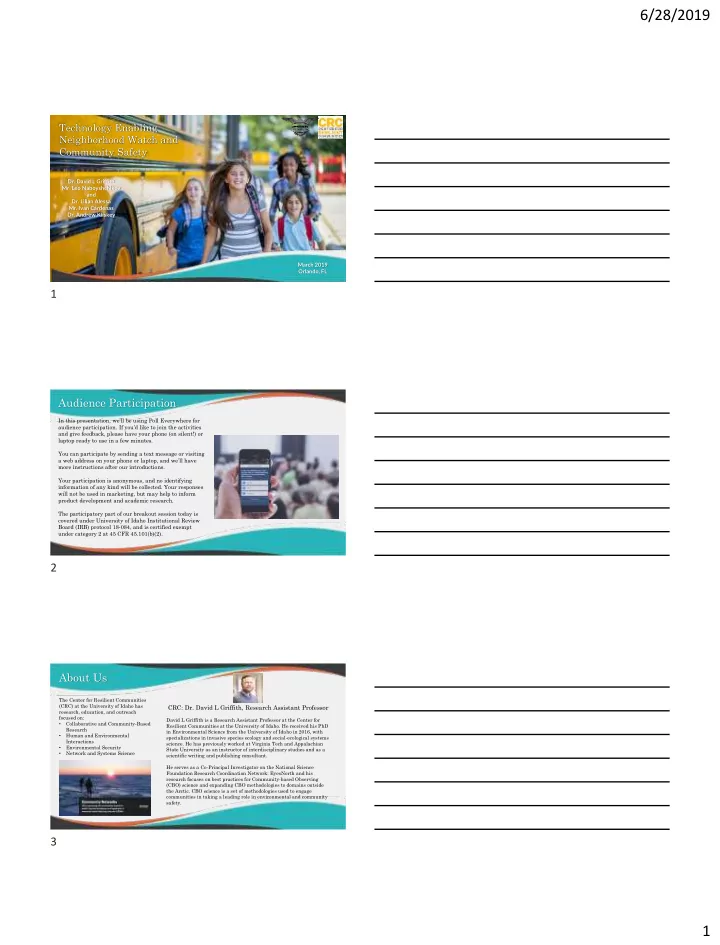
6/28/2019 Technology Enabling Neighborhood Watch and Community - - PDF document

6 28 2019
SMART_READER_LITE
LIVE PREVIEW

6/28/2019 Technology Enabling Neighborhood Watch and Community - - PDF document

6/28/2019 Technology Enabling Neighborhood Watch and Community Safety Dr. David L Griffith Mr. Leo Naboyshchikov and Dr. Lilian Alessa Mr. Ivan Cardenas Dr. Andrew Kliskey March 2019 Orlando, FL 1 Audience Participation In this


slide-1
SLIDE 1

6/28/2019 1

Technology Enabling Neighborhood Watch and Community Safety

  • Dr. David L Griffith
  • Mr. Leo Naboyshchikov

and

  • Dr. Lilian Alessa
  • Mr. Ivan Cardenas
  • Dr. Andrew Kliskey

March 2019 Orlando, FL

Audience Participation

In this presentation, we’ll be using Poll Everywhere for audience participation. If you’d like to join the activities and give feedback, please have your phone (on silent!) or laptop ready to use in a few minutes. You can participate by sending a text message or visiting a web address on your phone or laptop, and we’ll have more instructions after our introductions. Your participation is anonymous, and no identifying information of any kind will be collected. Your responses will not be used in marketing, but may help to inform product development and academic research. The participatory part of our breakout session today is covered under University of Idaho Institutional Review Board (IRB) protocol 18-084, and is certified exempt under category 2 at 45 CFR 45.101(b)(2). The Center for Resilient Communities (CRC) at the University of Idaho has research, education, and outreach focused on:

  • Collaborative and Community-Based

Research

  • Human and Environmental

Interactions

  • Environmental Security
  • Network and Systems Science

About Us

CRC: Dr. David L Griffith, Research Assistant Professor

David L Griffith is a Research Assistant Professor at the Center for Resilient Communities at the University of Idaho. He received his PhD in Environmental Science from the University of Idaho in 2016, with specializations in invasive species ecology and social-ecological systems

  • science. He has previously worked at Virginia Tech and Appalachian

State University as an instructor of interdisciplinary studies and as a scientific writing and publishing consultant. He serves as a Co-Principal Investigator on the National Science Foundation Research Coordination Network: EyesNorth and his research focuses on best practices for Community-based Observing (CBO) science and expanding CBO methodologies to domains outside the Arctic. CBO science is a set of methodologies used to engage communities in taking a leading role in environmental and community safety.

1 2 3

slide-2
SLIDE 2

6/28/2019 2

About Us

Kestrel: Leo Naboyshchikov – Sr. Analyst

  • Mr. Naboyshchikov is the lead analyst for Kestrel and is

responsible for the development of new analytical processes,

  • verarching analytical support for various mission sets

including disaster management, security, and humanitarian assistance, as well as research and development of new technologies and product development. Moreover, he has served in the role of a field engineer— providing testing, support, and execution of experimental and production deployments where needed with Kestrel’s array

  • f

related technologies. He also has extensive knowledge in social network analysis methodologies and programs, link and relational analysis, socio-behavioral analysis, data visualization, data fusion techniques, and data analysis. Kestrel Technology Group was founded in 2005 with a goal

  • f adding situational awareness to field operations with a

secure data collection application on readily-available mobile devices. Kestrel‘s unique combination of technology and methods empowers knowledge-based operations with a system that is versatile, scalable, and readily-deployed on clouds, servers, and field mobile units.

Smart phone, sensor and web based Internet Knowledge Management System

Easy to dep deploy Mu Multimedi dia/multilingual fiel eld d rep eporting Simple e data and d system em exc exchange Autonomous system em integ egration Works anywher ere e (Cel ellular/Wi WiFi/SATCO COM) M) Tasking and d Direc ection to fiel eld Scalable e and d Sec ecure Open en Standards ds format > compatibility

Related Work

CBONs are long term, collaborative

  • bservatories focused on linked

environmental and social change. They are driven by the data needs of both communities and researchers. Trusted and trained community members provide observations. Researchers assist with analysis and data management. Data is owned by the communities.

Community-Based Observation Networks (and Systems)

Related Work

4 5 6

slide-3
SLIDE 3

6/28/2019 3

Communication Methods

  • Dumb Phones (SMS messaging)
  • Smart Phones (Application-based)
  • 911 / 311 Landline-Based
  • Online Reporting (Crime Reporting, Suspicious Activity)
  • HAM Radios
  • Dedicated Radio to Public Safety Officers

Sensors and Passive Technology

  • Metal Detectors / Scanners
  • CCTV
  • Noise Identifying Sensors (Explosions / Gunshots)

Social Media (for better and worse)

  • Twitter
  • Facebook (Check In, etc.)
  • Reddit

Technology in Use Now Audience Participation

In this presentation, we’ll be using Poll Everywhere to enable us to do some audience participation. If you’d like to join the activities, please have your phone (on silent!) or laptop ready to use in a few minutes. All of your responses to questions are anonymous.

  • To participate on the web, open any browser and

visit www.pollev.com/nextgen2019

  • Wait for the poll to appear and submit your

response. Question 1 (Three Minutes):

  • As Leo discussed, there are different ways to

understand technology and how it is used in schools and communities. We are interested in what is being done in your school.

  • What types of technology does your school
  • r community use now in order to

increase safety?

  • List Three

Audience Participation

  • To participate on the web, open

any browser from phone or laptop and visit: www.pollev.com/nextgen2019

  • Wait for the poll question to

appear and submit your response.

  • All responses are anonymous.

7 8 9

slide-4
SLIDE 4

6/28/2019 4

Question 2 (Three Minutes):

  • It’s clear that there are many different

technologies being used, but that doesn’t mean the job is done.

  • Do you find the set of technological tools

you use currently to be useful and sufficient to the purpose of keeping everyone safe?

  • Not useful; not sufficient
  • Not useful; sufficient
  • Useful; not sufficient
  • Useful; sufficient

Audience Participation

  • To participate on the web, open

any browser from phone or laptop and visit: www.pollev.com/nextgen2019

  • Wait for the poll question to

appear and submit your response.

  • All responses are anonymous.

10 11 12

slide-5
SLIDE 5

6/28/2019 5

Question 3 (Three Minutes):

  • We use technology in our communities now, but

there are many new options that seem to come

  • nto the market daily. We’d like to identify and

discuss some of the factors that you think are responsible for why internet or app-based technological solutions aren’t already universally used.

  • What is a single word that you identify

with the most important barrier to or issue with using internet- or web-based technology in your school or community to enhance safety?

Audience Participation

  • To participate on the web, open

any browser from phone or laptop and visit: www.pollev.com/nextgen2019

  • Wait for the poll question to

appear and submit your response.

  • All responses are anonymous.

Question 4 (Five Minutes):

  • We’ve taken the top responses from the

previous question, and we’d like you to think about how important they are as barriers to or issues with adoption of internet- or app-based technology.

  • Please rank those issues from High

Concern (1) to Less Concern (10). Feel free to discuss with your neighbors while you complete this exercise.

Audience Participation

  • To participate on the web, open

any browser from phone or laptop and visit: www.pollev.com/nextgen2019

  • Wait for the poll question to

appear and submit your response.

  • All responses are anonymous.

13 14 15

slide-6
SLIDE 6

6/28/2019 6

Question 5 (Five Minutes):

  • We all want to do what we can to make and

keep our schools and communities as safe as

  • possible. Take a few minutes, and write a

single sentence that sums up for you the best way that you think technology can and should be used to improve safety for all of us.

  • Feel free to talk to your neighbors while

thinking of solutions, and you’ll be able to vote on which you think are best (or which shouldn’t even be on the table).

Audience Participation

  • To participate on the web, open

any browser from phone or laptop and visit: www.pollev.com/nextgen2019

  • Wait for the poll question to

appear and submit your response.

  • All responses are anonymous.

16 17 18

slide-7
SLIDE 7

6/28/2019 7

In addition to institutional support from Kestrel Technologies Group and the Center for Resilient Communities at the University of Idaho, we’d also like to thank the conference

  • rganizers and the National Science Foundation.

Our participation at the NextGen conference is supported by RCN:EyesNorth, a National Science Foundation funded research coordination network award (NSF #1642847). The views expressed here are not necessarily representative of the National Science Foundation or the University of Idaho.

Acknowledgments

Thank you for participating in our session, and we’d like to invite you to leave further comments and general feedback on the session. When the presentation advances to the next slide, you can access the survey at the link below. The survey should remain available for 24 hours, and should only take a few minutes

  • f your time.

The survey is available at: https://PollEv.com/nextgen2019

Follow Up Survey

19 20 21

slide-8
SLIDE 8

6/28/2019 8

Leonid Naboyshchikov Kestrel Technology Group, LLC. www.kestrel-tech.com leonidn@kestrel-tech.com +1-818-584-6016

  • Dr. David L Griffith

Center for Resilient Communities www.uidaho.edu/crc/ griffith@uidaho.edu +1-208-885-4409

22