6/24/2019 Objectives practical issues in the immuncompromised - - PDF document

6 24 2019
SMART_READER_LITE
LIVE PREVIEW

6/24/2019 Objectives practical issues in the immuncompromised - - PDF document

6/24/2019 Objectives practical issues in the immuncompromised traveller to be considered during pre travel asssessment options for medical care and insurance issues abroad symptoms immunosuppressed travellers need to be aware of and


slide-1
SLIDE 1

6/24/2019 1

Special Advice for the Immunocompromised Traveller

  • Micha Loebermann

Department of Tropical Medicine and Infectious Diseases University of Rostock

Universitätsmedizin Rostock

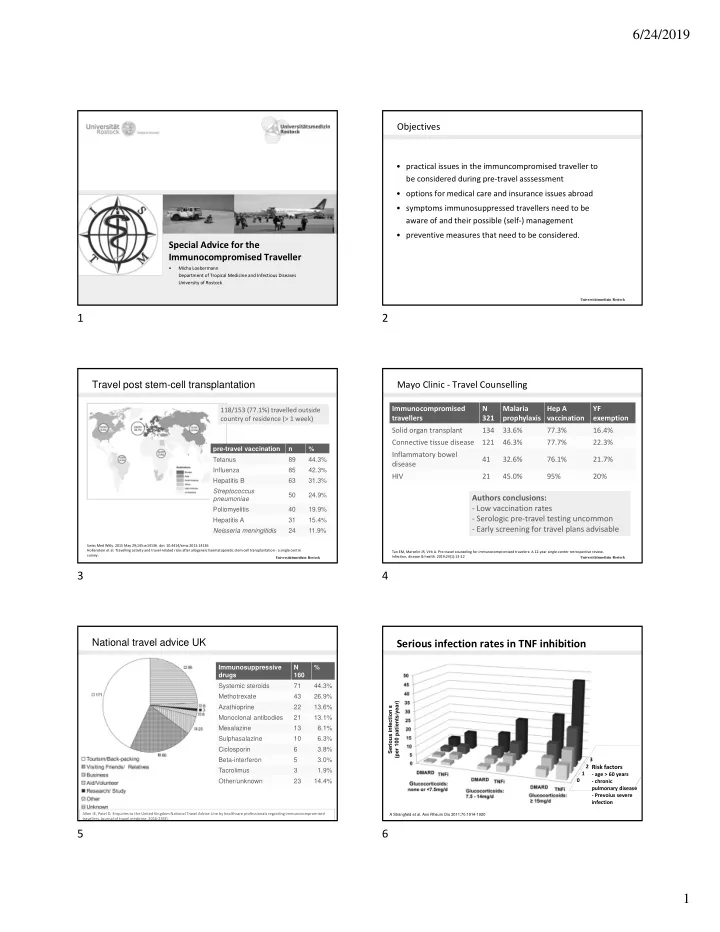
Objectives

  • practical issues in the immuncompromised traveller to

be considered during pre‐travel asssessment

  • options for medical care and insurance issues abroad
  • symptoms immunosuppressed travellers need to be

aware of and their possible (self‐) management

  • preventive measures that need to be considered.

Universitätsmedizin Rostock

Travel post stem-cell transplantation

Swiss Med Wkly. 2015 May 29;145:w14136. doi: 10.4414/smw.2015.14136 Hollenstein et al. Travelling activity and travel‐related risks after allogeneic haematopoietic stem cell transplantation ‐ a single centre survey.

118/153 (77.1%) travelled outside country of residence (> 1 week)

pre-travel vaccination n % Tetanus 89 44.3% Influenza 85 42.3% Hepatitis B 63 31.3% Streptococcus pneumoniae 50 24.9% Poliomyelitis 40 19.9% Hepatitis A 31 15.4% Neisseria meningitidis 24 11.9%

Universitätsmedizin Rostock

Mayo Clinic ‐ Travel Counselling

Tan EM, Marcelin JR, Virk A. Pre‐travel counseling for immunocompromised travelers: A 12‐year single‐center retrospective review. Infection, disease & health. 2019;24(1):13‐22

Authors conclusions: ‐ Low vaccination rates ‐ Serologic pre‐travel testing uncommon ‐ Early screening for travel plans advisable

Immunocompromised travellers N 321 Malaria prophylaxis Hep A vaccination YF exemption Solid organ transplant 134 33.6% 77.3% 16.4% Connective tissue disease 121 46.3% 77.7% 22.3% Inflammatory bowel disease 41 32.6% 76.1% 21.7% HIV 21 45.0% 95% 20%

Universitätsmedizin Rostock

National travel advice UK

Immunosuppressive drugs N 160 % Systemic steroids 71 44.3% Methotrexate 43 26.9% Azathioprine 22 13.6% Monoclonal antibodies 21 13.1% Mesalazine 13 8.1% Sulphasalazine 10 6.3% Ciclosporin 6 3.8% Beta-interferon 5 3.0% Tacrolimus 3 1.9% Other/unknown 23 14.4%

Allen JE, Patel D. Enquiries to the United Kingdom National Travel Advice Line by healthcare professionals regarding immunocompromised

  • travellers. Journal of travel medicine. 2016;23(3).

A Strangfeld et al. Ann Rheum Dis 2011;70:1914-1920

Serious infection s (per 100 patients/year) 3 2 1

Risk factors

‐ age > 60 years ‐ chronic pulmonary disease ‐ Prevoius severe infection

Serious infection rates in TNF inhibition

1 2 3 4 5 6

slide-2
SLIDE 2

6/24/2019 2

Universitätsmedizin Rostock

Medical risk assessment for travellers

  • infectious diseases
  • environmental factors
  • standard and availability of local

emergency medical and dental care

  • access to quality pharmaceutical

supplies

  • requirement for medical evacuation
  • cultural, language or administrative

barriers

https://www.travelriskmap.com/#/planner/map/medical 2018

Universitätsmedizin Rostock

Medical risks and availability of care

https://www.travelriskmap.com/#/planner/map/medical 2018

Universitätsmedizin Rostock

Treatment costs in different regions

https://www.brokerfish.com/resources/expat‐health‐insurance‐cost‐by‐country; PO 13.04 https://wwwnc.cdc.gov/travel/yellowbook/2018/the‐pre‐travel‐consultation/obtaining‐health‐care‐abroad

Locate adequate medical care options: embassies and consulates, medical insurance or credit card companies; www.istm.org

Poster 13.04

Universitätsmedizin Rostock

Travel insurance

  • Generally covers acute

illness

  • May not cover

‐ preexisting diseases ‐ repatriation ‐ medical prescriptions ‐ ambulance call outs ‐ optical/dental service

  • Additional trip

cancellation insurance

www.tinz.co.nz

Universitätsmedizin Rostock

Immunocompromised Travellers ‐ symptoms

Dekkiche S, et al. Travel‐related health risks in moderately and severely immunocompromised patients: a case‐control study. Journal of travel

  • medicine. 2016;23(3);

Suryapranata Fet al. Symptoms of infectious diseases in HIV‐positive travellers: A prospective study with exposure‐matched controls. Travel medicine and infectious disease. 2019

N Any health problem Significant clinical events* Immunocompromised travellers 116 27 (23.3%) 9 (7.8%) Solid organ transplant 4 2 (50%)

Infection 66.6% Inflammatory disease 11.1% Trauma 11.1% Cardivascular problem 11.1%

systemic immuno‐ suppressive med. 52 4 (7.7%) Splenectomized 20 0% HIV 15 3 (20%) Active cancer 25 0% Healthy controls 116 24 (20.7%) 2 (1.7%) Infection 100%

* repatriation, hospitalisation duuring/1 month after travel, medical consultation during travel

52 HIV vs 52 healthy travellers: comparable diarrhoea, vomiting, cough, rhinitis, pruritus, fatigue, or nausea.

Universitätsmedizin Rostock

Travel with stable disease condition

Multiple Sclerosis (MS) pseudo‐relapse (non‐inflammatory progression)

  • Infectious
  • Psychiatric
  • Vertigo
  • Temperature related
  • Trauma
  • Other neurological reasons

Rodriguez de Antonio LA et al. Non‐inflammatory causes of emergency consultation in patients with multiple sclerosis. Neurologia 2018; Loebermann M, et al. . Vaccination against infection in patients with multiple sclerosis. Nat Rev

  • Neurol. 2011;8(3):143‐51

7 8 9 10 11 12

slide-3
SLIDE 3

6/24/2019 3

Influenza

Metze C, et al. Immunogenicity and predictors of response to a single dose trivalent seasonal influenza vaccine in multiple sclerosis . CNS Neurosci

  • Ther. 2019 Feb;25(2):245‐254; Steffen R. Travel vaccine preventable diseases‐updated logarithmic scale with monthly incidence rates. Journal of travel
  • medicine. 2018.

Influenza affects 1/100 travellers (most frequent vaccine preventable infection)

  • Group travel
  • Cruise ship
  • Elderly
  • Chronic medical

conditions

Annual relaps rate months

Influenza vaccine in MS

Metze C, et al. Immunogenicity and predictors of response to a single dose trivalent seasonal influenza vaccine in multiple sclerosis . CNS Neurosci

  • Ther. 2019 Feb;25(2):245‐254; Steffen R. Travel vaccine preventable diseases‐updated logarithmic scale with monthly incidence rates. Journal of travel
  • medicine. 2018.

Universitätsmedizin Rostock

Acute travel associated diarrhea

Increased risk Previous severe course Reduced gastric acidity (antacids, gastric surgery) Immunodeficiency „All‐inclusive“ tourism IBD Risk of complication Dehydration: previous stroke, diabetes, young/old age Electrolyte imbalances: renal insufficiency, IBD

Steffen R et al. JAMA 2015;313:71‐80; Cook/Zumla. Tropical Diseases 2009

Universitätsmedizin Rostock

Diarrhoea – treatment

  • Prophylaxis
  • Not routinely recommended
  • Cholera vaccine (cross immunity)?
  • Bismuth subsalicylate (renal toxicity in renal tx)
  • Rifaximin (cyclosporin interaction)
  • Chinolons not recommended
  • Empiric therapy
  • Mild – symptomatic (rehydration, electrolyte substitution, anti‐

motility agents e.g. loperamide, bismuth)

  • Moderat – chinolons??, azithomycin, rifaximin
  • Severe – antibiotic therapy – microbiology testing
  • Cave: invasive infections, developing resistance (campylobacter)

Riddle MS et al. J Travel Med. 2017;24(suppl_1):S57‐S74; Beeching NJ, et al.Traveler's Diarrhea Recommendations for Solid Organ Transplant Recipients and Donors. Transplantation. 2018;102:S35‐s41

  • E. coli (ETEC) 40‐70%, Campylobacter, Shigella, Salmonella, Aeromonas etc.

Universitätsmedizin Rostock

Prophylactic measures against malaria

http://www.dtg.org; Boubaker R, et al. Malaria prevention strategies and recommendations, from chemoprophylaxis to stand‐by emergency treatment: a 10‐year prospective study in a Swiss Travel Clinic. Journal of travel medicine. 2017;24(5)

mosquito avoidance chemoprophylaxis stand‐by emergency treatment (SBET)

Universitätsmedizin Rostock

Drug interactions

Mariano D, Smith DS. Safe Travel Preparation for HIV‐Infected Patients. Current infectious disease reports. 2019;21(4):15. https://www.hiv‐druginteractions.org; www.drugs.com/interaction

Co‐medication Possible effect Doxycycline etravirine , nevirapine, efavirenz CYP3A4/CYP450‐associated decreased doxy concentrations calcineurin inhibitors (tacrolimus, cyclosporine) Elevated calcineurin inhibitor levels Proguanil‐ Atovaquone Efavirenz, rinonavir reduced proguanil metabolites, reduced atovaquon concentration Mefloquine efavirenz, lopinavir inceased QT‐interval calcineurin inhibitors (tacrolimus, cyclosporine) Elevated calcineurin inhibitor levels Chloroquine efavirenz, lopinavir inceased QT‐interval Primaquine etravirine , nevirapine potentially increased primaquine haemotoxicity Tafenoquin as for primaquine?

13 14 15 16 17 18

slide-4
SLIDE 4

6/24/2019 4

Universitätsmedizin Rostock

Practical issues

  • Sufficient medical supply
  • Carry‐on luggage & suitcase
  • Special requirements for fluids and

syringes

  • Cold‐chain (arrange with airline)
  • Medical supply certificate

United Arab Emirates – drug restrictions

  • psychotropic substances
  • analgetics
  • antitussives
  • hormons

ISTM Pharmacist Professional Group Database on International Regulations Poster 15.16

Universitätsmedizin Rostock

Countries with restrictions for HIV – short term travel

  • Azerbaidjan
  • Bhutan
  • Brunei
  • Egypt
  • Equatorial Guinea
  • Iran
  • Iraq
  • Jordan
  • Kyrgyzstan
  • Marshall Islands
  • Russia
  • Solomon Islands
  • Suriname
  • Syria
  • Tunisia
  • United Arab Emirates (UAE)
  • Yemen

http://www.hivtravel.org 2019

Universitätsmedizin Rostock

Yellow fever required vaccinations

/who.maps.arcgis.com 20171201 Schonenberger S, Hatz C, Buhler S. Unpredictable checks of yellow fever vaccination certificates upon arrival in

  • Tanzania. Journal of travel medicine. 2016;23(5)

Universitätsmedizin Rostock

Summary – ideal traveller

  • Early screening for travel plans done and vaccinations started
  • All generally usefull vaccines completed: pneumococcus, meningococcus, HAV,

HBV, TdaP, Influenza etc. (ImmunoStart Poster 17.08)

  • No drug interactions with antimalarials or other antibiotics
  • Has medical care at travel destination if needed
  • Has no legal travel restrictions
  • Has stable disease, is educated about underlying diesase and is well insured

19 20 21 22 23