Caring for God's Creation 2001 Annual Meeting of the American - - PDF document

caring for god s creation
SMART_READER_LITE
LIVE PREVIEW

Caring for God's Creation 2001 Annual Meeting of the American - - PDF document

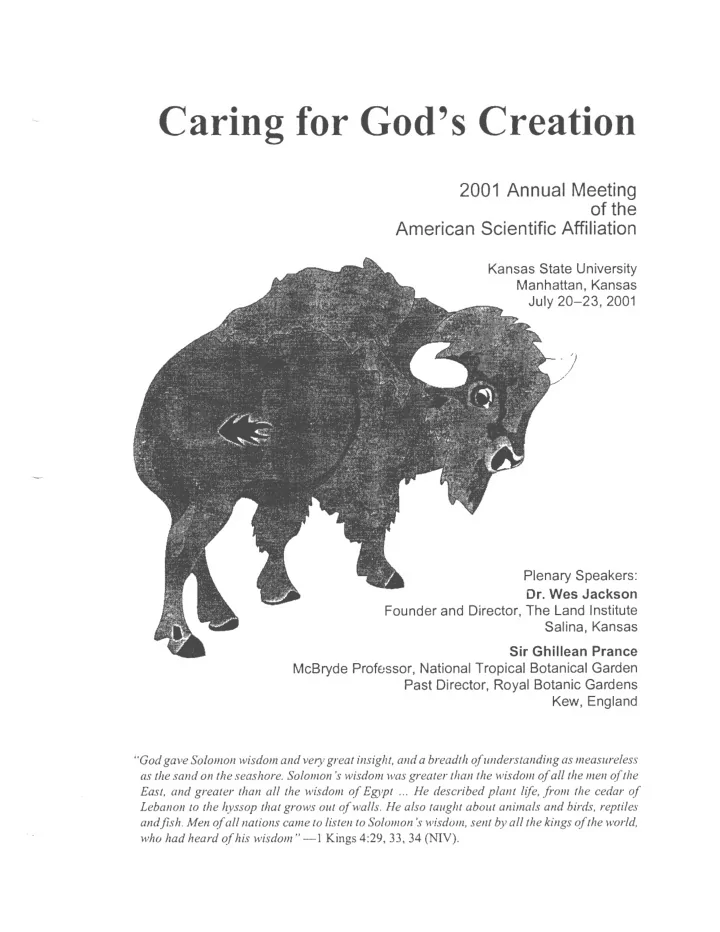
Caring for God's Creation 2001 Annual Meeting of the American Scientific Affiliation Kansas State University Manhattan, Kansas July 20-23 , 2001 / Plenary Speakers: Dr. Wes Jackson Founder and Director, The Land Institute Salina, Kansas


slide-1
SLIDE 1

Caring for God's Creation

2001 Annual Meeting

  • f the

American Scientific Affiliation

Kansas State University Manhattan, Kansas July 20-23, 2001

/ •

Plenary Speakers:

  • Dr. Wes Jackson

Founder and Director, The Land Institute Salina, Kansas Sir Ghillean Prance McBryde Professor, National Tropical Botanical Garden Past Director, Royal Botanic Gardens Kew, England

"God gave Solomon wisdom and very great insight, and a breadth of understanding as measureless as the sand on the seashore. Solomon's wisdom was greater than the wisdom of all the men of the East, and greater than all the wisdom of Egypt ... He described plant life, from the cedar of Lebanon to the hyssop that grows out of

  • walls. He also taught about animals and birds, reptiles

and

  • fish. Men of

all nations came to listen to Solomon's wisdom, sent by all the kings of the world, who had heard of his wisdom " -1 Kings 4:29, 33, 34 (NIV).

slide-2
SLIDE 2

Table of Contents

General Information

Bookstores .......................................................................................................................................... 1 Special Displays .............................................................. ................. .................................................. 1 Emergency Phone Numbers ............................................................................................................. .. 1 Many thanks to . . . .. ........................................................................................... ................................. 1

2001 ASA Annual Meeting Schedule

2001 ASA Annual Meeting Schedule ................................................................................................. 2 Saturday Parallel Sessions .................................................................................................................. .4 Sunday Parallel Sessions .............................................................. ....................................................... 6

Papers

Arveson, Paul .................................................................................... ............................................. ..... 8 *Assis, David N . and Lawrence M. Mylin ................ ........................................................................... 8 Ball, James ........................................................................................................................ .................. 9 Boorse, Dorothy F ...... .......................... .............................................................................................. 9 Bouma III, Hessel ... ........................... .......................................................... ..................................... 10 Cannon, Joel W .............. ................................ ................................................................................... 11 *Claude, Lakiesha .................. ............................................................................... ............................. 12 Cleaver, Gerald B ................................................. ........... ........ .......................... ............................... 13 *DeJong, Randall ................................................................. ....................... ....................................... 14 Discher, Mark R .......................................................................... ................... ................. ................. 14 Elisara, Christopher .......................................................................................................................... 15 *Futty, Kristina L ....................................................................... ................... ..................................... 16 Hartnett, David C ................................ ..............................................................................................

16

Hickernell, Fred S

............................................................................................................................. 17

Larzelere, Robert E ........................................................................................................................... 18 Lechner, Joseph H ....................... ..................................................................................................... 18 Lewis, Raymond J ............... ............................................................................................................. 19 Mcintyre, John A ............................................................ ........... .......... ............................................. 20 McReynolds, Karen Edminster .................................................. ....................................................... 20 Miller, Keith B ...................................................... ............................................................................ 21 Mylin, Lawrence M. and Satvir S.Tevethia ...................................................................................... 22 Nekrasov, Vladimir and Denis Vladimirovich Nekrasov ................................................................. 23 Osepchuk, John M .................................. .............. ....................... ..................................................... 23 *Rossmiller, Celeste J

....................... ................................. ................................................................

24 Rusbult, Craig ......................................................................... .......... .. .. .. ......... ................................. 25 Seely, Paul H ................................... .... ........................... .. ...... .......................................................... 26 Starkey, Lawrence Harry ...... ............................................................................................................ 26 *Strand, Mark A ............. .................................................................................................................... 27 Tucker, Jeanne C . ................................................... ....................... ... ............................................... . 28 Van Dellen, Kenneth J ........................................................... ...................... .............................. ...... . 28 Wiester, John L ................................................................................. ................................................ 29 Zimmer, J. Raymond ........................................................... ............................................................. 30

slide-3
SLIDE 3

Plenary Addresses

Jackson, Wes .................................................................................................................................... 31 Prance, Sir Ghillean T ................................................... .................................... ............................... 32

Posters

*Hall, Rebecca Florence ............................................. ..... .. ................................................................ .32 Kennedy, Sr., Charles ....................................................................................................................... 33 Resler, Carl ....................................................................................................................................... 34 Vos, Ronald ...................................................................................................................................... 34 Wamers, David and Randall Van Dragt ........................................................................................... 35

Symposia

Global Stewardship and Environmental Ethics Symposium *Bouma, RolfT

................................................................................................................................. .36

Bouma-Prediger, Steven ................................................................................................................... 37 Clements, David R ............................................................................................................................ 3 7 Curry, Janel M . ................................................................................................................................. 38 *Schramm, Jonathon, Randall Van Dragt, and David Wamers ................................ ......................... 39 *Strnad, Jeri, *Stan Freyenberger, and David Norman ..................................................................... .40 Swearengen, Jack C .......................................................................................................................... 40 Touryan, Kenell J. and John A. Turner ........................................................................................... .41 Wood, John R

...................................................................................................................................

42 Zylstra, Uko ........................................................................................ .............................................. 43 Evolution as a Work of the Trinity Sympoisum Lamoureux, Denis 0 ........................................................................................................................ .44 Miles, Sara Joan ................................................................................................................................ 45 Murphy, George L .............................................................................. .............................................. 45

Newman, Robert ................................................................................ ............................................... 46

Van Till, Howard J . ...................................................................................... .................................... 46

Templeton/ASA Lecture

Larson, Edward ................................................................................................................................. 47

ASA/CSCA Local Area Representatives

Canada .............................................................................................................................................. 48 United States ..................................................... ................................................................................ 48

*Students presenting a paper or poster through donated scholarships.
slide-4
SLIDE 4

General Information

Bookstores

The Kansas State University bookstore will be open for its regular summer business hours. They have graciously set up a "bookstore" featuring books of interest to our attendees in the Student Union Main and West Ballrooms on Saturday and Sunday. A local bookstore, Eighth Day Bookstore, also will set up a "bookstore" in the Derby Dining Center. Monday - Friday: Saturday: Sunday:

Kansas State University Bookstore Hours:

8:30 AM - 5:30 PM Student Union, Ground Floor 9:00 AM - 5:00 PM Student Union, Ballrooms 1 :00 PM - 5:00 PM Student Union, Ballrooms

Eighth Day Bookstore Hours:

Saturday and Sunday: 6:00 PM - 9:00 PM Derby Dining Center, Gold Room

Special Displays

Visit the Main and West Ballrooms in the Student Union Saturday and Sunday to see the information from the following exhibitors: ASA Web Site AuSable Institute Evangelical Environmental Network IVCF Graduate Faculty Ministries Konza Prairie Biological Station The Land Institute Quiet Garden Trust

Target Earth

Emergency Phone Numbers

Haymaker Hall: 785-395-3710 Conference Center: 785-532-6022, except Sunday

Many thanks to ...

Joseph Sheldon : Program Chair Ruth and Keith Miller: Local Arrangements Co-chairs Fred Hickernell: Acting Program Chair The American Scientific Affiliation encourages thoughtful and provocative scientific presentations and

  • discussions. Presenters and discussants are expected to maintain a humble and loving attitude toward

individuals who have a different opinion.

Kansas State University, Manhattan, KS 1

slide-5
SLIDE 5

2001 ASA Annual Meeting Schedule

2

2:00-8:00 PM 5:00-6:00 PM 7:00-7:45 AM 8:00 AM 2:00 PM 2:00-9:00 PM 4:00 PM 6:00 PM 8:00 PM 7:00-7:45 AM 8:15 AM 9:00 AM 10:00 AM 10:30 AM 12:30 PM 1:30 PM 3:30 PM 4:00 PM 5:30-6:00 PM 7:00 PM 8:30 PM

Thursday, July 19, 2001

Registration -Haymaker Hall, Lobby Dinner -Derby Dining Center

Friday, July 20, 2001

Breakfast -Derby Dining Center Trip to The Land Institute in Salina with guided tour and lunch Leave The Land Institute to return to KSU Registration -Haymaker Hall, Lobby Depart for Konza Prairie Biological Station Activities on the prairie including tour of Konza Bison herd Dinner -Picnic at Konza headquarters Introduction Ecology and Stewardship of

  • ur Native Grasslands:

The Konza Prairie Biological Station Leave Konza Prairie to return to KSU

Saturday, July 21, 2001

Breakfast -Derby Dining Center Publications Breakfast Meeting -Derby Dining Center Worship -Student Union, Forum Hall Music Devotions Announcements Plenary address -Student Union, Forum Hall Introduction The Changing Relationship Between the Tree of Knowledge and the Tree of Life Break -Union Concourse, outside the Cat's Pause Lounge Symposia and General Session 1 Lunch -Student Union, Main and West Ballrooms Young Scientists Luncheon Fellows Luncheon Symposia cont'd and General Session 2 Break -Union Concourse, outside the Cat's Pause Lounge Symposia cont'd and General Session 2 cont'd Dinner -Derby Dining Center Local Area Meetings at tables ASA Business Meeting -Derby Dining Center Affiliation meetings -Haymaker Lobbies Affiliation of Christian Biologists (ACB) Affiliation of Christian Geologists (ACG) African Institute for Scientific Research and Development (AISRED) Christian Engineers and Scientists in Technology (CEST)

  • Keith Miller
  • David Hartnett
  • Roman Miller
  • Larry and

Susan Martin

  • Kenell Touryan
  • Fred Hickernell
  • Keith Miller
  • Wes Jackson
  • Jay Hollman
  • Larry Seward
  • Keith Miller
  • Don Munro

Martin Price

  • Ruth Miller

2001 ASA Annual Meeting

slide-6
SLIDE 6

2001 ASA Annual Meeting Schedule

7:00-8:00 AM 8:45 AM 9:30 AM

11 :00 AM

12:30 PM 1:30 PM 3:10 PM 3:35 PM 4:00 PM 4:00-5:00 PM 4:25 PM 6:00 PM 7:30 PM 9:00 PM 7:00-7:45 AM 8:30-9:00 AM 9:15-10:15 AM 10:15-10:30 AM 10:30-11 :45 AM 12:00-1 :00 PM 1:30 PM

Sunday, July 22, 2001

Breakfast -Derby Dining Center Prayer meeting for ASA -Danforth and All Faiths Chapel Worship -Danforth and All Faiths Chapel Worship leader Special Music Sermon: "Breadmaking with Jesus," Matt. 6:5-12 Plenary address -Danforth and All Faiths Chapel Introduction Creation is Groaning Lunch - Student Union, Main and West Ballrooms Young Scientists Luncheon with Sir Ghillean Prance General Sessions 3, 4, and 7 General Session 5 Break -Student Union, outside Cat's Pause Lounge General Sessions 3, 5, and 7 cont'd Poster Session -Student Union, Main and West Ballrooms General Session 6 Dinner -Derby Dining Center, Gold Room Commission Meetings -Haymaker, Lounges Bioethics Communications Creation Global Resources and Environment History and Philosophy of Science Physical Sciences Science Education Social Sciences IVCF Reunion Meeting

Monday, July 23, 2001

Breakfast - Derby Dining Center Worship -Student Union, Main and West Ballrooms Music Devotions Announcements Templeton/ASA Lecture -Main and West Ballrooms God and the Galapagos Break - outside Main and West Ballrooms Panel -Main and West Ballrooms Challenges and Opportunities for Christians in Science at the Beginning of their Careers Lunch - Student Union, Bluemont Room Check out. Please return your key to the registration desk.

Kansas State University, Manhattan, KS

  • Fred Hickernell
  • Kevin Carnes
  • Robert Newman
  • Fred Hickernell
  • Sir Ghillean Prance
  • Hessel Bouma Ill
  • Paul Arveson
  • Robert Newman
  • John Wood
  • Sara Miles
  • Larry Martin
  • John Wiester
  • Judy Toronchuk
  • Terry Morrison
  • Larry and

Susan Martin

  • Judith Toronchuk
  • Fred Hickernell
  • Edward Larson
  • Don Munro, Moderator

Steven Hall Johnny Lin Ruth Miller Pam Veltkamp

3

slide-7
SLIDE 7

Saturday Parallel Sessions

10:30 AM

11 :00 AM

11:30 AM 12:00 PM 12:30 PM

Symposium: Global Stewardship and

Environmental Ethics

Session I, Philosophical & Theological Perspectives

  • n Stewardship and Environmental Ethics

Student Union, Big 12 Moderator: John Wood, Global Resources Commission Chair

Care Theory and "Caring" Systems of Agriculture Biblical Wisdom & Ecological Ethics: Looking at Scripture Again for the First Time Genetic Engineering of Nature and a Theology of Nature Ethics of Agricultural Biotechnology Lunch -Student Union, Main and West Ballrooms

Session II, Global Stewardship and Environmental Ethics in Research and Practice

Student Union, Big 12 Moderator: Hessel ("Bud") Bouma III, Bioethics Commission Chair

1 :30 PM Caring for God's Creation Through the Proper Use

  • f our Energy Resources

2:00 PM Industrial Ecology as an Environmental Ethics Course for Engineering Students 2:30 PM Assessing Property for Conservation Value:

Natural Areas Inventory

3:00 PM The Struggle for Survival and Sustainability: Farming Households in Low-Income Economies 3:30 PM Break -Student Union, outside Cat's Pause Lounge 4:00 PM 4:30 PM

  • Student Scholarship

Presenter

Session III, Global Stewardship and Environmental Ethics: Sustaining Biodiversity

Student Union, Big 12 Moderator: Janel Curry

Caring for Creation: What about the Weeds? Biophilia and the Gospel: Loving Nature or Serving God

  • Janel Curry
  • Steven

Bouma-Prediger

  • Rolf Bouma*
  • Uko Zylstra
  • Kenell Touryan and

John Turner

  • Jack Swearengen
  • Jonathon Schramm.*

Randall Van Dragt, David Warners

  • Jeri Stroad,*

Stan Freyenberger,* David Norman

  • David Clements
  • John Wood

4 2001 ASA Annual Meeting

slide-8
SLIDE 8

10:30 AM

11 :30 AM

12:30 AM 1:30 PM 2:30 PM 3:30 PM 4:00 PM 5:00 PM

Symposium:

Evolution As a Work of the Trinity

Student Union, Room 212 Moderator: George Murphy, Creation Commission Board Member

Beyond lnerrancy and Infallibility: Toward an lncarnational Hermeneutic Evolution and Theology: A View Toward the Left Lunch -Student Union, Main and West Ballroom Christ as Evolver and Evolved Some Problems for Theistic Evolution Break -Student Union, outside Cat's Pause Lounge If the Creation Is Equipped to Evolve, Is God a Deist? Panel discussion and wrap-up session

General Session 1 :

Engineering, Technology, and Biotechnology (CEST)

Student Union, Cottonwood Room Chair: Ruth D. Miller, CEST President

10:30 AM Treasurers of Sand: God's Gift to Technology

11 :00 AM

Problems Encountered in Public Education about Cell Phone Hazards

11 :30 AM

Hydromulching Sparlina alterniflora

General Session 2:

Science and Religion

Student Union, Cottonwood Room Chair: John W. Haas, Jr.

1 :30 PM The Historical Adam 2:00 PM The Natural World and Theories of Religion: A Critique Whose Time Has Come 2:30 PM Does the Bible Really Say the Sky Is Solid? 3:00 PM Evangelical Approaches to Christian Stewardship

  • r Creation-Care

3:30 PM Break -Student Union, outside Cat's Pause Lounge 4:00 PM TRIZ: As a Way for Understanding God

* Student Scholarship

Presenter

Kansas State University, Manhattan, KS Saturday Parallel Sessions

  • Denis Lamoureux
  • Sara Miles
  • George Murphy
  • Robert Newman
  • Howard Van Till
  • Fred Hickernell
  • John Osepchuk
  • Lakiesha Claude*
  • John Mcintyre
  • Celeste Rossmiller*
  • Paul Seely
  • James Ball
  • Vladimir Nekrasov
  • Denis Vladimirovich

Nekrasov

5

slide-9
SLIDE 9

Sunday Parallel Sessions

1:30 PM 1:55 PM 2:20 PM 2:45 PM 3:10 PM 3:35 PM 4:00 PM 4:25 PM 4:50 PM 1:30 PM 1:55 PM 2:20 PM 2:45 PM

General Session 3:

Environmental Issues Papers

Student Union, Big 12 Chair: Raymond Brand

Environmental Issues in Kenya: A Report from the Field Caring for Creation in a Crowded World: Principles Governing Human Population Planning Modern Humanity's Noisy Assault on the Sea What is a Quiet Garden? A Robust Theology Proves Able to Guide Community Development Work in China Break -Student Union, outside Cat's Pause Lounge The Global Stewardship Study Program: Educating University Students to Serve the Creator, the Creation, and the Poor It's a Jungle Out There: Applying Biblical Stewardship at Jaguar Creek Zinc and Copper Accumulation in Sediments of a Parking Lot Settling Pond

General Session 4: Origins Papers

Student Union, Cottonwood Room Chair: Gerald Hess

An Evaluation of the 1990 and 2001 Kansas

Science Standards Based on the ASA's Resolution

"A Voice for Evolution as Science" Should Science Be Logical? Does Van Till's Critique of Intelligent Design Succeed? Does Jesus Clearly Reveal God? An Internal Inconsistency in Some Intelligent Design-Based Writings

General Session 5:

Social Science Papers

Student Union, Cottonwood Room Chair: Sara Miles

3:10 PM Values and Social Science: Modernism, Postmodernism, and Faith 3:35 PM Break -Student Union, outside Cat's Pause Lounge 4:00 PM Semiotics of Miracles, Cognitive and Evolutionary Psychology, and the "Image of God"

  • Student Scholarship

Presenter

6

  • Kenneth Van Dellen
  • Dorothy Boorse
  • Paul Arveson
  • Jeanne Tucker
  • Mark Strand*
  • Chris Elisara
  • Karen McReynolds
  • Kristina Futty*
  • John Wiester
  • Craig Rusbult
  • Mark Discher
  • Joel Cannon
  • Robert Larzelere
  • J . Raymond Zimmer

2001 ASA Annual Meeting

slide-10
SLIDE 10

General Session 6:

Physical Science Papers

Student Union, Cottonwood Room Chair: Keith Miller 4:25 PM

Our Geological and Biological Environment and our Sense of Place

4:50 PM

The Beauty, Order and Complexity of God's Creation Implied by String Theory

1:30 PM 1:55 PM 2:20 PM 2:45 PM 3:10 PM 3:35 PM 4:00 PM 4:25 PM

General Session 7: Biology, Molecular,

and Biomedical Papers

Student Union, Room 212 Chair: Dorothy Chappell

Analysis of a Pedagogical Strategy for Teaching Biology to Nonmajors Defining Species of the Brown Alga Macrosystis CTL Escape Variant Selection and Analysis (Cancer Immunology) Selection of Cytotoxic T Lymphocyte Clone Y-1 Escape Variants from Murine Fibroblasts Transformed by Simian Virus 40 Large Tumor Antigen Your Faith Has Made you Well Break -Student Union, outside Cat's Pause Lounge Is It Ethical to Draw Blood Donations from Impoverished Haitians? Past and Present Relationship between Schistosoma mansoni a Human Parasite, and its Intermediate Hosts, Snails of the Genus Biomphalaria: Insights from Molecular phylogenetics

Poster Session

Student Union, Main and West Ballrooms 4:00-5:00 PM

Stewardship Implications of Ecology of Costa Rica The Science of Life, 2001

* Student Scholarship Presenter

In Praise of Mivart Smother Crop Potential for Weed Management in Zea Mays Creation Care in Horticulture: Naturalizing the College Campus

Kansas State University, Manhattan, KS Sunday Parallel Sessions

  • Keith Miller
  • Gerald Clever
  • Hessel Bouma 111
  • Raymond Lewis
  • Lawrence Mylin and

Satvir Tevthia

  • David Assis*
  • Joseph Lechner
  • Lawrence H. Starkey
  • Randall DeJong*
  • Rebecca Hall*
  • Charles Kennedy, Sr.
  • Carl Resler
  • Ronald Vos
  • David Warners and

Randall Van Dragt

7

slide-11
SLIDE 11

Papers Notes 8

Papers

Humanity's Noisy Assault on the Sea

Paul Arveson 6902 Breezewood Ter. Rockville, MD 20852 bridges@his.com Underwater acoustics has been my field for much of my career. At the Naval Surface Warfare Center, I designed, constructed, and used a variety of systems for measuring underwater sound. Since our business was designing ships and especially reducing the noise of ships, I thought it would be worthwhile to make some of my experiences available for this meeting. There is a growing awareness in the scientific community of the impact that manmade noise is having on sea animals. This talk, with an audio demonstration, will invite you to perceive the world from the perspective of a whale, and also to become aware of the impact of humans on the whale's environment within the past century. (The ASA's first President and one of its founders was F. Alton Everest. His field was electrical engineering, in particular the design of electroacoustic sensors or transducers used for underwater listening and sound projection. Alton Everest has long been retired, but he is still very much with us and I am dedicating this lecture to him.)

Selection of Cytotoxic T Lymphocyte Clone Y-1 Escape Variants from Murine Fibroblasts Transformed by Simian Virus 40 Large Tumor Antigen

David N. Assis and Lawrence M. Mylin Messiah College Grantham, PA 1 7027 717-766-2511 DA 1157@messiah.edu; Lmylin@messiah.edu CD8+ T lymphocytes play important roles in host immune defense due to their ability to recognize MHC class I bound peptides derived from intracellular

  • pathogens. CD8+ T cells should also be useful to combat tumors which express

peptides derived from mutated or aberrantly expressed host cell proteins. Unfortunately, genetic variation of epitope coding sequences may frustrate effective vaccination strategies. We are interested in understanding the consequences of epitope variation as it applies to the escape of tumors from immune surveillance in vivo. We have used transformed murine (H-Jb)

2001 ASA Annual Meeting

slide-12
SLIDE 12

fibroblasts which express a single integrated copy of the Simian virus 40 large tumor antigen (SY 40 Tag) oncoprotein in coculture (in vitro) with individual SY 40 T antigen epitope-specific CTL clones to select for transformed cell variants which express T antigen molecules in which the target epitope coding sequence has been mutated. Analysis of mutated epitope sequences in escape variants may lead to a better understanding of mechanisms by which tumors may escape from effective vaccination strategies. The result of a previous selection utilizing the Tag epitope I- specific CTL clone Y-1 yielded surviving variants harboring mutated epitopes in which only two substitutions affecting a single residue position were detected. The goal of this study was to determine whether this result indicated that these mutations were favored by biological mechanisms which lead to escape, or whether such mutants were present at an unusually high level in the cell population used for the initial selection.

Evangelical Approaches to Christian Stewardship

  • r Creation-Care

James Ball Evangelical Environmental Network 619 H Street SW Washington, DC 20024 202-554-1955 A four-part Stewardship Typology has been constructed out of an extensive review of the evangelical Protestant literature on environmental issues. Each of the four approaches-Wise Use, Anthropocentric Stewardship, Caring Management, and Servant Stewardship--has distinctive understandings of who God is, what role humans play, the ethical status of the rest of creation, and

what types of solutions are appropriate. The Stewardship Typology will be

presented, including a discussion of the outcomes of each approach.

Caring for Creation in a Crowded World: Principles Governing Human Population Planning

Dorothy F. Boorse Gordon College, Biology Dept. 255 Grapevine Rd. Wenham, MA 01984 dboorse@gordon.edu 978-927-2300 x4382 There is an increasing consensus among ecologists that global ecosystems are under strain from unsustainable consumption habits and human

  • verpopulation. However, there is no such consensus among Christians. Many

Christians are uncomfortable with any discussion of overpopulation because of

Kansas State University, Manhattan, KS Papers

Notes

9

slide-13
SLIDE 13

Papers

Notes

10

their concerns about undennining God 's sovereignty and about supporting family planning policies they oppose. Christian environmental ethicists do not always address human overpopulation as a root of environmental problems. The separation of scientific information from the teaching in the church can cause the church to be a hindrance rather than a help, in solving global issues. Here I propose an integration of the scientific knowledge of ecology with three scriptural principles: balance, wisdom, and corporate responsibility. These principles are compared to a list of seven principles for the protection of wild resources published by a group of eminent ecologists in a search for a population ethic that is scientifically sound and biblical. I conclude with a discussion of prior human population work by Christians and why such scholarship is not better known in the church.

Analysis of a Pedagogical Strategy for Teaching Biology to Nonmajors

Hessel Bouma III Calvin College, Department of Biology 3201 Burton Street, SE Grand Rapids, MI 49546 616-957-6401 boum@calvin.edu As Carnegie Fellow for 2000-01 in the Carnegie Academy for the Scholarship

  • f

Teaching and Learning, I have conducted a project assessing the effectiveness of incorporating contemporary issues of biomedical ethics in my sections of human biology for nonscience majors. In the mid-l 990s, the

leading textbooks in human biology began including short essays or sidebars

featuring such contemporary issues. With succeeding editions, the number, size, and prominent placement of these issues has increased indicating widespread interest. I have developed my own series of essays (8- 10 pages), which I use in a small group discussion format. Does this pedagogical tool stimulate interest, enhance interdisciplinary learning, promote critical thinking, and contribute to a sense of citizenship? Assessments of students' learning include pre- and post-course surveys of students' attitudes and opinions, an inventory of learning styles, quantitative and qualitative evaluation of pre- and post- small group discussion responses, comparative performance on select test questions, and comments on course evaluations. Another assessment survey of authors, senior editors of textbooks in human biology, and instructors is designed to determine whether and how the short essays or sidebars in textbooks might be used and what barriers are perceived to their being used

  • further. Although narrowly focused within a human biology course for

nonmajors, the conclusions of this project may be applicable to the inclusion of contemporary issues in biology courses for majors as well as courses in other disciplines.

2001 ASA Annual Meeting

slide-14
SLIDE 14

Does Jesus Reveal God? An Internal Tension in Some Intelligent Design-Based Writings

Joel W. Cannon Physics Department Washington and Jefferson College Washington, PA 15301 jcannon@jcannon.washjeff.edu Christians believe that God has revealed himself in the history oflsrael and revealed himself most clearly in Jesus (e.g., "Anyone who has seen me has seen the Father."). From a Christian perspective, the fundamental error of Richard Dawkins and other metaphysical naturalists who argue that evolution implies atheism is their assumption that Jesus is irrelevant to determining the truth of Christianity and answering the question of God's existence. I argue that some Christian Intelligent Design (ID) writings undermine the faith they seek to promote by letting stand Dawkins' fundamental error. ID writers thereby implicitly affirm Dawkins' assumption of Jesus' irrelevance when they discuss the question of God's existence without reference to Jesus, and are close to explicitly affirming Jesus' irrelevance when they argue that empirical detection of design is a necessary rational foundation for faith. I discuss how the choice to defend Christian faith without reference to Jesus can be construed as denying the central truth that Jesus is the clearest revelation of God. In short, an opponent might easily say, "If Jesus really is the clearest revelation of God as your faith claims, why not play your strongest card?" In addition, I discuss the incompatibility of the central truth that Jesus reveals God with statements from two important ID writers:

  • 1. (a) "I am not speaking of a God ... who acted undetectably behind some

naturalistic evolutionary process that was to all appearances mindless and

  • purposeless. That kind of

talk is about the human imagination, not the reality of

  • God. I speak of

a God who acted openly and who left his fingerprints all over the evidence. Does such a God exist, or is he a fantasy like Santa Claus?"' (b) Evolutionary Creationist teleology is "without scientific content" and " ... the theism is in the mind of the believer. "2

  • 2. "If

God purposely created life through Darwinian means, then God's purpose was ostensibly to conceal his purpose in creation. Within theistic evolution, God is a master of stealth who constantly eludes our best efforts to detect him empirically .. . For all we can tell, our appearance on planet earth is an accident.

"3

I conclude by suggesting that the paradoxical constraints of two competing truths make ID-based apologetics self-defeating from a Christian perspective.

If

Jesus clearly reveals God, Intelligent Design is irrelevant to the truth of Christianity and to the question of God's existence. Conversely, if Jesus does not clearly reveal God, then Christianity is false, independent of the presence

Kansas State University, Manhattan, KS Papers Notes 11

slide-15
SLIDE 15

Papers

Notes

12

  • r absence of

Intelligent Design. Jn short, the more vigorously ID is used to promote Christianity the more it calls into question Christianity's truth.4 'Phillip E. Johnson, Defeating Darwinism by Opening Minds (Downers Grove, IN: IVP, 1997), 23. 2Phillip E. Johnson and Denis 0 . Lamoureux, "Darwinism Defeated?" in The Johnson-Lamoureux Debate on Biological Origins (Vancouver: Regent College, 1999), 50, 51. 3William A. Dembski, Intelligent Design: The Bridge Between Science and Theology (Downers Grove, IN: IVP, 1999), 110.

4This critique was inspired in part by the critique of earlier Christian

apologetics by Michael J. Buckley, S.J., At the Origins of Modern Atheism (New Haven, CT: Yale, 1987).

Hydromulching Spartina alternijlora

Lakiesha Claude Biological Engineering Louisiana State University 3652 St. Ferdinand Street New Orleans, LA 70126 225-766-7335 and 504-813-6182 lclaude@lsu.edu Our objectives are to modify a hydromulcher to increase efficiency of planting stems of Spartina alterniflora in the brackish marsh and in turn, replenish Louisiana's valuable marsh. The Louisiana marsh is primarily composed of the native, perennial, warm-season grass. S. alterniflora is also known as smooth cord grass or oyster grass (Brown Marsh Website). Currently the S. alterniflora

is dying or browning at an abnormally rapid rate. This phenomenon is

commonly referred to as Spartina "dieback." Approximately 27% of 397,000 acres in the Barataria-Terrebone National Estuary are comprised of completely dead marsh (Public Meeting, 2000). This event could have a profound effect

  • n the continuous efforts to sustain the ecologically and economically

important coastal ecosystem. The plant is utilized extensively for shoreline protection and tidal marsh restoration. Under normal conditions, the above ground portion of the plant absorbs wave energy while the root system captures sediments and therefore inhibits soil erosion (USDA). The marsh is a very important part of Louisiana for several different reasons. First and foremost, the marsh provides a buffer for the storm surge caused by

  • hurricanes. The marsh decreases the storm surge one foot for every 2.7 miles
  • f

healthy marsh it must cross (Dunne, 2000). S. altemiflora provides resources to power the food chain as well as a safe brooding ground for many different aquatic organisms (Marshall, 2000). The modified hydromulcher will provide the necessary means to reach and to plant the majority of the effected marsh in a timely and cost efficient way. By revegetating the wetlands, erosion rates will be decreased, thus protecting the ecosystem during this vulnerable time.

2001 ASA Annual Meeting

slide-16
SLIDE 16

The Beauty, Order, and Complexity of God's Creation Implied by String Theory

Gerald B. Cleaver, Visiting Assistant Professor Center for Theoretical Physics Texas A&M University College Station, TX 77843 and Houston Advanced Research Center 4800 Research Forest Drive Houston, TX 77381 281-364-4028 gcleaver@rainbow. physics. tamu.edu For many physicists, String theory (and now its heir, M-Theory) has in the last decade revolutionized our understanding of the physical universe. String theory, if correct, presents a physical universe of profound beauty, extraordinary order, and amazing simplicity, yet of greater complexity then ever imagined. For Christians, string theory should be viewed as a very likely description of God's underlying "blueprint" of

  • creation. It is a blueprint that

truly shows forth the glory of God and bespeaks of his intelligent design of this um verse. I review in a pedagogical manner the essential ideas of string theory and its implications: (1) there is only one fundamental particle in nature, a string of "energy" 10-33 centimeters in length; (2) all matter and all forces in nature correspond to different vibrational modes of this elementary string; (3) string theory consistently unifies General Relativity with Quantum Mechanics and it appears to be the only theory that could ever do so; and (4) string theory implies that the electromagnetic and nuclear forces are derived from gravity.

This simplicity and order of

string theory can be realized only if the total universe is simultaneously more complex than we ever imagined, that it has not just four dimensions (height, width, depth, and time), but also six more. Since we cannot see or move in these six dimensions, they must be very tiny (as small as 10-33 cm in length). (That they are small is in fact a necessity for life, otherwise the electromagnetic could not exist.) String theory even suggests that one or two additional four dimensional "sub-universes" may exist a millimeter away from ours along one of the extra dimensions.

Kansas State University, Manhattan, KS Papers Notes 13

slide-17
SLIDE 17

Papers

Notes 14

Past and Present Relationships between Schistosoma mansoni, a Human Parasite, and its Intermediate Hosts, Snails of the Genus Biomphalaria: Insights from Molecular Phylogenetics

Randall Delong Castetter Hall University of New Mexico, Department of Biology Albuquerque, NM 87131 -1091 505-277-2743

rjdejong@unm.edu

Susceptible species of the freshwater snail genus Biomphalaria are obligatory intermediate hosts for Schistosoma mansoni and determine the distribution of intestinal schistosomiasis in Africa, Madagascar, the Middle East, and the

  • Neotropics. However, some species of

Biomphalaria are resistant and do not serve as hosts. The specificity and dependency exhibited by S. mansoni to its snail hosts require a consideration of the evolutionary relationships of Biomphalaria species to obtain insights into the past history and movements of this parasite. Nucleotide sequences (mitochondrial l 6S and nuclear ITS l and ITS2) from twenty-three of the thirty-two extant species of Biomphalaria were

  • btained and analyzed phylogenetically. Results support the origin of

Biomphalaria in the Americas, as all Neotropical species are basal. African species, all of which are susceptible, are the result of a single trans-Atlantic colonization event by an ancestor of

  • B. glabrata, the most important host in the
  • Neotropics. This relationship was likely a key element in the successful

establishment of

  • S. mansoni, brought by the slave trade, in the New World.

Our results also show that since its arrival in the New World less than five hundred years ago, S. mansoni has shown a remarkable ability to adapt to new snail hosts, and it may continue to do so, creating new epidemiological challenges.

Does Van Till's Critique of Intelligent Design Succeed?

Mark R. Discher Chair, Religion and Philosophy Dept. Ottawa University 1001 S. Cedar Ottawa, KS 66067 785-242-5200 x5472 discher@ottawa.edu In a presentation to the Oxford/Templeton Science and Religion group in Oxford in the summer of 2000, Howard Van Till attacked Intelligent Design (ID) on several fronts. Van Till claimed, inter alia, that proponents ofID misuse Scripture, propagate the theory of Intelligent Design through questionable means, and that ID theory reduces to folk science. Van Till

2001 ASA Annual Meeting

slide-18
SLIDE 18

proposed instead his own Robust Formational Economy Principle (RFEP), the idea that creation has within it from the beginning the wherewithal to bring about the emergence of all biological forms and complexities which have existed and do exist at present. In my paper, I show that, while ID may end up being incorrect and something like the RFEP may be correct, Van Till 's arguments against ID are not sound. Further, I challenge Van Till's a prioristic approach to science and suggest that Intelligent Design's a posteriori approach constitutes a better scientific method. In sum, to make the claim prior to empirical investigation that the laws of nature can and have produced all of the complexity of biological organisms is a philosophical presupposition which forecloses on the possibility that an empirical analysis of the data might suggest otherwise. On this score, ID seems to employ a superior scientific method than the one employed by those advocating the RFEP. It is an empirical investigation of the data which must be allowed either to confirm or disconfirm a scientific theory, not an a priori theoretical assumption.

The Global Stewardship Study Program: Educating University Students to Serve the Creator,

the Creation, and the Poor

Christopher Elisara P.O. Box 1283 Julian, CA 92036 Globa!SSP@aol.com The Global Stewardship Study Program (GSSP) is a Christian undergraduate environmental studies program with sites in Belize and the South Pacific- Samoa and New Zealand. Its mission is to equip Christian undergraduate students to fulfill the biblical mandate to care for "all God 's creation, both human and nonhuman, through the sustainable stewardship of the earth's interconnected systems." GSSP undertakes this educational mission in "cross-cultural" international settings using an "interdisciplinary" approach. Although GSSP is not an accredited institution, it is registered by the Council for Christian Colleges & Universities (CCCU), and to date has been reviewed and approved by twenty-five tertiary Christian institutions and five public universities. This paper explores several questions related to GSSP. The first question is: Why does GSSP pursue its particular educational mission? In other words, in the context of evangelical tertiary education, how does GSSP justify its educational mission and objectives? To answer this question, some discussion is given to the current landscape of evangelical higher education in general, "stewardship education" within those institutions in particular, and finally GSSP's place in that landscape. A second set of questions explores the educational methods used by GSSP, its educational outcomes, and some evaluative discussion of those outcomes. The final set of questions this paper

Kansas State University, Manhattan, KS Papers

Notes

15

slide-19
SLIDE 19

Papers

Notes

16

explores concerns the challenges and opportunities GSSP faces as it peers into the future. Moreover, are these challenges not only for GSSP, but also for tertiary evangelical stewardship education in general? Some discussion will be given to this question. The author's hopes that this paper will encourage discussion and reflection on the current state of evangelical tertiary stewardship education, its successes, its challenges, and potential directions for its future.

Zinc and Copper Accumulation in Sediments of a Parking Lot Settling Pond

Kristina L. Futty Messiah College Grantham, PA 17027 610-932-2631 KristinaL.F utty@hotmail.com Collecting and settling ponds are commonly placed near parking lots and buildings to protect surrounding areas from storrnwater runoff. However, atomic absorption spectrophotometry analysis of a small settling pond in Grantham, Pennsylvania suggests the soil and vegetation of these ponds may accumulate copper and zinc far above the surrounding soil levels and greatly in excess of the water in the drainage ponds themselves. Phytoremediation is explored as a potential solution to this problem.

Ecology and Stewardship of our Native Grasslands: The Konza Prairie Biological Station

David C. Hartnett Professor and Director Konza Prairie Biological Station Kansas State University Manhattan, KS The tallgrass prairie in North America is the most endangered ecosystem, with less than 5% of this once widespread grassland remaining. It is also an ecologically and agriculturally important ecosystem, characterized by high biodiversity, highly fertile soils, and resilient adaptation to fire, grazing, and a variable continental climate. The Konza Prairie Biological Station (KPBS) is an 8,600 acre native tallgrass prairie preserve and research station owned by The Nature Conservancy and Kansas State University and managed by the KSU Division of

  • Biology. The

2001 ASA Annual Meeting

slide-20
SLIDE 20

station is dedicated to a three-fold mission of long-term ecological research, education, and prairie conservation. It is a unique outdoor laboratory and classroom that provides opportunities for the study of grassland ecosystems and for basic ecological research on a wide range of organisms and processes. The station is open to scientists and students from throughout the world, and it serves as a "benchmark" for comparisons with areas that have been significantly affected by human activities. Decades of research on KPBS have yielded important insights into the ecology

  • f grassland ecosystems, the roles of key ecological processes such as fire and

grazing, the factors sustaining the biodiversity and productivity of these natural ecosystems, and the role of

  • ur world's grasslands in the context of global

environmental change. The continued goal of KPBS is to foster increased public understanding and appreciation of

  • ur natural grassland ecosystems, and

an increased appreciation of the value of science as a sound foundation for their stewardship and preservation.

Treasures of the Sand: God's Gift to Technology

Fred S. Hickernell 5012 E. Weldon Phoenix, AZ 85018 602-840-1719 fsh@qwest.net God has given us special geological resources from which we can develop technologies for the good of

  • humankind. Sand, which is generally in the form
  • f silicates and carbonates, is a major part of the E9rth 's crust. Sund is u sed as

an art form: from the summoning of the gods in the dry painting of the Navajos to the elaborate fairy-tale sand sculptures in shopping malls. Sandstone preserves the fossil record from ancient times and is used as a decorative building material. In The Brothers Karamazov, Dostoevski wrote: "Love all God's creation, the whole and every grain of sand of it." William Blake wrote: "To see a World in a Grain of Sand." There are at least twenty-eight verses in the Bible referencing sand. The reference to sand most often denotes something that cannot be numbered like the stars in the heavens or God's blessings to his people. In Deuteronomy 33: 19, Moses pronounces a blessing

  • n the tribes of

Zebulum and Issachar: "For they shall draw out the abundance

  • f the seas and the hidden treasures of the sand." Sand in the form of quartz

grains (silicon dioxide) has yielded many treasures: from glass of the early ancients to the fiber optic cable of today, from sand glass clocks to the high precision quartz time-controlled watches on our wrists, and from crystal gemstones to the extracted pure silicon crystals used in semiconductor chips. This paper looks at silicon dioxide, God's gift in the resource sand, as it has contributed to modem technology and in particular to the accurate control of time in the form of quartz crystals and their inherent piezoelectric effect.

Kansas State University, Manhattan, KS

Papers

Notes 17

slide-21
SLIDE 21

Papers

Notes 18

Values and Social Science: Modernism, Postmodernism, and Faith

Robert E. Larzelere Munroe-Meyer Institute, Psychology Dept. 985450 Nebraska Medical Center Omaha, NE 68198-5450 402-559-4951 rlarzelere@unmc.edu With crucial help from many colleagues, I have been doing systematic research

  • n parental discipline (e.g., spanking) for the past twenty-two years (e.g.,

Larzelere, 2000). This presentation summarizes some experiences about how values influence social scientific conclusions from the perspectives of modernism, postmodemism, and faith, using spanking research as an example. Whereas modernism emphasized logical reasoning and empirical evidence to make valid conclusions, postmodern ism emphasizes the role of values. In their extreme forms, modernism aimed to be value-free, whereas postmodernism replaces the "illusion of objectivity" by exposing pervasive underlying biases. These polarized perspectives will be critiqued briefly and compared with four epistemologies for integrating faith and science (Carter, 1977; Niebuhr, 1951 ). We need a balance that retains a rational basis for using logic and empirical evidence to decide fairly among competing explanations, but that also recognizes the role of values as both a positive and a negative influence. The method of multiple hypotheses (i.e., strong inference) represents one constructive way to integrate values into the scientific method (Larzelere & Skeen, 1984). This provides a better and more balanced perspective than extreme versions of either modernism or postmodernism.

Several examples of how postmodemism influences contemporary conclusions

in research on parental spanking will be summarized. For example, Table 1 summarizes how values influence various aspects of the scientific process for social scientific expert witnesses on opposing sides of a legal challenge against parental spanking in Canada (from my biased perspective). Opportunities and challenges for Christians will be discussed, including differences from the situation under modernism.

Your Faith Has Made You Well

Joseph H. Lechner 800 Martinsburg Road Mount Vernon, OH 43050-9500 740-397-6862 x32 l l jlechner@mvnc.edu Two generations ago, medical doctors were trained to use placebos, and their effectiveness was documented (H. K. Beecher, JAMA 159, [1955] : 1602).

2001 ASA Annual Meeting

slide-22
SLIDE 22

A new generation of physicians was too scientifically sophisticated to use them, so they were discarded. The word "placebo" took on a negative

  • connotation. If

an experimental drug accomplishes no better result than a placebo, it is a failure. However, certain drugs and surgical procedures succeeded as long as physicians believed in them. They stopped being effective after science had discredited them. Herbert Benson and his colleagues at the Mind-Body Institute have documented the effects of physicians' and patients' beliefs upon healing. Bedside manner, the physician's confidence, and the patient's compliance all make measurable contributions to the outcome

  • f medical treatments. If

the patient believes a treatment will help him, it does. Conversely, if someone believes a thing can harm him, it often does. After a chronically ill woman had touched the border of his garment, Jesus told her "your faith has made you well" (Luke 8:48). He may have meant this far more literally than anyone has suspected until now.

Defining Species of the Brown Alga Macrocystis

Raymond J. Lewis Wheaton College, Department of Biology Wheaton, IL 60187 630-752-5300 ray.lewis@wheaton.edu Our God-given role in dominion over all the creatures of the earth obligates us to care for these creatures. This is particularly true with the burgeoning human population resulting in degradation of habitats and diminution or extinction of

some species. Protecting these creatures from extinction necessitates a

workable definition of

  • species. A variety of definitions of species have been

proposed, including morphological, biological, and phylogenetic species

  • concepts. The giant kelp, Macrocystis, has been examined from the points of

view of these species concepts in order to get a better understanding of the biodiversity represented by this one genus of brown algae. Macrocystis is typically defined as having three morphologically distinct species, although more have been described. However, these three species have been shown to be interfertile, indicating a single species according to the biological species

  • concept. Genetic studies, utilizing Random Amplified Polymorphic DNA

(RAPD) patterns, indicate a pattern of similarity that follows geographical proximity rather than the defined morphological species. RAPDs indicate that strains from the southern hemisphere are more similar to each other than to those from the northern hemisphere, regardless of which species is being

  • compared. Thus, it appears that these species need to be revised. However, it is

unclear whether a single species should be recognized with subspecific groupings to recognize the diversity, or several species. Macrocystis is apparently in the midst of speciation, and each potential species should be preserved.

Kansas State University, Manhattan, KS Papers Notes 19

slide-23
SLIDE 23

Papers

Notes

20

The Historical Adam

John A. Mcintyre 2316 Bristol Street Bryan, TX 77802-2405 979-822-4398 jmcintyre@phys.tamu.edu Three difficulties about the historical Adam have been removed. They are:

  • 1. The biblical date for Adam. Some scholars have assumed that Adam lived

long before the biblical date of 4000 BC because of the evidence for prehistoric humans living before that time. By removing Augustine's nonbiblical requirement that Adam be the ancestor of all humans, Adam could well have lived at the biblical date.

  • 2. The transmission of

Original Sin. God could have selected one of the prehistoric, evolutionary humans to be the Adam "formed from the dust (atoms) of the ground." These evolutionary humans followed their natural instincts but could not sin because they did not have consciences. When Adam ate of the "tree of the knowledge of good and evil," he acquired a "conscience" and, hence, could sin. (What better definition of "conscience" than "the knowledge of good and evil?") Since Adam represented all humans, just as Christ represented all humans (Romans 5), all humans acquired consciences and could sin. Thus "through the disobedience of one man the many were made sinners."

  • 3. The origin of
  • evil. How could Adam sin when God had said that his

creation was "very good"? Adam's "old (evolutionary) self" coveted the forbidden fruit and so Adam, like Christians today, overruled the "new self' breathed into his nostrils by God, and ate the fruit.

It's a Jungle Out There: Applying Biblical Stewardship at Jaguar Creek

Karen Edminster McReynolds

P.O. Box 446

Belmopan, Belize 501-81-2034 jagcreek@btl.net or belizejunglelady@yahoo.com At Jaguar Creek, a Christian environmental education center in the jungle of Belize, a mind set of environmental ethics and responsibility has been present since its construction in 1995. For instance, Jaguar Creek generates its own electricity from solar panels and uses composting toilets in all its buildings. Rather than leveling the jungle for construction, trees were left standing wherever possible and buildings were designed to fit in to the local rainforest habitat rather than modifying the habitat to suit human needs.

2001 ASA Annual Meeting

slide-24
SLIDE 24

However, this level of care for the environment has its costs. The use of low-impact thatch for roofing, while natural, sustainable, and attractive, requires large amounts of sunshine to prevent rot in the jungle climate-but preserving the rainforest cover precludes sunshine. Solar power alone is inadequate during rainy seasons, and a reliable generator with its noise, smell, and associated problems is required. The composting material necessary for the toilets is peat, imported from Canada at significant environmental and financial cost. There is a place for ideals in the environmental world; Jaguar Creek began as an idealistic dream of the people who founded Target Earth. But environmental ethics look different from the jungle than they do from the drawing board. The wise steward will set aside his or her idealism long enough to come to terms with the reality of a given habitat. Of course, some amount of give and take is required in order for humans to thrive anywhere. Perhaps more precious habitats such as the jungle do more taking and require more giving.

Our Geological and Biological Environment and our Sense of Place

Keith B. Miller 108 Thompson Hall Kansas State University, Department of Geology Manhattan, KS 66506 785-532-2250 Kbmill@ksu.edu The geology, topography, and biology of any given area are a consequence of the incomprehensible long and dynamic evolutionary history. This vast history is the record of God's creative activity in bringing forth and sustaining the very good creation of which we are a part. The molding of our own human histories and cultures has been intimately tied to the geological and biological

  • environment. Yet, most people in our industrialized and technological society

have little knowledge of their natural environment or its history. Knowing creation begins with observing what is around us. In addition, it requires an awareness of the complex interrelationship and interdependencies in creation. The physical environment is itself extremely dynamic, and knowing creation involves being sensitive to this dynamic change. In a culture that has gone to great lengths to insulate us from our natural environment, attention to the dynamics and history of natural processes does not come easily. Just as our personal history is responsible for shaping who we are, geological and biological history has shaped the natural environment. In fact, the environments in which we live cannot really be known and understood in isolation from their histories. Understanding the role of geological and evolutionary processes in shaping our world needs to be seen as a vital

Kansas State University, Manhattan, KS Papers Notes 21

slide-25
SLIDE 25

Papers Notes 22

component of our stewardship mandate. Knowing natural history is part of experientially knowing our place in God's creation. That place is defined not just in space but also in creative history.

CTL Escape Variant Selection and Analysis (Cancer Immunology)

Lawrence M. Mylin Messiah College, Department of Natural Sciences Grantham, PA 17027 Lmylin@messiah.edu 717-766-2511 Satvir S.Tevethia Department of Microbiology and Immunology The Pennsylvania State University College of Medicine Hershey, PA 17033 Simian virus 40 (SV 40) large tumor antigen (T ag) contains three H-2Db-restricted (I, II/III, and V) and one II-2Kb-restricted cytotoxic T lymphocyte epitopes. A hierarchy exists among these CTL epitopes. Epitopes I, II/III and IV are co-immunodominant, while epitope V has been characterized as weak or immunorecessive. Our ongoing interest has been to understand the potential role of these individual epitopes in the immunotherapy

  • f SV

40-induced tumors in vivo. An important goal will be to analyze escape variant tumors, which arise following epitope-specific anti-tumor immunotherapy, for mutations which may occur within the relevant CTL epitope sequence(s).

In previous studies, our laboratory has identified a limited number of single

amino acid substitutions affecting epitopes II/III, IV, and V, respectively, following in vitro selection by the CTL clones Y-2 or Y-3, Y-4, or Y-5. Only deletions encompassing epitope I were recovered in variants resistant to the CTL clone Y-1. In preparation for in vivo studies utilizing SV 40 Tag and/or T cell receptor transgenic mice, it was important to determine whether those results indicated that resistance to lysis by those SV40 Tag-specific CTL clones could be achieved by only a limited number of naturally occurring substitution, or whether the earlier results were simply limited by the design of the study. Accordingly, we have attempted to identify larger numbers of escape variant epitope sequences by PCR amplification and random sequencing of epitope regions represented in uncloned resistant populations obtained following co culture with the CTL clones Y-1 ( epi tope I-specific), Y-4 ( epitope IV-specific), or Y-5 or II-I (epitope V-specific). By this approach, novel substituted sequences were obtained for each epitope. Our results imply an inverse correlation between the number of residue positions in which mutations were recovered and the stability of MHC-peptide complexes fom1ed by the wild-type epitope peptides.

2001 ASA Annual Meeting

slide-26
SLIDE 26

TRIZ: As a Way for Understanding God

Vladimir Nekrasov, Program Director Denis Vladirnirovich Nekrasov Proskurikova Str., Apt. # 25, Alarnudun-3, Bishkek, Kyrgyz Republic, 722191

996-312-22 18 88 or 996-312-66 50 46

trizrnir@yahoo. corn This paper shows how TRIZ methodology can be used for understanding God and it includes three parts. The first part presents the four main components of TRIZ methodology. They are: (1) Inventive Principles; (2) Trends of Evolution; (3) Methods for Solving Contradictions; and (4) The Multi-Screen

  • Approach. The examples shown confirm that engineering problems as well as

social or "human" problems can be solved using the same methods. The second part of the paper shows how the Multi-Screen approach can be used for understanding God. A system hierarchy is considered: "the human cell- the human being-society-God." An analogy of ties is drawn: "the human cell-the human being" and "society-God." The proof is brought forth that through the Old and New Testaments, God ensures this influence over all components of this hierarchy. The notion of "contradiction" is considered. One example of solving contradiction is: "a spatial solution of the contradictory properties of an object." The proof is adduced that it assists in understanding God as a part of

  • ur universe, though existing in invisible form in the part
  • ccupied by humans. This point of

view is supplemented with the position of the famous scientist-physicist Andre Sakharov. The third part of the paper shows that components ofTRIZ methodology such as "contradiction" and "psychological inertia" are widely represented in Bible. It is demonstrated that TRIZ methodology, primarily formed to solve creative engineering problems, can be used today for a deeper understanding of God 's Word.

Problems Encountered in Public Education about Cell Phone Hazards

John M. Osepchuk Full Spectrum Consulting Concord, MA 01742 978-287-5849 JMOsepchuk@cs.com Although the wireless revolution is well underway with over two hundred million wireless phone users worldwide, there has arisen some fear of a microwave radiation hazard both for the phone user and the general public who live or work near base stations. Per applicable safety standards worldwide, there is no hazard but fears persist and even extend sometimes to other sources

Kansas State University, Manhattan, KS Papers

Notes

23

slide-27
SLIDE 27

Papers

Notes

24

  • f

such energy like the Vatican Radio where two priests and one engineer have been indicted for allegedly criminally allowing hazardous radiation to emanate from Vatican property. Through both the IEEE (Institute of Electrical and Electronics Engineers) and the EEA (Electromagnetic Energy Association) we are involved in attempts to provide factual information on safety of wireless systems to the media and the public. We will review some of the problems and proposed solutions:

  • a. Being interviewed by the media, local, and national-What is lost when

hours of discussion are condensed into one paragraph by a reporter? How some media people viciously attack the educator if associated with industry

  • r government.
  • b. Producing Fact Sheets to educate, e.g. trying to give meaning to a technical

entity (SAR for specific abso1ption rate) that is assigned some value for each phone model, which must be below some regulatory limit, by analogy with the regulated microwave oven leakage.

  • c. Producing critical reviews to rebut sensational books and articles that

promote alarm or peddle alleged protective devices, etc.

  • d. Dealing with activists who use the Precautionaiy Principle to oppose new

wireless technology

  • e. Dealing with the residual problem of

poor-quality scientific literature: What are the causes? What can be done about it?

The Natural World and Theories of Religion: A Critique Whose Time Has Come

Celeste J. Rossmiller

Iliff School of Theology Denver, CO 303-355-6689 crossmil@du.edu The gender critique of religion, its most recent wave beginning in the 1970s, raised the issue of the massive omission of women's knowledge, voices, and experiences as a basis for theological and religious thinking and knowing. I propose an even larger and increasingly problematic omission: that of the natural world. Just as women's experience was considered a cipher, an empty category, certainly unnecessary given the "generic" male role and voice, so the disregard of the natural world leaves a chasm in what we could know, consider, experience in the study and "performance" of theology and religion. The revolution I am suggesting is a radical decentering of the human- with its "God-given" dominion over "creation"-from its place of power and privilege

  • n the stage of theology. The multiplicity of voices and collection of entities

and systems in the natural world must come to be listened to as "subjects" in their own right, and inform, enhance, and expand the way we do theology and study religion.

2001 ASA Annual Meeting

slide-28
SLIDE 28

For the purposes of this paper, and as an example of how a natural world theory might be employed, I will briefly examine some of the vvritings of Marx and Freud for the ways that they interface issues of humans, religion, and the natural world. In these modem thinkers, we find both prophetic insights as well as expressions which typify the mindset that needs to be problematized and changed for the sake of greater planetary well-being. Conclusions point to the systemic nature of both human and other natural world communities. I write in the hope that letting the natural world educate

  • ur ongoing critique of

religions and sense of self will revitalize not only our religions and our ways of doing theology, but also the rapidly failing biosystems of the earth.

Should Science Be Logical?

Craig Rusbult 2132 Kendall Ave. Madison, WI 53705-3916 608-238-8700 craig@chem.wisc.edu The ASA Resolution, "A Voice for Evolution as Science," proposes that we avoid "inappropriate entanglement" by "guarding against the intrusion of extra-scientific beliefs" into science and science education. But there is intrusion, in the new Kansas Science Standards, when science is defined as a search for natural explanations-not logical explanations- thereby endorsing a methodological naturalism (MN) that restricts scientific theories to natural

causes.

Unfortunately, this philosophical extra-scientific requirement can hinder our search for truth when we ask an important question: Did the history of nature include only natural causes? With MN an answer of "yes" is automatic (because this "scientific conclusion" is logically unavoidable due to MN, there can be no debate or doubt) and immediate (since we won't be delayed or confused by the process of science, by a logical analysis of empirical data). Reaching a scientific conclusion without doing science is efficient, but is it effective? Or will our search for truth improve if a Closed Science restricted by MN is liberated to become an Open Science that is willing to consider a wider range of possibilities? While we are carefully thinking about this question, we should ask three questions: (1) "What are the practical and logical arguments for and against adopting MN, in operations science and historical science?" (2) "Is there any way to prevent methodological naturalism from strongly implying atheistic metaphysical naturalism?" and (3) "In our schools, how can teachers cope with the challenges (legal, logical, and pedagogical) of teaching science in a climate of controversy?"

Kansas State University, Manhattan, KS Papers Notes

25

slide-29
SLIDE 29

Papers

Notes 26

Does the Bible Really Say the Sky Is Solid?

Paul H. Seely 1544 SE 34th Avenue Portland, OR 97214 Phseely@aol.com Scripture itself indicates there is no divine intention in Scripture to reveal natural science or correct the science of the times. Accordingly, when divine revelation touches upon natural science it is accommodated to the science of the times. I demonstrated an example of this in an earlier paper wherein I showed that Genesis 1, if interpreted in context, sets forth the sky (the firmament), as literally solid. Two papers and a booklet published since then (Jordan, Holding, Newman) have attempted to show that the Bible does not say the firmament is solid. This paper answers for the first time the most salient arguments presented against the solidity of the firmament. Ezekiel 1 :22 shows that a "firmament" is something solid, and this defines the firmament in Genesis 1. Revelation 4:6 shows that the solid firmament in Ezekiel 1 :22 is to be identified with the firmament in Genesis 1. Arguments to the contrary are linguistically, logically, and contextually invalid. The firmament in Genesis 1 cannot be atmosphere because the sun, moon, and stars were placed in it. Arguments to the contrary are linguistically and contextually invalid. The firmament in Genesis 1 cannot be outer space because there is a literal sea above it which falls as rain during Noah's Flood. The argument suggesting

  • therwise is contextually and scientifically invalid.

One has a choice of rejecting the solidity of the firmament based on idiosyncratic interpretations of Scripture or accepting the historic interpretation

  • f

the Church that the firmament of Genesis 1 is literally solid.

Is It Ethical to Draw Blood Donations from Impoverished Haitians?

Lawrence Harry Starkey 1325 North 63'd Street Wauwatosa, WI 53213 920-743-1672 As a thought problem loosely based upon Papa Doc's Haiti, I analyze the ethics of the United Blood Corporation in using impoverished Haitians as sources of blood for transfusions. Was the company exploiting these wretched

2001 ASA Annual Meeting

slide-30
SLIDE 30

people? Such ethical charges are premature until a confusion over the agents responsible for their plight is resolved by recalling, from Haitian history, that they themselves had killed or expelled the French, whose advanced agricultural equipment had been generating substantial wealth. Thus United Blood, as an

  • utsider entering a situation of

longstanding abuse, cannot be held culpable. Likewise, the company is innocent of any Kantian deontological infringements such as lying promises or defaults. That United Blood was fleecing the donors is unlikely if she is allowed a slush fund for use if forced to seek blood

  • elsewhere. Anyway, her dealings were always contractual not coerced. As for

Kantian dignity, the Haitians felt no violations; they tended to party with any windfalls rather than stoke their protein levels. Utilitarian analysis also absolves the company, but only conditionally. The half-million dollars then being paid to donors bolstered their economy. But how about the putative erosion in their health? Life expectancy was then about forty years; but United Blood was rejecting only four percent because of weakness or low hemoglobin. Regardless of whether donors chose to buy high-protein foods with their awards, the company should reassess this low rate ofrejection after better statistically controlled studies. As always, assurances about the facts should precede ethical judgment.

A Robust Theology Proves Able to Guide Community Development Work in China

Mark A. Strand 3330 Benton Street Wheat Ridge, CO 80212

303-274-4357

105714.2322@compuserve.com Good theology proves sound when applied to real work situations. What's more, work guided by good theology stands an improved chance of success. The Christian organization Shanzi Evergreen Service has been involved in community development work in China since 1994. Programs in micro lending, maternal and child health, and medical education have been established in cooperation with Chinese bureaus. Two Christian doctrines have proven crucial in guiding this work: imago Dei and original sin. General revelation testifies to the truthfulness of these two doctrines. Consequently, it is natural to refer to them publicly and openly, providing a Christian witness in secular Chinese society. Community development work that takes seriously the dignity of all persons (imago Dei) as well as the human tendency to corruption and abuse (original sin) stands a good chance of success.

Kansas State University, Manhattan, KS Papers Notes

27

slide-31
SLIDE 31

Papers

Notes

28

What is a Quiet Garden?

Jeanne C. Tucker Quiet Gardens of Kansas 810 SW Terrace Ave Topeka, KS 66611 785-232-5412 ksqgarden@aol.com The Quiet Garden movement began in England in 1993. The vision of the Quiet Garden Trust is to initiate and resource a network of local opportunities for silence, solitude and the appreciation of beauty; for the teaching of contemplative Christian prayer; and for the experiencing of creativity and healing in the context of God's love. In 1994, the Quiet Gardens of Kansas joined the network and now offers thirteen diverse Quiet Garden sites for spiritual growth opportunities. Quiet Gardens are about place, people, action, and ideas. The place is the easiest to see and explain. Place includes both outdoor and indoor space that reflect God's creation. Quiet Gardens exist in church yards, in private homes,

  • n a college campus, and on the Kansas prairie. Presently there are 225

international Quiet Gardens that range in size from formal gardens in England to tiny rocky spaces in Haiti. People are a part of the Quiet Garden network and grow there, too. As individuals discover a Quiet Garden, they enjoy an oasis of calm in a busy London courtyard or on the Kansas prairie. The Quiet Garden as action includes both physical action of planting and grooming the garden as a community of faith, and the mental action of spiritual growth opportunities. Quiet Days and retreats offer spiritual growth. Volunteers are encouraged to reflect on their own life situation as they prune, weed, and plant. The idea of Quiet Gardening is reflected in continued growth and the international connection of the web of prayer spun on all of the continents. Quiet Gardening moments happen in private homes and churches throughout the world. The mission of a Quiet Garden is simple. Prayer, reflection time, and the appreciation of God's beauty in creation in the context of God's love. The idea of Quiet Gardening is growing.

Environmental Issues in Kenya: A Report from the Field

Kenneth J. Van Dellen 1018 Nottingham Road Grosse Pointe Park, MI 48230-1332 313-821-5706 kenvandellen@home.com The economic situation in a country and the cultural attitude of the residents affect how environmental matters are dealt with. Any aspect of the

2001 ASA Annual Meeting

slide-32
SLIDE 32

environment that comes to mind, waste management and prevention, water supply and quality, air quality, soil conservation, biodiversity preservation, and the human population, should be an area of serious concern in Kenya, but the

  • utlook is bleak. Education of

citizens and future leaders at schools such as Daystar University is one way to change things. The more affluent can isolate themselves somewhat from environmental degradation, while the poor are too busy keeping themselves, and their usually rapidly growing families, alive and cared for to concern themselves much with the environment. Government corruption, in addition to shortages of revenue, affects trash collection, availability of water and electricity, and other aspects

  • f

the environment that contribute to poverty and lowering the quality of life, as the infrastructure deteriorates. Many Daystar students, despite being educated to the university level, are rather ignorant of environmental problems. A majority of those responding to a writing assignment on human population did not see the present rate of increase as a problem, even in a country that may be the leader in population growth, and some regarded the HIV/AIDS epidemic as a major reason why there is no cause for concern about population. Daystar has an enthusiastic, thriving Environmental Club that may play a significant role in educating students and the public.

An Evaluation of the 1999 and 2001 Kansas Science Standards based on ASA's Resolution "A Voice for Evolution as Science"

John L. Wiester 7760 Santa Rosa Rd. Buellton, CA 93427 805-688-6507 jwiester@aol.com After polling its members, the Executive Council of the American Scientific Affiliation, on December 7, 1991, adopted the Resolution: A Voice for Evolution as Science. The heart of the Resolution called for carefully defining the terms "evolution" and "theory of evolution" and using them with consistency of

  • meaning. In addition, the Resolution called for: (

1) forceful presentation of well-established scientific data and conclusions; (2) clear distinction between evidence and inference; and (3) candid discussion of unsolved problems and open questions. This paper will evaluate the strengths and weaknesses of both the 1999 and 2001 Kansas Science Standards, with emphasis on the differences between the two standards. This evaluation will be based on the tenets of the ASA

  • Resolution. For example: a weakness found in the 1999 Kansas Standard

would be their exclusion of evidence in support of the Big Bang. One of its strengths (with some qualifications) is making clear the difference between

Kansas State University, Manhattan, KS Papers

Notes

29

slide-33
SLIDE 33

Papers

Notes

30

evidence for micro- in contrast to macro-evolution. In that this difference is a point of disagreement among biologists, this paper will present evidence in favor of making this distinction especially as it affects the production of higher taxa and evolutionary novelties such as new structures and body plans. This distinction is crucial to the open question of whether the evidence for Darwinian mechanisms at the micro-level can be extrapolated to the macro-level.

Semiotics of Miracles, Cognitive and Evolutionary Psychology, and the "Image of God"

  • J. Raymond Zimmer

Department of Medical Physics Rush Presbyterian St. Luke's Medical Center 1653 W. Congress Parkway Chicago, IL 60612 John_R_Zimmer@Rush.edu Miracles are signs. The definition of "miracle" offered by Kenneth L. Woodward (The Book of Miracles) allows one to diagram the "miracle as sign" following Peirce's concept of the sign's triadic structure. Once this is done,

  • ne can find a parallel sign structure in the cognitive psychology of

Charles Laughlin Jr., John McManus and Eugene d'Aquili (Brain, Symbol and Experience). In addition, a parallel to the same triadic structure appears in the evolutionary psychology of Eliot Sober and David Wilson (Unto Others) and sociobiology of Richard Alexander (The Biology of Moral Systems). These three parallel diagrams support a pluralistic scientific view of the nature of miracles that includes culture and experience, cognitive psychology, and evolutionary theory. That scientific view can be extended to religious

  • representations. At the same time, the parallel diagrams may enhance our

appreciation of the ambiguous phrase, "image of God," that evocatively appears in the creation story in Genesis 1.

2001 ASA Annual Meeting

slide-34
SLIDE 34

Plenary Addresses

The Changing Relationship Between the Tree of Knowledge and the Tree of Life

Wes Jackson Founder and Director of The Land Institute 2440 E. Water Well Rd. Salina, KS 67401 In the Genesis account of creation, there is a garden planted by God. In this garden, God made to grow every tree that is pleasant to the sight and good for

  • food. The tree of life stood in the midst of the garden as well as the tree of

knowledge of good and evil. Here we humans estranged ourselves from nature by disobeying a direct order from God to avoid the fruit of the tree of

  • knowledge. It was also a theft. For that disobedience, an angel with a flaming

sword now stands guard protecting the tree of life. For the ancient Greeks, the split with nature had its origins only in a theft. There was no warning. Prometheus stole fire from nature's gods. For that theft, according to Aeschylus's tragedy, Zeus had Prometheus chained to some rocks on Mount Caucasus where an eagle daily ate from him. There must be something meaningful about these myths for they are still around for retelling and therefore available to be re-examined. During the Renaissance, the Promethean myth was used to validate defiance of the divine. Others saw it as a blow to the corrupt leaders of the time. Around 1600 when Francis Bacon and Rene Descartes helped launch the scientific revolution and the Enlightenment, Prometheus became a hero. The human genome project, cloning, using other animals to grow organs for humans, transgenics, and more are modem subjects of the ancient dilemma traceable back to the invention of agriculture. The metaphors of the ancient Greeks and Hebrews capture social and cultural realities hard to imagine in a time before farming was taken up as a way of life. Before agriculture, all life lived off the fruits of God's exclusive creation. The tree of life had long supported gatherers and hunters. With agriculture-seedbed preparation, planting, weeding, harvesting- humanity became a participant in the creation.

If

we were to approach the angel with the flaming sword protecting the tree of life, and ask that the sword be sheathed, how would we act on a promise to make the tree of knowledge subordinate to the tree of life?

Kansas State University, Manhattan, KS Plenary Addresses

Notes

31

slide-35
SLIDE 35

Posters

Notes 32

Creation is Groaning

Sir Ghillean T. Prance McBryde Professor, National Tropical Botanical Garden Past Director of the Royal Botanic Garden Kew, England The more I travel around the world- and I am doing a lot of that at present- the more I have come to realize the seriousness of the environmental

  • crisis. I am truly alarmed by what I have seen and will present some examples

from my travels and research. Creation is truly groaning (Romans 8:22). Evidence for human-caused climate change can no longer be denied. Species loss is increasing especially in the tropics in spite of conservation efforts. Urban pollution makes it almost unbearable in many large overcrowded cities

  • f

the developing world. The increasing population of the world is putting undue pressure on land use, soil fertility, food production, and water resources. In spite of many international efforts and treaties, the overall situation is not improving; this is because this is not only an environmental crisis, but also one

  • f
  • morals. Profit and short-term gain at any expense are the gods of today. If

we are to address the care of creation seriously, then it must begin with attention to the moral issues. Some secular organizations are recognizing this

  • fact. It is therefore our Christian obligation to become involved in the

stewardship of creation, yet there is a certain complacency about this in many churches I have visited. Christ was present at creation (Colossians 1: 16) and so we are destroying his handiwork. This lecture will conclude with some of the biblical reasons why New Testament Christians should be leaders rather than bystanders in the promotion of environmental stewardship and sustainable use

  • f our precious resources such as soil and water.

Posters

Stewardship Implications of the Ecology of Costa Rica

Rebecca Florence Hall Dordt College 185 5 Brightside #221 Baton Rouge, LA 70820 225-315-3564 rbccvn@dordt.edu Costa Rica has been one of the most exemplary countries in Central America with respect to land conservation and stewardship issues. One example of responsible stewardship has been the management of the Savegre Valley in the

2001 ASA Annual Meeting

slide-36
SLIDE 36

Talamanca Mountains of Costa Rica. Efrain Chacon, the leader of this community, has been a strong proponent for the conservation of primary tropical cloud forest. Pastures which had been maintained for cattle grazing are now being left to grow back into cloud forest. Because of this effort, several animals which had become rare are now being more common in the valley, amongst those animals are the knee high deer and trogons of which the most popular one is the Quetzal. However, some issues must still be dealt with such as the disappearance of frogs in the area and the disappearance of native fish in the streams. Much work is still necessary and as Christians it is our calling to learn to live sustainably and in unity with God's creation.

The Science of Life, 2001

Charles Kennedy, Sr. 2108 German St. Erie, PA 16503 814-455-6155 "The earth shall be filled with the knowledge (science) of the glory of God .. . " (Habakkuk 2: 14) This is going to happen; we have the opportunity to take part in it. Science is the pursuit of truth; the Bible is the highest written truth, harmonizing the two is necessary. Physical science recognizes three fundamental dimensions: distance, time, and

  • mass. These alone can not tell if an object is alive or dead. We introduce a

fourth one: life. These dimensions seem entirely different and separated, but actually they are intimately related. In fact, life generally is not visible unless it

is associated with matter.

We can distinguish different levels of life: inert matter is level zero, plants are level one, animals level two, and humans (Homo sapiens) level three. Each level is ranked higher because of its power over the lower levels. We see a fourth level of life: the human regenerated by faith in Jesus Christ (Homo redemptus). As these levels are extrapolated farther, we approach God. In the physical 3-dimensional world, entropy continues to increase; we foresee nothing but uniform temperature and chaos. The 4-dimensional world, which includes life, is quite different. Complexity increases. God's purpose, "Let us make man in(to) our image" continues to unfold. This is happening right before our eyes. In the phenomenon known as recapitulation, we see it in each

  • f
  • us. This is an observable fact. Therefore this study is the highest form of

science, blending science and Scripture.

Kansas State University, Manhattan, KS Posters Notes 33

slide-37
SLIDE 37

Posters

Notes 34

In Praise of Mivart

Carl Resler The University of Texas at Austin Section of Neurobiology Austin, TX 78712 resler@mail.utexas.edu One hundred years ago, British zoologist and evolutionist George Mivart was excommunicated by the Roman Catholic Church. Mivart had attempted to reconcile religion with his evolutionary views, and had declared that science lies outside the province of the Pope and the Church, and that the true priesthood of scientific truth rests with scientific investigators alone. Today Mivart would more likely be "excommunicated" by the AAAS for his position that natural selection is inadequate to explain evolution. In the 1871 book Genesis a/Species, Mivart responded to Darwin's Origin a/Species with a list of

  • bjections that Darwin took seriously, and Mivart is mentioned in the

later editions of Origin. Mivart argued that a population of organisms has an innate capacity to change form over time (generations) in a way that cannot be described as natural selection working on fortuitous minute variations (Darwinism). Mivart's most often quoted objection is that natural selection is incompetent to account for the incipient stages of useful structures. In my presentation, I will examine the list of Mivart's objectives to Darwinism.

It is my contention that Mivart has gone under-appreciated, and I will make the

case that his arguments are still relevant one hundred and thirty years after his book was published. I have made the entire text of "Genesis of Species" available on my web site at www.macrodevelopment.org/mivart.

Smother Crop Potential for Weed Management in Zea mays

Ronald Vos Dordt College, Professor of Agriculture 498 4th Avenue NE Sioux Center, IA 51250 712-722-6285 Ronvos@dordt.edu Alternative production management strategies for growing com (Zea mays L.) that add biodiversity and reduce potential harmful environmental effects need to be investigated. One such strategy is the use of smother crops to manage weeds, reduce erosion, and add organic matter to the system. Use of smother crops for these purposes may also reduce herbicide and fertilizer applications (the chemicals of which may pollute both surface and ground water in environmentally sensitive areas).

2001 ASA Annual Meeting

slide-38
SLIDE 38

Annual Medicago species (medics) are legumes that have some traits such as vigorous seedling growth and short life-cycles that may allow them to be utilized for weed management in row-cropped corn. The purpose of this research was to investigate if annual medics, when used as a spring-seeded living smother crop would control weeds, not adversely affect corn productivity, and be similar in cost to chemical application. Three species of annual medics (barrel medic) Medicago truncatula Gaerth., cultivar 'Caliph'; Medicago polymorpha L., cultivar 'Santiago' (burr medic); and Medicago scutellata L., cul ti var 'Sava' (snail medic); were evaluated in field trials in Sioux County, Iowa during 1996-1999 using a randomized complete block design experiment. Medics and a herbicide were banded at com planting in the row and inter-row at the rate of 20.0 kg ha-1 in the band. Weed densities, weed biomass, and com chlorophyll measurements were taken during the growing season. While there was some variation between the medic species and years, generally corn yield was similar in the medic-banded areas to the yield when only herbicide was

  • applied. Use of

enterprise budget analysis indicate that medic and nonmedic treatments had similar profitability, disregarding Nitrogen credits to the system. The information gained from this research indicates that annual medics may have a very important niche in achieving more sustainable, environmentally benign crop production systems.

Creation Care in Horticulture: Naturalizing the College Campus

David Wamers

Calvin College, Biology Department 3201 Burton Street, SE Grand Rapids, MI 49546 616-957-6820 Dwamers@calvin.edu Randall Van Dragt Calvin College, Chair, Biology Department 3201 Burton Street, SE Grand Rapids, MI 49546 616-957-6497 vdra@calvin.edu College campus grounds afford numerous research and classroom

  • pportunities for applying stewardship concepts by promoting the use of

native species in formal and habitat-level horticultural plantings. For the past two years at Calvin College, we have utilized students in biology classes, summer research projects, and the student environmental organization to collect,

Kansas State University, Manhattan, KS Posters

Notes

35

slide-39
SLIDE 39

Symposia Notes 36

process, and germinate seeds as well as to out-plant a variety of native Michigan plant species into our horticultural landscape. We have initiated two large-scale habitat restorations on campus as well as several smaller, more formal plantings. The benefits of this approach are numerous- it is cost efficient, aesthetically attractive, affords "internal" service-learning

  • pportunities, requires no chemical inputs and minimal maintenance, promotes

a variety of insect and animal diversity, and prevents the potential for non-native escapees. Overall, we feel that promoting the use of native species in horticulture is a very positive way of responding to our stewardship responsibility of caring for the creation. Due largely to the success of many of these initial efforts, additional development plans on our campus will include similar, yet even larger areas of native habitat restoration.

Symposia

Global Stewardship and Environmental Ethics Symposium

Genetic Engineering of Na tu re and a Theology of Nature

  • RolfT. Bouma

l 0 l Edge

brook Rd . Framingham, MA 01701 508-877-0714 rbouma@bu.edu Ethical issues involved in the genetic engineering of nonhuman species have

  • nly recently come to the attention of

the public, with issues of human safety taking priority. The use of transgenic and cloning technologies carries the potential for direct harm to organisms as well as ecosystemic disruptions. From a theological perspective, respect for the divine prerogative over creation and its creatures requires reflection on the genetic engineering of nonhuman

  • species. This must be done from the perspective of

a theology of nature informed by the ecological sciences. The ecological sciences understand genetics from an ecological perspective, i.e., genes express themselves in dialogue with the environment, and in tum are selected for by the environment. This intricate process gives rise to a world in which creatures are diverse, adaptable to change, and capable of flourishing in a variety of conditions. A theology of nature understands this process as a divine provision for a thriving creation. Furthermore, understanding the nature of this process provides clues for developing norms with regard to human intervention in

2001 ASA Annual Meeting

slide-40
SLIDE 40
  • creation, including the use of transgenic and cloning technology. This is a

modest, contemporary form of natural law ethics, and provides an ethical framework grounded in the created order.

Biblical Wisdom and Ecological Ethics; Looking at Scripture Again for the First Time

Steven Bouma-Prediger Hope College Holland, MI 49422-9000 boumapred@webmail.hope.edu Christians are people of the book. Scripture has traditionally played an important role in Christian theology and ethics, and so in the lives of a great many Christians. But many critics have argued that the Bible (and Christianity more generally) is one of the main reasons for our ecological problems. The Bible, they argue, sanctions the despoilation of the earth. To quote one contemporary eco-theologian, the Bible ought to be put on the shelf for twenty to thirty years. In this presentation, I argue that, contrary to what many (including many Christians) think, Scripture provides much ecological wisdom, and therefore

  • ught to be used as an important resource for ecological ethics. To quote

Wendell Berry: "The indictment of Christianity, however just it may be, does not come from an adequate understanding of the Bible and the cultural traditions that descend from the Bible." Thus our predicament, to quote Berry again, "requires us to learn to read and understand the Bible in the light of the present fact of Creation." My argument consists of numerous close readings of specific biblical texts- texts both familiar (Genesis 1- 2 and Colossians 1) and unfamiliar (Job 38-41 and Revelation 21-22). By looking again at Scripture, we might discover, perhaps for the first time, a rich ecological vision often

  • bscured or undisclosed by our typical understandings of

the text.

Caring for Creation: What about the Weeds?

David R. Clements Associate Professor of Biology Trinity Western University Langley, BC, Canada V2Y 1 Yl clements@twu.ca Most Christians readily accept that we should care for creation because God loves it. Still, there are always flies in the ointment: the fly itself, the mosquito,

  • r perhaps the weed. Can we love these? Does God love them? At Christmas

we sing, "no more let sins and sorrow grow, nor thorns infest the ground," reflecting a theological assumption that weeds are merely part of the curse. What is a weed? "A plant out of place or growing where it is not wanted"

Kansas State University, Manhattan, KS Symposia

Notes

37

slide-41
SLIDE 41

Symposia

Notes

38

(Blatchley) or "a plant whose virtues have not yet been discovered" (Emerson). To dismiss all weeds as evil all of the time is an oversimplification of the ecological web God has woven. This paper seeks to develop a more balanced perspective of the place of weeds within creation under human stewardship. Thousands of weed scientists worldwide have sought to control weeds throughout the past century, on the heals of agrarians who have faced the same battle through the centuries. Recently two important trends have further highlighted the weed paradox: (1) The virtues of many weeds are being discovered; and (2) Continuing invasions by weeds have been recognized as serious threats to creation. Amidst conflicting perceptions of weeds, there is a need for ethical discernment, and few weed scientists have stopped to consider

  • this. The consequences of

human sin for creation will be considered in formulating creation care principles that consider the multidimensional nature

  • f

weeds.

Care Theory and "Caring" Systems of Agriculture

Janel M. Curry Dean for Research and Scholarship Professor of Geography and Environmental Studies Calvin College 3201 Burton SE Grand Rapids, MI 49546 616-957-6869 jcurry@calvin.edu Care Theory is a growing school of ethics that starts with the assumption of the relational nature of human beings, rather than the more dominant Enlightenment assumption of autonomous human beings. Alternative agricultural thought parallels Care Theory and has the potential of extending Care Theory to human-nature relations. The goal of this paper is to show the parallels among Care Theory, alternative agriculture theorists, and Christian

  • thought. This paper will show how these schools of

thought can enrich each

  • ther and through that process, contribute to our understanding of the moral

choices embedded in agricultural systems. The autonomous view of human nature has made it difficult to integrate "relational" aspects ofreality into the realm of political action related to

  • agriculture. Variables such as community attachment, community vitality and

richness, and environmental "fit" cannot be incorporated into policy because such variables are perceived to be tainted by "attachment." Commitment to

  • thers, to community, to the physical environmental within which one works

and lives is seen as compromising rational judgment. The Care Theorists call for the inclusion of relational aspects of life, born out

  • f commitment to the "other," in policy debates. Such a change would allow

for a broad~r analysis of the impact of such decisions as to allow corporate hog

2001 ASA Annual Meeting

slide-42
SLIDE 42

confinement systems. These corporate systems do not exhibit long-term commitment to any one place, often being forced upon the local community. They also fail to be embedded in nature. The "system" attempts to overcome nature and finds its power in its mobility, remaining primarily an industry of extraction, whether it be the extraction of local groundwater from the Great Plains or the extraction of com from the Midwest to be sent to North Carolina for feed. In this sense, it fails to recognize the local context of nature. Farmers who get contracts with corporations also become disembedded from

  • community. They lose their need to buy from local suppliers and their skills at
  • marketing. Thus the hidden cost of choosing such an agricultural system is the

disembedding of individuals, particularly their economic activities, from community and the disembedding of the community from its natural setting. In contrast, living within limits in the context of commitment to place, people, and nature, actually enhances community life and caring.

Assessing Property for Conservation Value: Natural Areas Inventory

Jonathon Schramm Randall Van Dragt David Wamers Calvin College, Department of Biology 3201 Burton SE Grand Rapids, MI 49546 The Grand Rapids area is experiencing intense urban sprawl, and in the process many natural areas are being replaced by urban development. To facilitate conservation efforts in this rapidly changing landscape, we conducted a two-year inventory of the remaining natural areas within a thirteen-township

  • region. By using Landscan aerial photographs on CD-ROM, presettlement

vegetation maps, topographic maps, and soil survey maps, we identified all potentially high-quality natural sites greater than twenty acres in size. Of the 498 landowners initially contracted, 180 granted permission for a site visit. For sites that appeared to have high natural quality, a second visit was made (68 sites total), during which we performed a plant inventory and collected additional habitat data. From the information gathered, a prioritizing tool was developed to allow for a quantitative ranking of sites with respect to their conservation value. Our ranking tool used a Floristic Quality Index, presence and extent of non-native species, size of parcel, proximity to other protected areas, rarity of habitat type, evidence of physical disturbance, and ownership attitude. We ranked the 68 sites to generate a prioritized list of properties deserving of focused conservation efforts. All information gathered in the study was shared with landowners and with the Land Conservancy of West Michigan.

Kansas State University, Manhattan, KS Symposia Notes

39

slide-43
SLIDE 43

Symposia

Notes

40

The Struggle for Survival and Sustainability: Farming Households in Low-Income Countries

Jeri Stroad Stan Freyenberger David Norman Waters Hall Kansas State University, Agricultural Economics Department Manhattan, KS 66505 785-532-4484 dnorman@mail.agecon.ksu.edu This paper asserts sustainability has three dimensions (ecological, cultural and economic) that interact with and influence each other. These dimensions can be articulated at five different levels (i.e., international, national, community, household, and field level) with actions at higher levels particularly influencing those at a lower level. God's creation is not only represented in the ecological dimension but also through actions of human beings as being members of God's kingdom or community. These actions influence all three dimensions of sustainability. This paper explores the special problems of poor farming households in low-income countries who are sometimes compelled to implement strategies that they know compromise long-run intergenerational equity (i.e., ecological sustainability) in order to ensure short-term survival. Reasons for this increasingly significant trend are examined and the conclusion is reached that "external" influences (i.e., some well-intentioned and some based on "lack of understanding" or self-interest) are important contributors to this regrettable

  • trend. The paper finishes by outlining some of the major actions that are

required to reverse this trend in the spirit that globally we are all part of God's kingdom and as a result all have a responsibility to nurture God's creation and communiry.

Industrial Ecology as an Environmental Ethics Course for Engineering Students

Jack C. Swearengen Associate Professor, Manufacturing Engineering Washington State University 14204 NE Salmon Creek A venue Vancouver, WA 98686-9600 360-546-9636 swearjc@vancouver.wsu.edu Industrial Ecology purports to be the engineering of sustainability, and its key tools are life-cycle analysis--of products, processes, and facilities- and design for environment. However, the associated decision-making process (and indeed the subject of sustainability) is value-laden and controversial. Some evangelicals argue that sustainability is neither a biblical goal nor even a useful

2001 ASA Annual Meeting

slide-44
SLIDE 44
  • endeavor. In contrast, my experience is that the emerging framework of

Industrial Ecology provides many opportunities to introduce elements of a biblical world view. Study of environmental stressors is the familiar domain of environmental

  • science. However, the new accreditation requirements for undergraduate

engineering programs (year 2000) include training in social and ethical considerations and an awareness of global issues. These "soft" (less cognitive) topics are woven into the curriculum of a new degree program in manufacturing engineering at Washington State University at Vancouver, but are particularly featured in a new senior-level course entitled "Industrial Ecology and Sustainability in Manufacturing." In this course, the engineering students are brought into encounter with the stresses on natural life-support systems induced by industrial civilization. This course, however, takes students inside factories (literally and figuratively) where they study industrial processes for sources of the stressors and consider means to relieve them. In this presentation, I describe the course and highlight some of the

  • pportunities to compare naturalistic, postmodernist, and biblical world views.

I will also examine some of the common evangelical objections to pursuing sustainability.

Caring for God's Creation Through the Proper Use of our Energy Resources

Kenell J. Touryan National Renewable Energy Laboratory 1617 Cole Blvd. Golden, Colorado 80401

303-275-3009

Ken_ Touryan@NREL.gov John A. Turner National Renewable Energy Laboratory 1617 Cole Blvd. Golden, Colorado 80401 303-275-4270 jtumer@NREL.gov Energy is central to achieving the interrelated economic, social, and environmental aims of sustainable human development. But if we are to realize this important goal, the kinds of energy we produce and the ways we use them will have to change. Otherwise, environmental damage will accelerate, inequity will increase, and global economic growth will be jeopardized. We cannot simply ignore the energy needs of the two billion people who have no means of escaping continuing cycles of poverty and deprivation. Nor will the local, regional, and global environmental problems linked to conventional

Kansas State University, Manhattan, KS Symposia Notes 41

slide-45
SLIDE 45

Symposia

Notes

42

ways of using energy go away on their own. Other challenges confront us as well: the high prices of energy supplies in many countries, the vulnerability to interruptions in supply, and the need for more energy services to support continued development.

1

As Christians, we affirm that solutions to these urgent problems are possible, and that as stewards of God's Kingdom on earth, the future is much more a matter of choice than destiny. Outstanding among these choices are the efficient use of

  • ur depleting energy resources, a new emphasis on renewable

energy technologies, and a move toward a hydrogen economy. All three of these approaches have begun to resonate with significant trends that are converging to shape the energy future of this country and the entire world. The five trends are: (1) world energy demand growth; (2) global environmental awareness; (3) need for energy security; (4) availability of new technology

  • ptions; and (5) increasing business interest in the energy sector.2

In this presentation, the authors will show how recent developments in renewable energy technologies and the use of hydrogen as fueP can meet the challenges posed by the five trends mentioned above. The presentation will also cover the importance of using hybrid systems that utilize renewable technologies with natural gas or diesel operated generators as backup to maintain a cleaner environment and preserve our dwindling supplies of oil and natural gas.

1United Nations Development Programme, Energy and the Challenge of

Sustainability: An Overview (New York: Sept. 2000).

  • 2K. J. Touryan, "Renewable Energy: Rapidly Maturing Technology for the 21st

Century," AIAA Journal of

Propulsion and Power (March-April 1999): 163-74.

3John A. Turner, "A Reliable Renewable Energy Future," Science 285 (July

30, 1999): 687.

Biophilia and the Gospel: Loving Na tu re or Serving God

John R. Wood The King's University College 9125 501

h Street

Edmonton, AB Canada T6B 2H3 jwood@kingsu.ab.ca What creature do you love? By the thread of that simple question hangs a tale that I think affects us all. The world seems to divide itself between those who love the creatures of the earth and others who are indifferent, or even

  • ccasionally hostile to creation. I sometimes ask people what animal they love.

But posing this question carries the risk of being misunderstood. "What are you, some kind of New Ager?" How is it that we have come to the place where loving God's creation is taken as a sign of infidelity to the Creator?

2001 ASA Annual Meeting

slide-46
SLIDE 46

Is the natural world an autonomous and unresponsive entity, a mere stage, set for the human drama? Or do we have, as E. 0. Wilson says, an innate need for relation to the natural world? Is nature important, not just for our bodies, but to the human psyche and spirit? The paradox of our eml;>eddedness in nature is coming out in new and surprising ways. It has been said that "no matter how hard we try, we cannot separate God's work of creation from his work of redemption." This redemptive work does not take place in a vacuum, but within a world created and sustained by God. A world that is lovingly cared for by the Creator. Many Christians are now recognizing that creation is in itself grace-filled and responsive, even if it is not entirely safe.

Ethics of Agricultural Biotechnology

Uko Zylstra Calvin College, Biology Department Grand Rapids, MI 49546 616-957-6499 zylu@calvin.edu There has been a tremendous drive during the past decade for the development

  • f

transgenic plants. There is no doubt that transgenic plants offer significant potentials for increased food production, for more nutritious food products and for plants that may provide valuable pharmaceuticals. But there is also a downside to the development of genetically modified crops. The principal negatives are: (1) possible allergic side effects in human consumption; (2) possible ecological disasters from widespread implementations of genetically modified crops; (3) development of "food power" through patenting of genetically modified food crops; and (4) loss of biodiversity in the agro-ecosystem. The biotechnology industry argues that the development of transgenic crops is a necessity for feeding the growing human population. It is argued that crop production will not be able to keep up with the growing food needs without the development of transgenic crops. This may or may not be the case. It is certainly not a valid argument for the rapid approval the presently approved transgenic crops such that the total acreage of transgenic com, soybeans, and cotton in the U.S. reached over 40% of those crops within 3-4 years. The rapid approval and adoption of these crops was done without a thorough consideration of the ethical issues involved. Furthermore, it is questionable whether the goals of the biotech industry is really consistent with the stated rationale that transgenic plants are necessary to deal with the problems of world hunger. This paper will attempt to provide a critical analysis of the ethical rationale that transgenic crops are necessary to alleviate the problems of world hunger in a growing human population.

Kansas State University, Manhattan, KS Symposia Notes

43

slide-47
SLIDE 47

Symposia

Notes

44

Evolution as a Work of the Trinity Symposium

Beyond Inerrancy and Infallibility: Toward an lncarnational Hermeneutic

Denis 0. Lamoureux

  • St. Joseph's College, University of Alberta

Edmonton, AB Canada T6G 2J5 Evangelical Christians often complain that biological evolution undermines biblical inerrancy and infallibility. For example, Jesus' interpretation of the first chapters of Genesis is clearly literal (Matt. 19:4-6, 23 :35, 24:37-39;

  • Mk. 10:2-9, Lk. 11:51 , 17:26-27). The Lord accepted the historical reality of

creation of the original human couple (Gen. 1- 2) and Noah's Flood (Gen. 6-9). Similarly, the apostle Paul believed in the historicity of Adam and that his sin impacted all of creation (Rom. 5:12, 14, 15, 23; 8:19- 22; 1Cor.11:7- 12; 15:21- 22, 38-41 , 45-47, 2 Cor. 11 :3; 1Tim. 2:13- 15). To be sure, reconciling evolutionary biology with these passages is not possible. In moving beyond the common evangelical notion of inerrancy and infallibility, an incamational hermeneutic is proposed. This model includes three basic assumptions. First, a commitment is made to the Baconian Two Scrolls model. That is, it is assumed that the Scroll of God's Words and the Scroll of God's Works are both divinely inspired revelations. Second, the Baconian Compromise is accepted. As Bacon stated, the Book of Nature is a "key" to the Book of Scripture, "opening our understanding to conceive the true sense of the Scriptures." Finally, this hermeneutic affirms George Eldon Ladd's aphorism, "The Bible is the Word of God given in the words of men in history." That is, the Holy Spirit accommodated the Scriptures to human

condition.

An incamational hermeneutic appeals to God's greatest revelation to humankind Jesus. As Paul reveals in the famed Kenotic passage, the Lord "made Himself nothing, taking the very nature of a servant, being made in human likeness. And being found in appearance as a man he humbled Himself' (Phil. 2:6-8a). Similarly, the Bible humbly takes on "fleshy" intellectual categories in order to reveal the message of salvation. Inerrancy and infallibility, if these terms must be used, rest in the revelation of God, and not the human vessel who transports it.

2001 ASA Annual Meeting

slide-48
SLIDE 48

Evolution and Theology: A View Toward the Left

Sara Joan Miles Eastern College 1300 Eagle Rd.

  • St. Davids, PA 19087-3696

When issues of science and religion, especially evolutionary theory and Christian theology, arise, the focus is usually on theologically conservative responses to scientific pronouncements. ASA members are much more likely to know how fundamentalists react to Darwinian teachings than they are to know what more liberal Christians believe. The tacit assumption often is that mainstream or liberal theology simply "goes with the flow," adjusting its positions to be "scientifically credible." Such an assumption may reflect one's interests and perspectives, but it also may say more about one's lack of understanding of non-conservative theology (theologies?) than about the theological response. In this paper, I will examine some reactions of liberal, neo-orthodox, and process theologians to evolutionary ideas and the impact of evolutionary theory in particular and science more generally on the development of these theological positions. Inherent in the study of this "give and take" will be an assessment of attitudes of various theologians within these groups regarding biblical revelation and interpretation, the status of scientific and historical evidence in the exegetical and hermeneutical process, and the philosophical influences for their understanding of science, Christian thought, and their relationships to one another.

Christ as Evolver and Evolved

George L. Murphy

  • St. Paul's Episcopal Church

1361 W. Market St. Akron, OH 44313 In Christian thought, Christ is seen as the agent of creation, the savior from sin and death, and the pattern of genuine humanity. God's plan for creation is to unite all things in Christ (Ephesians 1: 10). Each of these concepts is important for attempts to develop an adequate theology of

  • evolution. If

God creates through evolution, Christ must be the agent of evolution. The death and resurrection of Christ save humanity and the world from the sin and evil which has come about in evolutionary history. And while scientists are wary of speaking about evolution as purposeful, we must be able to speak theologically of Christ as the goal of evolution. Several christological themes will be used to suggest ways of fulfilling these

  • requirements. Christ is the creative Logos who by being made flesh becomes a

participant in evolution on the side of the losers in the "struggle for survival,"

Kansas State University, Manhattan, KS Symposia

Notes

45

slide-49
SLIDE 49

Symposia

Notes

46

and thereby reorients creation toward its proper end. A realistic understanding

  • f

the church as the Body of Christ enables us to discern some aspects of creation's future. The assumption of the evolutionary history and relationships of humanity in the Incarnation gives salvation a cosmic scope, something difficult to understand with theories of special creation. Our christological approach allows us to see the suffering involved in natural selection not simply as a problem of theodicy but as suffering which God himself bears, and centers our theological understanding of evolution on the cross.

Some Problems for Theistic Evolution

Robert Newman Biblical Theological Seminary 200 N. Main Street Hatfield, PA 19440 In this paper, we will sketch Keith Miller's definition of theistic evolution as presented in his portion of the ASA Creation Commission statement, noting the diversity of theological positions encompassed by the term. We will look at a number of scientific problems for theistic evolution, including the matters of transitional fossils, irreducible complexity, natural law and mediation, and the mind-body problem. Then we will consider several theological problems. For those versions of theistic evolution which reject God's use of miracle in his formative activities (e.g., Howard Van Till's fully-gifted creation), we will discuss the place of miracle in God's activity, and the question of the extent of salvation history. We will look at angels in relation to their interaction with our

world, and how this may relate to its formative history. We will consider what

might be the genre of Genesis 1 and Genesis 2-3, and how we might justify a decision regarding genre identification. We will want to consider some exegetical questions regarding the details in Genesis 2- 3, especially regarding the origin and nature of

  • humankind. We will conclude with some thoughts on

the hermeneutics ofreading nature and Scripture.

If the Creation Is Equipped to Evolve, Is God a Deist?

Howard J. Van Till Calvin College 3201 Burton SE Grand Rapids, MI 49546 The Christian doctrine of creation declares that the universe has its being solely as the outcome of God's creative action of giving it being. Although historic Christianity is united in holding to this theological doctrine, there is nonetheless considerable diversity among Christians today regarding the nature

2001 ASA Annual Meeting

slide-50
SLIDE 50
  • f

the creation's being and the character of its formational history. Some of us envision a creation gifted from the very beginning with a "robust formational economy." That is, we envision a creation endowed with all of the formational resources, capabilities, and potentialities (aspects of its "functional integrity") needed to actualize every natural structure and living creature that has ever appeared. But there are other Christians, perhaps a majority, who envision a creation that was not equipped with all of the formational capabilities needed for biological evolution, so that occasional episodes of form-conferring intervention were essential for the actualization of some life forms. Many who favor this episodic creationist perspective are concerned that the robust formational economy principle eliminates the need for divine creative action and stands as an open invitation to deism. These differences of perspective demonstrate the need to reexamine our concept of divine creative action. How well does the traditional interventionist perspective hold up in light of what has been learned about the nature of the universe and the richness of its formational economy? And if the creation is equipped to evolve, is divine creative action made unnecessary?

Templeton/ASA Lecture

God and the Galapagos

Edward Larson 1998 Pulitzer Prize Winner in History University of Georgia at Athens, History Dept. Athens, GA 30609 ej larsson@hotrnail.com Everyone knows that the Galapagos Islands played a central role in Darwin's formulation of his theory of organic evolution. Less well known is the equally central role that the Galapagos Islands played in the ensuing scientific debates

  • ver the theory. This lecture will review those post-Darwinian debates fought
  • ver Galapagos tortoises and finches by such leading protagonists as Louis

Agassiz, Richard Owen, David Starr Jordan, Henry Fairfield Osborn, David Lack, Ernst Mayr, and Julian Huxley, with an eye toward the religious subtext

  • f their scientific theorizing.

Kansas State University, Manhattan, KS Templeton/ASA Lecture Notes

47

slide-51
SLIDE 51

ASAICSCA Local Area Representatives

Local Area

Alberta British Columbia Ontario Chicago, Greater Florida Hawaii Indiana/Ohio Michigan New England New York, Western New York City, Greater North Central Northwest Pennsylvania, Eastern Rocky Mountain San Diego, Greater San Francisco Bay South Central Southeast Southwest Texas Washington/Baltimore 48

Canada

Contact Persons

Harry Spaling Judith Toronchuk David Humphreys Robert Mann

United States

Marilyne Flora

  • J. Leon Dennison

Duane Stevens Ann Hunt Uko Zylstra Don Munro David Roll Beverley Ruegsegger William Monsma Jack Swearengen Edward Davis Karl Evans John Vayhinger Fred Jappe Walter Hearn Richard Ruble Lloyd Davis Fred Hickernell Glenn Joy Paul Arveson Timothy Chen

Areas Included

Alberta, Manitoba, Saskatchewan British Columbia Ontario, Quebec, and the Atlantic Provinces Illinois Florida Hawaii Indiana, Kentucky, and Ohio Michigan Connecticut, Maine, Massachusetts, New Hampshire, Rhode Island, and Vermont Western New York Eastern New York and Northern New Jersey Iowa, Minnesota, North Dakota, South

  • Dakota. and Wisconsin

Alaska, Idaho, Montana, Oregon, and Washington Pennsylvania, Delaware, and Southern New Jersey Colorado, Kansas, Nebraska, Utah, and Wyoming Southern California Northern California Alabama, Arkansas, Louisiana, Mississippi, Missouri, and Tennessee Georgia, North Carolina, and South Carolina Arizona, Nevada, and New Mexico Oklahoma and Texas District of Columbia, Maryland, Virginia, and West Virginia

2001 ASA Annual Meeting

slide-52
SLIDE 52