6/23/2016 Review of Parkinsons Disease: Outline PD demographics - - PowerPoint PPT Presentation

6 23 2016
SMART_READER_LITE
LIVE PREVIEW

6/23/2016 Review of Parkinsons Disease: Outline PD demographics - - PowerPoint PPT Presentation

6/23/2016 Review of Parkinsons Disease: Outline PD demographics Parkinsons Disease for the Primary Care Provider PD diagnostic criteria Main PD motor symptoms Non-motor PD symptoms Cognition and PD Clinical course of


slide-1
SLIDE 1

6/23/2016 1

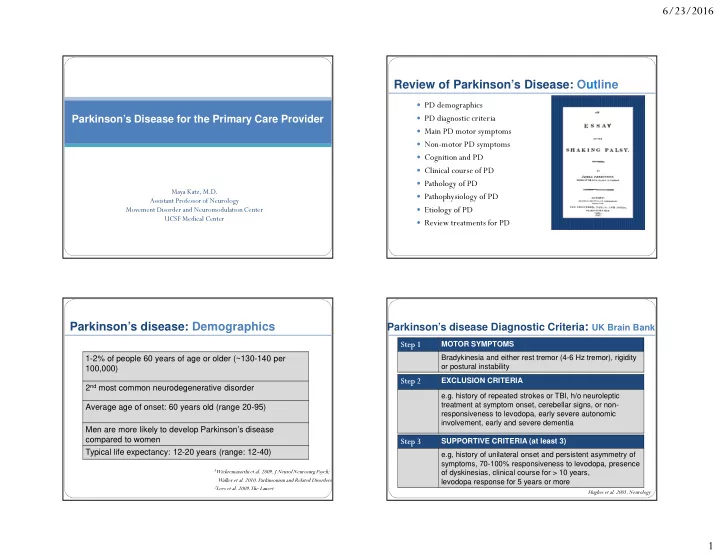
Parkinson’s Disease for the Primary Care Provider

Maya Katz, M.D. Assistant Professor of Neurology Movement Disorder and Neuromodulation Center UCSF Medical Center

Review of Parkinson’s Disease: Outline

PD demographics PD diagnostic criteria Main PD motor symptoms Non-motor PD symptoms Cognition and PD Clinical course of PD Pathology of PD Pathophysiology of PD Etiology of PD Review treatments for PD

Parkinson’s disease: Demographics

1Wickremaracthi et al. 2009. J Neurol Neurosurg Psych;

Walker et al. 2010. Parkinsonism and Related Disorders

2Lees et al. 2009.

The Lancet

1-2% of people 60 years of age or older (~130-140 per 100,000) 2nd most common neurodegenerative disorder Average age of onset: 60 years old (range 20-95) Men are more likely to develop Parkinson’s disease compared to women Typical life expectancy: 12-20 years (range: 12-40)

Parkinson’s disease Diagnostic Criteria: UK Brain Bank

Step 1

MOTOR SYMPTOMS Bradykinesia and either rest tremor (4-6 Hz tremor), rigidity

  • r postural instability

Step 2

EXCLUSION CRITERIA e.g. history of repeated strokes or TBI, h/o neuroleptic treatment at symptom onset, cerebellar signs, or non- responsiveness to levodopa, early severe autonomic involvement, early and severe dementia

Step 3

SUPPORTIVE CRITERIA (at least 3) e.g, history of unilateral onset and persistent asymmetry of symptoms, 70-100% responsiveness to levodopa, presence

  • f dyskinesias, clinical course for > 10 years,

levodopa response for 5 years or more

Hughes et al. 2001, Neurology

slide-2
SLIDE 2

6/23/2016 2

Parkinson’s disease:

NINDS Diagnostic Criteria

Possible Parkinson’s disease At least 2 features in Group A, with one

  • f them being either tremor or

bradykinesia, no features in group B present, and sustained response to dopaminergic therapy Probable Parkinson’s disease At least 3 of 4 features in group A present, no features in group B for > 3 years, and sustained response to dopaminergic therapy Definite Parkinson’s disease All criteria met for Possible PD, plus histopathologic confirmation of diagnosis at autopsy Group A: characteristic of PD Resting tremor (4-6 Hz) Bradykinesia Rigidity Asymmetric onset Group B: suggestive of alternative diagnosis Onset of the following symptoms < 3 years after PD onset: postural instability freezing hallucinations dementia Supranuclear gaze palsy (other than restriction of upgaze or slowed saccades) Severe dysautonomia Other condition known to cause parkinsonism

Gelb et al. 1999, Archives Neurol

Cardinal motor symptoms: Tremor

Cardinal motor symptoms: Bradykinesia Cardinal motor symptoms: Gait Impairment

slide-3
SLIDE 3

6/23/2016 3

Motor symptoms are Just the tip of the iceberg…

Langston, 2006, Ann Neurol

PD non-motor symptoms: Categories

Autonomic

Orthostasis

Constipation Urinary urgency ED

Sleep

RBD Poor sleep

maintenance

Sensory

Loss of smell Loss of taste Pain

Psychiatric Fatigue Depression Anxiety Apathy Psychosis

Cognitive

Executive dysfunction Impaired attention Impaired visuo-spatial

function

Relative preservation of

anterograde memory

Mild cognitive impairment Dementia

Barrone et al. 2009, Mov Disord

PD non-motor symptoms: Prevalence

Most PD patients report an

average of 8 non-motor symptoms

Non-motor symptoms are often: more difficult to treat impair quality of life more than

motor symptoms

Barrone et al. 2009, Mov Disord

Cognitive deficits: Prevalence and clinical course

Litvan et al., 2011, Mov Disord; Litvan et al., 2012, Mov Disord; Marras et al. 2013, Mov Disord

Normal PD-MCI PD Dementia (PDD)

  • PD-MCI:

primarily nonamnestic single domain impairment

  • ~30% meet criteria for

PD-MCI within 3 years after diagnosis

  • ~50% meet criteria for

PD-MCI after 5 years

↓ ↓

slide-4
SLIDE 4

6/23/2016 4 Parkinson’s disease: Clinical course

Stage 5: ~2 years

Wheelchair bound or bedridden Can only ambulate with another person assisting

Zhao et al. 2010, Mov Disord

Stage 4: ~2 years Severe disability, Needs an assistive device to walk or stand

Stage 3: ~2 years Mild to moderate bilateral involvement, Postural instability, Still independent Stage 2: ~7 years Mild bilateral involvement Stage 1: ~2 years Unilateral involvement

PD pathology: substantia nigra pars compacta degeneration

Scarr et al., 2013, Front. Cell. Neurosci.; Jenner 2002, Neurology

PD pathology: Lewy body PD pathology: prion like disease

slide-5
SLIDE 5

6/23/2016 5 PD pathology: Braak Staging

Braak et al., 2004, Cell Tissue Research

PD pathology: Peripheral Lewy Bodies

Tolosa and Vilas, 2015, Brain

  • DaTSCANs detect presnaptic dopaminergic

neuronal loss using SPECT imaging

  • Measures Ioflupane (123I), which is a DAT

ligand that binds to presynaptic dopamine transporters in the striatum

de la Feunte-Fernandez 2012. Neurology Piggott 1998; Fang and Martin, 2015, Parkinsonism and Related Disorders

PD imaging: DaTSCAN

DAT can be used as an imaging biomarker for PD Predictable change in Specific Binding Ratio (SBR)

annually, an average 7% SBR reduction annually, greater than 20 times the rate of signal loss seen in normal aging

Pigott 1998; Seibyl et al. 2016, presented at PPMI Investigator Conference

PD imaging: DaTSCAN

slide-6
SLIDE 6

6/23/2016 6 PD pathophysiology: Rate Model

The basal ganglia has two major intrinsic pathways:

Direct and Indirect

  • The direct pathway facilitates movement.
  • The indirect pathway inhibits movement
  • Striatal dopamine excites the direct pathway

(increasing movement), and suppresses the indirect pathway (increasing movement)

PD pathophysiology: Rate Model Basal Ganglia Direct and Indirect Pathways PD pathophysiology: Brain Arrhythmia

Phase amplitude coupling

Increased bursting of

neuronal activity

Increased synchronization

in neuronal activity

Increased oscillatory

activity

de Hemptinne et al. 2013, PNAS

PD etiology: Multifactorial

  • Complex interplay between
  • genetics (ingredients)
  • environment (recipe)

Tanner et al. 2011, Envi Health Perspectives Abbott et al. 2015, Neurology

slide-7
SLIDE 7

6/23/2016 7 PD Treatments: Role of exercise

Oguh et al. 2014, Parkinsonism and Related Disorders Shu et al. 2014, PLOS Yang et al. 2014, PLOS Sharp and Hewitt, 2014, Neurosci Biobehav Rev

PD Treatments: Role of cognitive training

Paris et al. 2011, Movement Disorders

PD Treatment: Medications

Carbidopa/Levodopa: Mechanism of Action

Cannas et al. 2010, Neuropsychiatr Dis Treat; Jenner, 2002, Neurology

PD Treatment: Medications

Carbidopa/Levodopa: Effects

The most effective and generally well-tolerated medicine for PD Short half-life (~90 minutes), may need to be taken frequently as PD progresses Should be taken 30-60 minutes before or after a protein-rich meal Main side effects: nausea, lightheadedness, hallucinations, and dyskinesias Cenci 2015, Frontiers in Neurology

slide-8
SLIDE 8

6/23/2016 8 PD Treatment: Medications

Sinemet CR

Carbidopa/Levodopa: Formulations

Sinemet IR Rytary Parcopa

PD Treatment: Medications

Carbidopa/Levodopa Extenders: Mechanism of Action

  • Rasagaline (Azilect)
  • Selegiline (Eldepryl)
  • Entacapone (Comtan)
  • Tolcapone (Tasmar)

Najib 2001, Clinical Therapeutics, Youdim 2006, Nature Rev

PD Treatment: Medications

Carbidopa/Levodopa Extenders: Effects Entacapone (Comtan)

Rasagaline (Azilect) Tolcapone (Tasmar)

Selegiline (Eldepryl)

1 HOUR INCREASED ON-TIME Side effects: drug interactions 1 HOUR INCREASED ON-TIME Side effects: drug interactions, HTN, insomnia, delirium Najib 2001, Clinical Therapeutics 1 HOUR INCREASED ON-TIME Side effects: diarrhea, orange urine 2-3 HOURS INCREASED ON-TIME Side effects: Liver failure

PD Treatment: Medications

Dopamine Agonist: Mechanism of Action

  • Pramipexole (Mirapex)
  • Ropinirole (Requip)
  • Rotigotine (Neupro)

Jenner, 2002, Neurology

slide-9
SLIDE 9

6/23/2016 9 PD Treatment: Medications

Dopamine Agonist: Effects

Compared to carbidopa/levodopa Lasts longer, half-life: ~6 hours Lower risk of causing dyskinesias More mild benefit Main side effects: sleep attacks, ICDs, sedation, confusion, hallucinations,

cognitive deficits, dry mouth, lightheadedness

Usually not prescribed to people over 70 years of age

Jenner, 2002, Neurology

PD Treatment: Motor Fluctuations & Dyskinesias

Cenci, 2014, Frontiers Neurology

PD Treatment: Motor Fluctuations

OFF MEDICATIONS ON MEDICATIONS

PD Treatments: Dyskinesias

slide-10
SLIDE 10

6/23/2016 10

The risk of dyskinesias is inversely proportional to the age of PD

  • nset

Age of PD onset Percentage developing dyskinesia after 5 years of L-dopa 40-49 70% 50-59 42% 60-69 33% 70-79 24%

Ku and Glass, 2010, Movement Disorders; PSG Study Group, NEJM, 2004

PD Treatments: Risk of dyskinesias

The risk of dyskinesias is inversely proportional to the L-dopa dose

Dose of levodopa Percentage developing dyskinesia after 1 year of L-dopa Placebo 3% 150 mg/day 3% 300 mg/day 2% 600 mg/day 15%

Dopamine agonists Trihexyphenidyl (Artane)

MAO-B inhibitor (Selegiline or Rasagaline)

Zonisamide

PD Treatments: Levodopa sparing therapy

Amantadine

PD Treatment: Medications

Levodopa sparing therapy: Effects Trihexyphenidyl

Dopamine agonists

Zonisamide

Mild-moderate reduction in parkinsonism Side effects: ICD, sleep attacks, hallucinations, cognitive deficits Najib 2001, Clinical Therapeutics Reduces tremor, mild benefit Side effects: nephrolithiasis, somnolence, ataxia, confusion, cognitive deficits Reduces tremor and dystonia Side effects: sedation, delirium, hallucinations, increased risk of dementia, dry mouth, constipation

PD Treatment: Medications

Levodopa sparing therapy: Effects MAO-B inhibitors

Najib 2001, Clinical Therapeutics

Amantadine

Very mild reduction in parkinsonism, Potential neuroprotective benefit Side effects: drug interactions, depends on whether rasagaline or selegiline are used Mild to moderate reduction in parkinsonism, Reduces dyskinesias Side effects: confusion, hallucinations, dry mouth, constipation,

slide-11
SLIDE 11

6/23/2016 11

CALM-PD PSG Study Group, 2000, JAMA

CALM-PD Clinical Trial

Dosing strategy Percentage developing dyskinesia after 2 years Improvement in movement and function scale (UPDRS) Pramipexole 10% 4.5 points Levodopa 30% 9.2 points

PD Treatments: Risk of developing dyskinesias vs. quality of life

PD MED Clinical Trial

Age of PD

  • nset

Percentage who discontinued allocated treatment due to side effects Percentage who developed dyskinesias after 3 years Domains of significant benefit (motor symptoms, QOL measures) Dopamine agonist or MAO-B inhibitor 26% 33% None Levodopa 2% 36% Overall QOL, Mobility, ADLs, Cognition, and Communication

PD MED Collaborative Group, 2014, The Lancet

PD Treatments: Risk of developing dyskinesias vs. quality of life

Amantadine

PD Treatments: Anti-dyskinetic medication

Only medication that controls

tremors, stiffness and slowness, AND also controls dyskinesias

Could early amantadine prevent

the development of dyskinesias?

PD Treatments: Duopa Infusion

Intestinal infusion of dopamine (levodopa)

Reduces off-medication time Can reduce dyskinesias Has been available in Europe for > 10

years

Possible side effects: Tubing issues Otherwise same as oral L-dopa

slide-12
SLIDE 12

6/23/2016 12 PD Treatments: Duopa Infusion

Maintains consistent plasma levels of

levodopa over a 16 hour infusion

Nyholm et al. MDS Conference abstract. 2012

PD Treatments: Duopa Infusion

The pump is worn throughout the day in a pack The pump is disconnected during sleep

PD Treatments: Deep brain stimulation (DBS) PD Treatments: Deep brain stimulation (DBS)

Permanently implanted brain pacemaker

  • 1. Lead
  • 2. Extension Wire
  • 3. IPG
slide-13
SLIDE 13

6/23/2016 13 DBS: video pre- and post-surgery

PRE-DBS POST-DBS

DBS: video pre- and post-surgery

PRE-DBS POST-DBS

DBS: video pre- and post-surgery

PRE-DBS POST-DBS

DBS: When to consider therapy?

Fasano & Deuschl 2012, Basal Ganglia

slide-14
SLIDE 14

6/23/2016 14 DBS: Ideal candidates

  • PD symptoms for at least 5 years
  • Good levodopa response, but with motor fluctuations,

dyskinesias, and/or adverse medication effects

  • Freezing of gait and postural instability should not be the

primary symptoms

  • Ability to comply with lifelong and frequent follow-up
  • Good social support
  • Reasonable expectations for the surgery
  • No medical contraindications for surgery
  • No untreated severe psychiatric disease
  • No dementia

Marks et al., Editor, 2015, Deep Brain Stimulation Managemen

DBS: What can DBS do?

  • In general, only what levodopa can do

Exceptions: tremor and peak dose dyskinesias

  • Increases the best “on-medication” state by 4-5

hours daily

  • Improves motor function by 25-50%
  • Raises the ceiling for off-medication times
  • Reduction in medication dosing (30-50%)

Marks et al., Editor, 2015, Deep Brain Stimulation Managemen

DBS: What are the limitations of DBS?

  • Less effective for midline symptoms
  • Will not treat non-motor symptoms (lightheadedness,

constipation, sleep)

  • Can make certain symptoms worse (e.g. speech,

falls, behavior and cognition)

Marks et al., Editor, 2015, Deep Brain Stimulation Managemen

Slide courtesy of Susan Heath

DBS: Basic Programming

slide-15
SLIDE 15

6/23/2016 15

Traditional DBS surgery: awake Interventional MRI (iMRI) DBS surgery: asleep

Deep Brain Stimulation: GPi vs. STN

Marks et al., Editor, 2015, Deep Brain Stimulation Managemen

Anatomy:

The goal is to implant the electrode into

the sensorimotor portion of the nucleus

Deep Brain Stimulation: GPi vs. STN

Marks et al., Editor, 2015, Deep Brain Stimulation Managemen

slide-16
SLIDE 16

6/23/2016 16 Deep Brain Stimulation: GPi vs. STN

Okun, Arch Neurol, 2005

Anatomy:

The GPi is a much larger target than the

STN (~500mm3 vs. 200 mm3).

The smaller STN target may make it

more susceptible to adverse effects due to spread of current.

The smaller size of STN is likely what

allows for a lower average charge density (fewer battery replacements).

More neurosurgeons feel comfortable

with STN targeting.

Deep Brain Stimulation: GPi vs. STN

Miocinovic et al. 2006, J Neurophys Okun 2005, Arch Neurol Rodriguez-Oroz 2005, Brain

  • Paresthesias
  • Dysarthria, dysphagia
  • Increased falls
  • Reduced verbal fluency
  • Dyskinesias
  • Behavioral changes
  • Increased suicidality
  • Hypomania

Benarroch, et al., 2008, Neurology

DBS: STN

Stimulation-induced adverse effects

  • Paresthesias
  • Dysarthria, dysphagia
  • Visual phenomena

Gross et al. 2006

DBS: GPi

Stimulation-induced adverse effects

slide-17
SLIDE 17

6/23/2016 17

Deep Brain Stimulation

GPi vs. STN

Williams et al., 2014, Movement Disorders

DBS: Mechanism of Action

  • DBS is a permanently implanted

brain pacemaker

  • Phase amplitude coupling observed

in PD is reversed with DBS

De Hemptinne et al., 2013, PNAS

PD Treatments: Palliative Care

…our most cruel failure in how we treat the sick and the aged is the failure to recognize that they have priorities beyond merely being safe and living longer.

Being Mortal: Medicine and What Matters in the End Atul Gawande, M.D.

UCSF Parkinson’s Disease

Supportive Care Clinic

Palliative Care for Parkinson’s Disease

slide-18
SLIDE 18

6/23/2016 18 Clinical Team

Palliative care physician: Steve Pantilat, M.D. Neurologist: Maya Katz, M.D. and Nick Galifianakis, M.D. Nurse: Karen Merchant, RN Chaplain: Judy Long, MS Social worker: Monica Eisenhardt, LCSW

Palliative Care for Parkinson’s Disease

Study design

Randomized Clinical Trial

Study visits Baseline, 3 months, 6 months, 9 months, 12 months Primary outcomes QOL and caregiver distress at 6 months Secondary outcomes Predictors of response, health service utilization, qualitative

interviews to optimize intervention

Study Summary Palliative Care for Parkinson’s Disease

Lorna Beccaria, Study Coordinator 415-353-9453 Lorna.Beccaria@ucsf.edu Maya Katz, Site Principal Investigator 415-446-9396 Maya.Katz@ucsf.edu

Questions/Referrals Palliative Care for Parkinson’s Disease Parkinson’s Disease Clinical Trials

slide-19
SLIDE 19

6/23/2016 19

UCSF MOVEMENT DISORDER AND NEUROMODULATION CENTER (MDNC) SFVA PARKINSON’S DISEASE RESEARCH, EDUCATION AND CLINICAL CENTER (PADRECC)

Jill L. Ostrem, M.D. – MDNC Medical Director Philip A. Starr, M.D., Ph.D. – MDNC Surgical Director Caroline M. Tanner, M.D., Ph.D. – PADRECC Director

Neurology Jill L. Ostrem, M.D. Caroline Tanner, M.D., Ph.D. Nicholas Galifianakis,M.D. Marta San Luciano, M.D. Maya Katz, M.D. Jim Mass, M.D. Robert White, M.D. Neurosurgery Philip A. Starr, M.D.., Ph.D. Paul S. Larson, M.D. Edward F. Chang, M.D., Ph.D. Dan Lim, M.D., Ph.D. Neuropsychology Caroline A. Racine, Ph.D. Johannes Rothlind, Ph.D. Nursing Monica Volz, N.P. Susan Heath, M.S., R.N. Karen Merchant, RN Clinical Support Staff Shatara Blackmon Yasmeen Gonzalez Christine Jiunti Melissa Chen Janet Allen Lori Anzaldo Sarena Perez Social Work Monica Eisenhardt, L.C.S.W. Research Staff Sarah Wang, Ph.D. Lorna Beccaria, R.N. Kristen Dodenhoff, B.A. Michael Dodge, B.A. Fellows Nijee Luthra, M.D., Ph.D. Cameron Dietiker, M.D. Erica Byrd, M.D. Jennifer Chen, M.D. Svjetlana Miocinovic, M.D., Ph.D. Brian Lee, M.D., Ph.D.

1

Parkinson’s Disease for the Primary Care Provider Advances in Internal Medicine

Self-Assessment Exam Question

Thank you

slide-20
SLIDE 20

Slide 73 1 Need an acknowledgment page

Maya Katz, 2/27/2013