6/21/2019 Mosquit Mosquito Bio Biology, Disea Disease Ri Risk sk, - - PDF document

6 21 2019
SMART_READER_LITE
LIVE PREVIEW

6/21/2019 Mosquit Mosquito Bio Biology, Disea Disease Ri Risk sk, - - PDF document

6/21/2019 Mosquit Mosquito Bio Biology, Disea Disease Ri Risk sk, and Pe and Pers rsonal Pr Prot otect ection on Philip M. Armstrong, ScD Department of Environmental Sciences Center for Vector Biology & Zoonotic Disease The Connecticut


slide-1
SLIDE 1

6/21/2019 1 Mosquit Mosquito Bio Biology, Disea Disease Ri Risk sk, and and Pe Pers rsonal Pr Prot

  • tect

ection

  • n

Philip M. Armstrong, ScD

Department of Environmental Sciences Center for Vector Biology & Zoonotic Disease The Connecticut Agricultural Experiment Station New Haven, CT

Maj Major Mosquit Mosquito‐born borne Di Dise seases es

Parasitic infections:

  • Malaria (Global tropics)
  • Lymphatic Filariasis (Global tropics)

Viral infections:

  • Dengue (Global tropics)
  • Chikunguna (Global tropics)
  • Yellow Fever (South America and West Africa)
  • Zika (Global tropics)
  • Japanese Encephalitis (South and East Asia)
  • West Nile Virus Encephalitis (Global distribution)
  • Rift valley fever (Africa)
  • Venezuelan Equine Encephalitis (South and Central America)
  • Ross River virus fever (Australia)

v

Vaccines Chemoprohylaxis

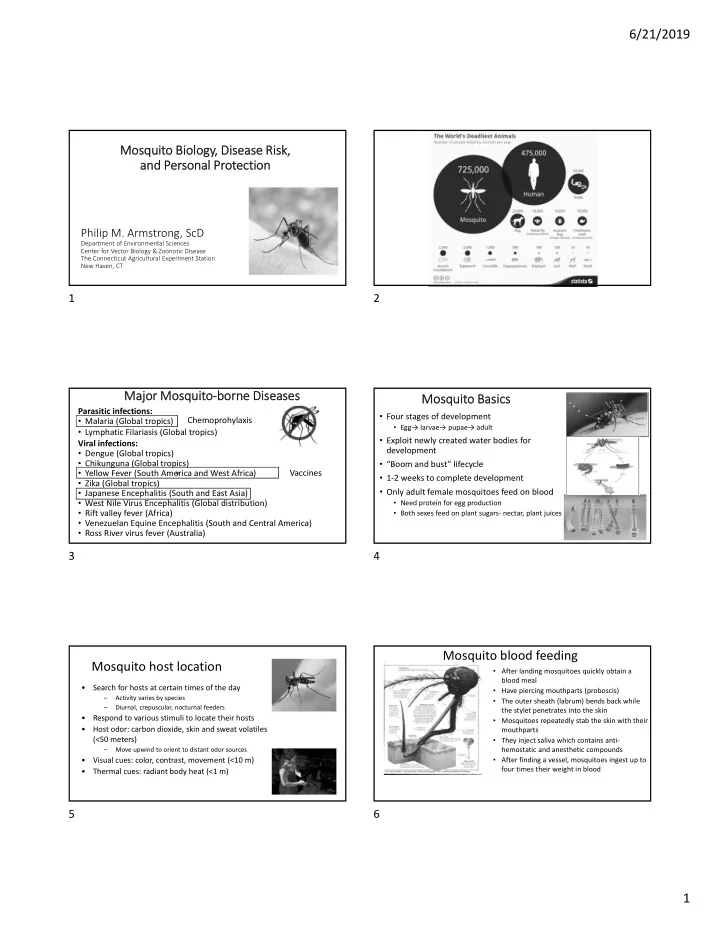
  • Four stages of development
  • Egg→ larvae→ pupae→ adult
  • Exploit newly created water bodies for

development

  • “Boom and bust” lifecycle
  • 1‐2 weeks to complete development
  • Only adult female mosquitoes feed on blood
  • Need protein for egg production
  • Both sexes feed on plant sugars‐ nectar, plant juices

Mosquit Mosquito Basi Basics Mosquito host location

  • Search for hosts at certain times of the day

– Activity varies by species – Diurnal, crepuscular, nocturnal feeders

  • Respond to various stimuli to locate their hosts
  • Host odor: carbon dioxide, skin and sweat volatiles

(<50 meters)

– Move upwind to orient to distant odor sources

  • Visual cues: color, contrast, movement (<10 m)
  • Thermal cues: radiant body heat (<1 m)
  • After landing mosquitoes quickly obtain a

blood meal

  • Have piercing mouthparts (proboscis)
  • The outer sheath (labrum) bends back while

the stylet penetrates into the skin

  • Mosquitoes repeatedly stab the skin with their

mouthparts

  • They inject saliva which contains anti‐

hemostatic and anesthetic compounds

  • After finding a vessel, mosquitoes ingest up to

four times their weight in blood

Mosquito blood feeding

1 2 3 4 5 6

slide-2
SLIDE 2

6/21/2019 2

  • ~3,500 mosquito species worldwide
  • Nuisance species
  • Primarily seek blood from large mammals
  • Feed opportunistically on humans
  • Disease vectors
  • Most important vectors specialize on human hosts
  • Most important genera:
  • Aedes‐ chikunguya, dengue, yellow fever, Zika
  • Anopheles‐ malaria
  • Culex‐ viral encephalitis, lymphatic filariasis
  • Primary urban vector of Dengue,

Yellow Fever, Chikungunya, and Zika viruses – “Yellow Fever Mosquito”

  • World wide distribution – limited to

tropical and subtropical climates

  • Generally found between 10o C

January isotherm in northern and western hemispheres

  • Ubiquitous in populated area of the

tropics and subtropics

  • Closely associated with human

habitation

  • Ranging from small rural villages to

megacities

Mosquito Vector- Aedes aegypti

Aedes aegypti - Biology

  • Oviposits eggs in natural and artificial

containers around human dwellings as preferred larval development sites

  • Adult females lay eggs on the sides of

water holding containers ~ 100 to 200 per gonotrophic cycle

  • Eggs can survive desiccation up to 6

months

  • Development is temperature dependent
  • Larvae ~ 4 to 9 days; Pupae ~ 3 to 7 days

Aedes aegypti - Adult Behavior

  • Females commonly rest inside houses in quiet

dark places (closets)

  • Feed indoors and out
  • Feed predominately on human blood
  • Bite during the day, “stealth biters”
  • Often take several partial blood meals during a

single gonotrophic cycle – increases vectorial capacity

  • Adults have a limited flight range ~ 100 meters
  • Epidemics can occur even when mosquito

densities are low

Malaria Vectors‐ Anopheles

  • About 40 species serve as malaria vectors
  • Typically found in rural and peri‐urban areas
  • Eggs do not survive desiccation
  • More adapted to permanent water bodies than

Aedes

  • Habitats vary by species such as:

– Irrigated fields – Ground pools with emergent vegetation – Water impoundments – Natural swamps

  • Most species are crepuscular or nocturnal

Neafsey et al. 2015. Science.

Distribution of Malaria Vectors

7 8 9 10 11 12

slide-3
SLIDE 3

6/21/2019 3 Anopheles gambiae

  • Important malaria vector in Africa

– Where 90% of malaria deaths occur

  • Associated with rural villages
  • Exploits sunlit pools‐ burrow pits, drainage

ditches, ground depressions close to homes

  • Reaches maximum density after seasonal rain
  • Typically found indoors
  • Feeds mainly on people at night
  • Insecticide treated bed‐nets effective against

this species

Culex species

  • Vectors of viral encephalitis and lymphatic filarisis
  • Found in urban, peri‐urban, and rural areas

depending on species

  • Breed in highly contaminated water including:

– Drainage and irrigation ditches – Cesspools – Storm drains – Sewage waste lagoons

  • Blood feeding activity‐ crepuscular or nocturnal
  • Culex quinquefasciatus

– Important vector of filariasis and West Nile virus – Global distribution in tropical and warm‐temperate climates

  • Limit exposure to mosquitoes when most active
  • Aedes aegypti‐ daytime
  • Anopheles and Culex‐ dusk to dawn
  • Use an EPA approved insect repellent and apply

according to directions

  • Cover‐up: shoes, socks, long pants, and long‐sleeved
  • shirts. Clothing material should be light or neutral‐

colored and tightly woven.

  • Consider wearing insecticide‐treated (permethrin)

clothing

  • Sleep in well‐screened or air‐conditioned rooms
  • Sleep under an insecticide‐treated bednet

Prevention Strategies for Travelers

  • Pros: effective, low toxicity, most‐studied insect

repellent

  • Cons: Oily, smelly, can damage plastic, not

always accepted by patients

  • Sold in concentrations 5 to 98%
  • 15‐30% recommended
  • Lasts 2‐8 hours depending on concentration
  • Controlled release formulations last 8‐12 hours
  • Approved for use in children >2 months of age
  • Do not apply to child’s hands or face

Insect Repellents‐ DEET Alternatives to DEET

Active Ingredient Concentration Protection Time Characteristics Picaridin 5‐30%(≥20% recommended) 2‐8 hours Synthetic version of compound from black pepper plant, available in US since 2005 Oil of Lemon Eucalyptus 10‐40% (≥30% recommended) 2‐8 hours Natural product. Approved for use in children >3 years. IR3535 7‐35% %(≥20% recommended) 2‐8 hours Synthetic compound available in US since 1999 (since 1970’s in Europe). Not very effective against Anopheles mosquitoes 2‐undecanone 7.75% 4 hours Registered in US in 2007. Active ingredients derived from wild tomato plants Botanical extracts Varies Generally <1 hour Natural oils (soybean, lemongrass, citronella, cedar, peppermint, lavender, geranium). Not registered by the EPA, no assurance that products work.

Clothing Only Repellent Permethrin

Fabric treatment options for consumers Factory Impregnated Clothing

13 14 15 16 17 18

slide-4
SLIDE 4

6/21/2019 4

Efficacy of Mosquito Repellents for Malaria Prevention

  • Tropical repellents applied to the skin
  • 5 of 6 studies found no evidence of a protective effect against clinical malaria
  • Poor compliance and amount applied were major limitations to this intervention
  • Spatial repellents‐ burning insect coils
  • 2 studies showed no evidence of a protective effect
  • Permethrin‐treated clothing
  • 2 studies showed a ~50% reduction in clinical malaria
  • Adherence to daily compliance remains a major limitation
  • Need for better designed studies to evaluate efficacy for these prevention measures

Maia et al. 2018. Cochrane Reviews: meta‐analysis of 10 randomized controlled trials.

Bednets

  • Insecticide‐treated bednets a foundation

for malaria prevention in many regions

  • Particularly effective in sub‐Saharan Africa

where Anopheles vectors bite predominately indoors

  • Reduce malaria mortality by ~20% and clinical

episodes by ~50%

  • Rise of pyrethroid resistance may

undermine the effectiveness of nets

  • A good option in the absence of well‐

screened or air‐conditioned housing

  • Relatively few mosquito species serve as disease vectors
  • The most effective vectors exploit disturbed environments

caused by human activity and readily feed on people

  • In the absence of vaccines or chemoprophylaxis, personal

protection measures against mosquito bites are the primary means for protecting travelers

  • Protective clothing, topical repellents, insecticide‐treated

clothing and bednets should be recommended to travelers to endemic areas

  • These are imperfect tools but may be more effective when used

in combination

  • Poor compliance may undermine the efficacy of these measures

Conclusions

Thank you!

Not recommended

  • Botanical repellents not approved by the EPA
  • Repellents mixed with sunscreen
  • difficult to regulate dose
  • Citronella Candles and mosquito coils
  • May not be effective
  • Emit fumes that could trigger respiratory problems
  • Bug zappers
  • Sonic repellents
  • Treated wristbands
  • Aerosol insecticide sprays

19 20 21 22 23