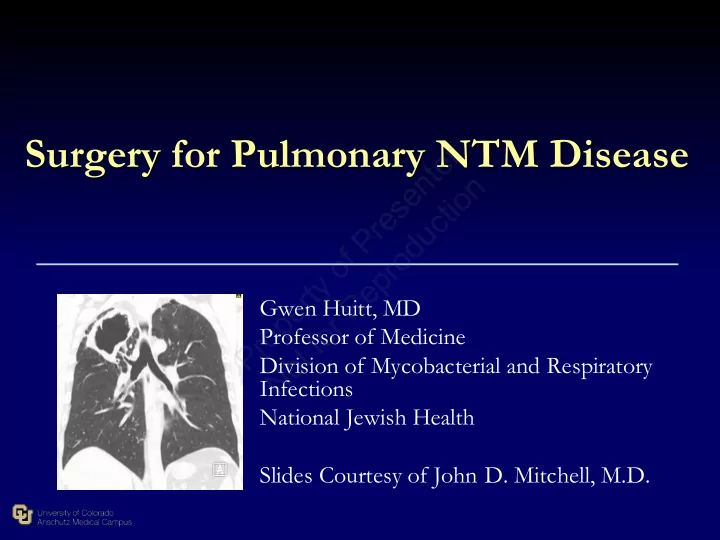
Surgery for Pulmonary NTM Disease r e t n n e o s i t e c - - PowerPoint PPT Presentation

surgery for pulmonary ntm disease
SMART_READER_LITE
LIVE PREVIEW

Surgery for Pulmonary NTM Disease r e t n n e o s i t e c - - PowerPoint PPT Presentation

Surgery for Pulmonary NTM Disease r e t n n e o s i t e c r u P d o f o r p y e t r R e Gwen Huitt, MD p r o o Professor of Medicine f r P t o Division of Mycobacterial and Respiratory N Infections National


slide-1
SLIDE 1

Surgery for Pulmonary NTM Disease

Gwen Huitt, MD Professor of Medicine Division of Mycobacterial and Respiratory Infections National Jewish Health Slides Courtesy of John D. Mitchell, M.D.

P r

  • p

e r t y

  • f

P r e s e n t e r N

  • t

f

  • r

R e p r

  • d

u c t i

  • n
slide-2
SLIDE 2

Disclosures: Nothing to disclose.

P r

  • p

e r t y

  • f

P r e s e n t e r N

  • t

f

  • r

R e p r

  • d

u c t i

  • n
slide-3
SLIDE 3

P r

  • p

e r t y

  • f

P r e s e n t e r N

  • t

f

  • r

R e p r

  • d

u c t i

  • n
slide-4
SLIDE 4

P r

  • p

e r t y

  • f

P r e s e n t e r N

  • t

f

  • r

R e p r

  • d

u c t i

  • n
slide-5
SLIDE 5

Surgery for Pulmonary NTM Disease

Case Presentation

  • 65 year old female
  • Chronic productive cough, recurrent infection
  • Documented MAC infection by ATS criteria
  • Repeated treatment failures, now macrolide resistant
  • Referral and evaluation at NJH
  • Imaging suggests areas of focal bronchiectasis

involving right lung

P r

  • p

e r t y

  • f

P r e s e n t e r N

  • t

f

  • r

R e p r

  • d

u c t i

  • n
slide-6
SLIDE 6

P r

  • p

e r t y

  • f

P r e s e n t e r N

  • t

f

  • r

R e p r

  • d

u c t i

  • n
slide-7
SLIDE 7

P r

  • p

e r t y

  • f

P r e s e n t e r N

  • t

f

  • r

R e p r

  • d

u c t i

  • n
slide-8
SLIDE 8

P r

  • p

e r t y

  • f

P r e s e n t e r N

  • t

f

  • r

R e p r

  • d

u c t i

  • n
slide-9
SLIDE 9

P r

  • p

e r t y

  • f

P r e s e n t e r N

  • t

f

  • r

R e p r

  • d

u c t i

  • n
slide-10
SLIDE 10

P r

  • p

e r t y

  • f

P r e s e n t e r N

  • t

f

  • r

R e p r

  • d

u c t i

  • n
slide-11
SLIDE 11

P r

  • p

e r t y

  • f

P r e s e n t e r N

  • t

f

  • r

R e p r

  • d

u c t i

  • n
slide-12
SLIDE 12

P r

  • p

e r t y

  • f

P r e s e n t e r N

  • t

f

  • r

R e p r

  • d

u c t i

  • n
slide-13
SLIDE 13

P r

  • p

e r t y

  • f

P r e s e n t e r N

  • t

f

  • r

R e p r

  • d

u c t i

  • n
slide-14
SLIDE 14

P r

  • p

e r t y

  • f

P r e s e n t e r N

  • t

f

  • r

R e p r

  • d

u c t i

  • n
slide-15
SLIDE 15

P r

  • p

e r t y

  • f

P r e s e n t e r N

  • t

f

  • r

R e p r

  • d

u c t i

  • n
slide-16
SLIDE 16

P r

  • p

e r t y

  • f

P r e s e n t e r N

  • t

f

  • r

R e p r

  • d

u c t i

  • n
slide-17
SLIDE 17

Surgery for Pulmonary NTM Disease

Pre-Surgery Treatment

  • Initiate multidrug regimen, including IV Amikacin
  • Planned VATS RML, RUL anterior segment

resection in 8 weeks after initiation of therapy

  • 2 – 4 day hospital stay with surgical procedure
  • 7 - 10 day stay in Colorado at time of surgery

P r

  • p

e r t y

  • f

P r e s e n t e r N

  • t

f

  • r

R e p r

  • d

u c t i

  • n
slide-18
SLIDE 18

Surgery for Pulmonary NTM Disease

“VATS” Approach

  • Thoracoscopic Lobectomy

– Two 1 cm incisions – One 3 cm “utility” incision – No rib spreading

  • Operation otherwise identical

to open approach

  • Double lumen tube
  • No epidural catheter
  • Prior surgery not absolute

contraindication

P r

  • p

e r t y

  • f

P r e s e n t e r N

  • t

f

  • r

R e p r

  • d

u c t i

  • n
slide-19
SLIDE 19

Surgery for Pulmonary NTM Disease

Double Lumen Endotracheal Tube

P r

  • p

e r t y

  • f

P r e s e n t e r N

  • t

f

  • r

R e p r

  • d

u c t i

  • n
slide-20
SLIDE 20

Surgery for Pulmonary NTM Disease

Anesthesia / Analgesia

  • Double Lumen Tube
  • Typically, no epidural
  • Intercostal blocks

administered at surgery

– 0.25% marcaine with epi

  • Postoperative PCA  oral

NSAID ± narcotic

P r

  • p

e r t y

  • f

P r e s e n t e r N

  • t

f

  • r

R e p r

  • d

u c t i

  • n
slide-21
SLIDE 21

Surgery for Pulmonary NTM Disease

Case Presentation

P r

  • p

e r t y

  • f

P r e s e n t e r N

  • t

f

  • r

R e p r

  • d

u c t i

  • n
slide-22
SLIDE 22

Thoracoscopic Lobectomy/Segmentectomy

Instruments

  • 0 - 120 degree scope
  • Soft tissue retractor
  • Thoracoscopic-specific:

– Clamps – Right angle – Forceps

  • Small (pediatric) sucker
  • Kidney pedicle clamp
  • Staplers
  • Thoracoscopic clip appliers
  • Harmonic scalpel

P r

  • p

e r t y

  • f

P r e s e n t e r N

  • t

f

  • r

R e p r

  • d

u c t i

  • n
slide-23
SLIDE 23

Thoracoscopic Lobectomy/Segmentectomy

Instruments

P r

  • p

e r t y

  • f

P r e s e n t e r N

  • t

f

  • r

R e p r

  • d

u c t i

  • n
slide-24
SLIDE 24

Thoracoscopic Lobectomy/Segmentectomy

Wound Protection

P r

  • p

e r t y

  • f

P r e s e n t e r N

  • t

f

  • r

R e p r

  • d

u c t i

  • n
slide-25
SLIDE 25

P r

  • p

e r t y

  • f

P r e s e n t e r N

  • t

f

  • r

R e p r

  • d

u c t i

  • n
slide-26
SLIDE 26

P r

  • p

e r t y

  • f

P r e s e n t e r N

  • t

f

  • r

R e p r

  • d

u c t i

  • n
slide-27
SLIDE 27

P r

  • p

e r t y

  • f

P r e s e n t e r N

  • t

f

  • r

R e p r

  • d

u c t i

  • n
slide-28
SLIDE 28

P r

  • p

e r t y

  • f

P r e s e n t e r N

  • t

f

  • r

R e p r

  • d

u c t i

  • n
slide-29
SLIDE 29

Surgery for Pulmonary NTM Disease

Indications for Surgery

Persistent, focal (cavitary or bronchiectatic) lung disease after antimicrobial treatment, usually in the setting of recurrent symptoms, documented treatment failure, or antimicrobial resistance. Surgical resection should be seen as an adjunct to antimicrobial therapy, which remains the mainstay of treatment. P r

  • p

e r t y

  • f

P r e s e n t e r N

  • t

f

  • r

R e p r

  • d

u c t i

  • n
slide-30
SLIDE 30

Surgery for Pulmonary NTM Disease

Basics of Surgical Therapy

What is the Goal?

P r

  • p

e r t y

  • f

P r e s e n t e r N

  • t

f

  • r

R e p r

  • d

u c t i

  • n
slide-31
SLIDE 31

Surgery for Pulmonary NTM Disease

Basics of Surgical Therapy - Goals

  • Eradicate infection

– Culture negative – Off antibiotics – Symptom free

  • Symptom control

– Intractable cough – Hemoptysis

  • Limit damage to uninvolved lung

P r

  • p

e r t y

  • f

P r e s e n t e r N

  • t

f

  • r

R e p r

  • d

u c t i

  • n
slide-32
SLIDE 32

Surgery for Pulmonary NTM Disease

Presentation

  • Middle-aged females, thin,

Caucasian, nonsmokers, right middle lobe / lingular disease

  • Isolated large, thick-walled

cavitary disease.

  • Elderly men, smokers, ETOH

abuse, underlying COPD. Resembles TB, may progress to complete lung destruction.

P r

  • p

e r t y

  • f

P r e s e n t e r N

  • t

f

  • r

R e p r

  • d

u c t i

  • n
slide-33
SLIDE 33

Surgery for Pulmonary NTM Disease

Presentation

  • Middle-aged females, thin,

Caucasian, nonsmokers, right middle lobe / lingular disease

  • Isolated large, thick-walled

cavitary disease.

  • Elderly men, smokers, ETOH

abuse, underlying COPD. Resembles TB, may progress to complete lung destruction.

P r

  • p

e r t y

  • f

P r e s e n t e r N

  • t

f

  • r

R e p r

  • d

u c t i

  • n
slide-34
SLIDE 34

Surgery for Pulmonary NTM Disease

Presentation

  • Middle-aged females, thin,

Caucasian, nonsmokers, right middle lobe / lingular disease

  • Isolated large, thick-walled

cavitary disease.

  • Elderly men, smokers, ETOH

abuse, underlying COPD. Resembles TB, may progress to complete lung destruction.

P r

  • p

e r t y

  • f

P r e s e n t e r N

  • t

f

  • r

R e p r

  • d

u c t i

  • n
slide-35
SLIDE 35

Surgery for Pulmonary NTM Disease

Results of Surgical Therapy

  • Corpe, 1981: 131 cases, mortality 6.9%, BPF 5.3%,

93% sputum conversion rate

  • Nelson, 1998: 28 cases, mortality 7.1%, BPF 3.6%,

complication rate 32%, 88% sputum conversion rate

  • Shiraishi, 2002: 21 cases, mortality 0%, complication

rate 29%, sputum conversion 100% → 90% at 2 years

  • Mitchell, 2008: 265 cases, mortality 2.6%, complication

rate 18%, BPF 4.2%, 87% sputum conversion rate

P r

  • p

e r t y

  • f

P r e s e n t e r N

  • t

f

  • r

R e p r

  • d

u c t i

  • n
slide-36
SLIDE 36

Procedures

50 100 150 1983-1990 1991-2000 2001- 2 4 6 8 10

% Mortality Rate

Mitchell JD et al Ann Thor Surg 2008;85(6):1887

P r

  • p

e r t y

  • f

P r e s e n t e r N

  • t

f

  • r

R e p r

  • d

u c t i

  • n
slide-37
SLIDE 37

Surgery for Pulmonary NTM Disease

Minimally Invasive (VATS) Approach

  • Study period: July, 2004 to June, 2010
  • 171 patients  212 cases

– 41 patients had bilateral resections

  • Mean age: 59 years (26 – 82 years)
  • Predominately Caucasian (93%) and Female (93%)

Mitchell JD et al Ann Thor Surg 2012 Apr;93(4):1033-40

P r

  • p

e r t y

  • f

P r e s e n t e r N

  • t

f

  • r

R e p r

  • d

u c t i

  • n
slide-38
SLIDE 38

Surgery for Pulmonary NTM Disease

Minimally Invasive (VATS) Approach

  • Prior thoracic surgery in 10%
  • Mean duration of medical therapy prior to referral for

surgery: 61 months (4-354 months)

  • Indications for surgery: Focal parenchymal disease

with recurrent hemoptysis or pulmonary infections, or failure or intolerance of medical therapy

Mitchell JD et al Ann Thor Surg 2012 Apr;93(4):1033-40

P r

  • p

e r t y

  • f

P r e s e n t e r N

  • t

f

  • r

R e p r

  • d

u c t i

  • n
slide-39
SLIDE 39

Surgery for Pulmonary NTM Disease

Minimally Invasive (VATS) Approach

Lobectomy 126 Segmentectomy 73 Mixed 13

Mitchell JD et al Ann Thor Surg 2012 Apr;93(4):1033-40

Conversion to thoracotomy in 10 cases (4.7%) No operative mortality; Complications in 19 patients (8.9%) Mean hospital length of stay 3.7 days (1 – 23 days)

P r

  • p

e r t y

  • f

P r e s e n t e r N

  • t

f

  • r

R e p r

  • d

u c t i

  • n
slide-40
SLIDE 40

Surgery for Pulmonary NTM Disease

How do patients really do?

P r

  • p

e r t y

  • f

P r e s e n t e r N

  • t

f

  • r

R e p r

  • d

u c t i

  • n
slide-41
SLIDE 41

Surgery for Pulmonary NTM Disease

Long Term Outcomes

  • Jurand et al: 69 patients treated for M abscessus.

Addition of surgery to treatment regimen significantly improved conversion and culture negativity at one year.

  • Asakura et al: 125 patients, MAC in 80%. Culture

conversion in 91%, with 10 year relapse rate of 20%. Pneumonectomy, low BMI, advanced age, residual cavitary disease associated with worse prognosis.

P r

  • p

e r t y

  • f

P r e s e n t e r N

  • t

f

  • r

R e p r

  • d

u c t i

  • n
slide-42
SLIDE 42

Surgery for Pulmonary NTM Disease

BPF after Pneumonectomy Shiraishi, 2010: MDR-TB vs. NTM pneumonectomy

  • No operative mortality
  • MDR-TB: 22 patients (7 right, 15 left)

– Male 72%, Sputum negative 63% – BPF rate 4.5% (1 right)

  • NTM: 11 patients (7 right, 4 left)

– Female 72%, Sputum negative 9% – BPF rate 45% (4 right, 1 left)

Shiraishi Y et al. ICVTS 2010;11:429

P r

  • p

e r t y

  • f

P r e s e n t e r N

  • t

f

  • r

R e p r

  • d

u c t i

  • n
slide-43
SLIDE 43

Surgery for Pulmonary NTM Disease

Common Questions

  • Should I have surgery to treat my NTM infection?
  • Can I have my surgery using a minimally invasive

(VATS) approach?

P r

  • p

e r t y

  • f

P r e s e n t e r N

  • t

f

  • r

R e p r

  • d

u c t i

  • n
slide-44
SLIDE 44

P r

  • p

e r t y

  • f

P r e s e n t e r N

  • t

f

  • r

R e p r

  • d

u c t i

  • n
slide-45
SLIDE 45

P r

  • p

e r t y

  • f

P r e s e n t e r N

  • t

f

  • r

R e p r

  • d

u c t i

  • n
slide-46
SLIDE 46

P r

  • p

e r t y

  • f

P r e s e n t e r N

  • t

f

  • r

R e p r

  • d

u c t i

  • n
slide-47
SLIDE 47

P r

  • p

e r t y

  • f

P r e s e n t e r N

  • t

f

  • r

R e p r

  • d

u c t i

  • n
slide-48
SLIDE 48

P r

  • p

e r t y

  • f

P r e s e n t e r N

  • t

f

  • r

R e p r

  • d

u c t i

  • n
slide-49
SLIDE 49

Surgery for Pulmonary NTM Disease

Common Questions

  • Should I have surgery to treat my NTM infection?
  • Can I have my surgery using a minimally invasive

(VATS) approach?

  • Can I have the surgery and skip the medicine?
  • When should the surgery occur?
  • What will my breathing be like after the surgery?

P r

  • p

e r t y

  • f

P r e s e n t e r N

  • t

f

  • r

R e p r

  • d

u c t i

  • n
slide-50
SLIDE 50

Surgery for Pulmonary NTM Disease

Summary

  • Surgical resection in pulmonary NTM disease may lead

to improved outcomes in selected cases

  • Lung resection and muscle flap use often possible using

modern minimally invasive techniques

  • Coordination of care best approached in

multidisciplinary environment

  • Resection for infectious lung disease differs from

resection for cancer: experience counts

P r

  • p

e r t y

  • f

P r e s e n t e r N

  • t

f

  • r

R e p r

  • d

u c t i

  • n