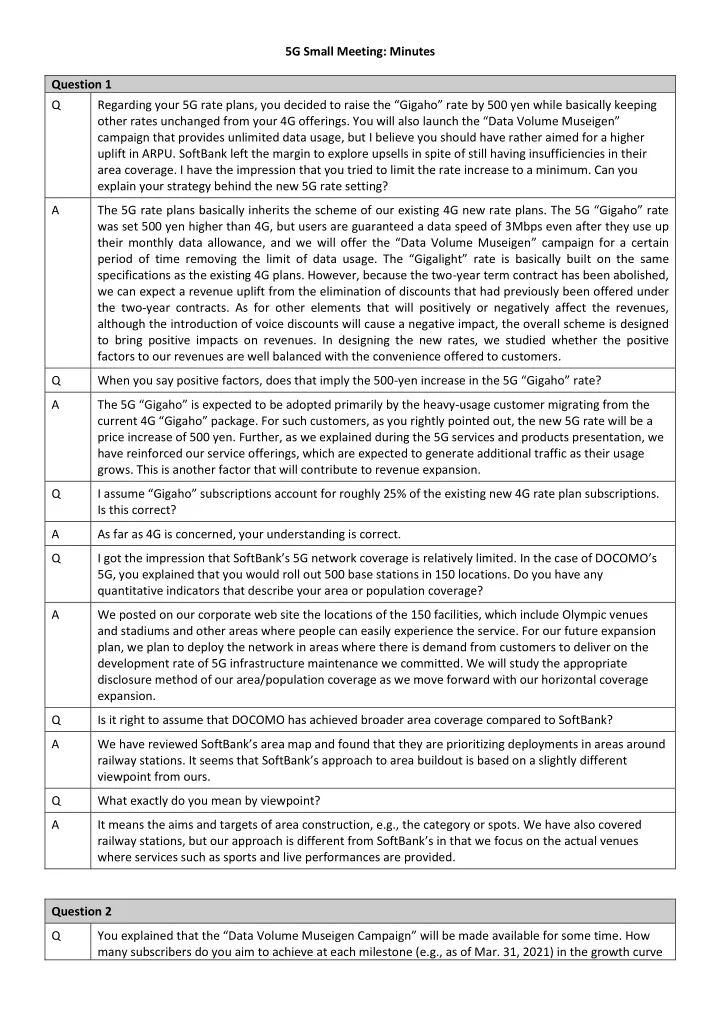
5G Small Meeting: Minutes Question 1 Q Regarding your 5G rate - - PDF document

5g small meeting minutes question 1 q regarding your 5g
SMART_READER_LITE
LIVE PREVIEW

5G Small Meeting: Minutes Question 1 Q Regarding your 5G rate - - PDF document

5G Small Meeting: Minutes Question 1 Q Regarding your 5G rate plans, you decided to raise the Gigaho rate by 500 yen while basically keeping other rates unchanged from your 4G offerings. You will also launch the Data Volume Museigen


slide-1
SLIDE 1

5G Small Meeting: Minutes Question 1 Q Regarding your 5G rate plans, you decided to raise the “Gigaho” rate by 500 yen while basically keeping

  • ther rates unchanged from your 4G offerings. You will also launch the “Data Volume Museigen”

campaign that provides unlimited data usage, but I believe you should have rather aimed for a higher uplift in ARPU. SoftBank left the margin to explore upsells in spite of still having insufficiencies in their area coverage. I have the impression that you tried to limit the rate increase to a minimum. Can you explain your strategy behind the new 5G rate setting? A The 5G rate plans basically inherits the scheme of our existing 4G new rate plans. The 5G “Gigaho” rate was set 500 yen higher than 4G, but users are guaranteed a data speed of 3Mbps even after they use up their monthly data allowance, and we will offer the “Data Volume Museigen” campaign for a certain period of time removing the limit of data usage. The “Gigalight” rate is basically built on the same specifications as the existing 4G plans. However, because the two-year term contract has been abolished, we can expect a revenue uplift from the elimination of discounts that had previously been offered under the two-year contracts. As for other elements that will positively or negatively affect the revenues, although the introduction of voice discounts will cause a negative impact, the overall scheme is designed to bring positive impacts on revenues. In designing the new rates, we studied whether the positive factors to our revenues are well balanced with the convenience offered to customers. Q When you say positive factors, does that imply the 500-yen increase in the 5G “Gigaho” rate? A The 5G “Gigaho” is expected to be adopted primarily by the heavy-usage customer migrating from the current 4G “Gigaho” package. For such customers, as you rightly pointed out, the new 5G rate will be a price increase of 500 yen. Further, as we explained during the 5G services and products presentation, we have reinforced our service offerings, which are expected to generate additional traffic as their usage

  • grows. This is another factor that will contribute to revenue expansion.

Q I assume “Gigaho” subscriptions account for roughly 25% of the existing new 4G rate plan subscriptions. Is this correct? A As far as 4G is concerned, your understanding is correct. Q I got the impression that SoftBank’s 5G network coverage is relatively limited. In the case of DOCOMO’s 5G, you explained that you would roll out 500 base stations in 150 locations. Do you have any quantitative indicators that describe your area or population coverage? A We posted on our corporate web site the locations of the 150 facilities, which include Olympic venues and stadiums and other areas where people can easily experience the service. For our future expansion plan, we plan to deploy the network in areas where there is demand from customers to deliver on the development rate of 5G infrastructure maintenance we committed. We will study the appropriate disclosure method of our area/population coverage as we move forward with our horizontal coverage expansion. Q Is it right to assume that DOCOMO has achieved broader area coverage compared to SoftBank? A We have reviewed SoftBank’s area map and found that they are prioritizing deployments in areas around railway stations. It seems that SoftBank’s approach to area buildout is based on a slightly different viewpoint from ours. Q What exactly do you mean by viewpoint? A It means the aims and targets of area construction, e.g., the category or spots. We have also covered railway stations, but our approach is different from SoftBank’s in that we focus on the actual venues where services such as sports and live performances are provided. Question 2 Q You explained that the “Data Volume Museigen Campaign” will be made available for some time. How many subscribers do you aim to achieve at each milestone (e.g., as of Mar. 31, 2021) in the growth curve

slide-2
SLIDE 2

toward the acquisition of 20 million 5G smartphone users? Please also share with us your expectations for the services. A The number of 5G subscriptions is projected to increase in a curve similar to or slightly more moderate than that of LTE. The target of acquiring 20 million subscriptions within FY2023 was set based on the same philosophy. Accordingly, the number of subscriptions as of Mar. 31, 2021 is estimated to be around 2.X million. As for the services, as we unveiled during today’s presentation, our offerings to customers in the initial phase will be centered around services that take advantage of 5G’s high-speed and large- capacity transmission capability. Q Regarding your capital expenditures, your base station deployment plan remains unchanged, with a target to complete the rollout of 10,000 stations by Jun. 20, 2021 and an additional 10,000 stations in the next six months, which will bring the cumulative number of 5G base stations as of Mar. 31, 2022 to 20,000. What are the main purposes of the base stations that will be rolled out during this period? You explained that you will bring forward the construction plan by two years. Does this imply your initial CAPEX plan of cumulative 1 trillion yen for the first five years will now change to cumulative 1 trillion yen for three years? A The CAPEX projection remains unchanged at 1 trillion yen for the first five years. Within this amount, we will simply change the allocation and expedite the rollout. Q Can you also comment on the CAPEX required for DOCOMO Open Innovation Cloud? A This is a type of MEC (Mobile Edge Computing) service that we newly started this time, in which some of the services of our partners are packaged together and offered by us. The Open Innovation Cloud resides in a virtual format on the servers of our core network, thus a huge amount of expenses are not required to offer this capability. We may have to anticipate incremental CAPEX as the number of customers and the amount of processing increases. At this point, however, the technology is not expected to incur a large amount of investment. Question 3 Q1 Do you plan to sell 4G and 5G devices in parallel? Or, will you adopt a policy to sell only 5G devices and stop selling 4G handsets to achieve your subscription target of 20 million? A1 As you have seen during our 5G services and products presentation, the high-end models are limited to 5G and we will adhere to this policy going forward. We will continue to sell high-end 4G devices until we run out of stock. After that, the high-end models will be available in 5G only, but we will prepare a lineup

  • f standard models in 4G. Further down the road, we plan to release less expensive 5G handsets to

facilitate subscriber migration to 5G. Q As for your 4G and 5G rate plans, you set the pay-as-you-go “Gigalight” packages at the same rates for both 4G and 5G, but you raised the “Gigaho” rate by 500 yen for 5G. What is the projected breakdown between “Gigaho” and “Gigalight” among the total 20 million 5G subscribers you plan to acquire? A In our existing 4G new rate plans, “Gigaho” subscriptions account for approximately 25%. In the transition phase to 5G, we believe “Gigaho” subscribers, who are users of high-end devices with heavy data usage, will account for the bulk. While this will be affected by the change of handset lineup, after the number of 5G devices becomes the majority, the proportion of “Gigaho” vs “Gigalight” is expected to be either similar to the current 4G subscriber distribution of 1:3, or the percentage of “Gigaho” users may come in slightly higher as a result of the expansion of data traffic. Q You commented that the projected CAPEX for the first five years remain unchanged at 1 trillion yen despite accelerating your construction. As you mentioned that you plan to increase the number of base stations by 10,000 in the second half of FY2021, can you confirm if we can expect flat growth in your annual CAPEX going forward? A We basically project flat growth. In our earlier annual CAPEX plan, we had assumed that LTE-related investments will outweigh 5G investments in FY2021, but we decided to increase the allocation to 5G. The 5G construction will be expedited as a result of this, but the total annual CAPEX will remain unchanged.

slide-3
SLIDE 3

Question 4 Q I would like to hear your thoughts about the revenues from the solution business to enterprises. Can you explain the rate structure and the projected amount of mobile communications services revenues of this business? A The enterprise business that we unveiled in the presentation includes services that are expected to make revenue contributions from both connectivity as well as solutions. We will start providing the 22 services sequentially from Day 1 of 5G service as co-creation projects with our partners. Six of the 22 services will be offered as a package by DOCOMO, blending our connectivity and MEC-based Open Innovation Cloud with the services and solutions we received from vendors in a wholesale arrangement. These services and solutions never existed in the past, so they are expected to provide us with genuinely incremental

  • revenues. We will share with you the concrete amount of revenues on another occasion, such as the

upcoming earnings results presentation. Q Are enterprise contracts included in the 20 million subscription target you mentioned earlier? If so, how many do they account for? A Enterprise contracts are included, but we would like to reserve our comments concerning their concrete contribution. Q Regarding the “5G Welcome Wari” discount program, the amount of discount is 22,000 yen for new subscriptions and approximately 8,000 yen for handset upgrades. Why did you differentiate the amount

  • f discounts when handset upgrades have a significant impact on the proliferation of 5G? In particular, I

would like to know the rationale behind setting a smaller amount of discount for handset upgrades. A We decided to provide discounts of 22,000 yen for new and port-in subscribers and 5,500 yen for handset upgrades under the “5G Welcome Wari” program in order to offer 5G handsets at reasonable prices. We also revamped the “d CARD Oshiharai Wari” program, which covers not only 5G but also 4G. We can offer a greater number of discounts to new subscribers responding to the trends in the competitive environment. Question 5 Q Although you explained the cloud-based games you unveiled in the presentation can be accessed via both 4G and 5G, are they originally designed for use on 5G network? A It is defined in the service agreement that the games can be played on both 4G and 5G, but for a comfortable experience, we recommend them to be used over 5G or high-quality Wi-Fi environments. The star titles, such as “Dynasty Warriors” and “Final Fantasy” were originally developed as a software for dedicated gaming consoles. If users expect to enjoy a similar experience, it is more desirable to play the games on 5G connections or comparable environments. Q Because at this point, 5G coverage is mostly provided in outdoor environments, do you think users will have to wait a little more to start enjoying these gaming services? A We will continue to strive for 5G area construction. In the meantime, we hope users will find the proper means of access for their own environment, combining the use of optical fiber and Wi-Fi, etc. Q During the recent DOCOMO Open House 2020 event, you recommended the use of MEC for cloud-based

  • games. Did you construct an MEC-enabled network environment for the games presented this time

around? A The gaming titles provided via the “d GAME” platform do not use MEC, because they do not require that level of low latency. Q How do you foresee the likelihood of MEC employed in gaming in the future? A In e-sports or other competition-like situations, low latency will be required and we are looking into the use of MEC for such scenarios.

slide-4
SLIDE 4

Question 6 Q I understood that you set the 5G rates almost unchanged from your 4G rate plans. Did you announce them as sustainable offers taking into consideration Rakuten’s rate plans? Or, if you have to make a decision to further cut down your rates in the future, what kind of moves on the part of Rakuten, in your view, will trigger such judgment? A We do not consider Rakuten’s rate plan a completely unlimited offer. Customers have to stay within Rakuten’s coverage in order to enjoy unlimited usage, but Rakuten’s area buildout in reality is not yet sufficient, and the connection in many cases switches over to KDDI’s network in a roaming arrangement. The situation in which customers have to use the service mindful of the area coverage cannot be considered a truly unlimited service. When this is taken into consideration, we believe our rate plans, including our 5G plans, are sufficiently competitive. We are aware that the state of competition will change over time in accordance with the progress of Rakuten’s area construction, but if we can outpace them in our 5G rollout, we believe we can compete reasonably well. Q What is the percentage of corporate accounts to your total subscriptions? In addition, with respect to the number of your partners, it is difficult to assess whether you are performing well or not by looking at the numerical target. Don’t you have any concrete numerical indicators, such as profit generated by the solutions? A Enterprise accounts represent approximately 20% of the total subscriptions. Although you mentioned that the number of partners does not provide any reference, we are currently cultivating new partners toward the goal of expanding the number from currently 3,300 to 5,000. It is difficult to make a general statement concerning revenues and profit, because the cases are individually different. In some cases, we sell only packaged products or connectivity, and in other cases, the solutions are sold via our co-creation partners, but we would like to pursue various possibilities. Previously, we shared with you our ambition to grow our non-telecom operating profit from Smart life and Other businesses to 300 billion yen, and enterprise solutions are positioned as one of the pillars for its achievement. As you have seen in the 5G services and products presentation, the solutions are gradually put into practical use and we intend to grow this business into one of the key components of our Smart life & Other businesses. Question 7 Q Are the 5G rate plans predicated upon the application of “d CARD Oshiharai Wari” discounts? Please also explain the business impact of abolishing the two-year term contracts with 5G. A We will break away from the concept of two-year term contracts in conjunction with the start of 5G rate plans, which have a rate gap of 170 yen a month depending on the application of “d CARD Oshiharai Wari” discount. When we revised our 4G rates in FY2019, we performed a strategic review on the abolishment of term contracts, but we did not reach a conclusion and term contracts remained available. Thereafter, we conducted another review attaching emphasis on the ease of understanding, and arrived at a conclusion that the application of “d CARD Oshiharai Wari” will provide a convincing proposition to

  • customers. We would also like to stress that the provision of benefits from the angle of membership (i.e.,

d CARD, d POINT, etc.) can deliver positive effects if we tackle these initiatives together with the sale of circuits. Question 8 Q You explained that the CAPEX plan of 1 trillion yen for the first five years remains intact, as you will reduce the 4G-related investments in lieu of accelerating 5G construction. What will be the outlook of the split between 4G and 5G outlays after bringing forward the 5G investments? Which will be the case: do you plan to delay 4G capital investments, or reallocate the budget originally intended for 4G to 5G? A We cannot comment on the breakdown of investments over the five-year period. The 4G traffic continues to increase, and we have hitherto added new 4G base stations in locations where we could not absorb the traffic with existing facilities. However, we have changed our policy to accommodate the growth of traffic using 5G as much as possible from now onwards. The cost per 1 bit of data transmission for 5G is projected to improve compared to 4G, so if we accommodate the ever-increasing traffic with 5G to the extent possible, we will be able to improve the overall efficiency of the network. We are currently verifying how smoothly we can achieve this by using AI and other insights. Having said that, however, the

slide-5
SLIDE 5

replacement to 5G of the locations initially planned to be covered with 4G cannot be realized just by allocating capital expenditures. This can only be done after we obtain customers’ consent pertaining to the use of 5G through marketing efforts and our rate plans. We therefore intend to perform a company- wide redesign process, so we can deploy 5G in a way that will deliver enhanced investment efficiency. Q Around summer 2020, the Ministry of Internal Affairs and Communication (MIC) will introduce a system that will allow the conversion of spectrum allocated for 3G and 4G into use for 5G. How do you plan to take advantage of this system? A We will study the conversion of spectrum bands that are currently used for LTE. To deliver high-speed, large-capacity services to customers, it is important that we first build thick 5G coverage over a wide area using the new spectrum allocated to us. This will be our primary focus for now. Question 9 Q Do you foresee any impact from the outbreak of novel coronavirus (COVID-19) on the procurement of handsets and network equipment, or the launch and coverage expansion of 5G? A Because there is no impact in FY2019 on the network equipment, we believe we will be able to launch the service as planned. On the handset side, we have witnessed a certain impact on a limited number of models, but we do not foresee any inconvenience to customers due to a lack of inventory for the near

  • term. However, we will keep a close eye on how things unfold as we head into the next fiscal year and

take actions as appropriate. Q At present, you do not handle e-SIMs, but what are your plans for the future? A We have already started using e-SIMs in cases where they are deemed to enhance the convenience of

  • customers. Specifically, we adopted e-SIMs in the previous “d Tab” model and our “Kid’s Keitai” feature
  • phones. In fact, we acknowledge ourselves as the first in the world to standardize e-SIMs and have never

played down its use. Q I believe the smartphones in your current lineup do not support e-SIM. Is it right to consider that there will be no changes to your conventional policy? A We assume your question relates to 5G smartphones. If so, your view is correct. Question 10 Q I believe you priced your 5G rate on par with KDDI’s unlimited plan for 4G. Do you think your plan has sufficient competitiveness as it effectively offers unlimited usage? A When we design our tariff structure, we take into consideration the rates of the competition. We believe

  • ur rates are competitive.

Q How should customers use your new 4G rate plan, which now offers an expanded data bucket size of 60GB instead of previously 30GB? Do the 5G handset users have the option to join a 4G rate plan? A Customers who purchased a 5G device are required to subscribe to a 5G rate plan. Question 11 Q In my understanding, the “Sumaho Okaeshi” program is not subject to the 20,000-yen handset discount ceiling because you removed the condition that limits the eligibility to subscribers of DOCOMO’s mobile communications services. I construed that you will be combining the “5G Welcome Wari” discounts on top of this program. Is my interpretation correct? Please also give us an indication of the prices of the seven 5G handset models that you unveiled in the presentation after applying the “Sumaho Okaeshi” program and “5G Welcome Wari” discounts. A Your understanding concerning our approach to handset discounts is correct. As for the price range, we believe we will be able to offer the said models at around 50,000-60,000 yen after applying the two discount packages. Q Will the price range you indicated apply to all models?

slide-6
SLIDE 6

A Nearly all models will likely fit within the said price range. Q The “5G Welcome Wari” provides a discount of 5,000 yen for change of subscriptions. I understand that this can be raised to 20,000 yen per unit. Is my understanding correct? A That is correct. Question 12 Q1 You gave us an explanation on the competitiveness of your network and rate plans, but then, why has DOCOMO been the sole loser in the MNP market? Do you think you can expand the number of users in the 5G competition? A1 Our performance in the MNP market varies depending on the competitor, and we have not been losing customers in the competition with other MNOs. However, we have seen an outflow of users, who are considered to be low data users in our analysis, to MVNOs and the second brand of MNOs in pursuit of lower prices. Q2 I thought you introduced the “Gigalight” package under your new rate structure to prevent the outflow

  • f such users, but your strategy does not seem to be functioning properly. Don’t you think the fact that

you have not been able to stop the outflow despite rolling out the new rate plans, which were intended for the retention of low-usage customers, implies your pricing measures are not functioning successfully? A2 We certainly admit that we still have issues in the competitiveness of our offerings for customers seeking low prices. However, the users of low-cost services are mostly affected by the handset prices, and we believe the availability of steep handset discounts for new and port-in customers significantly affects our

  • performance. That is one of the factors that led to the revision of our discount measures this time

around. Question 13 Q1 Does the 50,000-60,000 yen price range for 5G handsets that you alluded to earlier represent the total amount paid by the user in the first 24 months? A1

  • Correct. It represents the ballpark price a customer pays when switching to a new model in the 25th

month.