5/2/2016 Alpha Lipoic Acid and Its Clinical Applications Objectives - - PDF document

5 2 2016
SMART_READER_LITE
LIVE PREVIEW

5/2/2016 Alpha Lipoic Acid and Its Clinical Applications Objectives - - PDF document

5/2/2016 Alpha Lipoic Acid and Its Clinical Applications Objectives Burton M. Berkson, MD, MS, PhD Describe the structure and metabolic function of Alpha Lipoic Acid. Relevant financial relationships in the past twelve months by


slide-1
SLIDE 1

5/2/2016 1

Alpha‐Lipoic Acid and Its Clinical Applications

Burton M. Berkson, MD, MS, PhD

Relevant financial relationships in the past twelve months by presenter or spouse/partner: Employment: Integrative Medical Center of New Mexico Grant/Research Support: N/A Consultant: Livon Labs Supplements Speakers Bureau: Livon Labs Stock Shareholder: N/A Other: Bio‐tech Products Consultant

Status of FDA devices used for the material being presented N/A Status of off‐label use of devices, drugs or other materials that constitute the subject of this presentation N/A

Objectives

  • Describe the structure and metabolic function of Alpha‐Lipoic Acid.
  • Present some of the history of Alpha‐Lipoic Acid as an investigational

drug and as a nutraceutical.

  • Describe the role of Alpha‐Lipoic Acid in mitochondrial function.
  • Characterize the role of Alpha‐Lipoic Acid in liver disease.
  • Portray the role of Alpha‐Lipoic Acid in cancer therapy.
  • Describe the role of Alpha‐Lipoic Acid in auto‐immune disease.

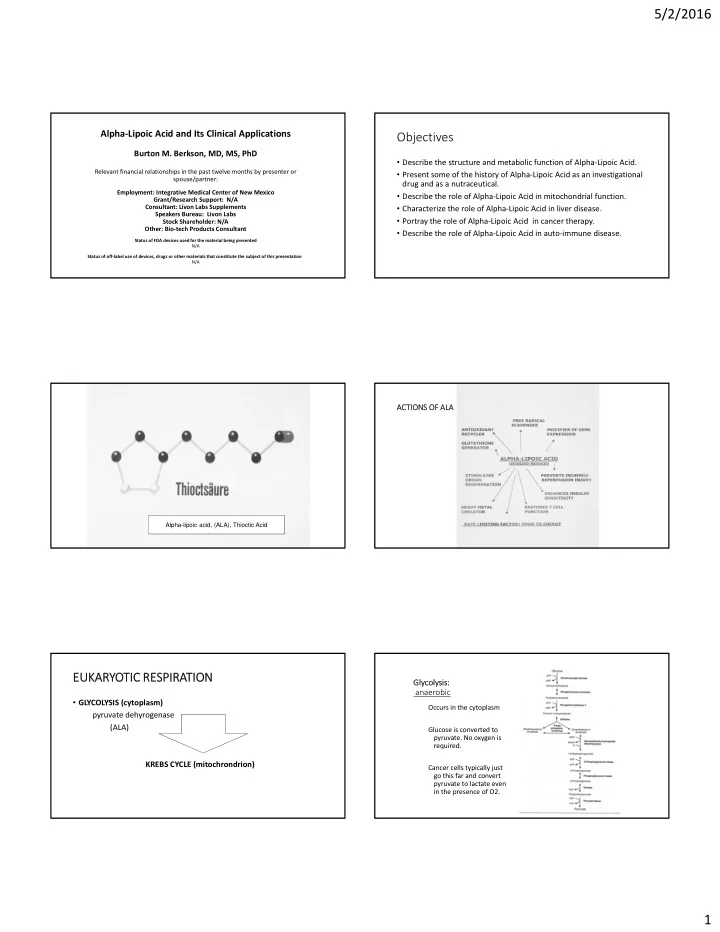
Alpha-lipoic acid, (ALA), Thioctic Acid

AC ACTION ONS OF OF ALA ALA

EUK EUKARYOTIC IC RE RESP SPIRATIO ION

  • GLYCOLYSIS (cytoplasm)

pyruvate dehyrogenase (ALA) KREBS CYCLE (mitochrondrion) Gly Glycolysis: anaerobic

Occurs in the cytoplasm Glucose is converted to

  • pyruvate. No oxygen is

required. Cancer cells typically just go this far and convert pyruvate to lactate even in the presence of O2.

slide-2
SLIDE 2

5/2/2016 2

Pyruvate Dehydrogenase Complex

Alpha lipoic acid is fundamental, for the conversion of food to energy. It is my understanding that ALA is the rate‐limiting agent for the production of energy from food in aerobic cells

Kr Krebs Cy Cycle cle

  • ALA

Occurs in the mitochondrion In the presence

  • f oxygen

aerobic

Glycolysis anaerobic

FATS CARBS PROTEINS

GLYCEROL PYRUVATE PDH ALPHA‐LIPOIC ACID ACETYL CO A

Pyruvate Dehyrogenase Kinase (PDK) inhibits the enzyme complex (PDH) that converts Pyruvate into Acetyl CoA Alpha Lipoic Acid decreases the rate of action of Pyruvate Dehyrogenase Kinase

Korotchkina LG, Sidhu S, Patel MS. Lipoic acid inhibits mammalian pyruvate dehydrogenase kinase. Free Radic Res. 2004 Oct;38(10):1083‐92.

Pyruvate dehydrogenase kinase inhibits Pyruvate Dehydrogenase More available Pyruvate Dehyrogenase results in increased Pyruvate being directed into the Krebs Cycle

  • ver the conversion of

Pyruvate to Lactate

Sutendra G, Kinnaird A, Michelakis ED Nu Nuclear pyruv pyruvate de dehydrogenase co comple lex is is im important fo for the the ge generation of

  • f ac

acetyl etyl‐CoA CoA an and his histone ac acetyla etylatio ion. n.

  • Cell. 2014 Jul 3;158(1):84‐97.

Alpha Lipoic Acid is important for the acetylation of histones in the cell nucleus. Alpha Lipoic Acid helps repair DNA

slide-3
SLIDE 3

5/2/2016 3

Since Since a yo young ung per person

  • n

produce duces eno enormous amo amounts of

  • f ALA,

ALA, wha what happ happen ens when when yo you feed eed a Thanksgi ksgivin ving dinner dinner to to a 2 year year old

  • ld child

child;

  • r
  • r an

an 80 80 year year old

  • ld man

man? Wha What if if a mito tocho chondr ndrio ion re receives to too much much ALA ALA? Lipoi Lipoic acid acid LD5 LD50 Studies Studies by by Dr Drs Vigil igil and and Co Couch uch.

Couch RC, Vigil M. et al. A dose escalation toxicity study of DL‐6‐8 thioctic acid (lipoic acid) in Rhesus monkeys. 1997. Poster display. Annual Meeting Society of Toxicology.

LOE B

  • Following these studies I was asked to observe the

necropsies and perform the electron microscopy work

  • n the damaged tissues at NMSU.
  • I observed extensive necrotic lesions in the liver,

kidneys, heart, and the large muscles of the extremities. Health Healthy prima primate mito tocho chondr ndrio ion (hepa epatocyt

  • cyte)

e)

Mitochondria from animals who had received excessively high doses of ALA became extremely edematous, and demonstrated a disruption of all the crucial structures. These mitochondria did not exhibit the regular double membrane wall structure, but showed a coalescence of these structures with a deliquescence of membranes thus exhibiting a complete disruption of normal ultrastructure. Pr Primate hepato tocy cyte te mi mito tochondr ndria follo llowing a LD50 LD50 IV IV lip lipoic aci cid do dose of

  • f

ab about

  • ut 90m

90mg/kg

slide-4
SLIDE 4

5/2/2016 4

LIVE LIVER MI MITOCHO CHONDRIA IA SUFFERED ERED SE SEVERE ST STRU RUCTU CTUAL DAM DAMAGE GE BY BY EXTREMEL EMELY HIG HIGH DO DOSES OF OF INT INTRAVENOUS ALPH ALPHA LIPO LIPOIC AC ACID Gl Global Ad Advance nces in in Hea Health th an and Me Medic dicine ne January,201 2014, 4, vo volume 3 num number 1

Michael Vigil MD Adjunct Associate Research Professor, Department of Biochemistry NMSU Burton M. Berkson MD MS PhD Former Assistant Professor, Rutgers University Former Associate Professor, Chicago State University Founder, The Integrative Medical Center of New Mexico Adjunct Professor, NMSU Adjunct Professor Oklahoma State Univ. College of Medicine bberkson@nmsu.edu (corresponding author) Ana Patricia Garcia DVM MS PhD Associate Research Professor and Veterinary Pathologist Yerkes Assistant Professor, Department of Pathology and Laboratory Medicine Emory University School of Medicine

  • In reality, much lower doses of IV lipoic acid may cause

serious bouts of hypoglycemia and the doctor and nurse must at all times watch carefully for possible problems.

With appropriate ALA levels, the mitochondrion functions normally. If the mitochondrion does not obtain sufficient ALA, it suffers, and the organism dies.

If the mitochondrion is supplied with excessive amounts of ALA, it accelerates aerobic respiration and the process runs ahead

  • f the other necessary constituents.

The mitochondrion heats up, free radicals accumulate, and its membranous components break down. Severe damage to the mitochondrion is first seen by gross swelling and then severe damage to the cristae and matrix material. It is interesting to note that therapeutic doses of intravenous ALA helps a liver regenerate but extremely high doses of the same agent causes liver necrosis. Of course, excessive and unreasonable amounts of any substance given intravenously can be lethal, including water and salt.

Does ALA help regenerate livers? 1st large scale clinical trial with IV alpha‐lipoic acid at NIH. (Bartter, Berkson, et. al. 1977‐1980)

B

slide-5
SLIDE 5

5/2/2016 5

Bartter FC, Barry Rumack, and Berkson B 1978 As visiting scientists at the Max Planck Institute in Heidelberg

We reported in 3 publications that we treated 79 people waiting for liver transplant surgery (acute hepatic necrosis) and 75 regenerated their livers with just the administration of intravenous Alpha‐ lipoic acid.

I was appointed by the FDA principal investigator for alpha lipoic acid as a prescription drug in 1983. That lasted 23 years.

B

Our first paper. Should have been titled ALA reverses Acute Hepatic Necrosis

If If IV IV ALA ALA re revers rses acut acute liv liver er diseas disease, will will it it re reverse chr chronic liv liver er disea disease, fo for exa example hepa hepatitis C? C? CIRR CIRRHOTIC LIVER LIVER

slide-6
SLIDE 6

5/2/2016 6

GE GERM RMAN AN JO JOURNAL OF OF INT INTERNAL ME MEDI DICINE CINE AR ARTICLE

Berkson BM. A conservative triple antioxidant approach to the treatment of hepatitis C. Combination of alpha lipoic acid (thioctic acid), silymarin, and selenium.Med Klin (Munich). 1999 Oct 15;94 Suppl 3:84‐9.

I took 3 cirrhotic hepatitis C patients in the process of liver transplant evaluation at University Hospital and administered ALA, silymarin and selenium (inhibition of replication). The 3 recovered normal liver function within 6 months.

B

Conclusion of my 1999 paper. I offered a more conservative approach to the treatment of hepatitis C, that is exceedingly less

  • expensive. One

year of the triple anti-oxidant therapy described in this paper costs less than $ 3,000, as compared to more than $ 500,000 a year for liver transplant surgery.

B

Are there other diseases that ALA might help?

Smith AR, Shenvi SV, Widlansky M, et al. Curr Med Chem. 2004 May;11(9):1135-46.)

Lipoic acid is a potential therapy for chronic diseases associated with oxidative stress.

Most chronic diseases are associated with OS.

B

Lipoic Acid prevents ischemia- reperfusion injury

Panigrahi M, Sadguna Y, Shivakumar BR, Kolluri SV, Roy S, Packer L, Ravindranath V. Brain Res. 1996;717(1- 2):184-188. -

Alpha-Lipoic acid protects against ischemia reperfusion injury following cerebral ischemia.

B

Suh JH, Shigeno ET, Morrow JD, et al. Faseb J. 2001;15(3):700-706.

Oxidative stress in the aging rat heart is reversed by supplementation with alpha-lipoic acid.

B

What about ALA and diabetes?

Jacob S, Henriksen E, Schiemann A. et al. Enhancement of glucose disposal in patients with type 2 diabetes by alpha-lipoic acid. Arzneimittel-Forschung 1995, 45(8):872-874.

Henriksen et al. published the first human study to show that ALA increases insulin stimulated glucose movement into the cell, and out of the blood stream, in diabetes.

B

slide-7
SLIDE 7

5/2/2016 7

Tankova T, Cherninkova S, and Koev D. Treatment for diabetic neuropathy with IV alpha-lipoic acid. Int J Clin Pract. 2005 Jun;59(6):645-50.

This study demonstrated that alpha-lipoic acid is an effective treatment for peripheral and autonomic diabetic neuropathy and also diabetic neuropathy of the cranial nerves leading to full recovery of the patients. At the Integrative Medical Center of New Mexico, we treat diabetic neuropathies with IV ALA every day.

B

What about ALA and cancer?

"All hallmarks of cancer including the Warburg effect can be linked to impaired respiration and energy metabolism,“ These are "downstream effects of damaged mitochondrial function."

Thomas Seyfried Cancer As a Metabolic Disease (Wiley, 2012)

Warburg O. The chemical constitution of respiration ferment. Science. 1928;68:437–443. Science.68.1767.437.

Wenzel U, Nickel A, and Daniel H. .Alpha-Lipoic acid induces apoptosis in human colon cancer cells by increasing mitochondrial respiration which results in O2-*-generation.

  • Apoptosis. 2005 Mar;10(2):359-68

This study provided evidence that ALA and its reduced form can induce cancer cell death by a prooxidant mechanism that is initiated by an increased uptake of oxygen into the mitochondrion.

B

Shi Shi DY DY, Liu Liu HL, HL, Stern ern JS, JS, Yu Yu PZ PZ, Liu Liu SL. SL. FE FEBS Le

  • Lett. 200

2008 Ma May 28;58 ;582(1 (12) 2):1 :1667 667‐71. 71.

Alpha‐lipoic acid induces apoptosis and necrosis in hepatocellular carcinoma cells.

Kisurina‐Evgen'eva OP, Onishchenko GE. Alpha‐lipoic acid triggers elimination of cells with abnormal nuclei in human carcinoma epidermoid cell line

  • Tsitologiia. 2010;52(3):225‐34.

Alpha‐lipoic acid not only triggered apoptosis of carcinoma cells, but it also activated the mechanism of elimination of

  • ther cells with abnormal

chromosome number.

Zachar Z, Marecek J, Maturo C, et al. ALA disrupts cancer cell mitochondrial metabolism and is a potent anticancer agent in vivo J Mol Med (Berl). 2011 Nov;89(11):1137-48. Epub 2011 Jul 19.

Lipoic Acid causes disruption of tumor metabolism and this is followed by cell death by multiple, pathways, including apoptosis and necrosis.

B

Na MH, Seo EY, Kim WK Nutr Res Pract. 2009 Winter;3(4):265‐ 71.

Alpha pha‐lip lipoic acid cid st stimul ulates es apo apoptosis in in huma human br breas east canc cancer er cells. cells.

and Choi SY, Yu JH, Kim H. Ann N Y Acad Sci. 2009 Aug;1171:149‐55.

Alpha pha‐lip lipoic acid cid induce induces apo apoptosis of

  • f lung

lung canc cancer er cells. cells.

B

slide-8
SLIDE 8

5/2/2016 8

From Cancer metabolic plan from Signaling And Metabolism In Cancer, Maurice Israël, Cancer Therapy, 2014

Non Non‐St Standar andard Cancer Cancer Pr Protoc

  • col
  • Intravenous Alpha Lipoic Acid (ALA) (Bartter and Berkson).
  • Intravenous Vitamin C. (after Riordan and Cathcart)
  • Low Dose Naltrexone (LDN) (after Zagon and Bihari.)
  • Hydroxycitrate (HCA) (after Schwartz L.).
  • Healthy diet and life style.
  • Supplements (artemesinin, curcumin, etc)
  • Prescription drugs (metformin, alprazolam, cimetidine, mebendazole, etc.)

Low Low Dose Dose Nalt Naltrexone (L (LDN)

  • 1.5 to 4.5 mg. LDN at hs
  • Fools the brain. Not enough endogenous opiates in blood stream.
  • In AM, flood of endogenous opiates released.
  • At least one of the opiates, met‐enkephalin binds to cancer cell

receptors and promotes apoptosis. Several papers by Ian Zagon and associates.

Transforming growth factor beta

From LDN website

Inflammation The T17 cell (Th17) produces interleukin 17 (IL 17). These cells produce tissue injury by inflammatory processes in Crohn’s disease, juvenile diabetes, MS, rheumatoid arthritis, SLE, etc. Normally, Th17 cells supplies anti-microbial immunity to epithelial and mucosal tissues by producing interleukin 22, etc. which stimulates epithelial cells to produce Inflammatory proteins to kill microbes. LDN down regulates Th17. Schwartz L., Buhler L, Icard P, Lincet H, Steyaert J. Metabolic Treatment of Cancer, Anticancer Research 2014

The metabolic effect of adding Hydroxycitrate to Alpha lipoic acid allows the reprogramming of cancer cells into oxidative aerobic metabolism rather than anaerobic metabolism. This should limit the availability of compounds necessary for the growth of cancer.

slide-9
SLIDE 9

5/2/2016 9

Alpha Lipoic Acid and Hydroxycitrate target at least four major Enzymes in the metabolism of glucose. Pyruvate Dehydrogenase Kinase ATP Citrate Lyase Alpha-amylase Alpha-glucosidase

ATP citrate lyase

Hydroxycitrate (HCA) down regulates ATP Citrate Lyase (ACL) ACL limits the conversion of cytoplasmic Citrate into Acetyl CoA available for the synthesis of Lipids and carbohydrate metabolism.

Hydroxycitric acid

(hydroxycitrate) HCA inhibits pancreatic alpha‐amylase (breaks down starch and glycogen) and intestinal alpha‐glucosidase (breaks down starch into glucose), leading to a reduction in carbohydrate metabolism. Studies of HCA have produced results that indicate a potential for modulation of lipid and carbohydrate metabolism in cancer cells. Alpha Lipoic Acid (ALA) inhibits Pyruvate Dehyrogenase Kinase (PDK) (the enzyme that stops Pyruvate Dehydrogenase) More available Pyruvate Dehyrogenase (PDH), results in the increased Pyruvate being directed into the Krebs Cycle

  • ver the conversion of Pyruvate to Lactate

“T “The lo long ng‐te term sur surviv ival al of

  • f a pa

patie tient with with pancr pancreatic ic can cancer er and and met metastases ases to to the the liv liver”

Berkson BM, Rubin DM, and Berkson AJ Integrative Cancer Therapies Volume 5, Number 1, March 2006

We published the first human study that demonstrated the therapeutic effects of ALA combined with LDN for cancer

B

slide-10
SLIDE 10

5/2/2016 10

FIGURE ONE OCTOBER 8, 2002

  • Mr. TA

FIGURE 2 OCTOBER 8, 2002

  • Mr. TA

Given no hope by MD Anderson

FIGURE 13 AUGUST 2008

  • Mr. TA

FIGURE 14 AUGUST 2008

  • Mr. TA

Hepatocellular Carcinoma following Hepatitis C

  • Mrs. JAL

60 year old RN Mrs JAL October 2006

slide-11
SLIDE 11

5/2/2016 11

MRS JAL January 2009 28 months later

  • Mr. JT Renal Cell Carcinoma
  • Diagnosis June, 2008 Urinating blood.
  • CT mass L kidney with possible mets to lung.
  • Nephrectomy L. kidney.
  • MD Anderson administered biological response modifiers and
  • chemotherapeutics. TS continued To deteriorate. No effect on JT’s

RCC.

  • JT told to get his affairs in order, no hope for survival June, 2010.
  • JT presents on August 16, 2010.
  • Put on clinic protocols.
  • July 2015, healthy, working, with no signs of disease.
  • Mr. JT Renal Cell Carcinoma
  • Mr. JT

August 2010 Presentation August 2014

Burton M. Berkson, Daniel M. Rubin, and Arthur J. Berkson Integr Cancer Ther. 2009 Mar;5(1):83-9.

Revisiting the ALA/N (α-Lipoic Acid/Low-Dose Naltrexone) Protocol for People With Metastatic Pancreatic Cancer: A Report of 3 New Cases

B

slide-12
SLIDE 12

5/2/2016 12

Pet Scan JANUARY O6 Mrs JK

Adeno- Carcinoma Pancreas

Pet Scan JUNE 2006

  • Mrs. JK

Berkson BM, Rubin DM, Berkson AJ. Integr Cancer Ther. 2007 Sep;6(3):293-6.

Reversal of signs and symptoms of a B-cell lymphoma in a patient using low-dose naltrexone.

MR TM DECEMBER 2005

  • MR. TM

MAY 2006 6 months later

Cance Cancer Case Case His Historie

  • ries

Mr

  • Mrs. MC

MC 68 yo woman with breast cancer. Refused Surgery, Chemotherapy, and Radiation. Pathology‐Invasive ductal adenocarcinoma Nottingham grade 2/3, Estrogen + Progesterone receptor ‐, pagetoid spread to skin Metastatic to L axilla lymph nodes

slide-13
SLIDE 13

5/2/2016 13

March 15, 2013 Pet scan March 20, 2013 July, 2013 Added Black Salve August 5, 2013 August 14, 2013

May 14, 2013‐‐‐‐September 23, 2013

  • Ca 27.29‐‐‐60‐‐‐39.5‐‐‐16‐‐‐11.5
  • Ca 15.3‐‐‐27.5‐‐‐19.6‐‐‐7.3
slide-14
SLIDE 14

5/2/2016 14

Lipoic Acid Plus Low‐Dose Naltrexone Reviewed for Cancer Treatment

  • NCI staff and invited guests listen to
  • Drs. Berkson and Donahue discuss

their research and treatments on March 19, 2012

  • A panel of researchers and clinicians was convened by the National Cancer

Institute (NCI) for presentations and a roundtable discussion about “The State of the Science of Alpha‐Lipoic Acid plus Low‐Dose Naltrexone for the Treatment of Cancer.” The meeting was hosted by the Cancer Therapy Evaluation Program (CTEP), both part of the NCI Division of Cancer Treatment and Diagnosis (DCTD). The meeting provided an opportunity for NCI staff and outside experts to review and discuss case reports from Dr. Burton M. Berkson, an integrative medicine physician and Ph.D. in Biological Sciences, and Adjunct Professor. Dr. Berkson presented on his experience treating patients with alpha‐lipoic acid plus low‐dose naltrexone for various cancers and autoimmune diseases. The group also heard from

  • Dr. Renee N. Donahue, (Zagon Group) Research Fellow at NCI about her

pre‐clinical research on the efficacy and proposed mechanism of action of LDN for the treatment of cancer. The cases being presented today by Dr. Berkson were submitted and given rigorous scientific evaluation under the NCI Best Case Series (BCS) protocol. The ultimate goal is to identify those integrative medicine interventions that have enough evidence to support NCI-initiated research.

  • Dr. Berkson reported that a combination of ALA (intravenously and orally) and

LDN (orally), along with diet, vitamins, and lifestyle changes caused several cancers to go dormant. Earlier in his medical career, Dr. Berkson published papers using ALA to repair liver damage in patients from mushroom poisoning and chronic infections with hepatitis C virus. He also cited a number of research articles in European medical journals showing ALA’s beneficial effects on cancer.

Routes of Administration of Alpha Lipoic Acid

  • Oral power in capsule.
  • Tablet
  • Liposomal Alpha Lipoic Acid (phospholipids from soy lecithin)
  • Intra Muscular Alpha Lipoic Acid dissolved in Trometamol
  • Intravenous Alpha Lipoic Acid dissolved with sodium hydroxide and buffered and

delivered in D5W or Normal Saline

Europe and Asia very interested in Alpha lipoic acid. Very little interest in the United States. Wha What abo about ALA ALA/N fo for sy syste stemic lupus lupus er erythematosus and and rheum rheumatoid arthr arthritis?

AL ALA plu plus LDN LDN fo for SLE SLE an and RA RA RA (RF) SLE (ANA)

slide-15
SLIDE 15

5/2/2016 15

Summary

ALA is a requisite for aerobic cell life. because ALA is essential for the conversion of pyruvate to acetyl Co A in the mitochondrion. ALA is the rate‐limiting factor for the production of energy from our cells. ALA inhibits pyruvate dehydrogenase kinase. ALA forces cells from an anaerobic metabolism into aerobic metabolism. ALA has many uses in human medicine. The efficacy, the apparent lack of toxicity, the long clinical track records of this agent in human medicine, all points toward the need for a clinical trial. Why aren’t there any large scale clinical trials? The agent has too many successful indications. Companies are working hard to change the alpha lipoic molecule so it can be used as a patented drug and not as useful for so many indications, however, up until now, the corrupted molecules don’t work nearly as well as the natural molecule.

Most of the patients that I see have hepatitis C, diabetes complications, SLE, RA, etc. Patients sign informed consent forms. Conventional therapies explained carefully with complete

  • bjectivity.

Most cancer patients that I see are end stage. They are told by their oncologist that nothing medically can be done. This lecture is just my experience and is not an authorization for others to experiment with these protocols. Boo Books des describing my my the therapies Al Also so ty type pe in in Berk Berkso son BM BM on

  • n Googl
  • ogle, Googl
  • ogle Sc

Scholar, or

  • r Pu

PubMed

Thank you for your attention! Any questions?

Burton M. Berkson MD MS PhD The Integrative Medical Center of NM Las Cruces, NM 88011 bberkson@nmsu.edu