4th Concept J. Hauptman; A. Penzo, A. Mikhailichenko, C. Gatto, F. - - PowerPoint PPT Presentation

4th concept
SMART_READER_LITE
LIVE PREVIEW

4th Concept J. Hauptman; A. Penzo, A. Mikhailichenko, C. Gatto, F. - - PowerPoint PPT Presentation

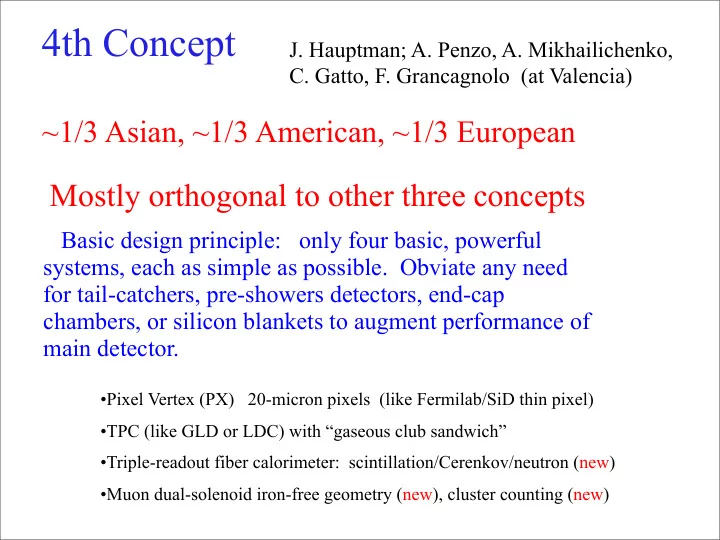
4th Concept J. Hauptman; A. Penzo, A. Mikhailichenko, C. Gatto, F. Grancagnolo (at Valencia) ~1/3 Asian, ~1/3 American, ~1/3 European Mostly orthogonal to other three concepts Basic design principle: only four basic, powerful basic


slide-1
SLIDE 1

4th Concept

  • Pixel Vertex (PX) 20-micron pixels (like Fermilab/SiD thin pixel)
  • TPC (like GLD or LDC) with “gaseous club sandwich”
  • Triple-readout fiber calorimeter: scintillation/Cerenkov/neutron (new)
  • Muon dual-solenoid iron-free geometry (new), cluster counting (new)
  • basic design

B

Mostly orthogonal to other three concepts

Basic design principle: only four basic, powerful systems, each as simple as possible. Obviate any need for tail-catchers, pre-showers detectors, end-cap chambers, or silicon blankets to augment performance of main detector.

~1/3 Asian, ~1/3 American, ~1/3 European

  • J. Hauptman; A. Penzo, A. Mikhailichenko,
  • C. Gatto, F. Grancagnolo (at Valencia)
slide-2
SLIDE 2

Patrick Le Du DAPNIA/SPP, 91191 GIF sur Yvette, France Daniele Barbareschi, Emanuela Cavallo, Vito Di Benedetto, Corrado Gatto, Franco Grancagnolo, Fedor Ignatov, Anna Mazzacane, Giovanni Tassielli, Giuseppina Terracciano INFN and Dipartimento di Fisica, via Lecce-Arnesano, 73100, Lecce, Italy Antonino Lamberto1, Aldo Penzo, Gaetana Francesca Rappazzo1 INFN, Trieste, Padriciano 99; I-34012 Padriciano, Trieste, Italy Giovanni Pauletta2 University di Udine, 33100 Udine, Italy Sunghwan Ahn, Tae Jeong Kim, Kyong Sei Lee, Sung Keun Park Department of Physics, Korea University, Seoul 136-701, Korea

  • T. Wua, C.C. Xua, Z.B. Yina, D.C. Zhoua, G.M. Huanga, Y.Z. Linb

aInstitute of Particle Physics, Huazhong Normal University, Wuhan 430079 China bHuazhong University of Science and Technology, Wuhan, China

Sorina Popescu3, Laura Radulescu3 IFIN-HH, Bucharest, Romania Sezen Sekmen, Efe Yazgan2, Mehmet Zeyrek Physics Department, Middle East Technical University, Ankara, Turkey S.I. Bondarenko, A.N. Omeliyanchuk, A.A. Shablo, N.S. Scherbakova, N.M. Levchenko Institute for Low temperature Physics and Engineering, Kharkov, Ukraine Alexander Mikhailichenko Cornell University, Ithaca, NY 14853-5001 USA Muzaffer Atac, Marcel Demarteau, Ingrid Fang, Stephen R. Hahn, Caroline Milstene, Robert Wands, Ryuji Yamada, G.P. Yeh Fermi National Accelerator Laboratory, Batavia, IL 60510 USA Oleksiy Atramentov, Anatoli Frishman, John Hauptman, Jerry Lamsa, Sehwook Lee, Jason Murphy, Norio Nakagawa, German Valencia Department of Physics and Astronomy, Iowa State University, Ames, IA 50011 USA Michael Gold, John Matthews, John Strologas2, Marcelo Vogel2 Department of Physics, University of New Mexico, Albuquerque, NM 87131 USA Nural Akchurin, Heejong Kim, Sungwon Lee, Mario Spezziga3, Igor Volobouev, Richard Wigmans Department of Physics, Texas Tech University Lubbock, TX 79409-3783 USA

slide-3
SLIDE 3

4th talks at Valencia Workshop

  • Alexander Mikhailichenko , Cornell LNS,

machine-detector interface, push-pull, B-field configuration

  • Aldo Penzo, INFN Trieste, dual readout

calorimetry and its extensions

  • Franco Grancagnolo, INFN Lecce, muon

spectrometer

  • Corrado Gatto, INFN Lecce, ILCroot

simulation and analysis of 4th Concept

slide-4
SLIDE 4

Final focus optics, mounted inside a cylinder attached to the detector by consoles. This reduces influence

  • f ground motion.

Dual solenoids Directional kicker Valves for push-pull disconnection FF optics

  • A. Mikhailichenko
slide-5
SLIDE 5

New magnetic field, new ``wall of coils’’, iron-free: many benefits to muon detection and MDI, Alexander Mikhailichenko design

slide-6
SLIDE 6

Aldo Penzo: DREAM module: simple, robust, not intended

to be “best” at anything, just test dual-readout principle

Unit cell Back end of 2-meter deep module Physical channel structure

slide-7
SLIDE 7

Downstream end of DREAM module, showing HV and signal connectors

slide-8
SLIDE 8

Dual-Readout: Measure

every shower twice - in scintillation light and in Cerenkov light.

200 GeV “jets” Data NIM A537 (2005) 537.

(e/h)C = ηC ≈ 5 (e/h)S = ηS ≈ 1.4 C = [fem + (1 − fem)/ηC]E S = [fem + (1 − fem)/ηS]E → C/E = 1/ηC + fem(1 − 1/ηC)

slide-9
SLIDE 9

DREAM data 200 GeV π-: Energy response

Scintillating fibers Scint + Cerenkov fEM ∝ (C/Eshower - 1/ηC )

(4% leakage fluctuations)

Scint + Cerenkov fEM ∝ (C/Ebeam - 1/ηC) (suppresses leakage)

Data NIM A537 (2005) 537.

slide-10
SLIDE 10

More important than good Gaussian response: DREAM

module calibrated with 40 GeV e- into the centers of each tower responds linearly to π- and “jets” from 20 to 300 GeV. Hadronic linearity may be the most important achievement

  • f dual-

readout calorimetry.

e- Data NIM A537 (2005) 537.

slide-11
SLIDE 11

DREAM module 3 scintillating fibers 4 Cerenkov fibers

“Unit cell”

ILC-type module

2mm Pb or brass plates; fibers every 2 mm

(Removes correlated fiber hits)

slide-12
SLIDE 12

Binding energy loss fluctuations: next largest hadronic shower fluctuation after EM fraction, correlated with MeV neutrons (1) Measure MeV neutrons by time. ~~~~~~~~~~~~~~

t(ns) → (protons) (neutrons) Pathlength (cm) Velocity of MeV neutrons is ~ 0.05 c (1) Scintillation light from np→np scatters comes late; and, (2) neutrons fill a larger volume

slide-13
SLIDE 13

Franco Grancagnolo: Muon spectrometer

slide-14
SLIDE 14

4th Concept Muon Tracking Field

Dual solenoid tracking along muon trajectories in the annulus between solenoids

slide-15
SLIDE 15

Dual readout of muons in DREAM module

π± rejection: 10−3 at 20 GeV 10−4 at 200 GeV

slide-16
SLIDE 16

Illustrates all the detectors of 4th Concept … particle ID “obvious”

e+e− → H0Z0 → W +W −µ+µ− → jj e−ν µ+µ−

Text Text Text Text Text Text Text Text

Corrado Gatto: ILCroot

slide-17
SLIDE 17
slide-18
SLIDE 18
slide-19
SLIDE 19
slide-20
SLIDE 20
slide-21
SLIDE 21