4BSD UNIX Virtual Memory Page Replacement Algorithm The clock - - PowerPoint PPT Presentation

4bsd unix virtual memory page replacement algorithm
SMART_READER_LITE
LIVE PREVIEW

4BSD UNIX Virtual Memory Page Replacement Algorithm The clock - - PowerPoint PPT Presentation

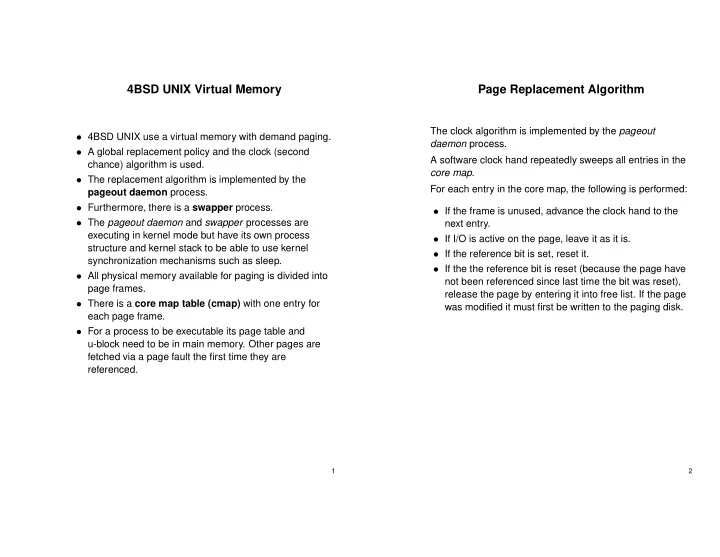
4BSD UNIX Virtual Memory Page Replacement Algorithm The clock algorithm is implemented by the pageout 4BSD UNIX use a virtual memory with demand paging. daemon process. A global replacement policy and the clock (second A software clock


slide-1
SLIDE 1

4BSD UNIX Virtual Memory

  • 4BSD UNIX use a virtual memory with demand paging.
  • A global replacement policy and the clock (second

chance) algorithm is used.

  • The replacement algorithm is implemented by the

pageout daemon process.

  • Furthermore, there is a swapper process.
  • The pageout daemon and swapper processes are

executing in kernel mode but have its own process structure and kernel stack to be able to use kernel synchronization mechanisms such as sleep.

  • All physical memory available for paging is divided into

page frames.

  • There is a core map table (cmap) with one entry for

each page frame.

  • For a process to be executable its page table and

u-block need to be in main memory. Other pages are fetched via a page fault the first time they are referenced.

1

Page Replacement Algorithm

The clock algorithm is implemented by the pageout daemon process. A software clock hand repeatedly sweeps all entries in the core map. For each entry in the core map, the following is performed:

  • If the frame is unused, advance the clock hand to the

next entry.

  • If I/O is active on the page, leave it as it is.
  • If the reference bit is set, reset it.
  • If the the reference bit is reset (because the page have

not been referenced since last time the bit was reset), release the page by entering it into free list. If the page was modified it must first be written to the paging disk.

2

slide-2
SLIDE 2

Clock Algorithm with two Clock Hands

  • If a large main memory is used, the clock algorithm with
  • ne hand do not work very well because the time to

scan all page frames are too large.

  • On some systems an algorithm with two clock hands is

used.

  • The first clock hand is used to reset the reference bit,

and the second clock hand releases pages with the referenced bit still reset. (they have not been referenced in the time span between the scan of the first and second clock hands)

3

Page Replacement Algorithm

  • The goal for the pageout daemon is to assure that there

are a sufficient number of free frames available at all times.

  • The pageout daemon is awakened every 250 ms by a

timeout to check that there is at least lotsfree (system parameter) free page frames. If this is the case the pageout daemon continues to sleep.

  • If the number of free frames is below lotsfree, the clock

hand will sweep a number of steps. How many steps depends of the number of pages needed to reach lotsfree free frames.

  • There is a maximum number of steps the pageout

daemon is allowed to sweep at one occasion. This is adjusted so that the pageout daemon should not use more than 10% of the CPU time.

4

slide-3
SLIDE 3

Swapping

If it is discovered that the paging system is overloaded, the swapper process will be started to swap out some processes entirely (including page table and u-block). The reason for using swapping is to try to avoid that the system enters a thrashing condition. The swapper process is started only if the following conditions are fulfilled:

  • 1. Load average is high (many processes in the ready

queue).

  • 2. The number of free page frames is below a low value

minfree.

  • 3. The average number of free frames is less than desfree.

(lotsfree > desfree > minfree).

5

Swapping

Swapout The swapping algorithm worked as follows:

  • If some process has been idle more than 20 seconds,

swap it out.

  • Else select the one among the four biggest processes

that has been in main memory the longest time. The algorithm is repeated until a sufficient number of frames is available or no more candidate processes for swapping can be found. Swapin with a few seconds interval, the swapper process will check if some swapped out process can be swapped in again. Only the page table and the u-block is brought in by the swapper process. The pages are not fetched until they generate a page fault.

6

slide-4
SLIDE 4

Page Fault Handler

When a process references a page that is not in main memory, a page fault is generated by hardware. In principle the system will allocate a page frame for the page, read it in from the paging disk and update the page table so that the process can be restarted. In some cases the page need not be fetched from the disk:

  • If the page have been used earlier, it may remain

unmodified in the free list. In this case the page can be re-found by a hashing search. The page table is updated and the process restarted.

  • Pages in uninitialized data or stack areas do not need to

be fetched from disk. A free frame is allocated and initialized with zeros, and the process is restarted.

7