48 Ca Enrichment of 48 Ca Enrichment of ~Separation with a crown - - PowerPoint PPT Presentation

48 ca
SMART_READER_LITE
LIVE PREVIEW

48 Ca Enrichment of 48 Ca Enrichment of ~Separation with a crown - - PowerPoint PPT Presentation

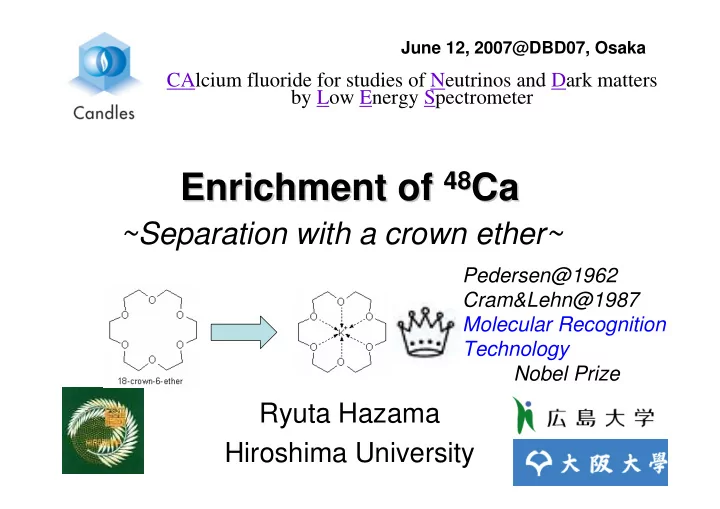
June 12, 2007@DBD07, Osaka CAlcium fluoride for studies of Neutrinos and Dark matters by Low Energy Spectrometer 48 Ca Enrichment of 48 Ca Enrichment of ~Separation with a crown ether~ Pedersen@1962 Cram&Lehn@1987 Molecular Recognition


slide-1
SLIDE 1

Ryuta Hazama Hiroshima University

June 12, 2007@DBD07, Osaka

Enrichment of Enrichment of 48

48Ca

Ca

~Separation with a crown ether~

CAlcium fluoride for studies of Neutrinos and Dark matters by Low Energy Spectrometer Pedersen@1962 Cram&Lehn@1987 Molecular Recognition Technology Nobel Prize

slide-2
SLIDE 2
  • Natural abundance

→ 0.187% – Enriched isotope → expensive

(elemag. separator; Calutrons)~200K$/g

~10g × 2 (in the world) →no gaseous compounds at room temp. Gas centrifuge

48Ca enrichment

A.I.Karchevski ββ isotopes; 48Ca, 96Zr, 150Nd etc.

slide-3
SLIDE 3

×

for Ca

×

Find a cost-effective & efficient way of enrichment!!!

slide-4
SLIDE 4

O O O O O O C C C C C C C C Dicyclohexano 18-crown-6 Crown Ether

  • Held by electrostatic attraction

between negatively charged O- of the C-O dipoles & cation (Ca2+)

  • How well the cation fits into the

crown ring

  • Liquid(aq-salt)-liquid(org-crown)

extraction in isotopic equilibrium

DC18C6 Complexing of cations(anions) by neutral molecules is an uncommon phenomenon.

Ca2+

  • -
  • Total # of atoms in the ring

# of oxygen atoms in the ring

Stability is ~104 ×no-ring(crown)

Unique Property of Crown Ether

slide-5
SLIDE 5

Ca Isotope effects~ ~ ~ ~Separation Principle

40Ca2+(aq)+48CaL2+(org) 48Ca2+(aq)+40CaL2+(org)

DC18C6: Aldrich Chemical, 98.0% CHCl3:Nakarai Tesque, 99.0% CaCl2:Nakarai Tesque, 95.0%

Crown-chloroform organic

CaCl2 aqueous phase

40Ca

0.07M

Magnetic Stirrer

1.vacant extraction to reduce impu. 2.mixed & stirred for 1 hour

  • 3. standing for 1 hour @7

7 7 7° ° ° °C

  • 4. LLE iterated 6 times

Solvent Extraction process

B.E.Jepson&R.Dewitt, J. Inorg.nucl.Chem38(1976)1175

48Ca

slide-6
SLIDE 6

Ca isotope

40Ca 42Ca 43Ca 44Ca 46Ca 48Ca

abunda nce(%) 96.9 0.65 0.135 2.09 0.004 0.187

The mean square Nuclear charge radius

  • f Ca

Two doubly magic isotopes; A parabolic behavior L.Vermeeren et al., J.Phys.G,22(1996)1517 Can be fractionated from the most abundant

4

Ca?

slide-7
SLIDE 7

Major background molecular ions formed from the Ar Plasma, nebulized water and dissolved/contained air.

× × × × × × × ×

Enemy

m/z=

+ +

Max resolution=12000 Resolving power R=m1/(m2-m1)

slide-8
SLIDE 8

Ar+ Ca+ NH3 NH3

+ 40Ar+ 40Ar

Ar+ + NH3 NH3

+ + Ar

Q inside reaction-cell allows use of ammonia can avoid interference of Ar by reaction-gas

Perkin Elmer ELAN-DRCII@Kochi Univ.

How to measure 40Ca?

  • 1. TIMS(TRITON Thermo Electron)

No-Ar

  • 2. Reaction(collision)-cell ICPMS

Simple collision-cell must use simple gas(H2, He) to limit adverse side reaction products

Reduce Ar+109 >103

Only four TRITONs in Japan

40Ca

+

slide-9
SLIDE 9

Ar+ =15.76 eV Ca+=6.11 eV 10.16eV Ca(6.11eV)<NH3(10.16eV)<Ar(15.76eV)

Charge transfer is allowed for Ar+, but disallowed for Ca+

slide-10
SLIDE 10

40Ca,48Ca are doubly magic A parabolic behavior

Nuclear mass effect > Nuclear size&shape effect!!!

mass effect

This is crucial asset to realize 48Ca enrichment (from 40Ca) δ<r2> from Optical Isotope Shifts

K.Helig&K.Steudel,Atom.Data Nucl. Data Tables 14(1974)613

slide-11
SLIDE 11

1.0020 1.0028 1.0010 1.0007 1.0010 1.0010 1.0006 1.0009 1.0006~1.0013

Preliminary

~800 iteration 0.187 2.0%

Comparison

Need to verify by precise TIMS & More iterate LLE

slide-12
SLIDE 12

Prospect for Mass production

LLE by Microchannel/reactor

  • Fast & Highest

conversion synthesis

  • Aqueous-organic multi-

phase flow Column chromatography using crown ether resins

  • Multi-stage process
  • Slow & low conversion

Packed column (stationary phase) Ca solution: Analyte(mobile phase)

Eichrom

  • r IBC

Resin

=

  • Prof. Y. Fujii@TIT Frontal development: α40

48 ~1.0028

slide-13
SLIDE 13

Macro)10cm cube S/V~0.6/cm 250µm wide,100µm deep, and 3cm length S/V~80/cm No-stirring,Fast!!

slide-14
SLIDE 14
slide-15
SLIDE 15

100µm wide,40µm deep, and 40cm length

slide-16
SLIDE 16

World’s 1st 30 ton/yr production Microchip Chemical Plant

3000 3000 3000 3000 microchannels( ( ( (10 10 10 10 blocks) ) ) ) 80 80 80 80μ μ μ μ gel particles ~2L/h

slide-17
SLIDE 17

Summary

  • The preliminary largest separation factor of

Ca by LLE using DC18C6 is suggested.This still needs to be checked by TIMS, temp.& concentration dependence.

  • We evaluated each contribution ratio of the

field shift/hyperfine splitting shift effect to the mass effect of Ca for the 1st time. The contributon of the field shift effect is small, especially for 40Ca-48Ca, compared with Cr.

  • These indications are promissing towards the

mass production of enriched 48Ca by the chemical separation method with the help of resins and/or microchannel chip.

Many Thanks to Prof. Fujii, Y. Sakuma, M. Tanimizu, M. Tokeshi & Y. Shibahara