418 RECENT DEVELOPMENTS2013 2. Business Tax - - PDF document

418
SMART_READER_LITE
LIVE PREVIEW

418 RECENT DEVELOPMENTS2013 2. Business Tax - - PDF document

American Bar Association This information or any portion thereof may not be copied or disseminated in any form or by any means or downloaded or stored in an electronic database or retrieval system without the express written consent of the


slide-1
SLIDE 1
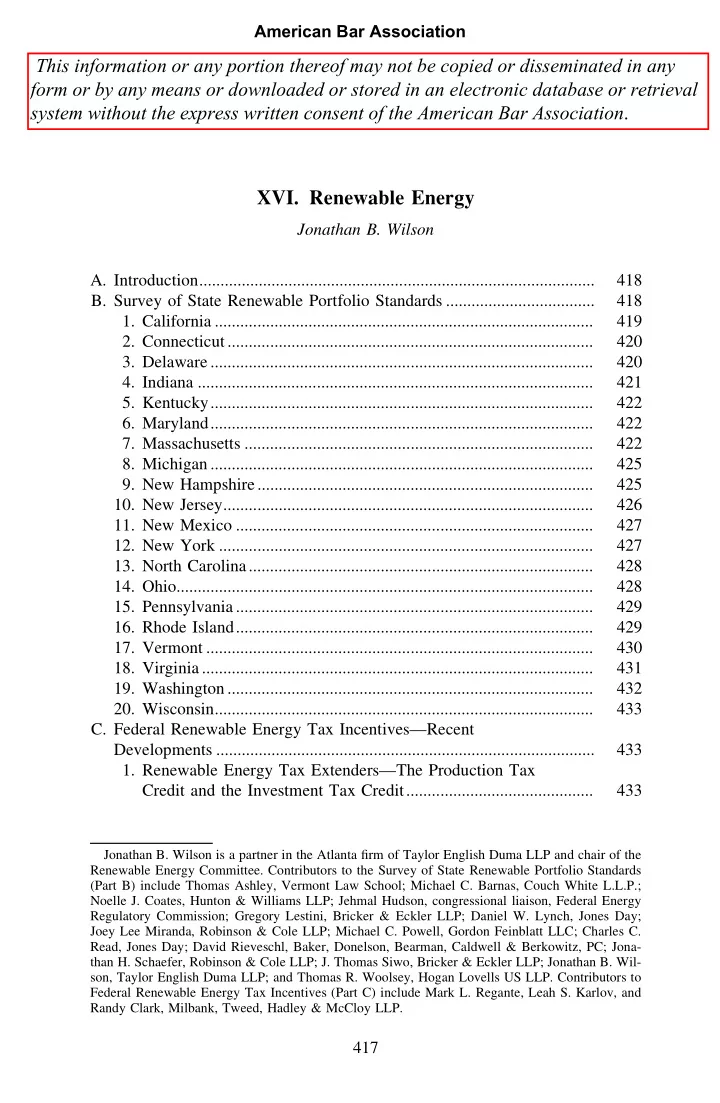
  • XVI. Renewable Energy

Jonathan B. Wilson

  • A. Introduction.............................................................................................

418

  • B. Survey of State Renewable Portfolio Standards ...................................

418

  • 1. California .........................................................................................

419

  • 2. Connecticut ......................................................................................

420

  • 3. Delaware ..........................................................................................

420

  • 4. Indiana .............................................................................................

421

  • 5. Kentucky..........................................................................................

422

  • 6. Maryland..........................................................................................

422

  • 7. Massachusetts ..................................................................................

422

  • 8. Michigan ..........................................................................................

425

  • 9. New Hampshire...............................................................................

425

  • 10. New Jersey.......................................................................................

426

  • 11. New Mexico ....................................................................................

427

  • 12. New York ........................................................................................

427

  • 13. North Carolina.................................................................................

428

  • 14. Ohio..................................................................................................

428

  • 15. Pennsylvania ....................................................................................

429

  • 16. Rhode Island....................................................................................

429

  • 17. Vermont ...........................................................................................

430

  • 18. Virginia ............................................................................................

431

  • 19. Washington ......................................................................................

432

  • 20. Wisconsin.........................................................................................

433

  • C. Federal Renewable Energy Tax Incentives—Recent

Developments ......................................................................................... 433

  • 1. Renewable Energy Tax Extenders—The Production Tax

Credit and the Investment Tax Credit............................................ 433

Jonathan B. Wilson is a partner in the Atlanta firm of Taylor English Duma LLP and chair of the Renewable Energy Committee. Contributors to the Survey of State Renewable Portfolio Standards (Part B) include Thomas Ashley, Vermont Law School; Michael C. Barnas, Couch White L.L.P.; Noelle J. Coates, Hunton & Williams LLP; Jehmal Hudson, congressional liaison, Federal Energy Regulatory Commission; Gregory Lestini, Bricker & Eckler LLP; Daniel W. Lynch, Jones Day; Joey Lee Miranda, Robinson & Cole LLP; Michael C. Powell, Gordon Feinblatt LLC; Charles C. Read, Jones Day; David Rieveschl, Baker, Donelson, Bearman, Caldwell & Berkowitz, PC; Jona- than H. Schaefer, Robinson & Cole LLP; J. Thomas Siwo, Bricker & Eckler LLP; Jonathan B. Wil- son, Taylor English Duma LLP; and Thomas R. Woolsey, Hogan Lovells US LLP. Contributors to Federal Renewable Energy Tax Incentives (Part C) include Mark L. Regante, Leah S. Karlov, and Randy Clark, Milbank, Tweed, Hadley & McCloy LLP.

417 American Bar Association

This information or any portion thereof may not be copied or disseminated in any

form or by any means or downloaded or stored in an electronic database or retrieval system without the express written consent of the American Bar Association.

slide-2
SLIDE 2
  • 2. Business Tax Extenders—Depreciation..........................................

434

  • 3. Sequestration....................................................................................

435

  • 4. The 1603 Cash Grant ......................................................................

436

  • 5. Remaining Issues.............................................................................

437

  • A. INTRODUCTION

The past year was a difficult one for producers of renewable energy in the United States. Several key tax incentives for renewable energy production began to sunset and the political prospects for extending those programs appear

  • unlikely. In 2012, for the first time since 2007, the total production of renewable

energy in the United States declined year-over-year, as hydropower in the Pa- cific Northwest fell dramatically from an above-normal level of production in 2011.1 At the same time, U.S. ethanol production in 2012 amounted to only 13.3 billion gallons, its lowest level since 2009, reflecting drought conditions in the U.S. Midwest and cutbacks and sunsetting of federal liquid fuels tax credits.2 This report updates the Committee’s previously published fifty-state survey of state renewable portfolio standards and its previous reporting on federal tax credit programs.

  • B. SURVEY OF STATE RENEWABLE PORTFOLIO STANDARDS

This Committee’s 2011 report contained a survey of the implementation of renewable portfolio standards (RPS) in the fifty states.3 RPS are a tool used by policymakers to require utilities to generate at least a portion of their total power capacity through one or more types of renewable power generation. This report contains an update of that effort, taking into account developments between January 31, 2012, and January 1, 2013. The appendix on page 438 summarizes RPS requirements by state with more detail available in this section of the report for those states that have changed requirements during the reporting period. Each state’s RPS is described as of January 1, 2013.

  • 1. Short Term Energy Outlook, U.S. ENERGY INFO. ADMIN. (Mar. 19, 2013), http://www.eia.gov/

forecasts/steo/report/renew_co2.cfm.

  • 2. Id.
  • 3. The Database of State Incentives for Renewables & Efficiency (DSIRE) is an ongoing project
  • f the North Carolina Solar Center and the Interstate Renewable Energy Council. It is funded by the

U.S. Department of Energy’s Office of Energy Efficiency and Renewable Energy, primarily through the Office of Planning, Budget and Analysis. The site is administered by the National Renewable Energy Laboratory, which is operated for the Department of Energy by the Alliance for Sustainable Energy, LLC. See generally http://www.dsireusa.org/about/. Although much of the information in this report can be found on the DSIRE website, it is intended to provide a resource with greater legal source citations that was available through the DSIRE website as well as to create a baseline for future reports to the Section.

418

RECENT DEVELOPMENTS—2013

American Bar Association

slide-3
SLIDE 3
  • 1. California

On March 28, 2012, the California Energy Commission (CEC) suspended bio- methane as an RPS-eligible fuel, unless it was biogas produced onsite or deliv- ered via a dedicated pipeline or delivered to the power plant via truck or railcar.4 The CEC’s suspension excluded power plants already certified as RPS-eligible, if certain conditions were met. The resolution cited the preference in Senate Bill X1-25 for electricity generation that displaces in-state fossil fuel consump- tion, reduces in-state air pollution, and helps the state meet its greenhouse gas emission goals. In its notice to consider the resolution, the CEC indicated that biomethane injected into a natural gas pipeline may not displace in-state fossil fuel consumption and may not be physically delivered within California.6 Effectively reversing the CEC’s suspension, on September 27, 2012, Assem- bly Bill 2196 was signed into law, allowing biomethane to count towards Cali- fornia’s RPS requirement under certain conditions.7 This includes biomethane delivered through a natural gas (common carrier) pipeline if

  • The biomethane is injected into a common carrier pipeline that flows within

California or towards the generating facility;

  • The biomethane was not injected into the common carrier pipeline before

March 29, 2012 (or sufficient incremental quantities to satisfy the bio- methane procurement contract requirements began to be injected after March 29, 2012); and

  • The seller or purchaser of the biomethane demonstrates that capture and in-

jection of the biomethane into a common carrier directly reduces or avoids criteria air pollutant emissions in California, reduces or avoids pollutants that adversely affect California waters; or alleviates local nuisance associ- ated with odor emissions within California. Biomethane procurement for contracts executed or amended on or after March 29, 2012, will be assigned to one of the three RPS portfolio content cat- egories, which will depend on how the electricity is delivered from the generat- ing facility consuming the biomethane. In June 2012, the California Public Utilities Commission approved rules to calculate and resolve net deficits in RPS annual procurement target obligations through 2010 and used the statutory “safe harbor” to excuse prior annual pro- curement target deficits.8 The decision also allows RPS contracts of less than ten years’ duration to count towards a utility’s RPS compliance (after a certain

  • 4. Cal. Energy Comm’n, Suspension of RPS Eligibility Guidelines Related to Biomethane, Res.

12-0328-3 (Mar. 28, 2012).

  • 5. S.B. 2, 2011–2012, 1st Ex. Sess. (Cal. 2011).
  • 6. Cal. Energy Comm’n, Notice to Consider Suspension of the RPS Eligibility Guidelines Related

to Biomethane, Docket Nos. 11-RPS-01, 02-REN-1038 (Mar. 16, 2012).

  • 7. A.B. 2196, 2011–2012 Leg., Reg. Sess. (Cal. 2012).
  • 8. Decision Setting Compliance Rules for the Renewables Portfolio Standard Program, Decision

12-06-038 (Cal. Pub. Util. Comm’n June 21, 2012).

RENEWABLE ENERGY

419 American Bar Association

slide-4
SLIDE 4

number of contracts lasting ten years or more have been established); carries forward RPS procurement contracts signed prior to June 1, 2010; and applies excess procurement from one compliance period to future periods, subject to certain limitations.

  • 2. Connecticut

By February 1, 2012, the Department of Energy and Environmental Protection (DEEP) was required to submit a report to the General Assembly analyzing the

  • ptions for minimizing the cost to electric ratepayers of procuring renewable re-

sources and the feasibility of increasing the RPS, including the benefits, costs, and impacts of expanding Class I renewable sources to include hydropower and other technologies that do not use nuclear or fossil fuels.9 As of February 28, 2013, DEEP still had not issued its report. However, in February 2013, DEEP did release its Final Comprehensive En- ergy Strategy (CES).10 Among other things, the CES announced that DEEP would be launching a comprehensive review of the RPS “that will include an eval- uation of whether further changes to Class III renewable energy credits are [also] warranted.”11 This review was expected to be completed in the first quarter of 2013.12 Likewise, as of February 28, 2013, there were proposed bills before the Connecticut legislature to expand the type of hydropower that qualifies as a Class I renewable energy source13 and extend the RPS deadlines beginning in 2016.14

  • 3. Delaware

On April 17, 2012, the Delaware Public Service Commission (PSC) approved final rules implementing legislation signed into law during 2011.15 The new RPS rules permit energy from fuel cells in qualified projects within the state to be used to satisfy renewable energy credit (REC) requirements.16 The new rules also assign sole responsibility for the acquisition of RECs derived from Dela- ware loads to Commission-regulated energy companies (CRECs), and provide for the transfer of existing REC agreements to CRECs from other retail energy

  • 9. An Act Concerning the Establishment of the Department of Energy and Environmental Pro-

tection and Planning for Connecticut’s Energy Future, Conn. Pub. Act 11-80 (2011), § 129 (to be codified in CONN. GEN. STAT.), available at http://www.cga.ct.gov/2011/act/pa/pdf/2011PA-00080- R00SB-01243-PA.pdf.

  • 10. CONN. DEP’T OF ENERGY & ENVTL. PROT., 2013 COMPREHENSIVE ENERGY STRATEGY FOR CONNECT-

ICUT (Feb. 19, 2013), available at http://www.ct.gov/deep/cwp/view.asp?a=4405&q=500752&deep

Nav_GID=2121%20.

  • 11. Id. at 58.
  • 12. Id. at 70.
  • 13. Proposed H.B. 6086 (Conn. 2013).
  • 14. Proposed H.B. 5475 (Conn. 2013).
  • 15. Del. Pub. Serv. Comm’n, Order 8139 (Apr. 17, 2012), implementing DEL. CODE ANN. tit. 26,

§§ 351–353.

  • 16. 26 DEL. ADMIN. CODE § 3008, R. 3.2.4.

420

RECENT DEVELOPMENTS—2013

American Bar Association

slide-5
SLIDE 5

providers.17 Delmarva Power and Light Company is currently the only CREC in the state.

  • 4. Indiana

Indiana has implemented a voluntary RPS, or a clean portfolio standard goal (the CPS goal) as defined in Indiana state law.18 Enacted in May 2011, the Com- prehensive Hoosier Option to Incentivize Cleaner Energy (CHOICE) program allows electricity suppliers to apply to the Indiana Utility Regulatory Commis- sion to participate in the program and the Commission has established rules for participation. The CPS goal is divided into three periods and sets the following benchmarks, requiring participating energy suppliers to utilize not less than the following levels of clean energy (measured as a percentage of their total electricity generated):

  • 1. CPS Goal Period I: For the six calendar years beginning January 1, 2013,

and ending December 31, 2018, an average of at least 4 percent;

  • 2. CPS Goal Period II: For the six calendar years beginning January 1, 2019,

and ending December 31, 2024, an average of at least 7 percent; and

  • 3. CPS Goal Period III: In the calendar year ending December 31, 2025,

at least 10 percent.19 Even though the program is voluntary, the electric utility must still submit its application to the Commission for approval. The Commission must determine the utility’s application is in order and that the utility may reasonably obtain clean energy to meet the energy requirements of the goal. In addition, to approve the application, the Commission must still determine it “will not result in an in- crease to the retail rates and charges of the electricity supplier above what could reasonably be expected if the application were not approved.”20 Only after all three factors are met may the Commission approve the utility’s voluntary application. Indiana defines clean energy resources in roughly a dozen broad categories that range from wind energy to biomass to energy from a natural gas facility constructed after July 1, 2011, that displaces generation from an existing coal- fired plant.21 In concert with the CPS goal, the State of Indiana has an energy efficiency standard that requires utilities to reach a demand-side management (DSM) sav- ings of 2 percent by 2019. Although the program is offered by investor-owned utilities, it is run by a third-party administrator to ensure consistency and effi-

  • 17. Id. R. 3.2.3.
  • 18. IND. CODE ANN. § 8-1-37-5.
  • 19. Id. § 8-1-37-12.
  • 20. Id. § 8-1-37-11.
  • 21. Id. § 8-1-37-4.

RENEWABLE ENERGY

421 American Bar Association

slide-6
SLIDE 6

ciencies in operation. Indiana’s DSM program is the result of an order issued by the Commission.22 In addition to the overall 2 percent reduction, utilities must reduce peak-demand by 0.1 percent for ten years beginning in June of 2008 and ending in 2018. Plans for demand reduction must be submitted to the Com- mission for review and compliance monitoring.

  • 5. Kentucky

As of February 19, 2013, Kentucky did not have an RPS. In 2012, the Ken- tucky Legislature introduced a bill, House Bill 167, aimed at “energy indepen- dence and security by diversifying the portfolio of energy sources used for gen- erating electricity for Kentucky retail electric customers . . .”23 The bill would have created a 12.5 percent RPS by 2022 and beyond with benchmarks and a 1 percent solar carve-out, along with an energy efficiency standard of 10.25 per- cent by 2022. The bill was not adopted in 2012.

  • 6. Maryland

During the winter 2012 session, Maryland passed four pieces of legislation impacting RPS standards. Two promoted solar power and two allowed the use

  • f British thermal unit (BTU) values in place of kilowatts in calculating RECs

for certain thermal systems. In the most far-reaching change, the General Assembly accelerated the dead- lines for meeting the solar power portion of the RPS. The required thresholds were increased for each year starting in 2013, culminating in a requirement that 2 percent of electricity sales must include solar energy by 2021.24 A second bill promoted small solar projects of less than ten kilowatts by permitting the sale of solar energy REC (SREC) contracts with terms less than the previous fifteen-year minimum.25 To promote the installation of geothermal heating and cooling systems, the General Assembly passed legislation allowing owners to substitute BTU values for electricity in calculating RECs.26 A second bill allows BTUs generated from energy (such as methane) created through certain thermochemical and anaerobic digestion thermal biomass systems to be counted as RECs.27

  • 7. Massachusetts

On August 3, 2012, Massachusetts Governor Deval Patrick signed An Act Relative to Competitively Priced Electricity in the Commonwealth (the Act), which contains numerous provisions affecting the energy sector, including pro-

  • 22. Cause No. 42693, available at http://www.in.gov/iurc/files/Cause_No._42693.pdf.
  • 23. Available at www.lrc.ky.gov/record/12rs/hb167.htm.
  • 24. S.B. 791/H.B. 1187 (Md. 2012), amending MD. CODE ANN., PUB. UTIL., § 7-703.
  • 25. H.B. 258 (Md. 2012), amending MD. CODE ANN., PUB. UTIL., § 7-709.
  • 26. S.B. 652/H.B. 1186 (Md. 2012), amending MD. CODE ANN., PUB. UTIL., §§ 7-701, 7-704.
  • 27. S.B. 1004 (Md. 2012), amending MD. CODE ANN., PUB. UTIL., §§ 7-701, 7-704.

422

RECENT DEVELOPMENTS—2013

American Bar Association

slide-7
SLIDE 7

visions relating to studies on useful thermal energy and reducing the reliance

  • n alternative compliance payments for Class II renewable energy generating

sources.28 The Act requires the Executive Office of Energy and Environmental Affairs (EEA) and the Massachusetts Department of Energy Resources (DOER) to conduct a study regarding the inclusion of useful thermal energy in the Alter- native Portfolio Standard (APS). Useful thermal energy can be generated with renewable sources or other alternative energy sources, such as waste heat. The report, submitted to the legislature on December 15, 2012,29 recommends in- cluding useful thermal energy in the APS by awarding qualified projects a one- time strip of alternative energy credits (AECs) for a defined time period (i.e., five or ten years) of modeled net energy generation and concomitant AEC gener- ation.30 The DOER also came to the preliminary conclusion that the current min- imum standard may become insufficient to accommodate new technologies and recommended two possible solutions: (1) change the APS standard to a floating standard, at least for 2015–20, automatically increasing a set percentage point

  • ver the preceding year’s generation; and (2) decrease the influx of AECs by de-

creasing the number of years that AECs are mined for a project, limiting the list of renewable thermal technologies made eligible for the APS, or applying a fraction to the AECs awarded per megawatt hour (MWh) of useful thermal energy.31 The Act further directed DOER to “study what legislative or regulatory steps would serve to reduce reliance on alternative compliance payments [ACP] in meeting Class II renewable energy generating sources” and submit a report to the legislature by January 1, 2013.32 In its report, DOER found that over 70 per- cent of the Class II compliance obligations in 2011 were met using ACP com- pliance, thereby causing the program compliance obligation to be unbalanced with the eligible supply.33 DOER recommended reducing the current 3.6 percent minimum standard—the percentage of electricity each retail electricity provider is required to obtain from qualified Class II sources—to a three-year forward schedule minimum standard, taking effect for the 2013 compliance year and re- flecting past generation while providing for an annual supply growth each of the next three years.34 A formula would be used to maintain, but not exceed, the

  • 28. See An Act Relative to Competitively Priced Electricity in the Commonwealth, Acts 2012,
  • ch. 209 (Mass. 2012), available at http://www.malegislature.gov/Laws/SessionLaws/Acts/2012/

Chapter209.

  • 29. EXECUTIVE OFFICE OF ENERGY & ENVTL. AFFAIRS, DEP’T OF ENERGY RES., HEATING AND COOLING IN

THE MASSACHUSETTS ALTERNATIVE PORTFOLIO STANDARD—REPORT TO THE LEGISLATURE (Dec. 2012),

available at http://www.mass.gov/eea/docs/doer/pub-info/heating-and-cooling-in-aps.pdf.

  • 30. Id. at 6.
  • 31. Id.
  • 32. An Act Relative to Competitively Priced Electricity in the Commonwealth, supra

note 28, § 45.

  • 33. EXECUTIVE OFFICE OF ENERGY & ENVTL. AFFAIRS, DEP’T OF ENERGY RES., EVALUATION OF MASSA-

CHUSETTS RPS CLASS II PROGRAM: MARKET ANALYSIS, RELIANCE ON ACP MECHANISM, AND POLICY REC- OMMENDATIONS—REPORT TO THE LEGISLATURE (Dec. 31, 2012), available at http://www.mass.gov/eea/

docs/doer/pub-info/rps-class-2-evaluation.pdf.

  • 34. Id. at 16.

RENEWABLE ENERGY

423 American Bar Association

slide-8
SLIDE 8

aggregate three-year growth rate, and the forward schedule’s next year’s mini- mum standard would take into consideration the actual settlement of Class II certificates in the last compliance year.35 In August 2012, the DOER issued its final biomass regulation to establish cri- teria that woody biomass facilities must meet under the Massachusetts RPS.36 The key provisions of the regulation are (1) a definition of “eligible biomass woody fuel,”37 (2) a requirement that biomass units provide lifecycle greenhouse gas analysis and demonstrate emissions reductions of at least 50 percent over twenty years,38 (3) a strict limitation on the weight of harvested forest products that can be removed as eligible biomass woody fuel,39 (4) establishment of a threshold requiring overall efficiency of biomass generation units to be at 40 per- cent in order to qualify for one-half renewable energy certificate (REC) credit per MWh of generation—with REC credit increasing linearly to a full credit at an overall efficiency of 60 percent or above,40 and (5) provisions for the treat- ment of existing biomass generation units already qualified for the RPS Class I program.41 On August 23, 2012, the DOER suspended consideration of any woody bio- mass statement of qualifications applications (SQAs) for the RPS Class II pro- gram.42 This suspension is expected to continue until such time as the applicable provisions of the Class I regulation can be promulgated into the Class II regula- tion.43 As of February 28, 2013, the DOER had not yet begun rulemaking on the RPS Class II regulation to accommodate these necessary changes. Effective as of November 1, 2012, higher eligible capacity limits apply for hydroelectric power generating units under the RPS. The limit for hydroelectric in RPS Class I rose from twenty-five to thirty megawatts (MW), and the limit for RPS Class II rose from 5 to 7.5 MW.44

  • 35. Id.
  • 36. Renewable Energy Portfolio Standards—Class I (final regulation published Aug. 2012)

(codified at 225 MASS. CODE REGS. 14.00), available at http://www.mass.gov/eea/energy-utilities- clean-tech/renewable-energy/biomass/renewable-portfolio-standard-biomass-policy.html?utm_cam paign=RPS%20Biomass%20Final%20Regulation&utm_medium=email&utm_source=newsletter&utm_ content=RPS%20Biomass%20Policy%20Regulatory%20Process.

  • 37. 225 MASS. CODE REGS. § 14.02.
  • 38. Id. § 14.05(1)(2)(7)(f).
  • 39. Id. § 14.05(8)(a)(5).
  • 40. Id. § 14.05(8)(c).
  • 41. Id.
  • 42. Letter from Mark D. Sylvia, Comm’r, Mass. Dep’t of Energy Res., to Mass. Biomass & RPS

Stakeholders (Aug. 23, 2012), available at http://www.mass.gov/eea/docs/doer/renewables/biomass/ doer-commisioner-letter-on-biomass-class-ii.pdf.

  • 43. Id.
  • 44. These higher capacity limits are mandated by Act §§ 15 and 16. Although these changes are

not yet incorporated into the RPS regulations, as of November 1, 2012, they are in effect by law. See Press Release, Mass. Dep’t of Energy Res., Higher Eligibility Limits for Hydropower in MA RPS, Classes I & II (Nov. 1, 2012), http://www.mass.gov/eea/docs/doer/rps/higher-mw-limits-for-hydro- ma-rps.pdf.

424

RECENT DEVELOPMENTS—2013

American Bar Association

slide-9
SLIDE 9

For compliance year 2013, the DOER calculated the RPS Class I Solar Carve- Out Minimum Standard to be 0.2744 percent, which is equivalent to a compli- ance obligation of 135,495 MWh under 2011 load assumptions.45 However, on February 27, 2013, the DOER also issued a notice of public comment and hear- ing on revised regulations that include, among other things, proposed changes to the Solar Carve-Out 2013 Minimum Standard.46

  • 8. Michigan

Utilities in Michigan must achieve an RPS of 10 percent by 2015, calculated from a baseline of renewable energy production. The state defines the baseline for a utility as the amount of energy produced by renewable energy sources for the year prior to the implementation of the state’s RPS. Michigan also allows the use of energy efficiency and “advanced energy” to meet a portion of the RPS. Utilities may use advanced energy technologies to meet no more than 10 percent of their overall RPS requirement. In addition, certain renewable sources qualify for bonus credits over the standard source credit. In addition to the RPS, Michigan also has an energy efficiency standard. Util- ities were required to achieve a 0.3 percent reduction of their retail sales through efficiency in both 2008 and 2009. They must achieve 1.0 percent for every sub- sequent year. Michigan has a similar efficiency standard for natural gas, mea- sured in decatherms, with an eventual 0.75 percent reduction over each previous year beginning in 2012 and every year thereafter.

  • 9. New Hampshire

In June 2012, the New Hampshire legislature passed a bill that, as of Janu- ary 1, 2013, permits the useful heat produced by renewable power technologies to qualify to produce RECs that can be used to satisfy the renewables require- ment.47 The value of Class I certificates for useful thermal energy, however, has been set at $25, as compared to $55 for all other Class I certificates.48 The New Hampshire legislature also revised the definition of eligible biomass technologies and renewable energy source.49 In addition, the Class I goal for 2025 was reduced from 16 percent to 15 percent, while the Class III and Class IV goals for 2025 were increased to 8 percent and 1.5 percent, respectively.50 A set percentage of the annual Class I totals must also now be satisfied by the acqui-

  • 45. For information on how the 2013 calculation was made, see http://www.mass.gov/eea/docs/

doer/rps/ma-rps-solar-carve-out-determination-of-cy2013-min-std-doer-082412.pdf.

  • 46. Ongoing Public Rulemaking Process—Regulatory Changes to 225 CMR 14.00 RPS Class I,
  • MASS. EXECUTIVE OFFICE OF ENERGY & ENVTL. AFFAIRS.
  • 47. See An Act Relative to Electric Renewable Portfolio Standards, S.B. 218 (N.H. 2012), avail-

able at http://www.gencourt.state.nh.us/legislation/2012/SB0218.html.

  • 48. N.H. REV. STAT. ANN. § 362-F:10.
  • 49. Id. § 362-F:2.
  • 50. Id. § 362-F:3.

RENEWABLE ENERGY

425 American Bar Association

slide-10
SLIDE 10

sition of RECs from qualifying renewable energy technologies producing useful thermal energy.51 For 2013, this percentage is 0.2 percent with annual increases

  • f 0.2 percent through 2025.52

In January 2013, the New Hampshire Public Utilities Commission (PUC)

  • pened a proceeding to evaluate whether it is appropriate to adjust Class III

renewable portfolio requirements, and, if so, what calendar years should be ad- justed and how the adjustments should be calculated.53 Subsequently, the PUC announced that, as part of the proceeding, it would also address whether it is ap- propriate to accelerate or delay, by up to one year, any given year’s incremental increase in Class I renewable portfolio requirements.54

  • 10. New Jersey

New Jersey recognizes two classes of renewable energy and associated renew- able energy certificates (RECs). Class I Renewable Energy is produced from wind, solar, geothermal, wave, or tidal sources; landfill or biomass fuel sources;

  • r fuel cells using renewable fuels. Class II Renewable Energy is produced at

approved resource recovery or select hydroelectric facilities. Each supplier of electricity is expected to retire RECs in each class at least equal to a mandated percentage of its total sales to customers regulated by the Board of Public Util- ities (BPU). In 2011, rules implementing the Solar Energy Advancement and Fair Com- petition Act (SEAFCA)55 were promulgated. Prior to SEAFCA, each supplier

  • f electricity was required to use SRECs to meet a portion of its Class I require-

ment; both SREC and total Class I targets were stated as a percentage of total

  • sales. SEAFCA restated the SREC carveout as a fixed gigawatt-hour require-
  • ment. The effect was to dramatically increase solar generation targets to 5,316

gigawatt hours in the 2025–26 energy year without regard to overall load growth.56 In 2012, the legislature approved a bill returning to percentage-based targets for solar at rates slightly lower than in the period before SEAFCA.57

  • 51. Id.
  • 52. Id.
  • 53. See N.H. Pub. Utils. Comm’n, Docket No. 13-021, Elec. Renewable Portfolio Standard Ad-

justments to Class III Renewable Portfolio Requirements, Order of Notice (Jan. 18, 2013), available at http://www.puc.nh.gov/Regulatory/Docketbk/2013/13-021/INITIAL%20FILING%20-%20PETI TION/13-021%202013-01-18%20ORDER%20OF%20NOTICE.PDF.

  • 54. See N.H. Pub. Utils. Comm’n, Docket No. 13-021, Elec. Renewable Portfolio Standard Ad-

justments to Class III Renewable Portfolio Requirements, Supplemental Order of Notice (Jan. 31, 2013), available at http://www.puc.nh.gov/Regulatory/Docketbk/2013/13-021/ORDERS/13-021%20 2013-01-31%20SUPP%20ORDER%20OF%20NOTICE.PDF.

  • 55. Solar Energy Advancement and Fair Competition Act, P.L. 2009, c. 289 (N.J. 2009).
  • 56. N.J. ADMIN. CODE § 14:8-2.3, tbl. B.
  • 57. An Act Concerning Certain Electric Customer Metering and Solar Renewable Portfolio Stan-

dards Requirements, P.L. 2012, c. 24 (N.J. 2012).

426

RECENT DEVELOPMENTS—2013

American Bar Association

slide-11
SLIDE 11
  • 11. New Mexico

The New Mexico Public Utilities Commission adjusted the state’s RPS diver- sity targets by modifying the definition of a fully diversified renewable energy portfolio.58 Specifically, the Commission increased the wind target from 20 per- cent to 30 percent of the RPS portfolio and decreased the “other” RPS category target from 10 percent to 5 percent, citing the difficulty experienced by utilities in successfully bringing biomass and biogas projects online.

  • 12. New York

The mandatory component of New York’s RPS is administered by the New York State Energy Research and Development Authority (NYSERDA) under the supervision of the Public Service Commission (PSC).59 It is comprised of two sets of programs: the main tier, under which NYSERDA purchases RPS At- tributes from wholesale generators, and the customer-sited tier (CST), through which NYSERDA supports “behind the meter” projects. CST-eligible technolo- gies include methane digestion, fuel cell, and solar hot water, as well as photo- voltaic solar, ocean, tidal, and wind. On April 19, 2012, the PSC authorized NYSERDA to reallocate $19,093,556 in unencumbered funds from the 2011 program year. The 2011 shortfalls had

  • ccurred in the anaerobic digestion ($13,458,381), solar thermal, and fuel cell

categories; the funds were reallocated for support of solar photovoltaic (PV) ($17,593,556) and small wind projects in the current year. Small PV projects were to be funded at a rate of $1.75 per kilowatt (subject to adjustment by NYSERDA at two-month intervals) and would be capped at 7 kW for residen- tial sites, 50 kW for commercial sites, and 25 kW for projects at not-for-profit institutions.60 In his 2012 annual address, New York Governor Andrew Cuomo announced a “NY-Sun” initiative, with the intent of doubling during 2012 the installed base

  • f customer-sited solar capacity over the previous year, followed by doubling

the 2012 installed base in 2013. To support this initiative, the PSC issued an-

  • ther order providing expanded funding for CST programs.61

The Commission ordered NYSERDA to reallocate $36,400,000 of unencum- bered main tier funds to 2012 PV projects in the CST. All of the 2012 funds were directed to the “Geographic Balance” program, under which NYSERDA evalu- ates competing proposals for larger projects to be located throughout the state. The Commission also ordered NYSERDA to reallocate $54,000,000 from its 2013 main tier budget to PV programs in the CST. Of that amount, $13,500,000

  • 58. N.M. Pub. Regulatory Comm’n, Final Order Repealing and Replacing Rule 17.9.572 NMAC,

Case No. 11-00218-UT (Dec. 18, 2012).

  • 59. Details may be found at http://www.nyserda.org/rps/index.asp.
  • 60. N.Y. Pub. Serv. Comm’n Order, Case 03-E-0188 (Apr. 20, 2012).
  • 61. N.Y. Pub. Serv. Comm’n Order, Case 03-E-0188 (Apr. 24, 2012).

RENEWABLE ENERGY

427 American Bar Association

slide-12
SLIDE 12

was allocated to smaller first-come, first-served projects, with the balance re- served for the Geographic Balance program. In its April 24, 2012, order, the PSC also ordered NYSERDA to submit a Re- newable Portfolio Standard Customer-Sited Tier Operating Plan for the years 2012 through 2014. NYSERDA did so on June 2962 because “without consum- ing electricity from the grid, it cannot generate electricity, renewable or not.”63

  • 13. North Carolina

The North Carolina Utilities Commission (NCUC) modified the poultry and swine waste set-aside requirements of the North Carolina RPS by relieving the poultry and swine waste requirements for 2012 and initiating those require- ments for the first time in 2013.64 The impetus for the change was the insuffi- cient progress made in the development of power generators from poultry and swine waste and delayed completion of power purchase agreements between incumbent utilities and developers. The ruling allows utilities that acquired swine and poultry waste RECs for 2012 to bank those RECs for future compli- ance years. After giving effect to the changes required by the order, the North Carolina RPS schedule is

  • 2010: 0.02 percent from solar.
  • 2012: 3 percent (including 0.07 percent from solar).
  • 2013: 3 percent (including 0.07 percent from solar + 0.07 percent from

swine waste + 170,000 MWh from poultry waste).

  • 2014: 3 percent (including 0.07 percent from solar + 0.07 percent from swine

waste + 700,000 MWh from poultry waste).

  • 2015: 6 percent (including 0.14 percent from solar + 0.14 percent from swine

waste + 900,000 MWh from poultry waste).

  • 2018: 10 percent (including 0.20 percent from solar + 0.20 percent from

swine waste + 900,000 MWh from poultry waste).

  • 2021: 12.5 percent (including 0.20 percent from solar + 0.20 percent from

swine waste + 900,000 MWh from poultry waste).

  • 14. Ohio

Ohio’s RPS includes renewable energy sources, advanced energy sources, en- ergy efficiency, and a state-sourced requirement. Ohio’s RPS requires utilities to generate 25 percent of their retail electric energy from advanced or renewable

  • 62. Available at http://www.nyserda.ny.gov/Program-Planning/Renewable-Portfolio-Standard.aspx#

customer.

  • 63. Id. at 7.
  • 64. Order Modifying the Poultry and Swine Waste Set-aside Requirements and Granting Other

Relief, Docket No. E-100, Sub 113 (Nov. 29, 2012), available at http://ncuc.commerce.state.nc.us/ cgi-bin/webview/senddoc.pgm?itype=Q&parm2=KBAAAA43321B&parm3=000127195

428

RECENT DEVELOPMENTS—2013

American Bar Association

slide-13
SLIDE 13

energy sources by 2025. This reduction must take place off of a baseline estab- lished by the average retail sales over the three preceding years. Half of the 25 percent mandate must be from renewable sources such as wind, biomass, solar, and geothermal. Half of the renewable percentage must come from gener- ation in Ohio. The other 12.5 percent of the RPS mandate may come from ad- vanced energy sources that include combined heat and power, fuel cells, clean coal, and advanced nuclear. In addition to the division between advanced and re- newable sources, a total of 0.5 percent of the renewable production must come from solar by the year 2025. Ohio’s code includes rulemaking authority on the part of the Public Utilities Commission of Ohio as it pertains to the state’s RPS. Ohio also has an energy efficiency standard that equals a total cumulative 22 percent reduction in energy usage by 2025. The 22 percent can be achieved through energy efficiency measures and peak demand reduction. Peak demand reduction must equal a 7 percent reduction over a three-year average by 2017. In 2012, the Ohio legislature passed S.B. 315, enabling waste energy recovery systems and combined heat and power systems to qualify as energy-efficient resources.

  • 15. Pennsylvania

Pennsylvania’s Alternative Energy Portfolio Standard (AEPS) requires 18 per- cent of a utility’s production to come from renewable or alternative sources by

  • 2020. The standard is broken into two tiers. Tier I sources include renewable en-

ergy production such as photovoltaic, solar thermal, wind, coal-mine methane, and geothermal. A total of 8 percent of utility’s production must come from Tier I sources. Tier II technologies include clean coal, distributed generation, wood pulping, demand-side management, municipal solid waste, and inte- grated gasification combined cycle coal. Ten percent must come from Tier II sources. Pennsylvania also requires utilities to meet energy efficiency and conservation

  • standards. Utilities must reduce energy consumption by 1 percent by mid-2011

and 3 percent by 2013. In addition, utilities must reduce peak demand by 4.5 per- cent by 2013. Under the state’s conservation program, the Pennsylvania Public Utilities Commission established guidelines including procedures for approving utility plans, standards for diversifying energy efficiency mechanisms, and a cost recovery plan to ensure that those consumers benefiting from the conservation measures are the same rate payers financing the improvements, among others. All criteria for the Pennsylvania energy efficiency program can be found in the Commission’s rules.

  • 16. Rhode Island

In July 2011, Rhode Island established a renewable energy coordinating board to draft and recommend a strategic renewable energy implementation plan.65

  • 65. R.I. GEN. LAWS § 42-140.3-8.

RENEWABLE ENERGY

429 American Bar Association

slide-14
SLIDE 14

The plan coordinates implementation of renewable energy policies, including the renewable energy standard (RES), by state agencies.66 The board is required to issue a biannual report to the governor, legislature, and state agencies on March 15 and September 15.67 Although the first report was due on March 15, 2012, it had not been released as of February 28, 2013.68

  • 17. Vermont

Vermont law required its Public Service Board (PSB) to make a determination

  • n or before January 1, 2013, regarding the total amount of sustainably priced

energy enterprise development (SPEED) resources that were supplied (or certi- fied to have been supplied) to Vermont retail electricity providers in order to de- termine if the SPEED program is successful.69 The SPEED program would be deemed successful if either (1) the amount of qualifying SPEED resources that were issued a certificate or came online, between January 1, 2005, and July 1, 2012, were equal to or greater than the aggregate statewide growth in retail elec- tric sales during that same time period, and at least 5 percent of the 2005 total re- tail electric sales in the state were provided by qualified SPEED resources, or (2) the amount of qualifying SPEED resources was equal to or greater than 10 per- cent of the retail electric sales in 2005 for the state.70 If neither of these conditions was met, the RPS would have become mandatory and the state’s electric utilities would have been required to meet any increase in statewide retail electricity sales between 2005 and 2012 by using renewables with associated attributes, by pur- chasing RECs, or by making an alternative compliance payment to the Vermont Clean Energy Development Fund.71 On December 18, 2012, the PSB issued an

  • rder finding that the 2012 SPEED goal had been met because the first condition

had been satisfied.72 In 2012, Vermont Act 170 (Act 170) amended the state’s renewable energy goals but did not include an RPS.73 The existing SPEED goal of 20 percent

  • f total retail sales statewide from new renewable energy by 2017 remains in

place, while a new total renewables target (TRT) was created.74 The TRT is a tar- get for renewable energy addressed to the specific supply portfolios of each com-

  • 66. Id. § 42-140.3-11(7).
  • 67. Id. § 42-140.3-8(e).
  • 68. Id.
  • 69. VT. STAT. ANN. tit. 30, § 8005(d)(2).
  • 70. Id. § 8005(d)(1).
  • 71. 30 V.S.A. § 8004.
  • 72. Vt. Pub. Serv. Bd. Investigation, Pursuant to 30 V.S.A. § 8005(d)(1), into the Total Amount of

Qualifying SPEED Resources, Report and Recommendation re: Amount of SPEED Resources, Docket No. 7812, (Dec. 18, 2012), available at http://psb.vermont.gov/sites/psb/files/orders/2012/ 2012-12/7812Final.pdf.

  • 73. An Act Relating to the Vermont Energy Act of 2012 (S. 214), Act No. 170 (Vt. 2012), avail-

able at http://www.leg.state.vt.us/docs/2012/Acts/ACT170.pdf.

  • 74. Id. § 3.

430

RECENT DEVELOPMENTS—2013

American Bar Association

slide-15
SLIDE 15

pany engaged in the distribution or sale of electricity directly to the public.75 The TRT starting in 2017 is 55 percent and rises to 75 percent by 2032.76 Act 170 also required the PSB to conduct a study, which was released on Jan- uary 15, 2013, on whether and how to establish an RPS.77 Although the report did not contain any specific recommendations for legislative action (such as the enactment of an RPS), it did recommend that, if the legislature chooses to adopt a new renewable energy policy, that the policy (1) encourage the de- velopment of the most cost-effective new renewable resources, regardless of whether they are located in Vermont or elsewhere, and (2) encourage the de- velopment of in-state renewable distributed generation resources to the extent permissible under federal law in order to bolster Vermont’s transmission and distribution systems.78 The report also recommended any renewable policy to be mindful of Federal Trade Commission guidelines regarding the use of en- vironmental claims, specifically those regarding renewable energy, to ensure that customers would be aware of the nature of the electricity that they pur- chase.79 Finally, in order to avoid double counting of environmental benefits, the report recommended that RECs associated with utility-owned (or purchased) renewable energy be retired, and that any generation facility seeking to become eligible for a Vermont RPS register with ISO New England’s NEPOOL GIS system.80 Finally, Act 170 required the Department of Public Service (DPS) to report on proposed policies and funding mechanisms that would support achieving DPS’s recommendation that 90 percent of energy consumed in Vermont be renewable by 2050.81 Intended to address Vermont’s total energy consumption, including electricity, thermal energy, and transportation, the report is due by December 15, 2013.82

  • 18. Virginia

The 2013 session of the Virginia General Assembly produced several bills that would amend the statutory provisions governing the Commonwealth’s vol- untary RPS program. The ones that survived the legislative process and either were signed into law by Governor McDonnell or are awaiting signature make potentially significant changes to the program.

  • 75. Id.; see VT. STAT. ANN. tit. 30, § 8002(9).
  • 76. Act 170 § 3.
  • 77. PUB. SERV. BD. IN CONSULTATION WITH THE COMM’R OF PUB. SERV., FURTHER ANALYSIS AND RE-

PORT ON RENEWABLE ENERGY REQUIREMENTS (Jan. 15, 2013), available at http://psb.vermont.gov/

sites/psb/files/publications/Reports%20to%20legislature/RPSreport2013/Further%20Analysis%20and%20 Report%20on%20Renewable%20Energy.pdf.

  • 78. Id.
  • 79. Id. at 9.
  • 80. Id. at 8.
  • 81. Act 170 § 13. The DPS recommendation can be found in the 2011 Comprehensive Energy

Plan, available at http://publicservice.vermont.gov/publications/energy_plan/2011_plan.

  • 82. Id.

RENEWABLE ENERGY

431 American Bar Association

slide-16
SLIDE 16

In February, the governor signed emergency legislation83 that, among other changes to the statutes governing the rates of Virginia’s two investor-owned util- ities, eliminated the fifty-basis-point bonus on the return on common equity that had been available to the utilities if they met the RPS goals. Another bill that was approved by both houses of the General Assembly adds “solar energy system” to the definition of renewable thermal energy as an eligi- ble source for meeting the RPS goals.84 Finally, legislation passed by both houses clarifies that renewable energy pur- chased by a participating utility is eligible to meet the RPS goals only if the power purchase agreement expressly transfers ownership of the associated re- newable attributes to the utility. The legislation also changes the geographic lo- cation of eligible renewable facilities owned by the participating utility: if the public utility owns at least a 49 percent interest in the facility and is located in the Commonwealth, in PJM’s footprint, or in a control area adjacent to PJM, the energy generated by such facility can be used towards meeting the RPS goals.85

  • 19. Washington

Effective June 7, 2012, the Washington legislature updated the definition of “biomass energy” to include, subject to certain exceptions:

(i) [o]rganic by-products of pulping and the wood manufacturing process; (ii) animal manure; (iii) solid organic fuels from wood; (iv) forest or field residues; (v) untreated wooden demolition or construction debris; (vi) food waste and food processing re- siduals; (vii) liquors derived from algae; (viii) dedicated energy crops; and (ix) yard waste.86

Additionally, the legislature also amended Washington Revised Code § 19.285.030 to allow biomass energy facilities in operation before March 31, 1999, to be con- sidered “qualified biomass energy facilities” for the state’s RES.87 However, after January 1, 2016, the use of qualified biomass energy will be limited to a utility that owns or is directly interconnected to the biomass facility to meet its RES obligation.88 Additionally, utilities may no longer use biomass facilities if the associated industrial pulping or wood manufacturing facility ceases oper- ation for any purpose other than maintenance or upgrade.89

  • 83. H.B. 2261 (Va. 2013).
  • 84. H.B. 1917 (Va. 2013).
  • 85. H.B. 2180 (Va. 2013).
  • 86. E.S.B. 5575, 62d Leg., Reg. Sess. (Wash. 2012), amending WASH. REV. CODE §§ 19.285.030

and 19.285.040 and creating a new section.

  • 87. Id.
  • 88. See WASH. REV. CODE § 19.285.040(2)(j) (2012).
  • 89. Id.

432

RECENT DEVELOPMENTS—2013

American Bar Association

slide-17
SLIDE 17
  • 20. Wisconsin

The Wisconsin legislature amended Wisconsin Statutes § 196.378(3) to (1) permit an electric provider to bank excess renewable resource credits for use in a subsequent year and (2) allow a customer or member of an electric pro- vider to create renewable resource credits from its use of renewable energy of certain types (including wind, hydroelectric, and solar) if the use displaces such person’s use of electricity from conventional resources.

  • C. FEDERAL RENEWABLE ENERGY TAX

INCENTIVES—RECENT DEVELOPMENTS Approved by Congress on January 1, 2013, H.R. 8, the American Taxpayer Relief Act of 2012 was signed into law by President Obama on January 2, 2013.90 The Act was intended to avert the so-called fiscal cliff and includes a number of extensions and modifications related to renewable energy tax provi- sions, including the 2.2-cent-per-kilowatt-hour production tax credit (PTC)91 and the 30 percent investment tax credit (ITC).92 The Act also contains certain business tax extenders, such as bonus depreciation, important to renewable en- ergy projects. In addition, the Act delayed the planned budget sequestrations from January 2, 2013, to March 1, 2013.93

  • 1. Renewable Energy Tax Extenders—Production Tax Credit

and the Investment Tax Credit Section 407 of the Act extends the PTC and ITC to otherwise qualifying wind facilities for which construction begins before January 1, 2014. In addition to wind energy facilities, construction requirement replaces the prior “placed in service before January 1, 2014” requirement applicable to several other types

  • f renewable energy facilities, including closed and open-loop biomass facilities,

geothermal facilities, landfill gas facilities, trash facilities, qualified hydropower facilities, and qualified marine and hydrokinetic renewable energy facilities. Consequently, any such otherwise qualifying facility (or the -electricity gener- ated and sold from any such facility), construction of which begins before Jan- uary 1, 2014, will also be eligible for the PTC or the ITC, regardless of when the facility is placed in service. The Act left several questions unanswered by the Act and, as of the date of this report, no official guidance has been issued.94 As an initial matter, the Act fails to define what it means to “begin construction.” A similar standard

  • 90. American Taxpayer Relief Act of 2012, Pub. L. No. 112-240, 126 Stat. 2313 (2013).
  • 91. I.R.C. § 45 (Internal Revenue Code of 1986).
  • 92. I.R.C. § 48.
  • 93. American Taxpayer Relief Act § 1001.
  • 94. The staff of the Joint Committee on Taxation published a general explanation of the Act, but it

did not provide an explanation or interpretation of the PTC and ITC provisions.

RENEWABLE ENERGY

433 American Bar Association

slide-18
SLIDE 18

was applicable for purposes of cash grants under § 1603 of Division B of the American Recovery and Reinvestment Act of 2009 (ARRA).95 The guidelines issued by the U.S. Department of the Treasury in connection with the cash grant program provided that a grant applicant “commenced construction” if it had started and continued physical work of a significant nature or had paid or incurred at least 5 percent of the total cost of the renewable energy project (com- monly referred to as the 5 percent safe harbor). Although the “begin construc- tion” standard under the Act is similar to the “commence construction” standard under ARRA § 1603, it is not clear that the Internal Revenue Service will apply the same standards as those used by Treasury in the case of cash grants. For example, it is possible that the IRS, borrowing from the standards used for pur- poses of bonus depreciation, could adopt a 10 percent rather than 5 percent safe

  • harbor. This would mean that renewable energy project owners would have to

incur at least 10 percent of the total project cost before January 1, 2014, in

  • rder to be treated as having begun construction under the Act.96 However, all
  • f this is speculation at this point until formal guidance is issued.

It is important to note that the Act does not modify the current PTC and ITC placed-in-service eligibility requirements for all renewable energy facilities, most notably solar energy facilities. Solar energy facilities still must be placed in service before January 1, 2017, to be eligible for the ITC.97 Unlike solar en- ergy facilities, the date by which a taxpayer could place in service a wind energy facility and qualify for PTCs or the ITC was about to expire and, given the lead time required to develop and build wind energy facilities, a “begin construction” standard for wind energy facilities (and certain others) received sufficient legis- lative support. Likely, at least in part due to the legislative climate surrounding the fiscal cliff, there was not sufficient legislative support to adopt a similar stan- dard for solar energy facilities that continue to have another four years to satisfy the placed-in-service date requirement. The Act also did not modify the current PTC and ITC placed-in-service eli- gibility requirements for small irrigation power facilities, refined coal production facilities, and coal facilities on Tribal lands. However, the Act extends the avail- able PTC period for Native American coal facilities placed in service before Jan- uary 1, 2009, from seven years to eight years.98

  • 2. Business Tax Extenders—Depreciation

Section 331 of the Act extends the special first-year depreciation allowance, commonly referred to as 50 percent bonus depreciation, to qualifying property that is both acquired and placed in service before January 1, 2014. Under

  • 95. American Recovery and Reinvestment Act of 2009, Pub. L. No. 111-5, 123 Stat. 115.
  • 96. See Treas. Reg. § 1.168(k)-1(b)(4)(iii)(B)(2). That standard provided a safe harbor where the

taxpayer paid or incurred more than 10 percent of the total cost of the property. Id.

  • 97. Pursuant to law in effect since 2004, solar energy facilities placed in service after 2005 have

not been eligible for the PTC.

  • 98. American Taxpayer Relief Act § 406.

434

RECENT DEVELOPMENTS—2013

American Bar Association

slide-19
SLIDE 19

prior law, property placed in service after December 31, 2012, would not have been eligible for 50 percent bonus depreciation.99 In addition, certain long production-period property and aircraft will be eligible for 50 percent bonus de- preciation if acquired before January 1, 2014, and placed in service before January 1, 2015. Section 315 of the Act extends the increased limitation for the expensing

  • f certain depreciable property under Internal Revenue Code § 179. Under the

Act, an aggregate cost of up to $500,000 may be taken into account as a deduct- ible § 179 expense for qualifying property placed in service in 2013.100 The $500,000 limitation is subject to reduction if the total amount of qualifying prop- erty placed in service in 2013 exceeds $500,000.101 For taxable years after 2013, the applicable limitation is $25,000, which is subject to reduction if the total amount of qualifying property exceeds $200,000.102 Section 313 of the Act reintroduces the special accelerated depreciation periods for business property used on an Indian reservation. For qualified Indian reservation property placed in service on or before December 31, 2011, IRC § 168(j)(2) provided special recovery periods that were shorter than the other- wise applicable MACRS periods. The Act provides that § 168(j) will apply to property placed in service on or before December 31, 2013, explicitly including qualified Indian reservation property placed in service in 2012.103

  • 3. Sequestration

Section 1001 of the Act modifies the sequestration provisions of the Balanced Budget and Emergency Deficit Control Act of 1985,104 as amended by the Bud- get Control Act of 2011 (BCA).105 The BCA requires a mandatory sequestration, starting within fifteen days after the current Congress adjourns, to eliminate any budget-year breach of specified discretionary spending limits. The Act provides that, notwithstanding any other provision of law, this “after-session” sequestra- tion for fiscal year 2013 will be implemented on March 27, 2013. In addition, the BCA requires that, unless an approved budget achieves a def- icit reduction of greater than $1.2 trillion, discretionary spending limits, dis- cretionary appropriations, and direct spending must be further reduced. These reductions were previewed in a report published in September 2012 by the Of- fice of Management and Budget (OMB) pursuant to the Sequestration Transpar- ency Act of 2012.106 That report suggested that funding for cash grants would be reduced by 7.6 percent without answering significant questions as to how such

  • 99. See former I.R.C. § 168(k).
  • 100. American Taxpayer Relief Act § 331.
  • 101. Id.
  • 102. Id.
  • 103. Id. § 313.
  • 104. Balanced Budget and Emergency Deficit Control Act of 1985, Pub. L. No. 99-177, 99 Stat.

1037.

  • 105. Budget Control Act of 2011, Pub. L. No. 112-25, 125 Stat. 240.
  • 106. Sequestration Transparency Act of 2012, Pub. L. No. 112-155, 126 Stat. 1210.

RENEWABLE ENERGY

435 American Bar Association

slide-20
SLIDE 20

cuts would be implemented. A recent report issued by the Congressional Budget Office estimated the sequestration reduction for cash grants to be 5.3 percent. Given the number of months remaining in fiscal year 2013, this would effec- tively amount to a 9 percent reduction for cash grants paid after the date the sequestration order is issued.107 The Act provided that the sequestration, previously required to be calculated by OMB and ordered by the president for fiscal year 2013 on January 2, 2013, would be delayed until March 1, 2013. The Act therefore did not prevent seques- tration, but provided additional time to reach a budget deal and avoid the dam- aging effects highlighted in the OMB report. Because a budget deal was not reached by the March 1, 2013, deadline, President Obama signed the sequestra- tion order.108 In response, Treasury announced three days later that every final decision concerning cash grant, evidenced by an award letter that is delivered between March 1, 2013, and September 30, 2013, will reflect an 8.7 percent re- duction in the cash grant award amount.109 This reduction will apply regardless

  • f the date that Treasury received the application for a dash grant. The 8.7 per-

cent reduction is subject to change when the fiscal year ends on September 30, 2013.

  • 4. 1603 Cash Grant

To stimulate investment in U.S.-based renewable energy projects, ARRA § 1603, as amended by the Tax Relief, Unemployment Insurance Reauthoriza- tion, and Job Creation Act of 2010,110 directs Treasury to pay cash grants in lieu of the ITC to owners (and, in some cases, lessees) of certain renewable en- ergy projects, including solar, wind, biomass, combined heat and power, fuel cells, geothermal, incremental hydropower, landfill gas, marine hydrokinetic, microturbine, and municipal solid waste facilities.111 Among other require- ments, to be eligible for a cash grant, the property must have been placed in ser- vice in 2009, 2010, or 2011; or, if the property was not placed in service during that period, construction must have begun after December 31, 2008, and before January 1, 2012. Further, the property must be placed in service before the “credit termination date” applicable to the particular type of project. The credit termination date was January 1, 2013, for large wind energy facilities and is

  • 107. CONGRESSIONAL BUDGET OFFICE, THE BUDGET AND ECONOMIC OUTLOOK: FISCAL YEARS 2013–

2023 (Feb. 2013).

  • 108. Memorandum from Jeffrey D. Zients, Deputy Dir., Executive Office of the President, Office
  • f Mgmt. & Budget, Issuance of the Sequestration Order Pursuant to Section 251A of the Balanced

Budget and Emergency Deficit Control Act of 1985, as amended (Mar. 1, 2013), available at http:// www.whitehouse.gov/sites/default/files/omb/memoranda/2013/m-13-06.pdf.

  • 109. Press Release, U.S. Dep’t of Treasury, Message on Sequestration (Mar. 4, 2013), available at

http://www.treasury.gov/initiatives/recovery/Documents/Message%20on%20Sequestration%201603 %20Program.pdf.

  • 110. Tax Relief, Unemployment Insurance Reauthorization, and Job Creation Act of 2010, Pub. L.
  • No. 111-312, 124 Stat. 3296.
  • 111. I.R.C. § 46, as amended.

436

RECENT DEVELOPMENTS—2013

American Bar Association

slide-21
SLIDE 21

January 1, 2017, for solar energy facilities.112 The cash grant credit termination dates and the commencement of construction requirement were not extended, nor were cash grant eligibility requirements otherwise modified by the Act.

  • 5. Remaining Issues

The commencement of construction deadline has passed and renewable en- ergy projects that did not commence construction before January 1, 2012, or that did not file either a “begun construction application” or “placed in service application” before October 1, 2012, will not qualify for cash grants. Neverthe- less, several important aspects remain relevant to renewable energy projects, their equity owners, and their lenders on a going-forward basis. As an initial matter, to be eligible to receive a cash grant, the renewable en- ergy property must be placed in service by the relevant credit termination date. For applicants that met the commencement of construction requirement but did not place the property in service prior to October 1, 2012, and, as a result, sub- mitted a begun construction application prior to the October 1, 2012, deadline, a subsequent placed-in-service application must be filed no later than ninety days after the renewable energy property is placed in service. Although ARRA § 1603 directs that cash grants be paid within sixty days of receipt of a placed-in-service application, Treasury often has questions about an application and does not treat the application as being complete until its ques- tions have been satisfactorily answered. Further, as described above, sequestra- tion and other legislative action or inaction could further delay or reduce pay-

  • ments. Cash grant proceeds are subject to recapture if eligibility requirements

are not continuously satisfied during the five-year period beginning on the date the renewable energy property is placed in service.113 If cash grant property ceases to qualify as specified energy property within the recapture period or the property is transferred (directly or indirectly) to “disqualified persons” during the recapture period, all or a portion of the cash grant received must be repaid to Treasury.114

  • 112. For most other types of renewable energy facilities, the credit termination date is January 1,

2014.

  • 113. If certain eligibility requirements cease to be met within five years from the date the property

is placed in service, the cash grant must be repaid to the Treasury as follows: 100 percent of the cash grant must be repaid if the disqualifying event takes place within one year of the date the property is placed in service; 80 percent if the disqualifying event takes place after one year but before two years from the placed-in-service date; 60 percent if the disqualifying event takes place after two years but before three years from the placed-in-service date; 40 percent if the disqualifying event takes place after three years but before four years from the placed-in-service date; and 20 percent if the disqual- ifying event takes place after four years but before five years from the placed-in-service date.

  • 114. “Disqualified persons,” as defined by the Treasury, are not eligible for cash grants. Generally

speaking, disqualified persons include (i) federal, state, or local governments; (ii) tax-exempt entities; and (iii) partnerships or other pass-through entities with such persons as direct or indirect partners or members, unless they own their interest through an entity treated as a taxable C corporation. There is no de minimis exception; any direct or indirect ownership by a disqualified person will disqualify the applicant for any amount of cash grant. In addition, subject to a limited exception for certain projects located in U.S. possessions, the cash grant is only available for U.S.-based renewable energy projects.

RENEWABLE ENERGY

437 American Bar Association

slide-22
SLIDE 22

Appendix

State Renewable Portfolio Standards as of January 1, 2013 State RPS Summary Change since 1/31/2012** Alabama None None Alaska None None Arizona

  • ARIZ. ADMIN CODE

§ 14-2-1804(b) (LexisNexis 2011) 15% by 2025 None Arkansas None None California

  • CAL. PUB. UTIL.

CODE § 399.11 (West 2011); Executive Order S-21-09 20% by 2013 and 33% by 2020 ** Colorado

  • COLO. REV. STAT.
  • ANN. § 40-2-124

(1)(c)(I) (2010) 12% by 2011–14, increasing to 30% by 2020 None Connecticut

  • CONN. GEN. STAT.

§ 16-1(a) et seq., as amended by

  • Pub. Act 11-80

(2011) (not yet codified) 12% by 2011, increasing to 20% by 2020 ** Delaware

  • DEL. CODE ANN. tit.

26, § 351 et seq. 25% by 2025 ** Florida None None Georgia None None Hawaii

  • HAW. REV. STAT.

§ 9-92(a) et seq. 40% by 2030 None Idaho None None Illinois 20 ILL. COMP. STAT. 3855/1-75 (2010) 2% in 2008, increasing to 25% by 2025 None (Continued) 438

RECENT DEVELOPMENTS—2013

American Bar Association

slide-23
SLIDE 23

State Renewable Portfolio Standards as of January 1, 2013 (Continued) State RPS Summary Change since 1/31/2012** Indiana Cause No. 42693;

  • IND. CODE ANN.

§ 8-1-37-5-b. (West 2011) 2% by 2019 ** Iowa IOWA CODE § 476.41 et seq. (2009) State’s two investor-

  • wned utilities

must produce at least 105 MW of renewable power; voluntary goal set at 1,000 MW by 2001 None Kansas

  • KAN. STAT. ANN.

§§ 66-1256–66- 1262 20% by 2020 None Kentucky None ** Louisiana None None Maine

  • ME. REV. STAT.
  • ANN. tit. 35,

§ 3210 30% by 1999; new additional generation required of 10% by 2017; additional wind generation capacity required in stages through 2030 None Maryland

  • MD. CODE ANN.,
  • PUB. UTIL. COS.

§ 7-701 et seq. 3.5% in 2006, increasing to 20% by 2022 ** Massachusetts 225 MASS. CODE

  • REGS. § 14.05 et

seq. Multiple standards ** Michigan

  • MICH. COMP. LAWS

§ 460.1021 et seq. 10% by 2015 ** (Continued)

RENEWABLE ENERGY

439 American Bar Association

slide-24
SLIDE 24

State Renewable Portfolio Standards as of January 1, 2013 (Continued) State RPS Summary Change since 1/31/2012** Minnesota

  • MINN. STAT.

§ 216B.1691 (2010) Multiple standards; Xcel Energy required to generate 15% by 2010, increasing to 30% by 2020; different requirements for

  • ther generators

None Mississippi None None Missouri

  • MO. REV. STAT.

§ 393.1020 (2010) 2% by 2011, increasing to 15% by 2021 None Montana

  • MONT. CODE ANN.

§ 69-3-2004 et

  • seq. (2010)

10% by 2010, increasing to 15% by 2015 None Nebraska None None Nevada

  • NEV. REV. STAT.

§ 704.7818 (2010) 15% in 2011, increasing to 25% by 2025 None New Hampshire N.H. REV. STAT.

  • ANN. § 362-F:1

et seq. 23.8% by 2025 ** New Jersey N.J. STAT. ANN. § 48:3-49 et seq.; N.J. ADMIN. CODE § 14:8-1.1 22.5% by 2025 ** New Mexico N.M. Code R. § 17.9.572.10(b) (LexisNexis 2011) Investor-owned utilities to achieve 15% by 2015 and 20% by 2020; co-

  • ps to achieve 5%

by 2015 and 10% by 2020 ** (Continued) 440

RECENT DEVELOPMENTS—2013

American Bar Association

slide-25
SLIDE 25

State Renewable Portfolio Standards as of January 1, 2013 (Continued) State RPS Summary Change since 1/31/2012** New York Multiple orders of the New York Public Service Commission 30% by 2015 ** North Carolina N.C. GEN. STAT. § 62-133.8 (as amended) 12.5% by 2020 for investor-owned utilities; lower requirements for municipal utilities and co-ops ** North Dakota N.D. CENT. CODE § 49-0-28 (2009) Voluntary objective

  • f 10% by 2015

None Ohio OHIO REV. CODE

  • ANN. § 4928.64

et seq 25% by 2025 ** Oklahoma

  • OKLA. STAT. tit. 17,

§ 801.4 15% by 2015 None Oregon

  • OR. REV. STAT.

§ 469A.055 et

  • seq. (2011)

Multiple standards, with a requirement

  • f 10% by 2025 for

the largest utilities and lower requirements for

  • thers

None Pennsylvania 73 PA. STAT. ANN. § 1648-1 et seq. (West 2005) 18% by 2020 ** Rhode Island R.I. GEN. LAWS § 39-26-4 Multiple standards and requirements ** South Carolina None None South Dakota S.D. CODIFIED LAWS § 49-34A- 101 et seq. (2010) Voluntary objective

  • f 10% by 2015

None (Continued)

RENEWABLE ENERGY

441 American Bar Association

slide-26
SLIDE 26

State Renewable Portfolio Standards as of January 1, 2013 (Continued) State RPS Summary Change since 1/31/2012** Tennessee None None Texas

  • TEX. UTIL. CODE
  • ANN. § 39.904(a)

(West 2009); 16

  • TEX. ADMIN.

CODE § 25.173 (a)(1) Renewable generation of 3,272 MWh required in 2009, increasing to 5,880 MWh by 2015 None Utah UTAH CODE ANN. § 10-19-201(1) et seq. (LexisNexis 2010) Voluntary goal of 20% by 2025 None Vermont

  • VT. STAT. ANN. tit.

30, § 8001 et seq. Voluntary goal of 20% by 2017 administered through Sustainably Priced Energy Enterprise Development (SPEED) program ** Virginia

  • VA. CODE ANN.

§ 56-585.2 Voluntary goal of 15% by 2025 ** Washington

  • WASH. REV. CODE

§ 19.285.040 et seq.; WASH.

  • ADMIN. CODE

§ 480-109 3% by 2012, increasing to 15% by 2020 ** West Virginia

  • W. VA. CODE § 24-

2F-1 et seq. (2009) Voluntary goal of 25% by 2025 None Wisconsin

  • WIS. STAT.

§ 196.378 10% by 2015 ** Wyoming None None

** A double asterisk (**) indicates change since January 31, 2012.

442

RECENT DEVELOPMENTS—2013

American Bar Association